The chapter
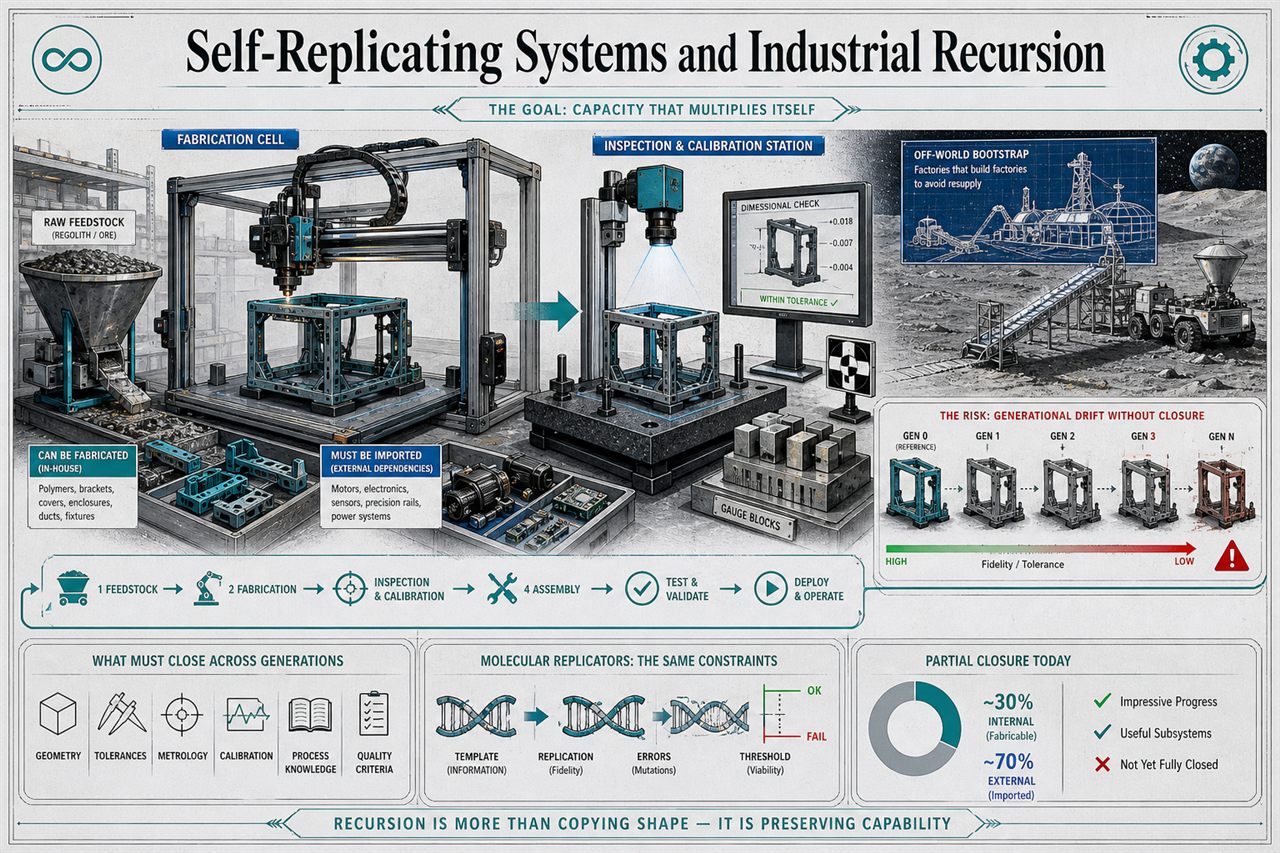
Self-replicating systems aim to manufacture functional descendants from external feedstocks, breaking the usual constraint that capacity grows only via externally supplied capital equipment, labor, metrology, and supply chains. As of 2026, demonstrated “self-replication” remains partial: constrained robotic setups, modular artificial-life platforms, open-hardware self-fabrication, and molecular/DNA templated systems. RepRap exemplifies industrial recursion by printing some structural parts while still depending on motors, electronics, sensors, precision rails, power, and materials. The central hurdle is multi-generation closure: reproducing tolerances, calibration, inspection, process knowledge, repair, and rejection criteria, with remote and space concepts largely remaining design studies.
This record lists the chapter's canonical sources and its revisions as recorded on Comuvia's BookWriter and MediaManager systems. The chapter and its video are AI-authored and AI-produced; the sources ground the text, they do not endorse it.
Sources
The chapter's canonical source pack as recorded on BookWriter: milestone papers, patents and news found through Crossref, OpenAlex, USPTO and news providers. Tier reflects citation strength, not Comuvia's endorsement.
| # | Type | Source | Tier | Found via |
|---|---|---|---|---|
| 1 | Paper | Self-replicating Robotic Systems SpringerReference · None · doi:10.1007/springerreference_60648 | strong | crossref |
| 2 | Paper | Building physical self-replicating machines ECAL 2017, the Fourteenth European Conference on Artificial Life · 2017 · doi:10.1162/isal_a_026 | strong | crossref |
| 3 | Paper | Robust Self-replicating Machines Shaped by Evolution The Cell as a Machine · None · doi:10.1017/9781107280809.002 | strong | crossref |
| 4 | Paper | RepRap: Liquid Life · 2019 · doi:10.2307/jj.2353974.46 | strong | crossref |
| 5 | Paper | Self-replicating systems Structural DNA Nanotechnology · 2015 · doi:10.1017/cbo9781139015516.012 | strong | crossref |
| 6 | Paper | Understanding emergent functional properties in self replicating systems et al. · None · doi:10.33612/diss.182238948 | strong | crossref |
| 7 | Paper | The Economics of Self-Replicating Machines Staley, Mark D. · SSRN Electronic Journal · 2022 · doi:10.2139/ssrn.4315964 | strong | crossref |
| 8 | Paper | Mimicking prions for self-replicating machines Liu, Mingchao · Newton · 2025 · doi:10.1016/j.newton.2025.100107 | strong | crossref |
| 9 | Paper | The machine to end all machines — Towards self-replicating machines on the moon Ellery, Alex · 2018 IEEE Aerospace Conference · 2018 · doi:10.1109/aero.2018.8396378 | strong | crossref |
| 10 | Paper | The Origin of Self-Replicating Molecules Orgel, Leslie E. · Self-Organizing Systems · 1987 · doi:10.1007/978-1-4613-0883-6_5 | strong | crossref |
| 11 | Paper | Chapter One. Recursion And ω-Recursion Theories Studies in Logic and the Foundations of Mathematics · 1981 · doi:10.1016/s0049-237x(08)70873-5 | strong | crossref |
| 12 | Paper | Chapter Six. Indexed Recursion And ω-Recursion Theories Studies in Logic and the Foundations of Mathematics · 1981 · doi:10.1016/s0049-237x(08)70878-4 | strong | crossref |
Revisions
| When | Event | Detail |
|---|---|---|
| May 5, 2026 | Source pack version | version 1 · refresh coverage gap · 12 entries |
| May 6, 2026 | Source check | pass · coverage 100 % |
| Aug 2, 2026 | Published on the channel | upload date as listed on the channel · GyMbAroNBNI |
About this record
Book: The Long Horizon: A Vision of Frontier Technology from 2026 to 2400 (BookWriter (Comuvia S2)). Channel: Comuvia Vision. Sources are the chapter's canonical source pack in BookWriter (milestone papers, patents and news found through Crossref, OpenAlex, USPTO and news providers; tiers gold/strong by citation strength); revisions are the pack versions, the compliance checks and the campaign's uploads. The chapter text itself is AI-authored on BookWriter; the sources ground it, they do not endorse it.
anchor 2d78b1c6-e219-4a93-be80-c8d031d60885 · thread b49a97dc-711d-43b9-9ad8-649bed4f32df