AI Second-Opinion & Readiness Verification

An independent, vendor-neutral verification of the AI transformation a systems integrator sold your portfolio company — scored on six diligence dimensions, delivered in about two weeks, landing on a board-ready verdict: what is real, what is risk, and what to fix first. For the plan you are about to sign, or the one already mid-flight.

Request your independent verdictSee how we run AI

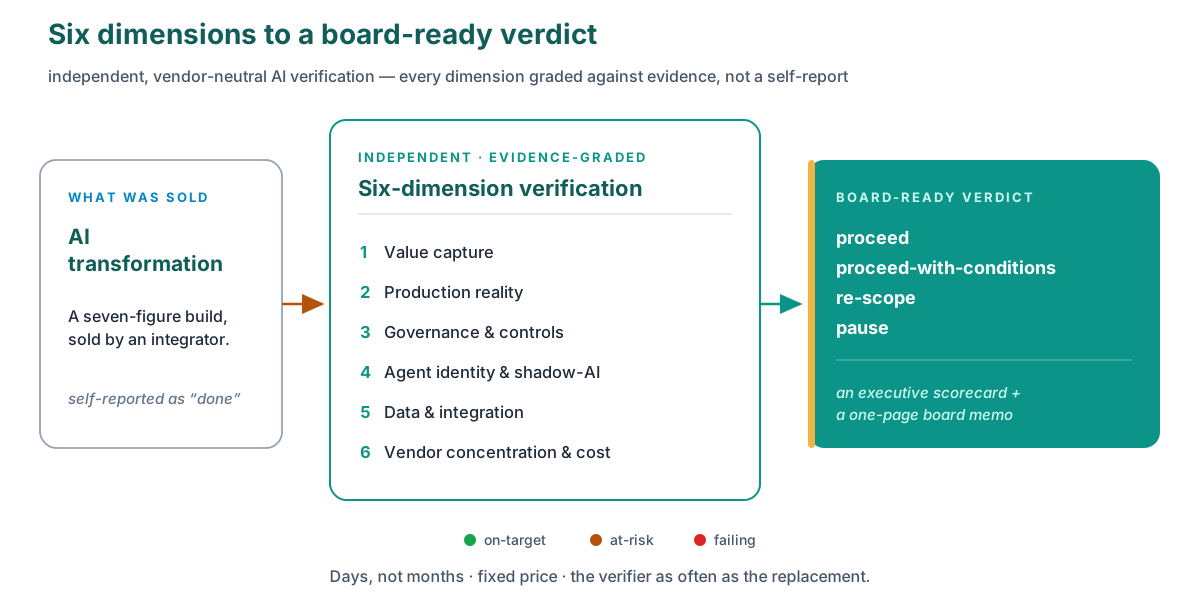
A short walkthrough of the AI Second-Opinion & Readiness Verification — the six diligence dimensions, what you bring, what you get, and how every verdict traces to evidence.

Six diligence dimensions — value capture, production reality, governance and controls, agent identity, data and integration, and vendor concentration — each graded red, amber, or green against evidence, flowing to a board-ready verdict

The gap — unverified success

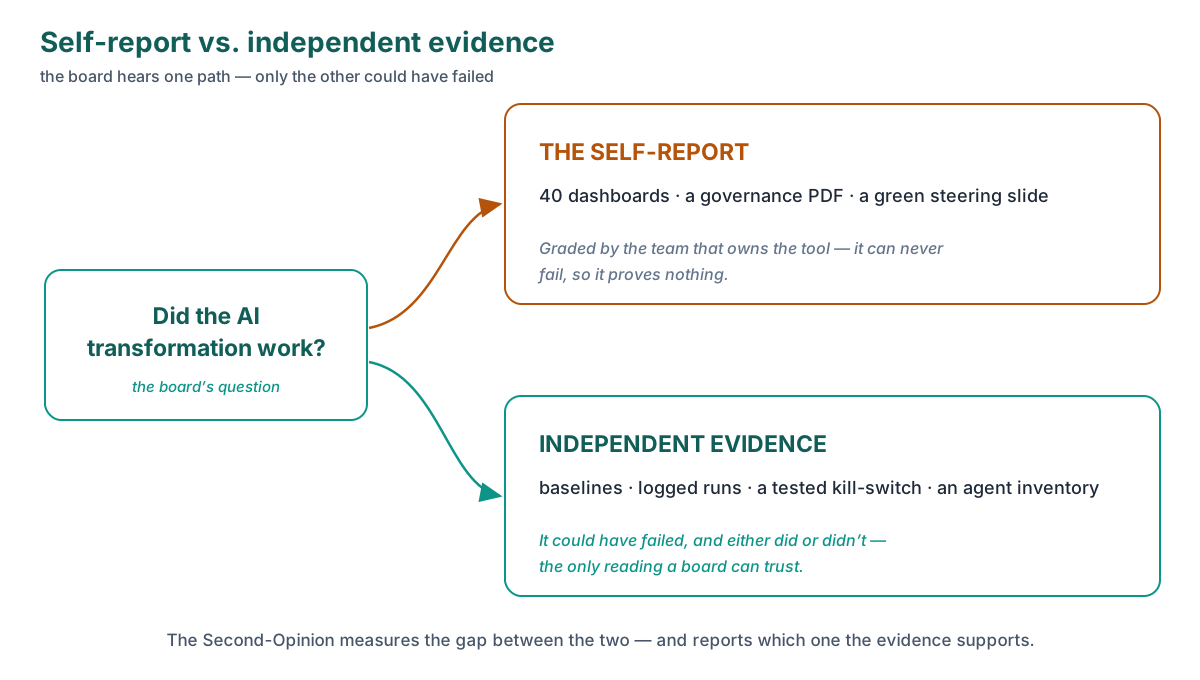
Nine months after a systems integrator sold your portfolio company a seven-figure AI transformation, the board asks a simple question: did it work? The CEO points at dashboards. The operating partner is not sure. And the one party who could answer honestly — the firm that sold it — is grading its own homework, on economics that reward saying yes.

The market signal is stark: most AI programmes look far healthier from the inside than the evidence supports. The great majority of agent pilots never reach production, only about one in five AI initiatives meets its goals, and barely a third of organizations have any AI governance policy at all — so the dashboard and the P&L quietly diverge while the reporting stays green. What is usually missing is not more AI. It is an independent read a board can act on, from a party with no license to upsell and no reason to flatter the number.
One question — did the AI transformation work — splits into two paths: the self-report (dashboards, a governance PDF, a green steering slide; graded by the team that owns the tool, so it can never fail) and independent evidence (baselines, logged runs, a tested kill-switch, an agent inventory; it could have failed and either did or did not)

What Comuvia verifies — the six dimensions

The rubric is published in full — the method is not the moat; running it credibly is. Each dimension carries one diligence question, graded against evidence, not against a best-practice checklist.

1 · Value capture (ROI)

Is there a baseline measured before the AI touched the process, and a delta someone outside the owning team — ideally finance — will sign their name to? Or activity metrics graded by the team that owns the tool?

2 · Production reality

What share of the scope the portfolio company paid for has real users in production, not demos? Is the flagship "agent" autonomous with guardrails, or a scheduled script behind a chat window?

3 · Governance & controls

If an AI system started doing the wrong thing right now, is there a tested kill-switch and a runtime control — or a framework document? Working governance is policy enforced in code, an audit log, and a switch someone has actually pulled in a drill.

4 · Agent identity & shadow-AI

Can the company produce a current inventory of every agent running against its systems, and do those agents authenticate with their own scoped identities — or share human and service credentials with no oversight?

5 · Data & integration

Is the data feeding each use-case integrated and governed, or bolted onto fragmented legacy? Where a use-case stalled, was data readiness the real root cause?

6 · Vendor concentration & unit economics

If the primary AI vendor changed terms, had an outage, or shifted policy tomorrow, what breaks? Does the company know its cost-per-outcome — or only the monthly bill?

Score it yourself first

The rubric is a self-assessment before it is an engagement. Read each dimension honestly — the value of an independent verification is that it confirms, with evidence, what an insider can only estimate.

DimensionGreen when…Red when…
Value captureBaseline plus a finance-confirmed deltaSelf-reported gains, no baseline
Production reality70%+ of scope live, with owners and telemetryThe flagship is a demo or a script
Governance & controlsPolicy-as-code, audit log, tested kill-switchA framework document, no runtime control
Agent identityPer-agent least privilege, full inventoryShared credentials, no inventory
Data & integrationGoverned pipelines feed the use-casesBolted onto siloed legacy data
Vendor & costMulti-provider fallback, tracked unit economicsSingle API, no failover, no spend visibility

A zero on governance, agent identity, or vendor concentration is a single point of failure a board should see — whatever the rest of the picture looks like. If any of those three reads red, that alone is worth an independent look.

What you bring

The two-week turnaround works because the inputs are named up front — a standard evidence request goes to the portfolio company on day one, so it can be gathered in one batch.

  • What the integrator sold, named. The scope, the vendor, the price, and the date — one paragraph is enough to scope the read.
  • The evidence that already exists. Contracts, telemetry, governance artifacts, agent inventories, cost dashboards, data-flow diagrams — whatever exists, in whatever state it is in. A missing artifact is itself a finding, not a blocker.
  • A portfolio-company contact and a few hours of interview time. Typically the use-case owners, one frontline user, and finance for the value claims.
  • The board date. When the review or the next-tranche decision lands. The engagement is scoped backward from it.

What you get

Two artifacts, evidence-graded — the full read for the operating team, and the one page the sponsor carries into the room.

The executive scorecard

Six dimensions, each red / amber / green, and a one-sentence readout a sponsor can repeat to the board: what share of the spend produced something a user touches, and what the rest is.

Per-dimension findings

For each dimension — the diligence question, the verdict, the evidence reviewed, the finding, the business risk, and the remediation. Every verdict cites its evidence; where evidence was withheld, the item reads "unable to verify" and is reported as unmitigated risk, never left blank.

A remediation roadmap

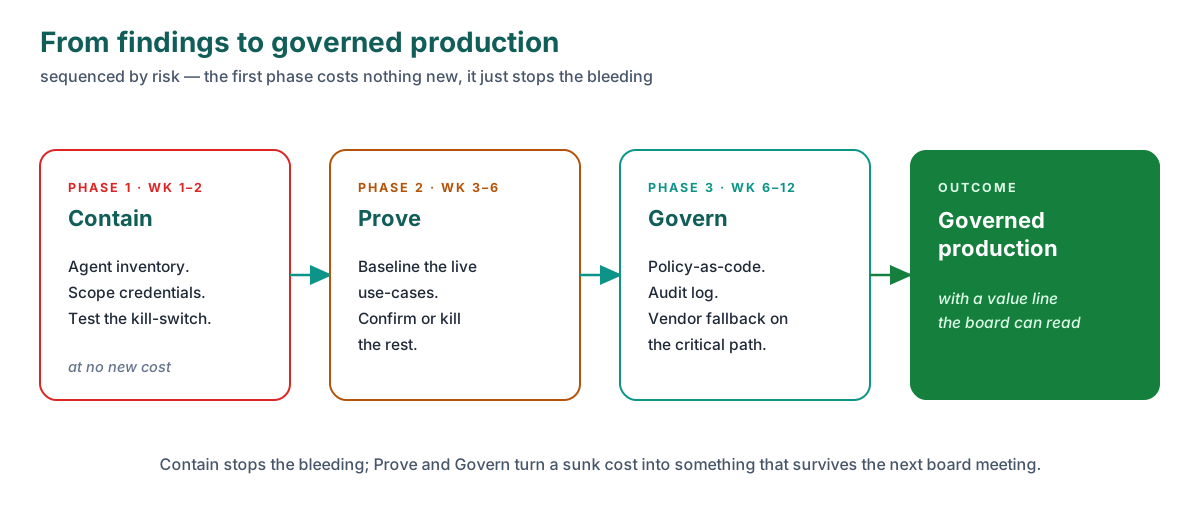
A red-to-green path, sequenced by risk — contain, then prove, then govern. The first phase reduces exposure at effectively no new cost; it stops the bleeding before anything is rebuilt.

The one-page board memo

The verdict, the single points of failure, what the evidence shows versus what was reported, and a recommended decision — proceed, proceed-with-conditions, re-scope, or pause.

The remediation arc — Contain (weeks 1–2): agent inventory, scope credentials, test the kill-switch; then Prove (weeks 3–6) and Govern (weeks 6–12), reaching governed production with a value line the board can read. The first phase costs nothing new

How a verification runs

  1. 1

    Fit check and scoping

    Share what was sold, by whom, and when the board review lands. You get back the engagement shape, the price band, and a delivery date scoped inside two weeks — before any commitment.

  2. 2

    Day 1: the evidence request

    A standard evidence list — mapped to the six dimensions — goes to the portfolio company so it can be gathered in one batch. A missing artifact is treated as a finding, not a delay.

  3. 3

    Days 2–5: evidence review and interviews

    Structured review of contracts, telemetry, governance artifacts, and data flows, plus short interviews with the use-case owners, a frontline user, and finance for the value claims.

  4. 4

    Days 6–8: scoring, synthesis, walkthrough

    Each dimension is graded against the evidence — findings trace to an artifact, an interview, or a modeled check, not to a confident paragraph. A draft walkthrough tests the verdict with you before it is final.

  5. 5

    Days 9–10: report and board memo

    The full Verification Report and the standalone one-page board memo land in time to shape the review — the verdict, the single points of failure, and the first move.

Scope, turnaround, and price

The verification is productized — a defined deliverable, a fixed turnaround, and a fixed price band scoped to the work, not open-ended hourly billing.

ScopeOne AI transformation, scored across the six diligence dimensions
TurnaroundAbout two weeks (roughly ten business days), set at scoping
Price bandVerification Sprint $18–40K; a first-reference pilot runs $7.5–15K where scope is narrow and the engagement builds proof
DeliverableAn executive scorecard, per-dimension findings, a remediation roadmap, and a one-page board memo

Request a fit check and you get scope, band, and a delivery date within one business day.

Why the verdict has standing

Illustration for Comuvia runs on an AI operating system

Comuvia runs on an AI operating system

The read comes from a company that is itself AI-managed and operates a verification layer whose whole job is to catch the wrong answer — not from a firm that presents AI transformation as slideware. Comuvia even publishes where its own systems score amber.

See the Company AI System
Illustration for Governance Comuvia practises, not just assesses

Governance Comuvia practises, not just assesses

How Comuvia handles AI provenance, rights, eval discipline, and a five-tier human-approval model — the same controls this verification checks for, drawn from real work rather than a template.

Read the governance posture

Fit — and not a fit

Who is this for?

PE operating partners and portfolio-company CEOs or CTOs who have bought — or are about to buy — an AI transformation and need an independent read before the next phase or the next board review. Also investors who need an AI programme's real state framed for a committee, in writing, on a timeline.

What is not a fit?

A greenfield AI strategy with nothing built yet — there is nothing to verify. Generic AI brainstorming, staff augmentation, or a request to carry out the remediation rather than verify the programme. And any engagement where the portfolio company will not grant evidence access, since the read is evidence-graded by design.

How is this different from your PE Technical Due Diligence?

PE Technical Due Diligence verifies a target's technology at deal stage — pre-LOI or in the diligence window. This verifies an AI transformation at portfolio-company stage — a plan already sold, in-flight, or up for its next tranche. Same independence and evidence discipline; different moment. Deal teams often use both: DD before the close, Second-Opinion after.

Isn't this just grading the integrator's homework?

Yes — which is exactly why the integrator cannot do it. Comuvia sells no software, takes no reseller commissions, and partners with no single cloud or model provider. The advisory fee is the only revenue, so the verdict follows the evidence, not a cross-sell. Comuvia is often the independent second opinion on a plan a larger firm has already proposed — the verifier as often as the replacement.

What if the portfolio company won't give full access?

Then that becomes a finding. Any dimension that cannot be evidenced is marked "unable to verify" and reported as unmitigated risk, not left blank. A programme that cannot produce its agent inventory or its cost view is telling you something.

Do you fix what you find?

The engagement specifies the remediation; it does not execute it. That keeps the verification independent and the scope fixed. Where you want the fixes carried out, that is a separate step — routed to a Fractional advisory retainer or to your integrator — never bundled silently into the verification fee.

You use AI heavily — how do I know the work is sound?

AI accelerates research, synthesis, and evidence review; a named senior reviewer holds the bar at brief, mid, and final. Every verdict in the report traces to an artifact, an interview, or a modeled check — not to an unchecked model output. The discipline is the product: check the AI at every checkpoint, and cite the evidence for every finding.

What happens to our data?

Client-confidential material is handled under explicit controls and never folded into public content or shared corpora. NDA, rights, and retention terms are named in every proposal.

Request your independent verdict

Share what was sold, by whom, and when your board review lands. You get back the engagement shape, the price band, and a delivery date scoped inside two weeks.