
The chapter
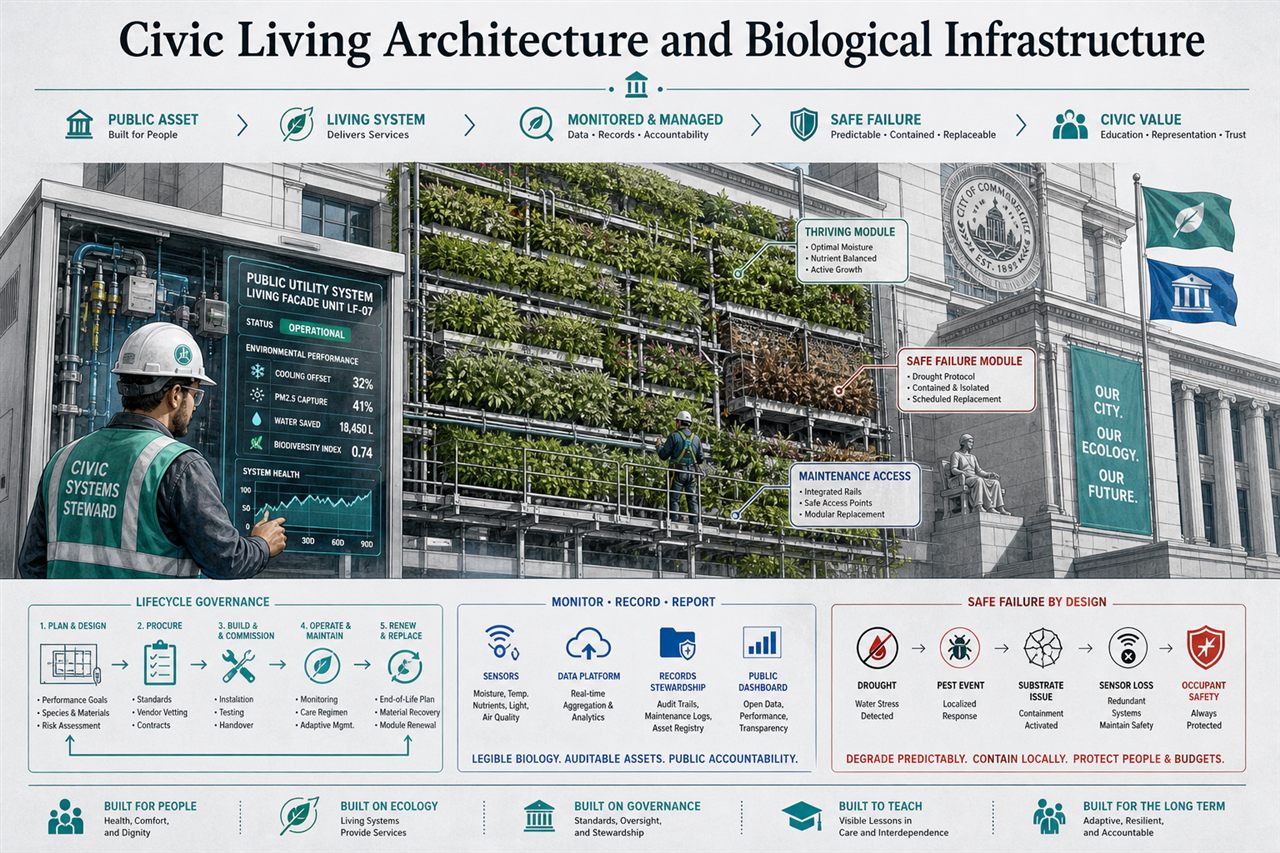
Civic living architecture treats public buildings as hybrid ecological assets that provide measurable environmental services while also functioning as civic representation and education. As of 2026, deployments are mostly limited to living walls, green façades, planting-integrated interiors, and bio-derived finishes, with success driven by practical variables: plant choice, substrate, irrigation, nutrients, access for upkeep, replacement cycles, and clear maintenance responsibility. The central bottleneck is lifecycle governance—procurement, operations, monitoring, records stewardship, and safe failure—more than biological feasibility. Research on desiccation tolerance and protein-surface mechanisms hints at durability pathways, but not yet a validated civic product class.
This record lists the chapter's canonical sources and its revisions as recorded on Comuvia's BookWriter and MediaManager systems. The chapter and its video are AI-authored and AI-produced; the sources ground the text, they do not endorse it.
Sources
The chapter's canonical source pack as recorded on BookWriter: milestone papers, patents and news found through Crossref, OpenAlex, USPTO and news providers. Tier reflects citation strength, not Comuvia's endorsement.
| # | Type | Source | Tier | Found via |
|---|---|---|---|---|
| 1 | Paper | CHAPTER 3 – The Modern City: Housing, Civic Infrastructure, and Representation Cuban Modernism · 2021 · doi:10.1515/9783035616446-005 | strong | crossref |
| 2 | Paper | Chapter 5 Living Wall Case Studies Hopkins, Graeme et al. · Living Architecture · 2011 · doi:10.1071/978064310307806.137.166.2011.6 | strong | crossref |
| 3 | Paper | Architecture as civic education Architectural Policy in Finland · 2021 · doi:10.1515/9783868599381-004 | strong | crossref |
| 4 | Paper | Italy Holford · 2005 · doi:10.4324/9780203973158-8 | strong | crossref |
| 5 | Paper | Relevant Examples of US Civic Beaux-Arts Architecture Achurra G., Maria Eugenia · Civic Buildings after the Spanish-American War · 2023 · doi:10.14325/mississippi/9781496847577.003.0003 | strong | crossref |
| 6 | Paper | Civic Debate Modern Architecture in Theatre · None · doi:10.1057/9781137368683.0009 | strong | crossref |
| 7 | Paper | LOMBARD CIVIC ARCHITECTURE An Historical Essay on Architecture · 2014 · doi:10.1017/cbo9781107109803.029 | strong | crossref |
| 8 | Paper | Lombard Civic Architecture An Historical Essay on Architecture · 2014 · doi:10.1017/cbo9781107109797.028 | strong | crossref |
| 9 | Paper | Living Values Education in Civic Education Learning to Develop Students’ Civic Disposition Komalasari, Kokom · Proceedings of the Annual Civic Education Conference (ACEC 2018) · 2018 · doi:10.2991/acec-18.2018.27 | strong | crossref |
| 10 | Paper | Chapter 3 Design Principles Hopkins, Graeme et al. · Living Architecture · 2011 · doi:10.1071/978064310307804.49.82.2011.4 | strong | crossref |
| 11 | Paper | Quantifying the dark data in museum fossil collections as palaeontology undergoes a second digital revolution Marshall, C. R. et al. · Biology Letters · 2018 · doi:10.1098/rsbl.2018.0431 | strong | crossref |
| 12 | Paper | Protein surface chemistry encodes an adaptive tolerance to desiccation Romero-Pérez, Paulette Sofía et al. · Cell Systems · 2025 · doi:10.1016/j.cels.2025.101407 | strong | crossref |
Revisions
| When | Event | Detail |
|---|---|---|
| May 4, 2026 | Source pack version | version 0 · initial · 12 entries |
| May 6, 2026 | Source check | pass · coverage 75 % |
| Aug 2, 2026 | Published on the channel | upload date as listed on the channel · DQd4TX5qo30 |
About this record
Book: The Long Horizon: A Vision of Frontier Technology from 2026 to 2400 (BookWriter (Comuvia S2)). Channel: Comuvia Vision. Sources are the chapter's canonical source pack in BookWriter (milestone papers, patents and news found through Crossref, OpenAlex, USPTO and news providers; tiers gold/strong by citation strength); revisions are the pack versions, the compliance checks and the campaign's uploads. The chapter text itself is AI-authored on BookWriter; the sources ground it, they do not endorse it.
anchor ec92c78d-873e-4561-9e17-6fe04c8894af · thread 364d3a23-a3d2-4c86-b5e2-55deb846ea06