
The chapter
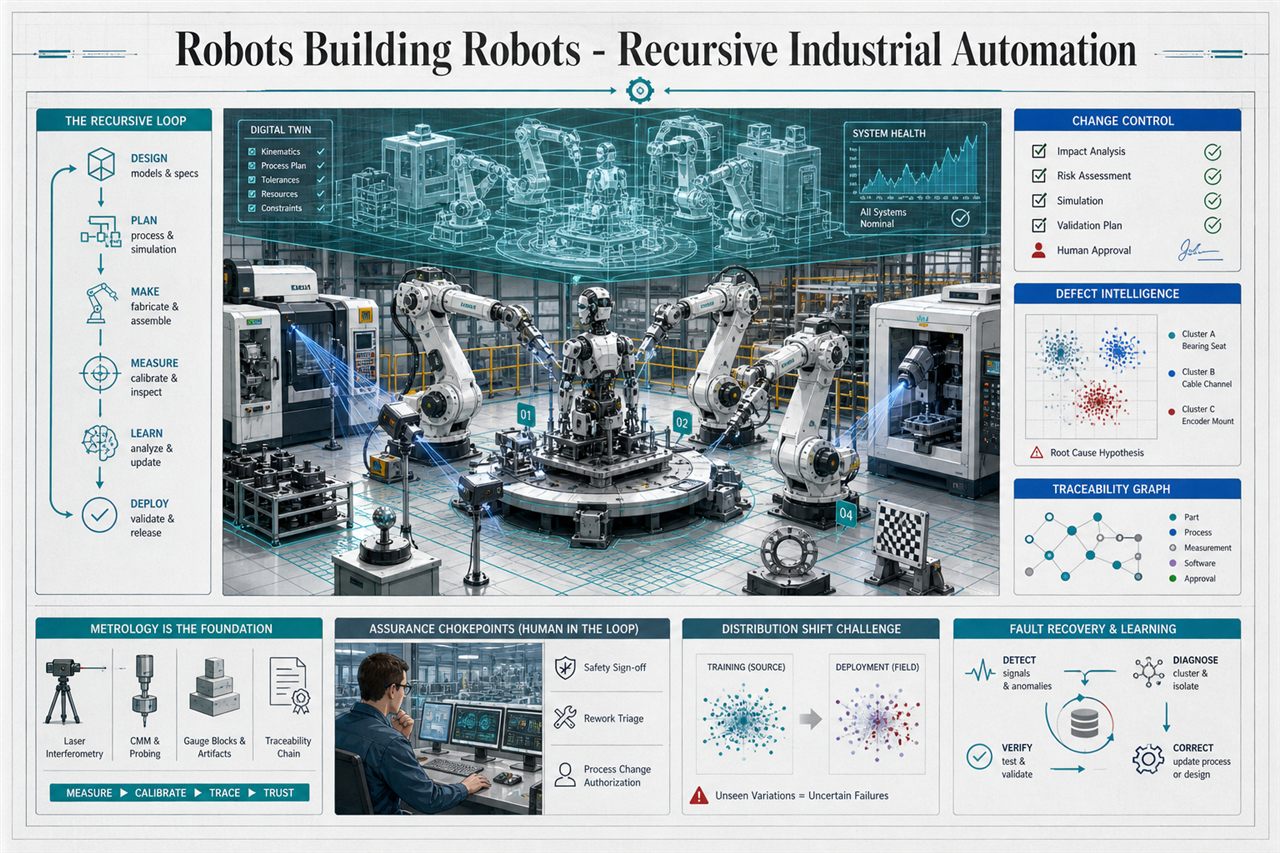
Recursive industrial automation means factories can fabricate, assemble, calibrate, inspect, repair, and iteratively upgrade their own robotic production equipment with limited human intervention. Today’s industrial robots excel at structured, repeatable tasks, and “partial recursion” already exists because automated machine tools, PCB lines, and inspection systems help produce robot components. The limiting factor is system integration: tightly closed-loop links among sensors, Industrial IoT, controllers, quality data, digital twins, defect analytics, explainable logs, and rigorous change-control. Learning-based perception and adaptive control work in bounded settings but face distribution shift, validation burden, and safety/explainability demands. Treat it as a whole-factory capability, not self-sufficient robot reproduction.
This record lists the chapter's canonical sources and its revisions as recorded on Comuvia's BookWriter and MediaManager systems. The chapter and its video are AI-authored and AI-produced; the sources ground the text, they do not endorse it.
Sources
The chapter's canonical source pack as recorded on BookWriter: milestone papers, patents and news found through Crossref, OpenAlex, USPTO and news providers. Tier reflects citation strength, not Comuvia's endorsement.
| # | Type | Source | Tier | Found via |
|---|---|---|---|---|
| 1 | Paper | Gradient-based learning applied to document recognition Yann LeCun, Léon Bottou, Yoshua Bengio et al. · 1998 · doi:10.1109/5.726791 | gold · highly cited | openalex 57,535 citations |
| 2 | Paper | Initial sequencing and analysis of the human genome Eric S. Lander, Lauren Linton, Bruce W. Birren et al. · 2001 · doi:10.1038/35057062 | gold · highly cited | openalex 24,496 citations |
| 3 | Paper | Explainable Artificial Intelligence (XAI): Concepts, taxonomies, opportunities and challenges toward responsible AI Alejandro Barredo Arrieta, Natalia Díaz-Rodríguez, Javier Del Ser et al. · 2019 · doi:10.1016/j.inffus.2019.12.012 | gold · highly cited | openalex 8,578 citations |
| 4 | Paper | Multivariate Adaptive Regression Splines Jerome H. Friedman · 1991 · doi:10.1214/aos/1176347963 | gold · highly cited | openalex 8,056 citations |
| 5 | Paper | Advanced capabilities for materials modelling with Quantum ESPRESSO P Giannozzi, O Andreussi, T Brumme et al. · 2017 · doi:10.1088/1361-648x/aa8f79 | gold · highly cited | openalex 7,326 citations |
| 6 | Paper | Data clustering Anil K. Jain, M. Narasimha Murty, Patrick J. Flynn · 1999 · doi:10.1145/331499.331504 | gold · highly cited | openalex 13,132 citations |
| 7 | Paper | PRISMA 2020 explanation and elaboration: updated guidance and exemplars for reporting systematic reviews Matthew J. Page, David Moher, Patrick M. Bossuyt et al. · 2021 · doi:10.1136/bmj.n160 | gold · highly cited | openalex 10,559 citations |
| 8 | Paper | Reinforcement Learning: A Survey Leslie Pack Kaelbling, Michael L. Littman, Andrew Moore · 1996 · doi:10.1613/jair.301 | gold · highly cited | openalex 8,771 citations |
| 9 | Paper | Ultrasensitive fluorescent proteins for imaging neuronal activity Tsai‐Wen Chen, Trevor J. Wardill, Yi Sun et al. · 2013 · doi:10.1038/nature12354 | gold · highly cited | openalex 7,031 citations |
| 10 | Paper | Coordination of groups of mobile autonomous agents using nearest neighbor rules Ali Jadbabaie, Jie Lin, A. Stephen Morse · 2003 · doi:10.1109/tac.2003.812781 | gold · highly cited | openalex 8,397 citations |
| 11 | Paper | Review of deep learning: concepts, CNN architectures, challenges, applications, future directions Laith Alzubaidi, Jinglan Zhang, Amjad J. Humaidi et al. · 2021 · doi:10.1186/s40537-021-00444-8 | gold · highly cited | openalex 7,353 citations |
| 12 | Paper | Physics-informed machine learning George Em Karniadakis, Ioannis G. Kevrekidis, Lu Lu et al. · 2021 · doi:10.1038/s42254-021-00314-5 | gold · highly cited | openalex 6,097 citations |
Revisions
| When | Event | Detail |
|---|---|---|
| May 6, 2026 | Source check | refresh_pack · coverage 50 % |
| May 6, 2026 | Source pack version | version 6 · refresh coverage gap · 12 entries |
| Jul 2, 2026 | Published on the channel | upload date as listed on the channel · 8yc9JEwI1XQ |
About this record
Book: The Long Horizon: A Vision of Frontier Technology from 2026 to 2400 (BookWriter (Comuvia S2)). Channel: Comuvia Vision. Sources are the chapter's canonical source pack in BookWriter (milestone papers, patents and news found through Crossref, OpenAlex, USPTO and news providers; tiers gold/strong by citation strength); revisions are the pack versions, the compliance checks and the campaign's uploads. The chapter text itself is AI-authored on BookWriter; the sources ground it, they do not endorse it.
anchor 67ca9e65-a3d6-4800-b1d5-192fb1460784 · thread eb2afa78-98ea-4be8-b09b-3ab20bcb4215