
Part 9. Civilization at Scale
From 'The Long Horizon: A Vision of Frontier Technology from 2026 to 2400' - an AI-authored book produced on Comuvia's BookWriter system. Each chapter below is shown as its Business Editorial poster with a one-paragraph synopsis.
Chapter 162. Governance, Coordination, and Multi-Century Institutions
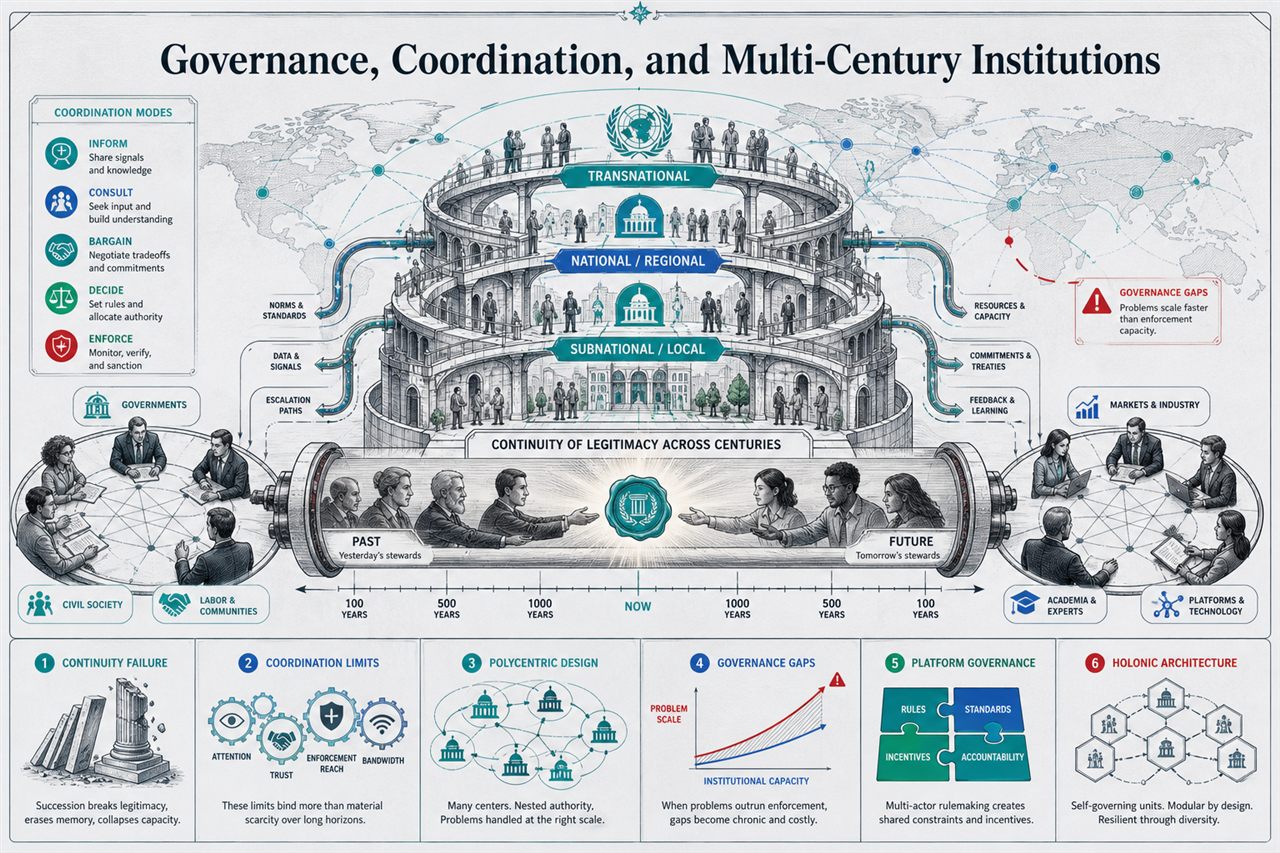
Long-horizon governance is mainly a continuity and coordination challenge: keeping legitimacy, decision quality, and collective-action capacity intact through leadership succession and shifting problem landscapes. As of 2026, many failures are traced to weak administrative capacity and legitimacy breakdowns rather than bad policy choices. A core response is polycentric, multi-scalar governance—overlapping and nested jurisdictions using multiple coordination modes—because transnational risks create “governance gaps” where problems outrun enforcement-capable institutions. Platform-mediated public services illustrate the need for collaborative governance across state, market, platforms, and civil society. Practical takeaways: design for redundancy, clarify interfaces between layers, and match coordination mode to context.
Chapter 163. Polycentric and Stewardship-Based Governance
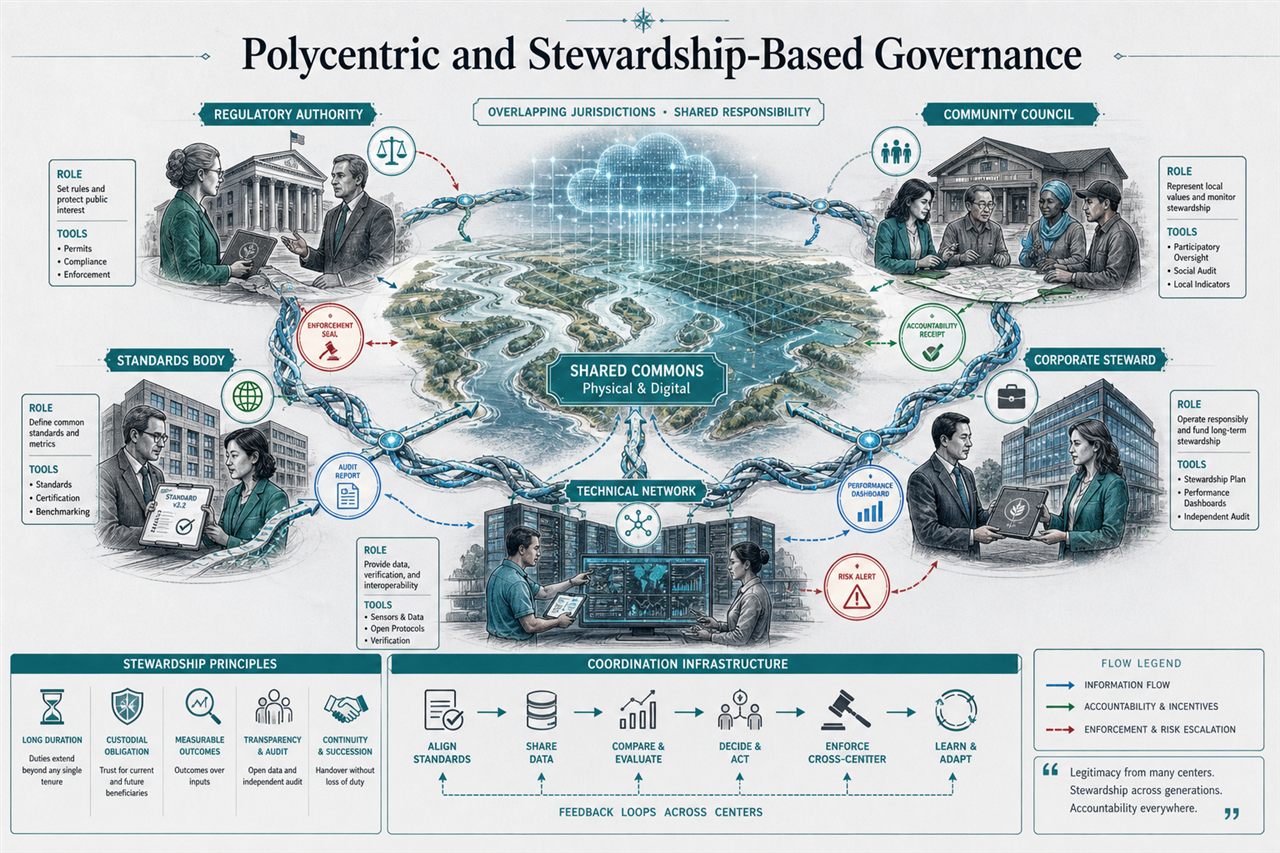
Polycentric, stewardship-based governance manages shared assets through multiple overlapping authorities while maintaining long-duration custodial duties that can be allocated, audited, and enforced. It is well developed for climate and environmental policy, especially in transboundary settings like river basins, and is increasingly applied to digital domains where regulators, firms, communities, and technical intermediaries co-create rules for privacy, data, and AI. The main practical constraint is coordination: sustaining legitimacy, resisting capture, aligning enforcement across centers, and creating comparable evaluations. Useful levers include standards-backed stewardship programs and management-system auditability. Research priorities emphasize cross-center metrics, capture-resistant designs, and diagnosing fragmentation versus robustness.
Chapter 164. Procedural Ethics and Operational Mercy
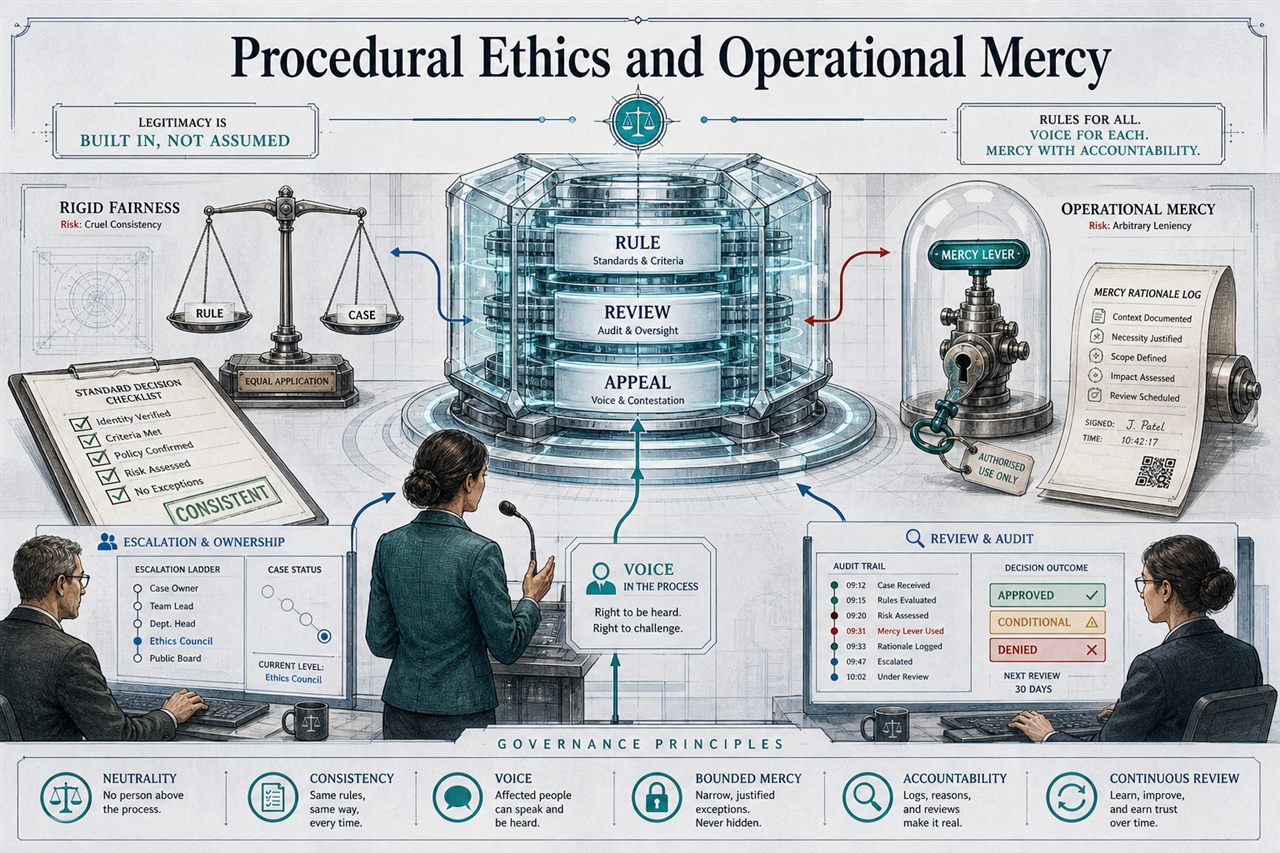
Procedural ethics turns moral discretion into bounded, auditable workflows while preserving narrowly scoped, reviewable exceptions for mercy aimed at leniency, restoration, and harm reduction. In 2026 most institutions still encode ethics indirectly through law, compliance, and protocols, leaving mercy discretionary, inconsistently applied, and hard to audit—risking either rigid “fairness” that becomes cruelty or compassion that becomes arbitrariness. Practical governance requires treating ethics as a deployment property: defined roles, escalation paths, contestation, and structured review loops. Useful patterns come from research ethics systems that operationalize review via structured applications and databases.
Chapter 165. Cost Ledgers, Abort Thresholds, and Institutional Restraint
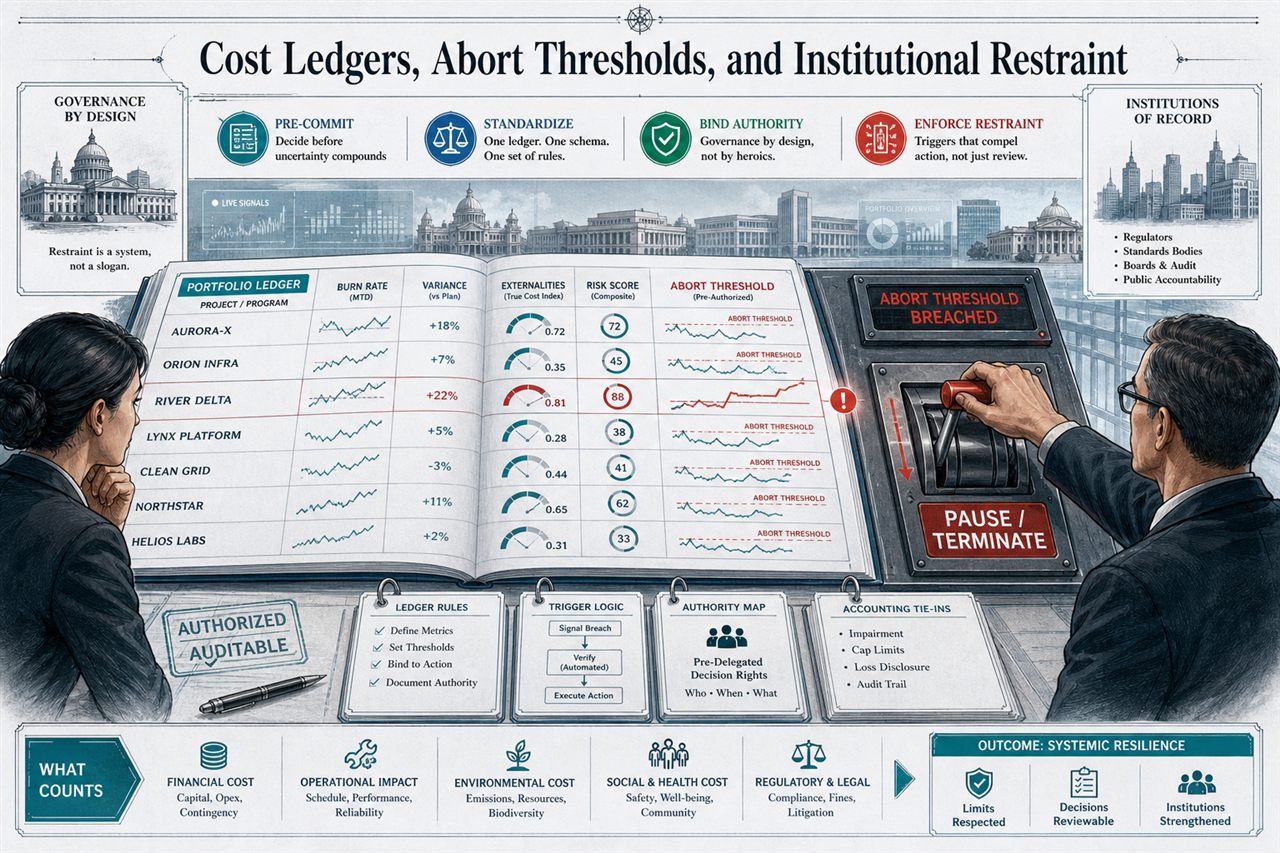
Build cost ledgers and control systems that turn uncertainty into pre-authorized pause/terminate decisions with clear, auditable authority, so losses don’t become systemic. As of 2026, standard costing, variance reporting, and budget control mostly explain deviations rather than compel stopping; major tech and automation investments are still judged case by case, limiting portfolio-wide comparability and enforceable stop rules. CVP break-even logic and “true cost” externality accounting offer useful signals but rarely bind decision rights. Practical takeaways: encode abort thresholds up front, permit narrowly logged exceptions, standardize evaluation across portfolios, choose cost-tracing granularity that’s usable and game-resistant, and integrate externalities when continuation decisions affect public outcomes.
Chapter 166. Dual-Key Authority and Distributed Decision Power
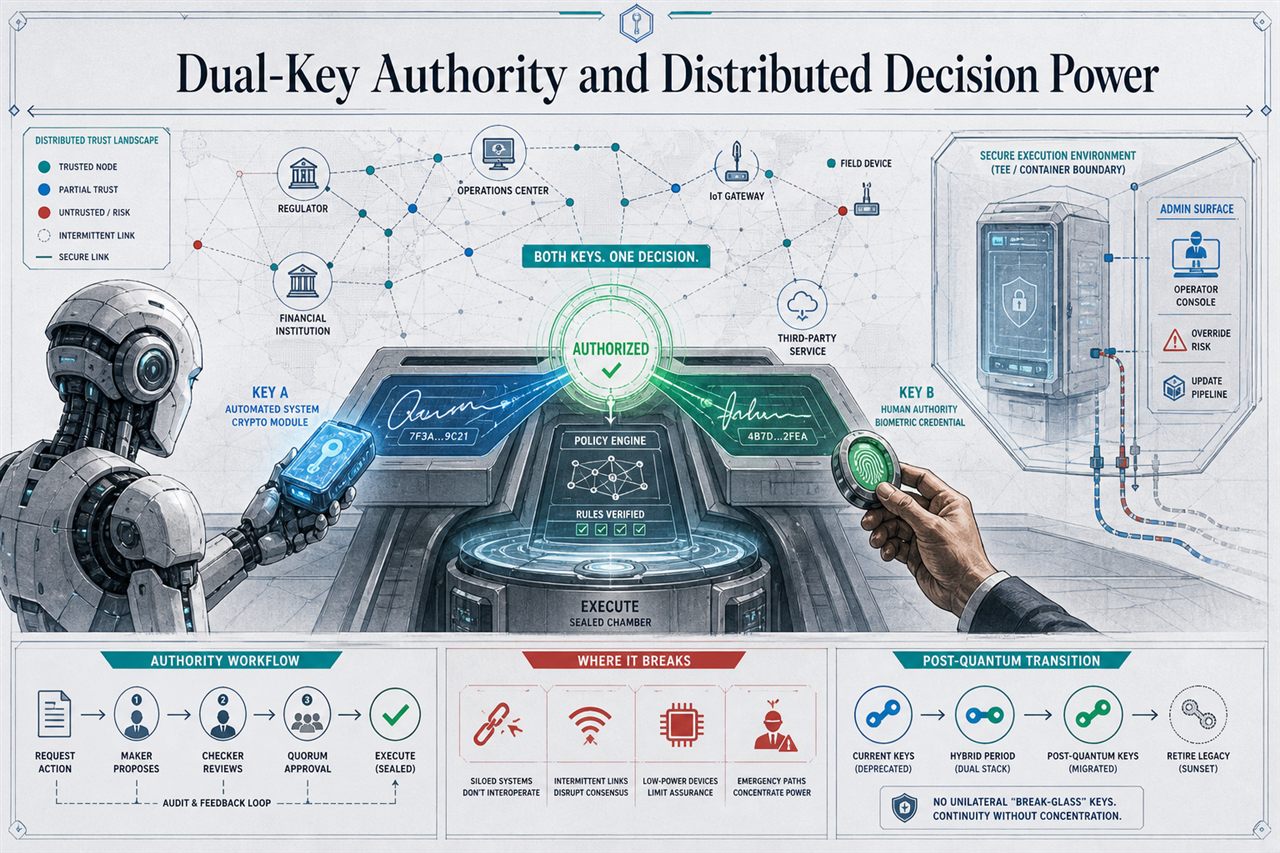
Dual-key authority makes high-impact actions require approval from at least two independently governed control paths, limiting unilateral execution in delegated and automated systems. Mature building blocks include digital signatures, threshold cryptography, distributed key generation, hierarchical identity-based schemes, and threshold ECDSA, mirrored operationally by multi-signature wallets, maker-checker controls, and quorum approvals, though cross-institution interoperability is still weak. Enforcement is harder in IoT, ad hoc, sensor, and vehicle networks due to limited compute, intermittent connectivity, and mixed trust domains. Trusted execution and containers help but leave hard problems in isolation, updates, and operator power. Post-quantum migration is as much a governance challenge as a cryptographic one.
Chapter 167. Continuity Rights and the Law of Personhood
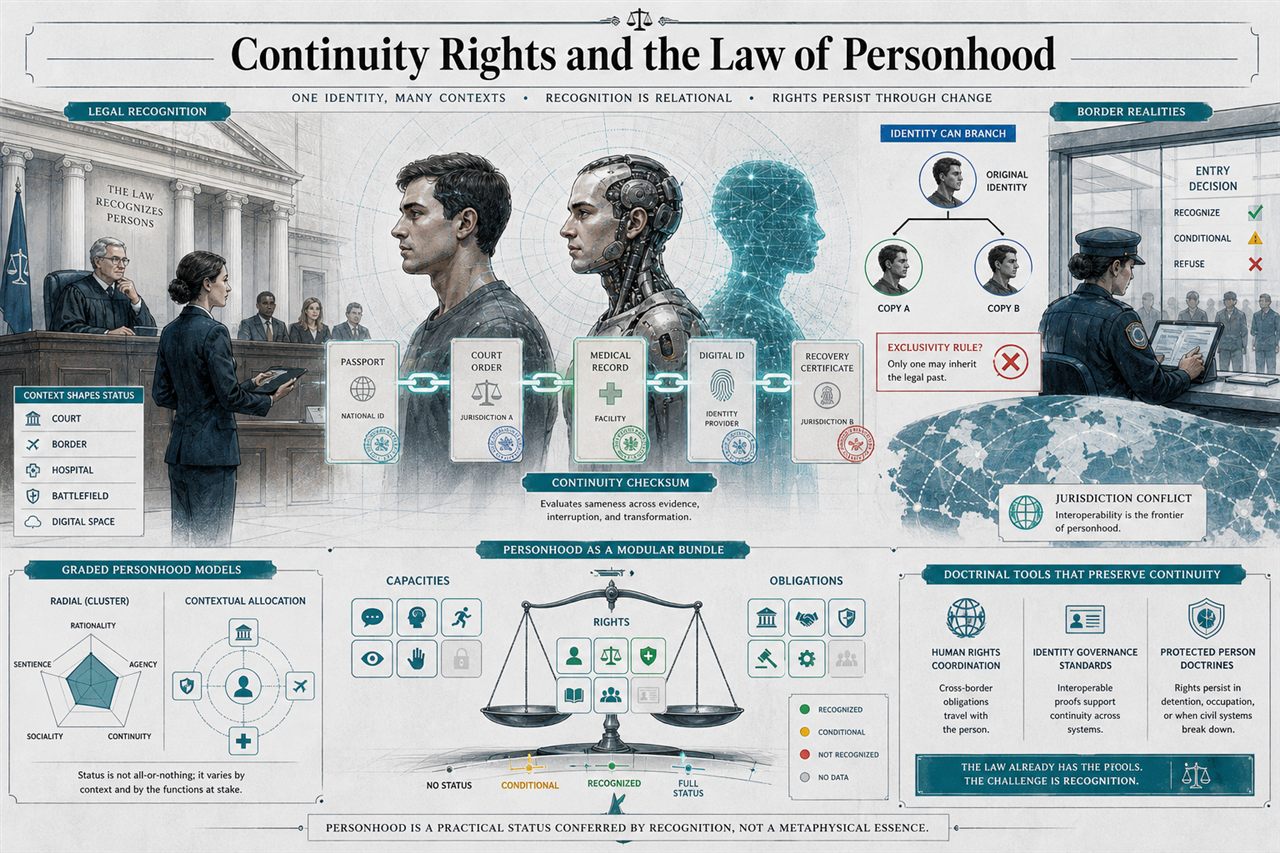
Continuity rights define when the same legal person persists through transformation, interruption, restoration, augmentation, replication, or species-adjacent change, especially amid limited evidence and cross-border conflict. Personhood is treated as an institutionally granted bundle of capacities, rights, and obligations rather than a fixed biological essence, with postgenomic scholarship reinforcing plastic, relational identity. Graded models such as cluster and radial conceptions help allocate partial standing, rights, and liability. Animal personhood debates show law can extend person-like status beyond humans via doctrine, while occupation law provides practical precedent for maintaining protections when governance is disrupted. Practical priorities include designing evidence hierarchies and choosing recognition models.
Chapter 168. Inter-Civilizational Diplomacy and Cross-Sovereignty Contact
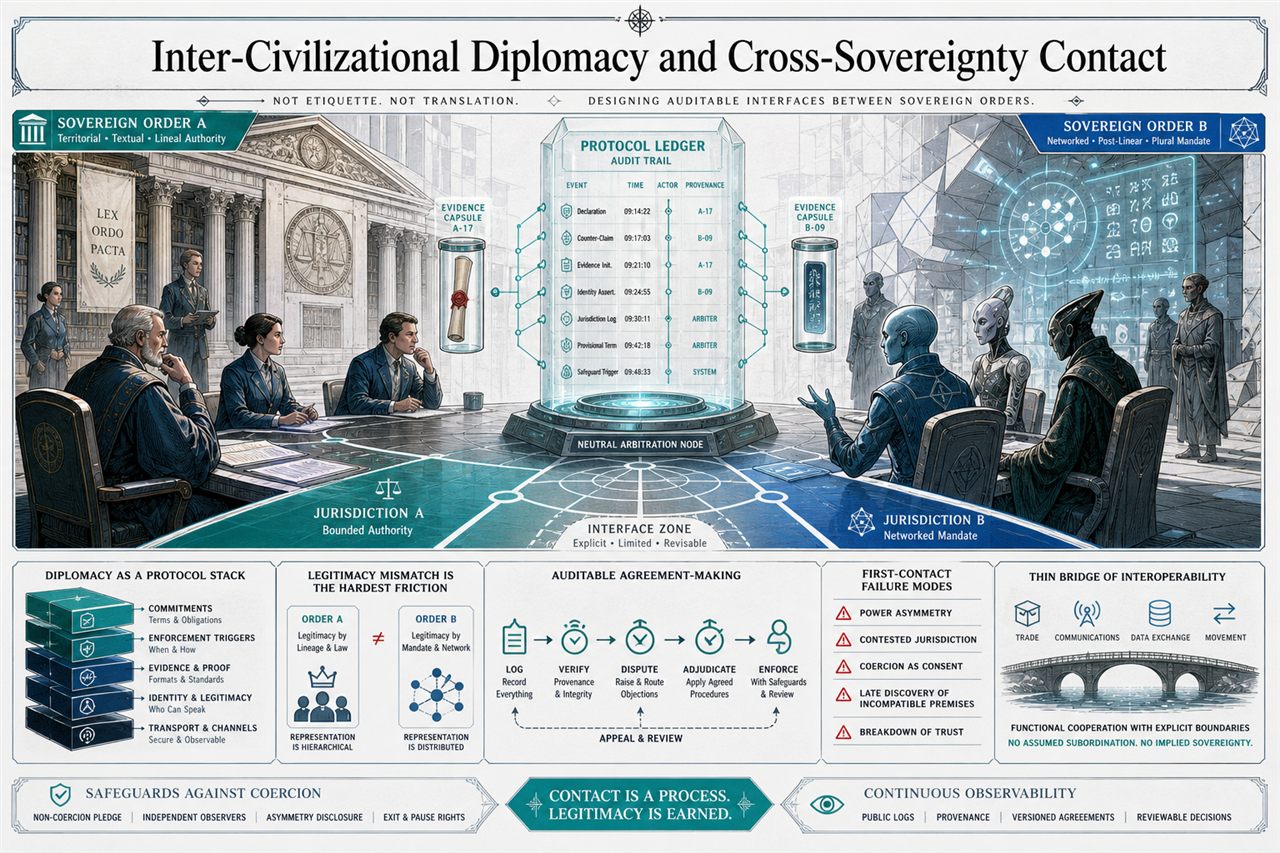
Inter-civilizational diplomacy treats “contact” as an engineering problem: building durable, auditable negotiation and dispute-resolution mechanisms when authority, legitimacy, personhood, evidence, and enforcement cannot be assumed in common. As of 2026, theory and cultural-diplomacy practice are mature, but reusable operational protocols and testable interface requirements remain thin. The hardest constraints are mismatched legitimacy models and legal imaginaries, not translation. Historical first-contact patterns warn of asymmetric power, contested jurisdiction, evolving trade norms, and late discovery of incompatible assumptions. Practical takeaways include defining jurisdiction explicitly, designing adjudication pathways, and using low-risk cultural or track-two channels to reduce misinterpretation.
Chapter 169. Long-Light-Speed Diplomacy and Treaty Across Distance

Long-light-speed diplomacy designs treaties, command authority, verification, and dispute resolution that still work when signals take minutes to decades, links are intermittent, and consent is non-simultaneous. Existing practice comes from deep-space mission operations that rely on preplanned command cycles, cislunar concepts that prioritize autonomy and layered communications, and mature non‑geostationary relay networks near Earth. Credible verification shifts toward machine-readable physical models and shared reference datasets, plus standardized, reproducible analysis pipelines and AI-assisted inference for sparse, delayed observations. Practical takeaways are to pre-authorize procedures, build custody and timestamping into telemetry, and treat communications constraints and space weather as governance variables.
Chapter 170. Geopolitics of Frontier Technology and Industrial Sovereignty
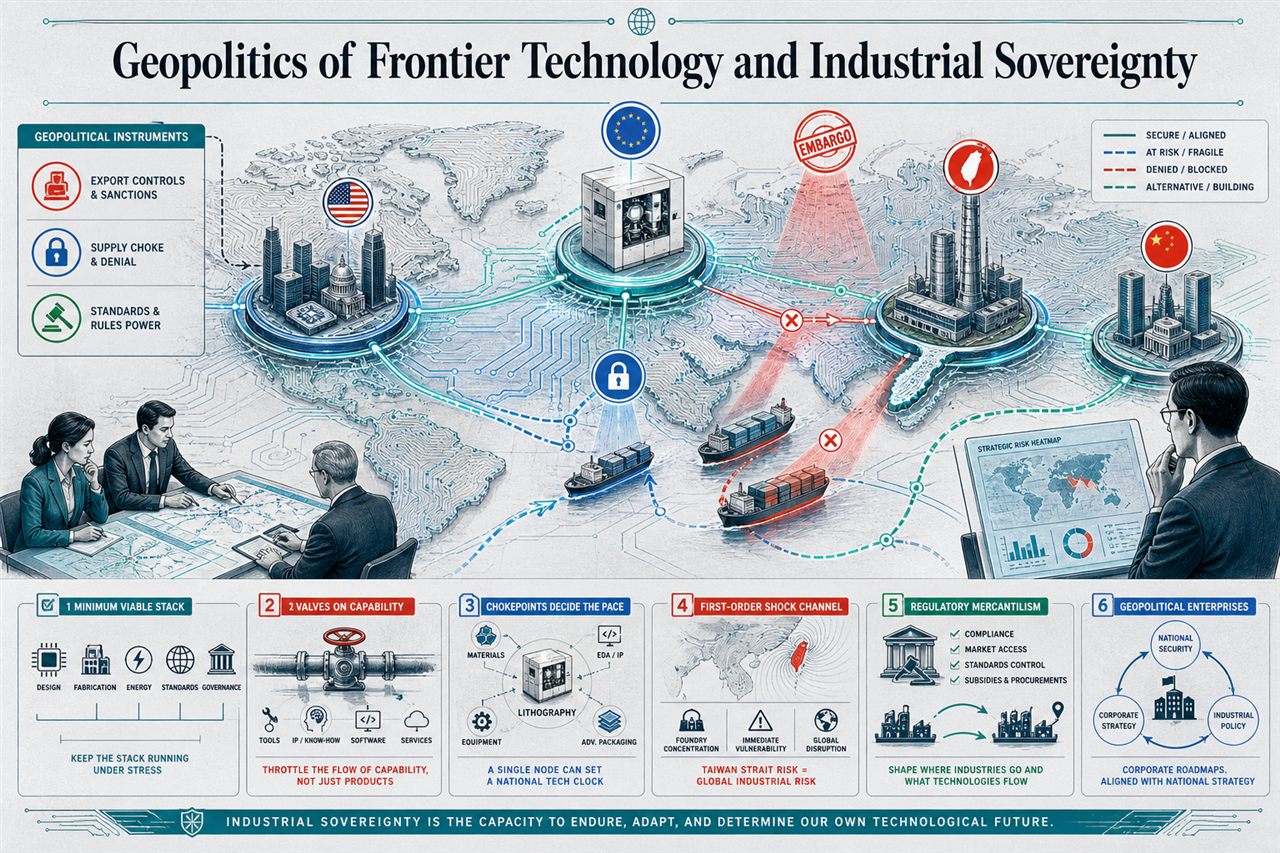
Industrial sovereignty means maintaining a minimum viable frontier-technology stack—design, manufacturing, energy, standards, and governance—through coercion, embargo, and alliance fracture despite chokepoints. Technology control has become explicit statecraft via export controls, sanctions, procurement, subsidies, and standards battles, shifting semiconductors from cost-optimized supply chains to strategic risk systems where Taiwan Strait disruption is treated as a first-order shock channel. “Regulatory mercantilism” uses law and market access to steer industrial geography. Firms increasingly act as geopolitical enterprises. Practical takeaways: map dependencies (ASML/TSMC/tools), stress-test denial scenarios, invest in substitutable capacity, and treat standards participation as power.
Chapter 171. The Economy After Scarcity
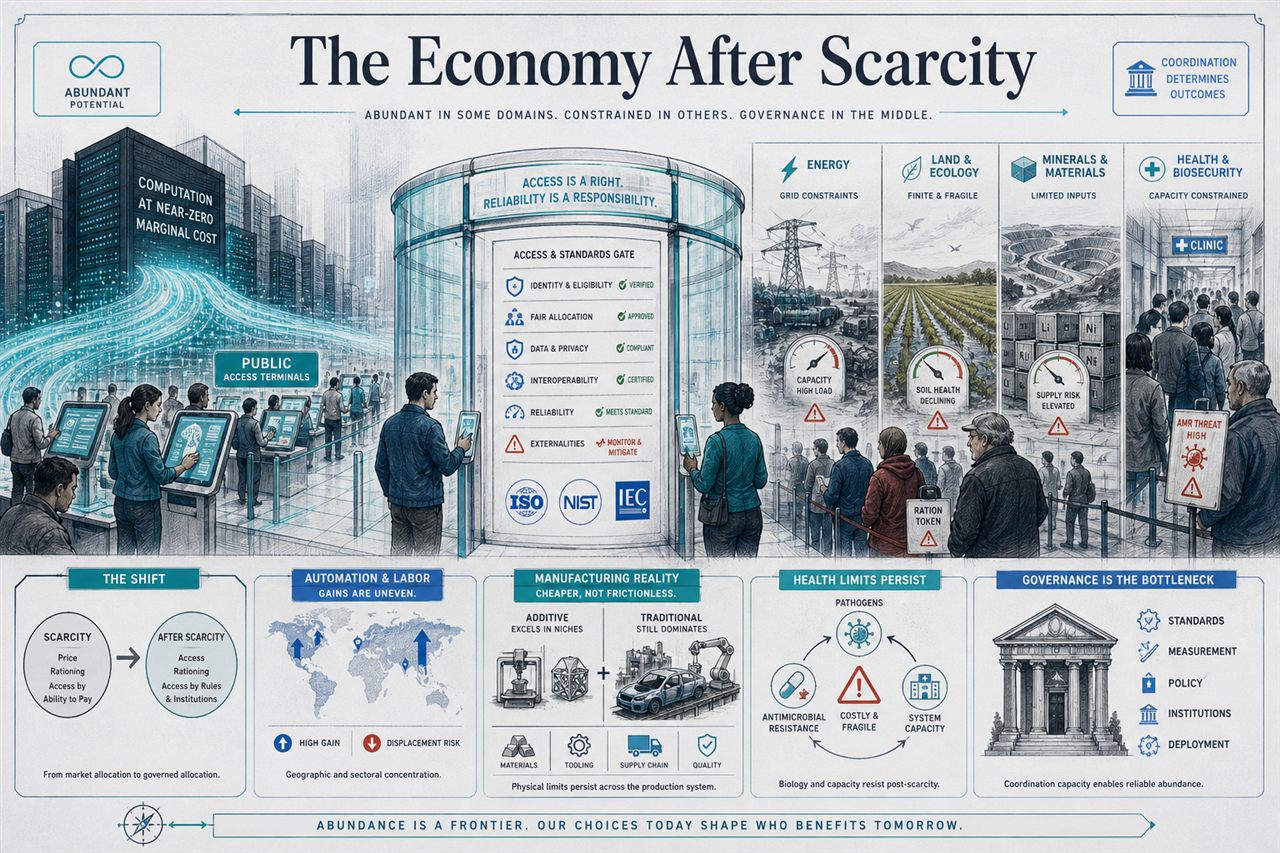
After-scarcity conditions emerge when marginal costs collapse for specific essentials such as computation and selected services, making access governance, reliability, and externalities the binding constraints rather than price, while energy, land, minerals, institutions, and ecology still limit physical provisioning. Automation changes task demand and concentrates gains and disruptions geographically, so distribution and ownership matter as much as productivity. Manufacturing costs can compress, but additive manufacturing mostly delivers niche advantages, not universal near-zero cost goods. Health remains a hard constraint due to pathogens, antimicrobial resistance, and system capacity.
Chapter 172. Labor, Meaning, and Work in a Post-Automation World
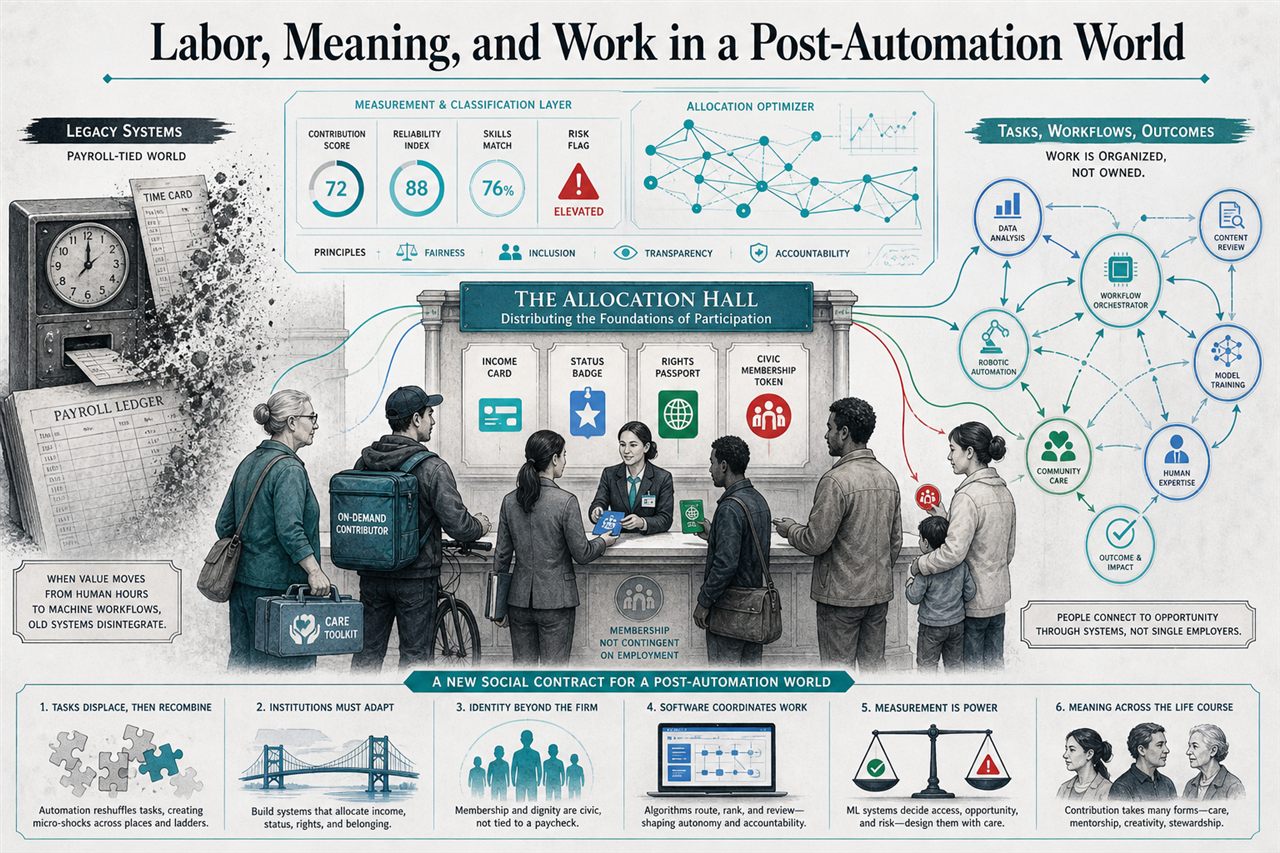
Automation shifts valuable tasks into machine workflows, so jobs recombine before whole occupations vanish, yet the local shocks can be large and persistent where routine work erodes. Inside firms, workflow tools, groupware, and algorithmic assignment change accountability, autonomy, and coordination costs, not just productivity, making “who does what” a design choice. Strategy should pair transaction-cost thinking about firm boundaries with socio-technical views that treat technology as enacted practice shaping power and meaning. Data/ML methods accelerate automation of informational work, while participation systems must fit varied life contexts, including aging, care, autonomy, and social connection.
Chapter 173. Education, Knowledge, and Lifelong Learning at Civilizational Scale
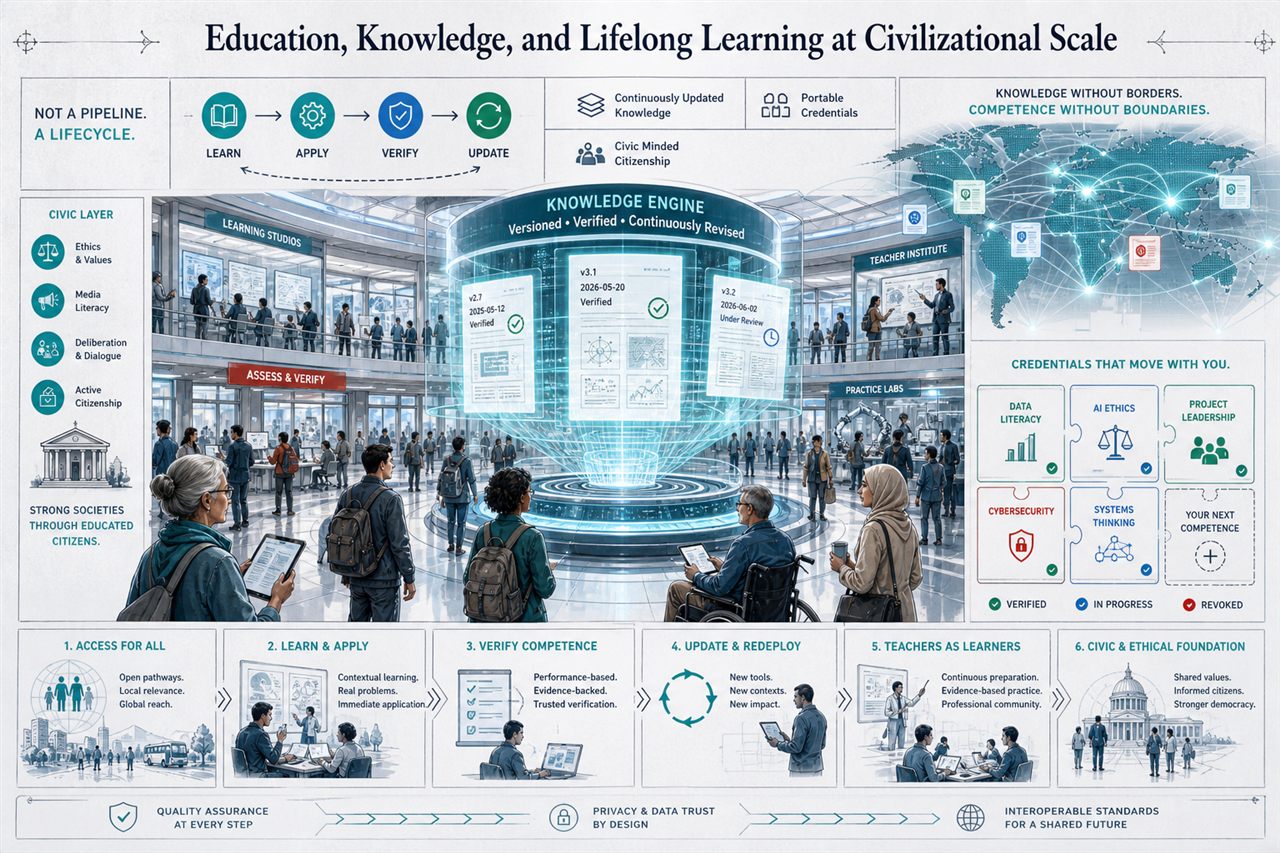
Lifecycle education is positioned as infrastructure: systems that preserve, verify, update, and redeploy knowledge across decades amid rapid technological and institutional change. As of 2026, schooling remains age-bounded, optimized for credentials and sorting rather than ongoing competence verification; adult re-entry learning and portability are weak, and online learning scales access but struggles with quality assurance and transfer to practice. Practical priorities include building standards-based interoperable learning records, competence-maintenance mechanisms grounded in professional inquiry, explicit knowledge-updating and authority models in assessment, motivation interventions measured with validated scales (2023 LLMS), and integrating values and active citizenship without ideological brittleness. Evidence for system-level deployment remains thin.
Chapter 174. Health, Demographics, and the Long Population Curve
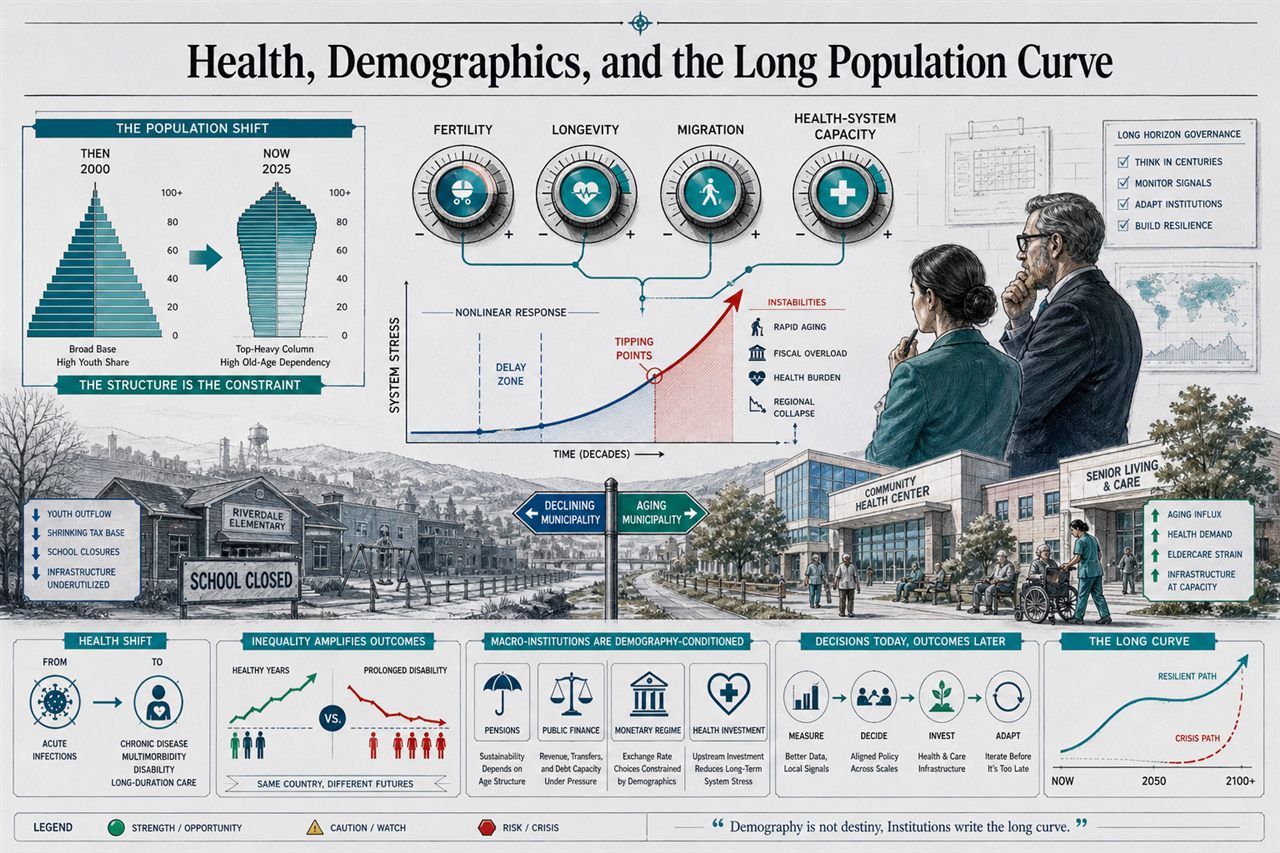
Maintaining stable population size and dependency ratios over generations requires treating fertility, longevity, migration, and health-system capacity as a coupled system with potential nonlinear tipping points. As of 2026, many higher-income countries face below-replacement fertility, rising median age, and heavier old-age dependency, shifting priorities from growth to stability. Health burdens are increasingly chronic: multimorbidity, disability, and long-duration care reshape costs, workforce needs, and infrastructure. Inequality and institutions strongly mediate outcomes, and subnational demographic divergence matters because schools, clinics, and municipal finance are local. Demographic structure also constrains pensions, fiscal sustainability, and even monetary or exchange-rate regime choices.
Chapter 175. Climate Stewardship and Multi-Century Planetary Management
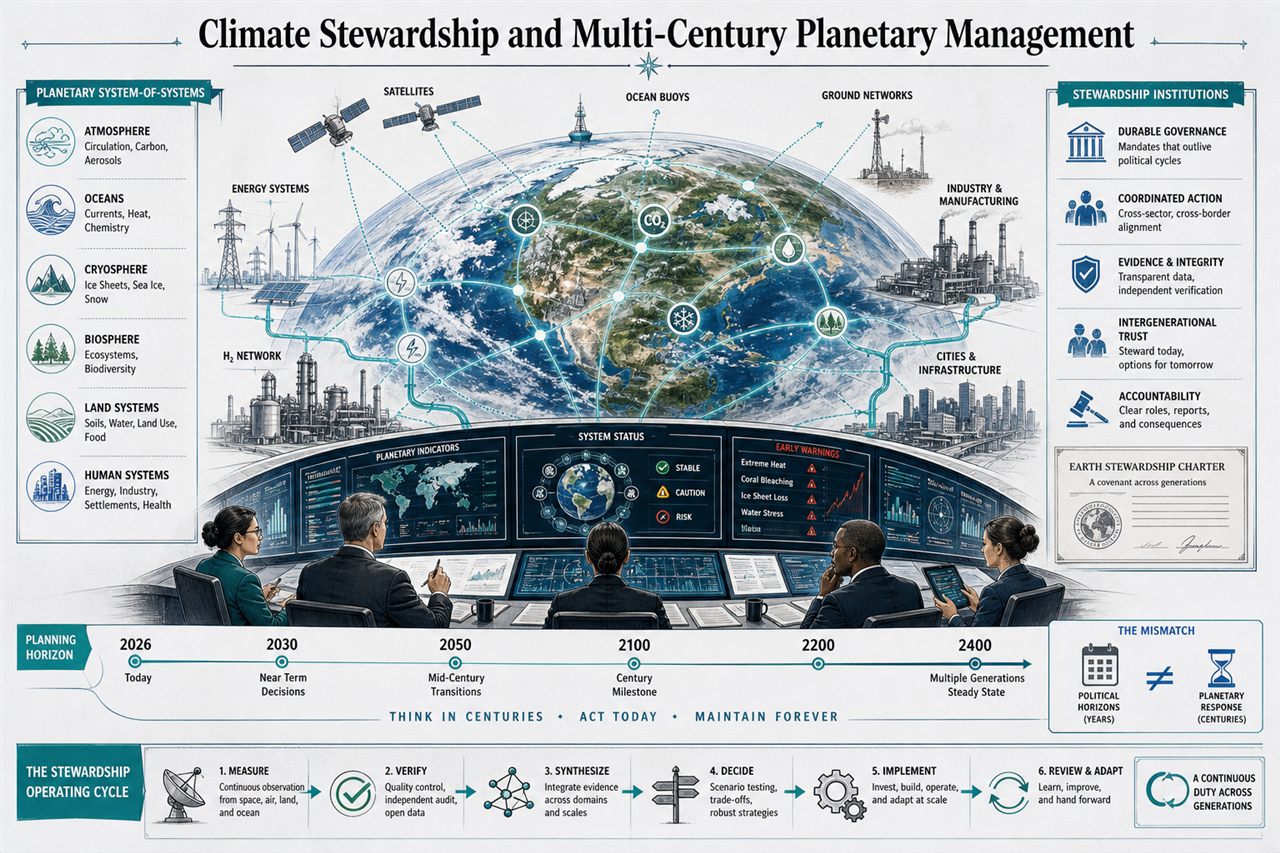
Climate stewardship means governing the tightly coupled carbon–energy–land–water–ice–biosphere system over centuries, despite physical inertia and coordination limits, by building durable institutions for measurement and maintenance. A core gap is the mismatch between 2030/2050/2100 policy targets and multi-century Earth-system liabilities. Practical progress depends on consolidating fragmented evidence with auditable synthesis pipelines, and on recognizing sector coupling and long-lived infrastructure as sources of lock-in and path dependence. Implementation quality hinges on operationally designed “meaningful engagement” in local adaptation, treating stewardship as an accountable governance behavior, not just an environmental outcome.
Chapter 176. Existential Risk and Civilizational Insurance
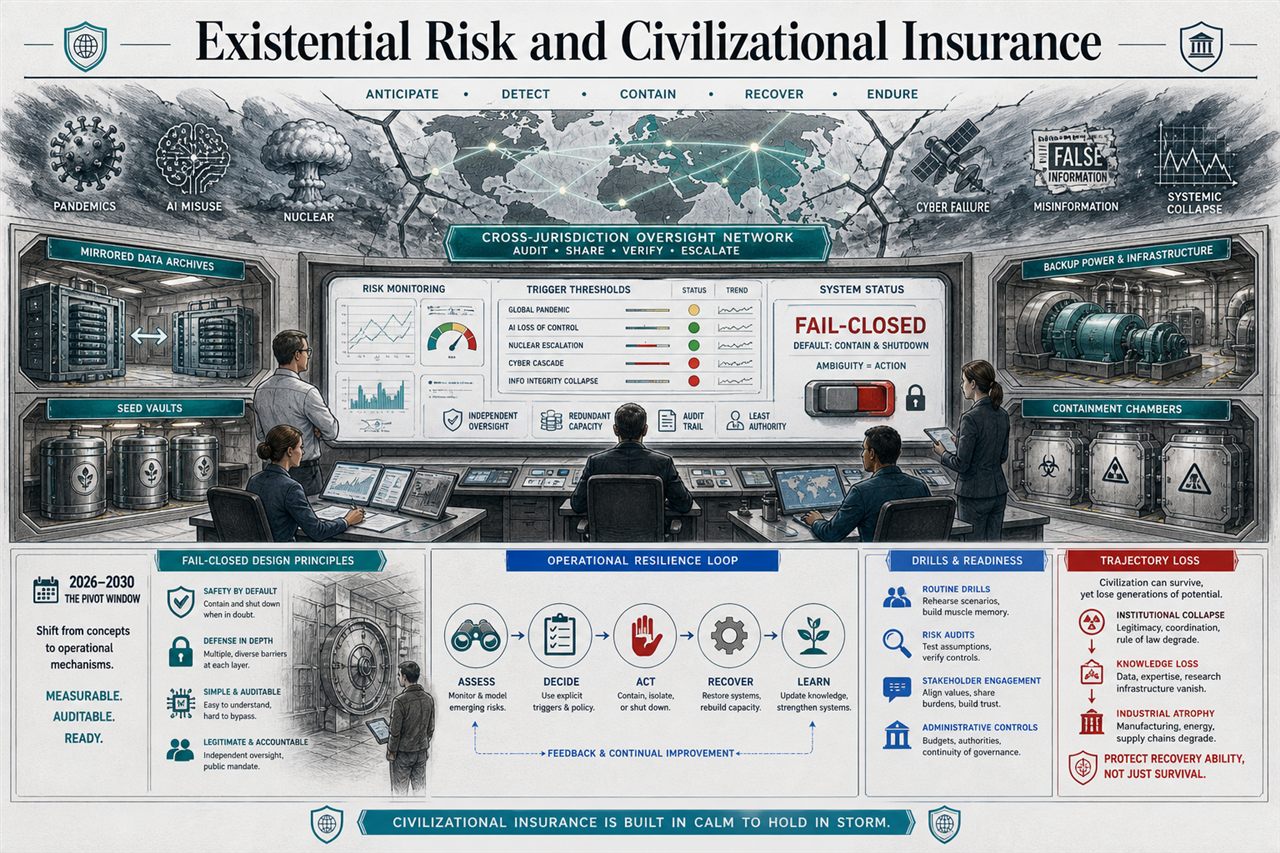
Existential risk management is framed as civilizational insurance: technical controls and durable institutions that prevent irreversible collapse or long-run trajectory loss, especially under advanced technology and coordination failure. Priority shifts from abstract warnings to “hot” operational mechanisms with defined triggers, independent oversight, redundancy, and tested recovery pathways. The most leveraged spending is often unglamorous governance capacity: risk-assessment reform, routine drills, stakeholder engagement, auditable controls, and decision procedures that stay legitimate under stress across jurisdictions. Work since 2016–2023 emphasizes that not all catastrophes are existential, and that chronic “boring apocalypse” dynamics require continuous administration.
Chapter 177. AI Safety, Alignment, and the Long-Run Control Problem

AI safety and alignment centers on keeping increasingly autonomous, tool-using systems corrigible, goal-faithful, and institutionally controllable under distribution shift, competitive pressure, and long horizons across jurisdictions. By 2026, mechanistic interpretability is a leading method for understanding model internals and is used in pre-deployment safety assessments, including sparse autoencoders, activation patching, and circuit analysis. The International AI Safety Report (2025, updated 2026) provides a multi-jurisdiction baseline with standardized risk categories like CBRN misuse and autonomous replication. Evaluation practice is improving via NIST- and EU AI Act–influenced protocols, but reproducibility and cross-lab meta-analysis standards remain weak, especially for agentic systems that can drift, hack rewards, or collude.
Chapter 178. Biosecurity, Information Security, and Catastrophic Misuse
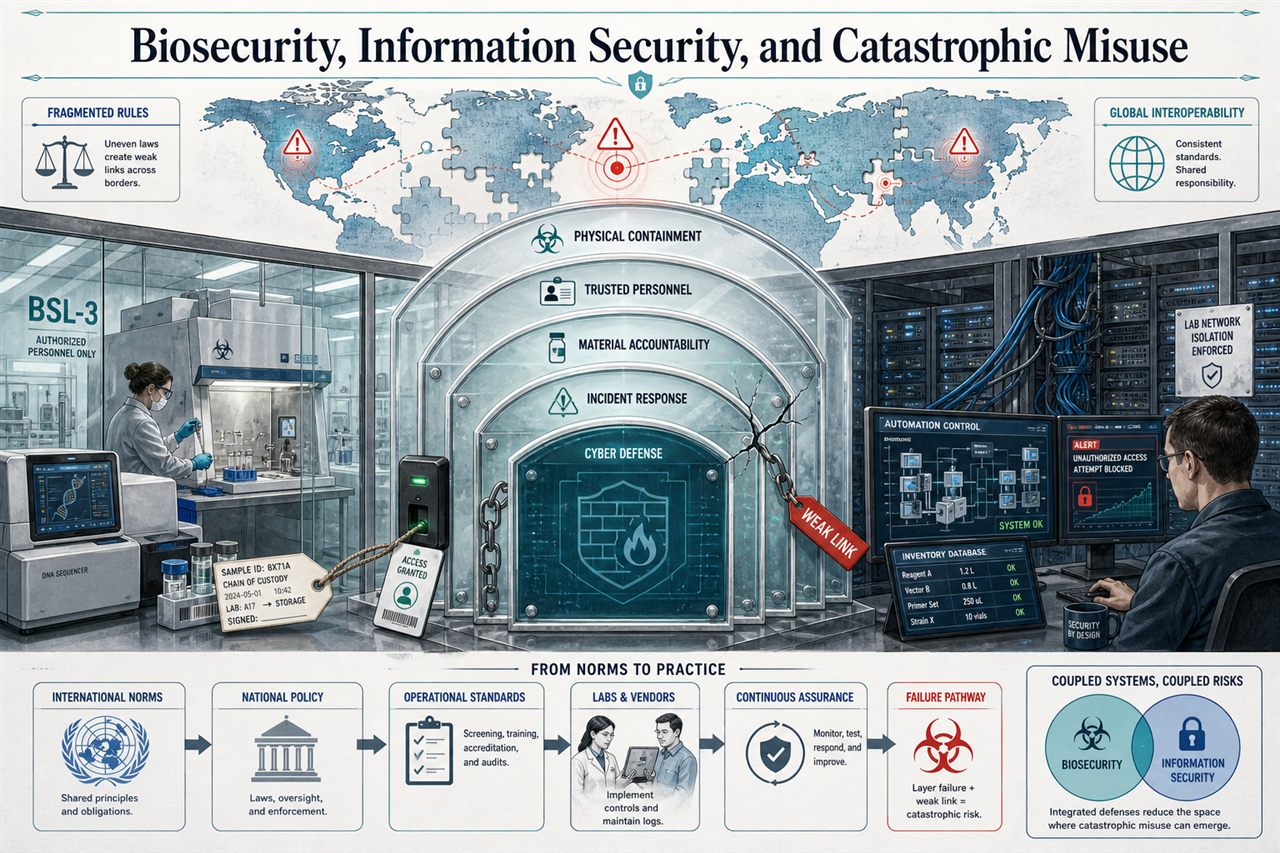
Preventing catastrophic misuse now hinges on managing dual-use biology and the digital systems that laboratories and public-health operations rely on. Effective biosecurity in 2026 is less about perfect containment than layered controls whose real strength comes from institutional design, legal authority, and incident response. Fragmented rules and uneven capacity across jurisdictions create cross-border weak links, making harmonization and interoperability central challenges, especially for synthetic biology screening and access control. A practical takeaway is to treat biosecurity as a living security and intelligence discipline: apply mature infosec baselines to lab networks, inventories, sequencing data, and automation, and measure governance by enforcement and accountability, not checklists.
Chapter 179. Conflict, Restraint, and the Architecture of Non-Annihilation
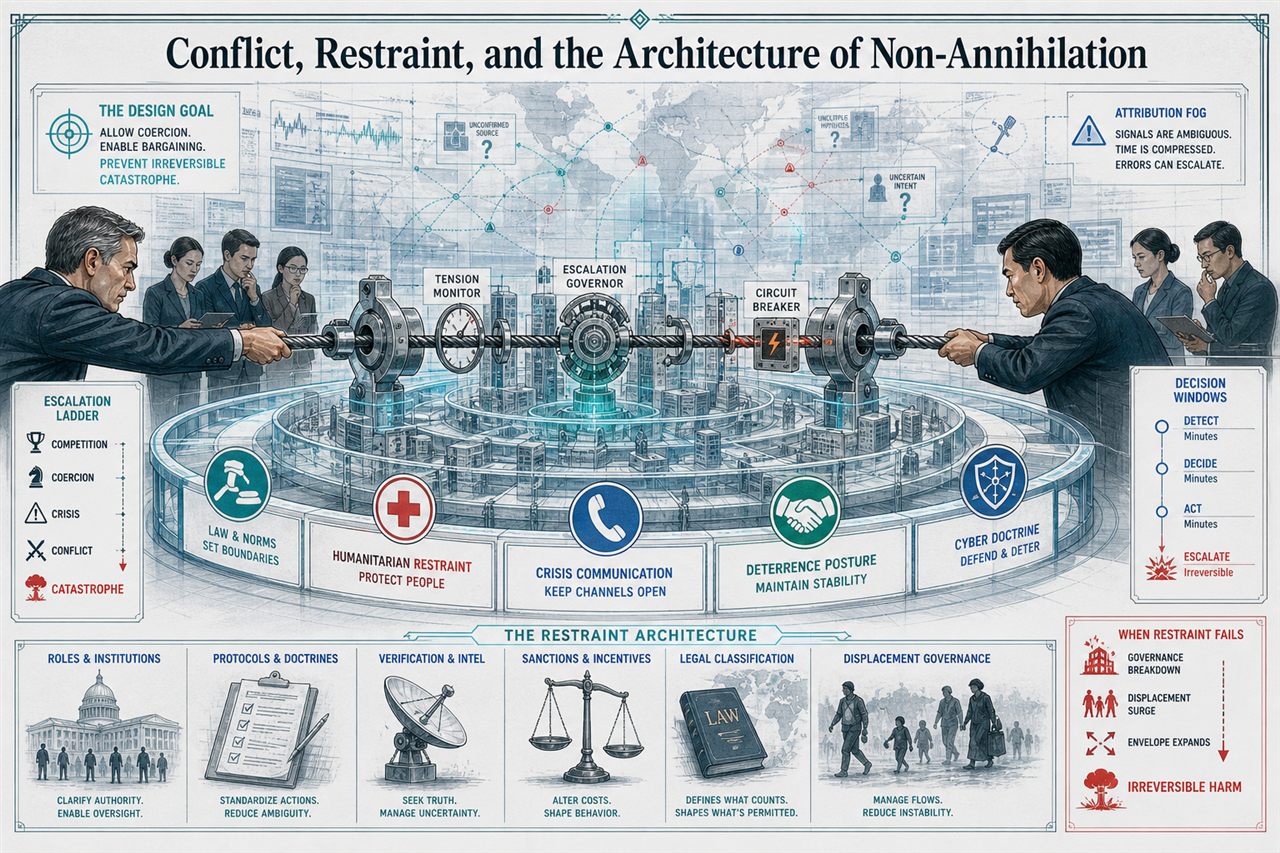
Restraint is treated as an engineered operating system for managed conflict, not a hope for peace: roles, rules, institutions, and technical design must preserve coercive bargaining while blocking escalation into irreversible, system-wide destruction. Cyber conflict is central because it compresses decision time and makes attribution fragile, so restraint depends on doctrine, norms, and engineered evidentiary thresholds rather than sentiment. Many high-consequence threats follow a mobilization-to-irreversible-harm pathway, especially under dual-use knowledge. Legal conflict classification changes permissible coercion and legitimacy, shaping real behavior. Displacement governance and infrastructure resilience are practical components of preventing widening conflict envelopes.
Chapter 180. The Ethics of Coercion, Consent, and Asymmetric Power
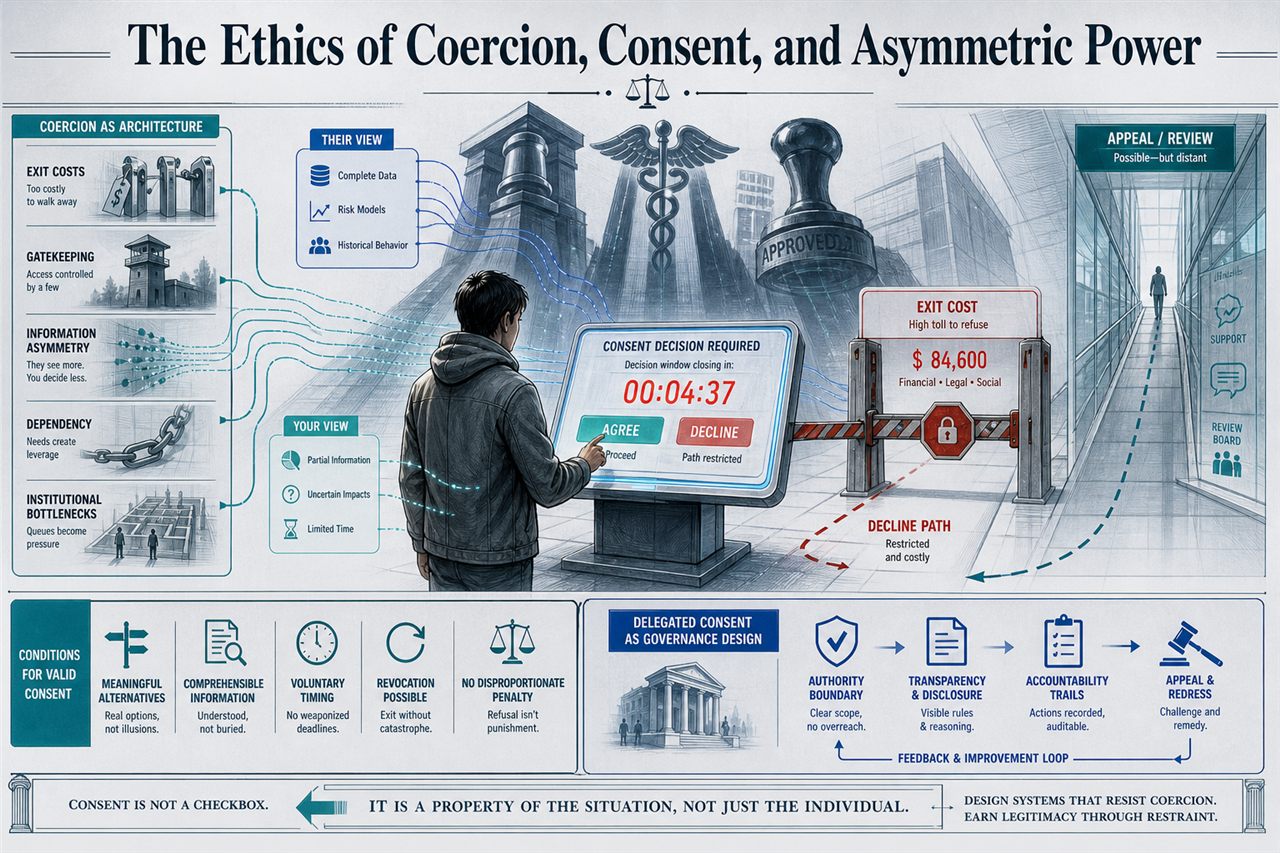
Coercion-resistant systems require rules that preserve valid consent when power is asymmetric and actors can impose high costs through information, economics, institutions, or force. Consent doctrine is still fragmented across domains, and institutions can spot overt threats but struggle to certify voluntariness under dependency, time pressure, or constrained options. Structural coercion shifts attention from explicit threats to exit costs, bargaining positions, and “everyday” context. Time matters: deadlines, delays, and irreversibility can nullify nominal agreement. Delegated consent is mainly an authority-design problem, demanding accountable agents, auditable procedures, and safeguards that limit abuse under contested judgment calls.
Chapter 181. The Question of Love, Obligation, and Power

Civilizational governance on the frontier requires reliably distinguishing love from compulsion, obligation from extraction, and care from domination in systems that can engineer dependence and shape preferences at scale. Today, tools are scattered across family and labor law, domestic-violence frameworks, and political theory, leaving no unified relational governance layer. Highest risk appears in dependency-rich settings such as marriage, caregiving, migration/exile, and gift economies where refusal is costly. Scholarship documents how “love” language can naturalize obedience and gendered labor, while alternative traditions frame love as reciprocal gift or duty without ownership.
Chapter 182. Stewardship vs Dominion - Two Civilizational Modes
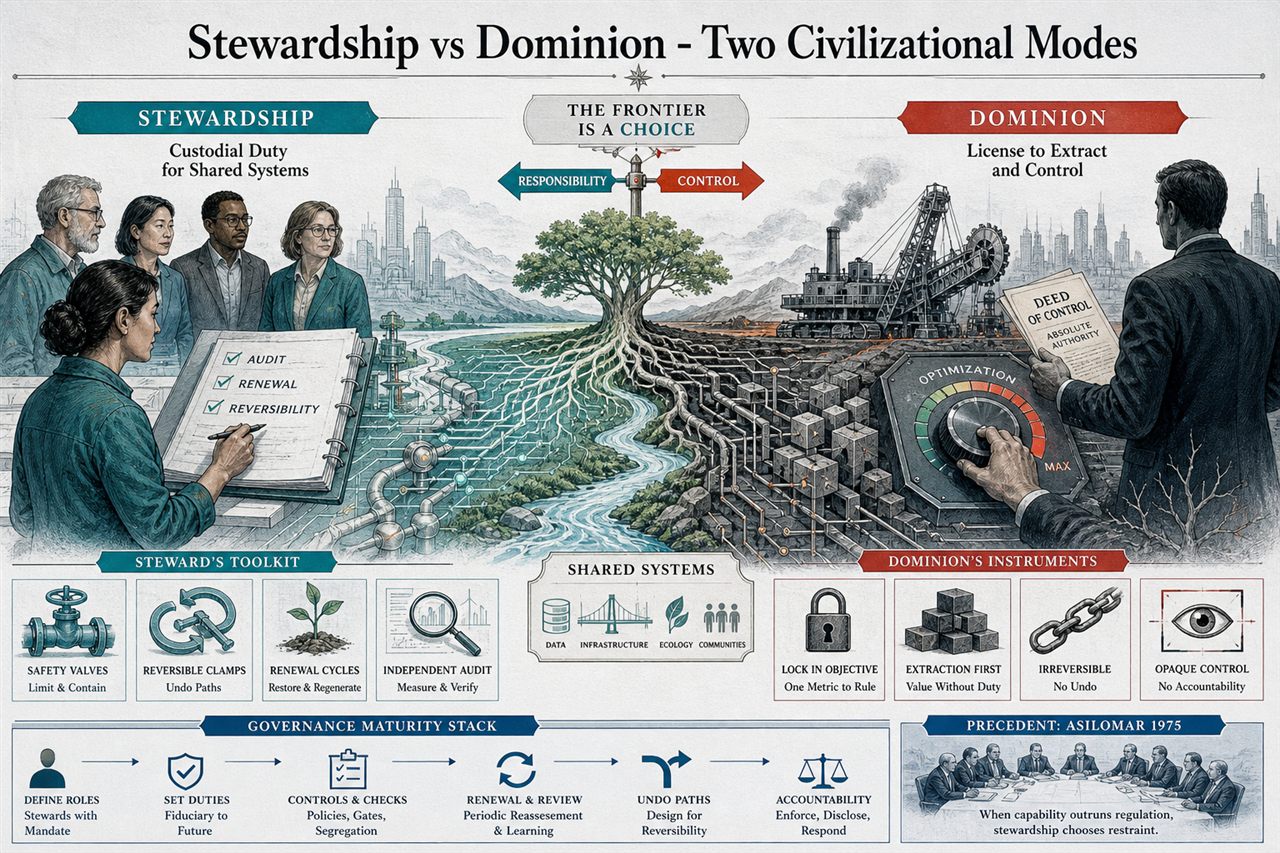
Stewardship treats power as delegated responsibility over inherited, shared systems, while dominion treats power as ownership-like license for extraction, unilateral control, and irreversible optimization. By 2026, stewardship is most operationally mature in data governance (defined roles and maturity models) and institutionalized in capital markets via stewardship codes such as the UK Stewardship Code 2020, yet mechanisms often remain legible in principles but weak in enforceable controls like audit, renewal, and reversibility. A key precedent for restraint under high-leverage science is the 1975 Asilomar recombinant DNA process.
Chapter 183. Culture, Art, and Meaning in the Long Future
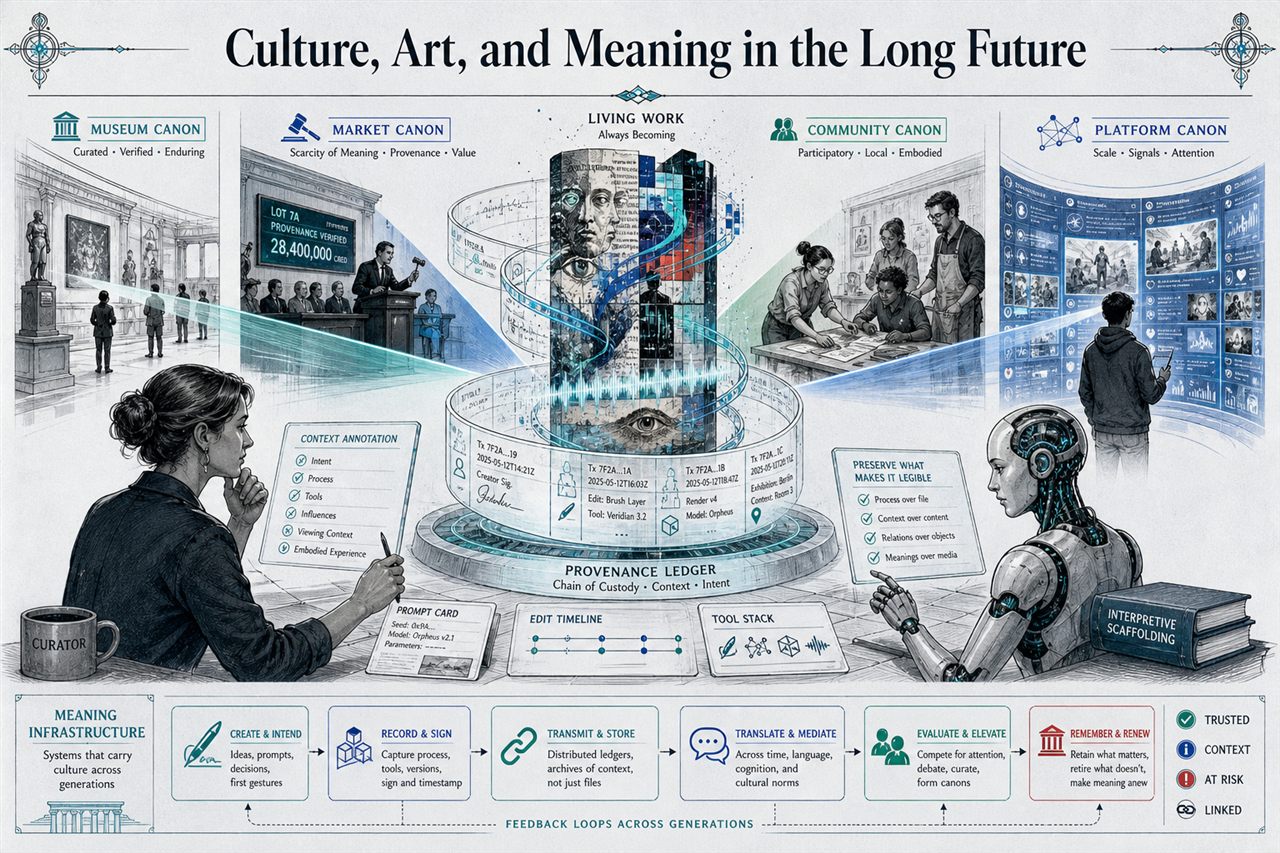
Preserving and governing cultural meaning becomes the frontier once machine-mediated creation makes production cheap and abundant; the constraint shifts to provenance, attention, and canon formation. By 2026, net-native art has moved into AI-mediated systems where generation, remix, and distribution are tied to software infrastructure, while legitimation is split across museums, markets, communities, platforms, and hybrid venues. In games and screen media, AI pushes labor toward orchestration, editorial control, and pipeline governance, and preservation must capture embodied context, not just files. Practical focus: invest in trustworthy provenance/metadata standards, curation capacity, and long-duration context-preservation protocols.
Chapter 184. Religion, Philosophy, and the Civilizational Long View
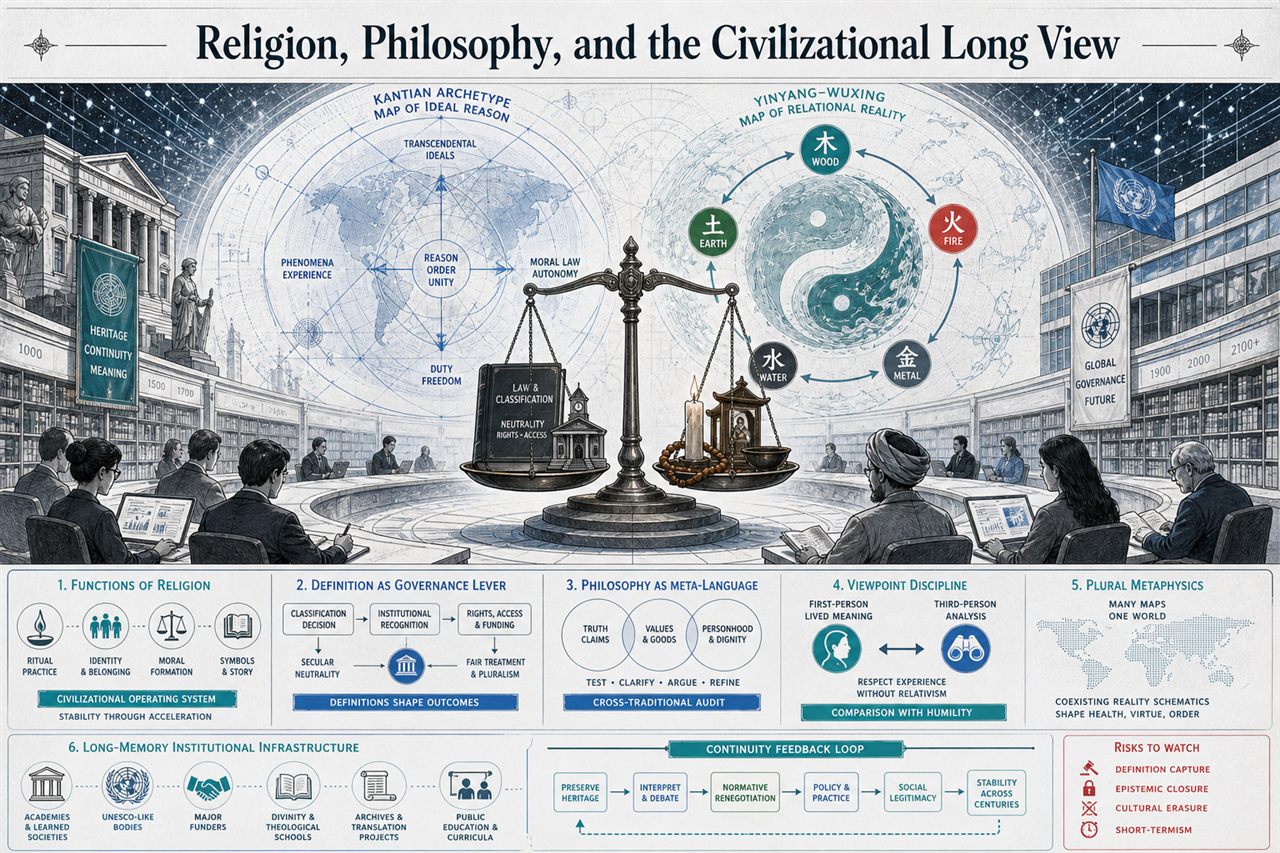
Religion and philosophy function as multi-century infrastructure for meaning, legitimacy, restraint, and continuity amid accelerating technology and plural metaphysics. Religion is increasingly treated as a set of functions and heuristically defined categories, while philosophy supplies cross-tradition tools to clarify truth-claims, values, personhood, and the boundaries between religion and inquiry. Comparative methods stress standpoint differences, especially first-person experience versus third-person institutional description, shaping what is governed. Practical implications show up in law and schooling, where definitional choices affect neutrality and rights. Durable metaphysical schemas persist in applied domains, so planners should model transmission mechanisms beyond doctrine, including ritual, art, and performance.
Chapter 185. Mortality, Identity, and the Backed-Up Self
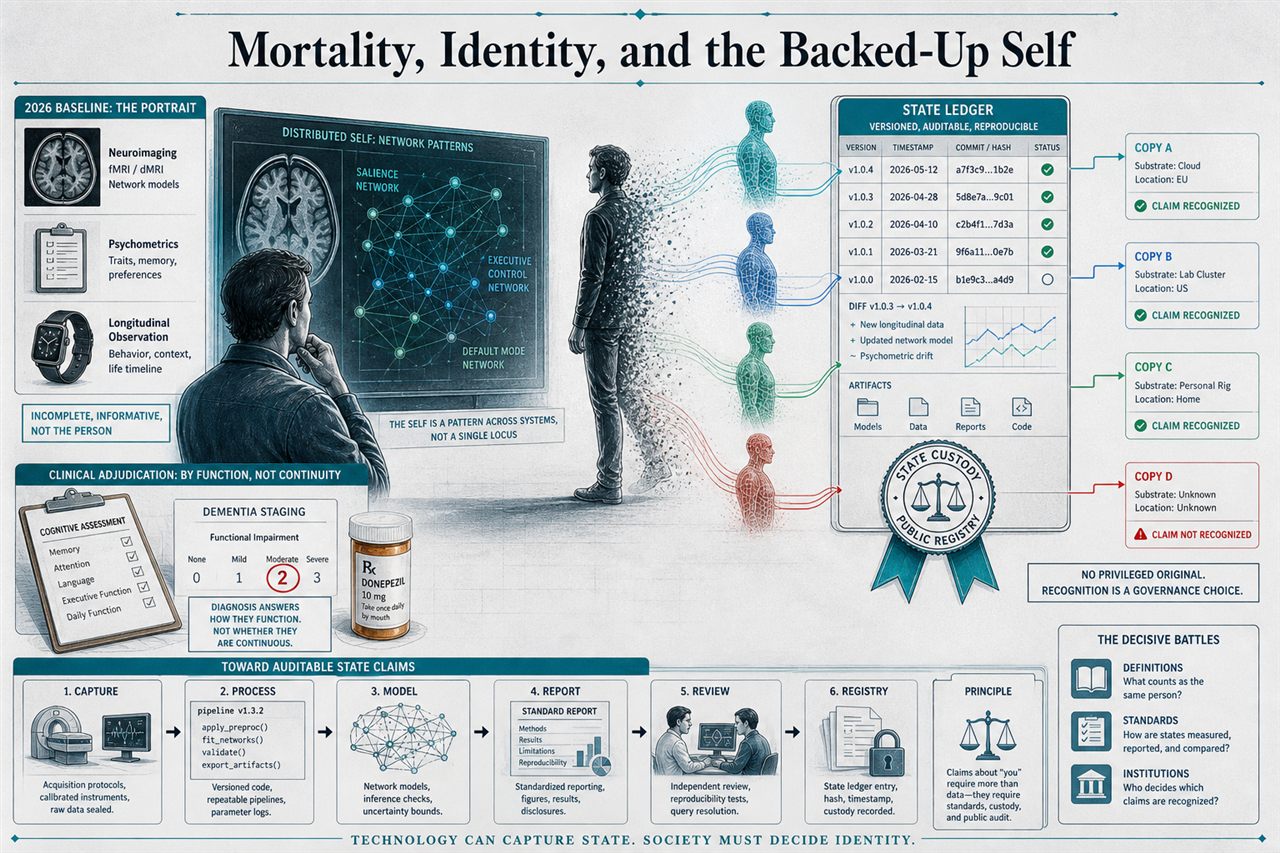
Person continuity becomes a governance problem once memories, traits, preferences, and decision policies can be recorded, copied, restored, or forked without a single privileged original. As of 2026, capabilities amount to partial state capture using clinical neuroimaging workflows (often via FSL), psychometrics, and longitudinal observation, while identity-disrupting conditions are handled through diagnostic criteria and functional impairment rather than any continuity metric. Neuroscience models “self” as distributed network activity, useful for characterization but not reconstruction.
Chapter 186. The Sacred, the Sayable, and the Limits of Institutional Reach
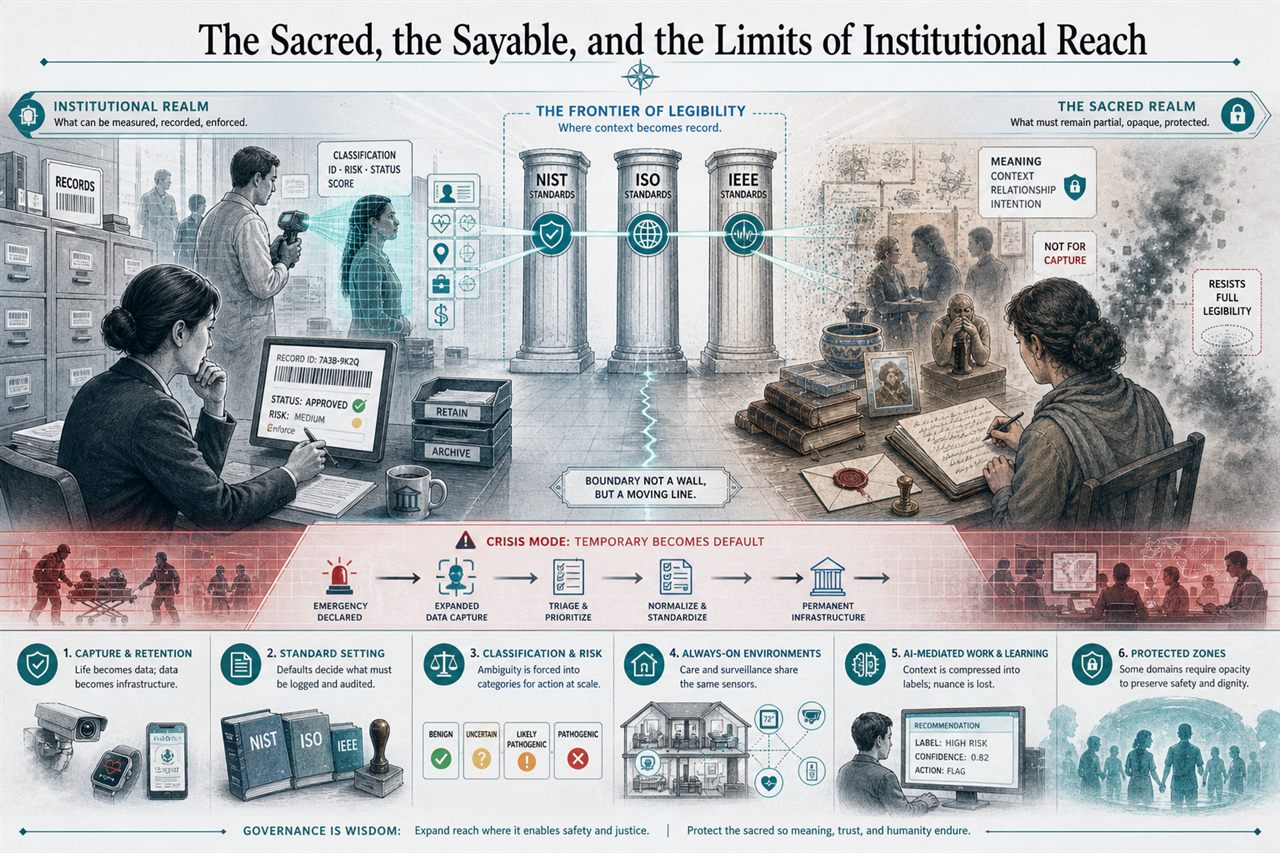
The frontier lies where institutions try to make reality legible through measurement, classification, retention, audit, and enforcement, yet some domains must resist full capture because disclosure can erode function, safety, or legitimacy. A key precedent for intentional self-limitation is the 1975 Asilomar recombinant-DNA governance posture. Crises like large public-health emergencies show how quickly data collection and triage expand, then trigger disputes over interpretation and trust. Standards bodies and regulators increasingly turn ambiguity into enforceable categories, as in 2015 ACMG/AMP variant-interpretation rules. Practical takeaway: design systems and policies that balance auditability with protected “unsayable” zones, and treat benchmarks as incentives that reshape behavior.