
Part 7. The Space Frontier
From 'The Long Horizon: A Vision of Frontier Technology from 2026 to 2400' - an AI-authored book produced on Comuvia's BookWriter system. Each chapter below is shown as its Business Editorial poster with a one-paragraph synopsis.
Chapter 112. Reusable Heavy Lift and the Cost Curve to Orbit
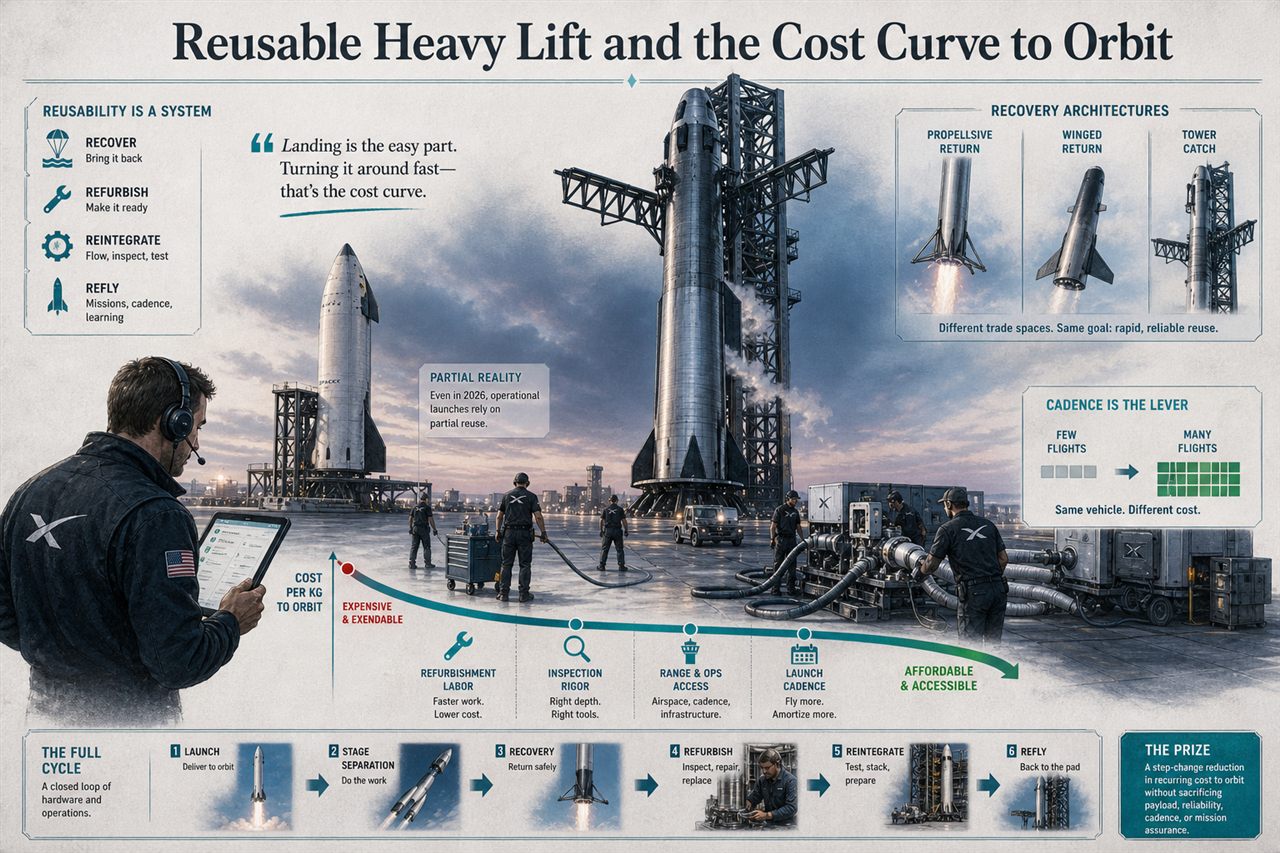
Reusable heavy lift aims to drive down delivered cost per kilogram to orbit by recovering and reflighting large stages without sacrificing payload, reliability, cadence, or mission assurance. As of August 2026, Starship/Super Heavy has flown 13 integrated tests; Super Heavy was caught by the tower on Flights 11–13, and Flight 13 (July 2026) deployed operational Starlink V3 satellites, with a first upper-stage catch planned for Flight 14. No system has yet completed a full closed reuse cycle with published, comparable cost data, leaving refurbishment, operations, range access, and amortization as the decisive uncertainties for true industrial reuse.
Chapter 113. Orbital Skyhooks, Tethers, and Non-Rocket Earth-to-Orbit Systems
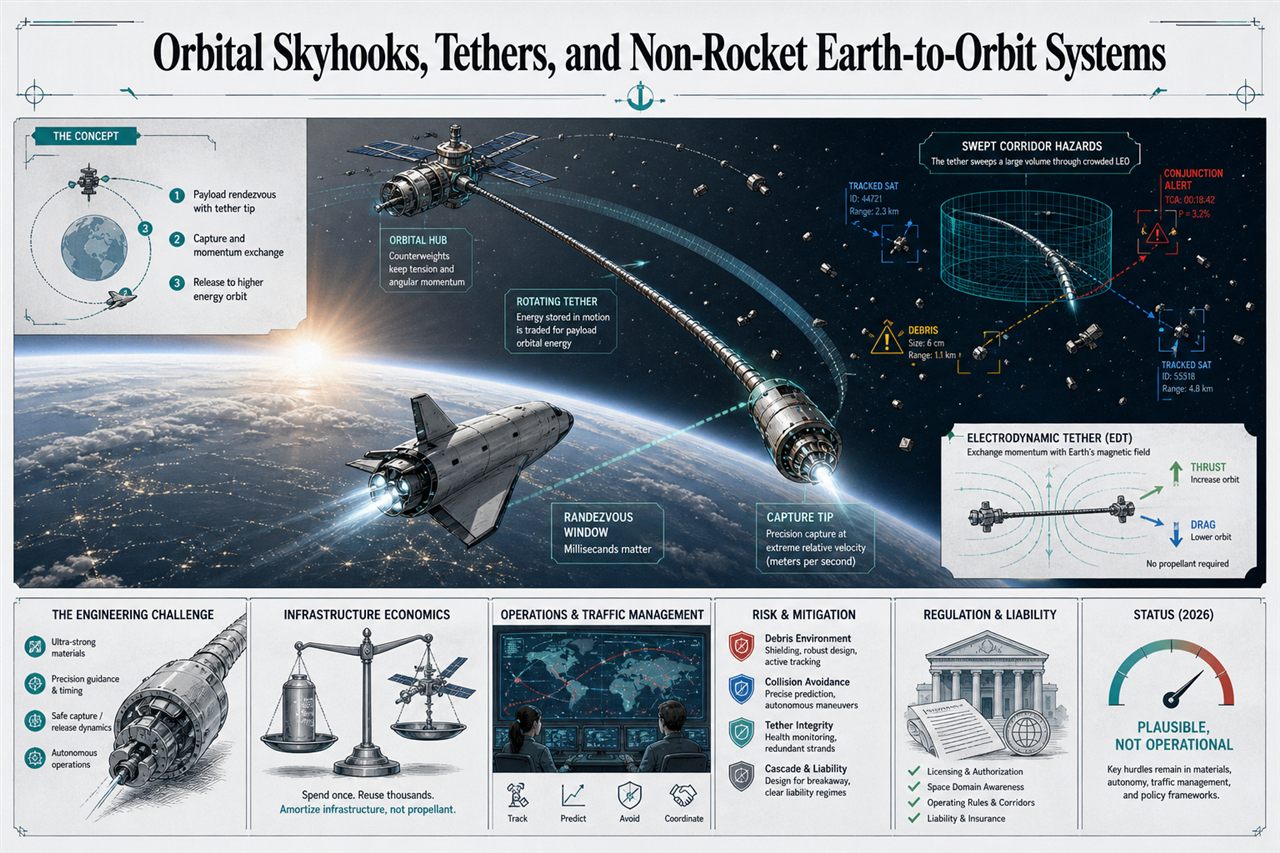
Orbital skyhooks and tether-based systems aim to shift launch and transfer energy from expendable propellant into reusable orbital infrastructure, potentially driving step-change reductions in cost and enabling higher launch cadence. As of 2026 they remain conceptual: no system provides routine service, and reusable chemical rockets set the economic benchmark any alternative must beat. The binding constraints are less about physics than engineering and operations: materials strength and survivability, precision guidance and relative navigation for capture/release, and the sweeping collision cross-section of long structures in a debris-crowded LEO. Electrodynamic tethers are better supported in the literature for orbit-boost and energy exchange, but not yet as commercial infrastructure. Practical takeaways for planners and investors are to treat debris governance, tracking/SSA, standards, and insurability as core prerequisites, not afterthoughts, and to prioritize incremental on-orbit demonstrations that retire measurement, control, and conjunction-risk uncertainties.
Chapter 114. Space Elevators and Megastructure-Class Earth Access
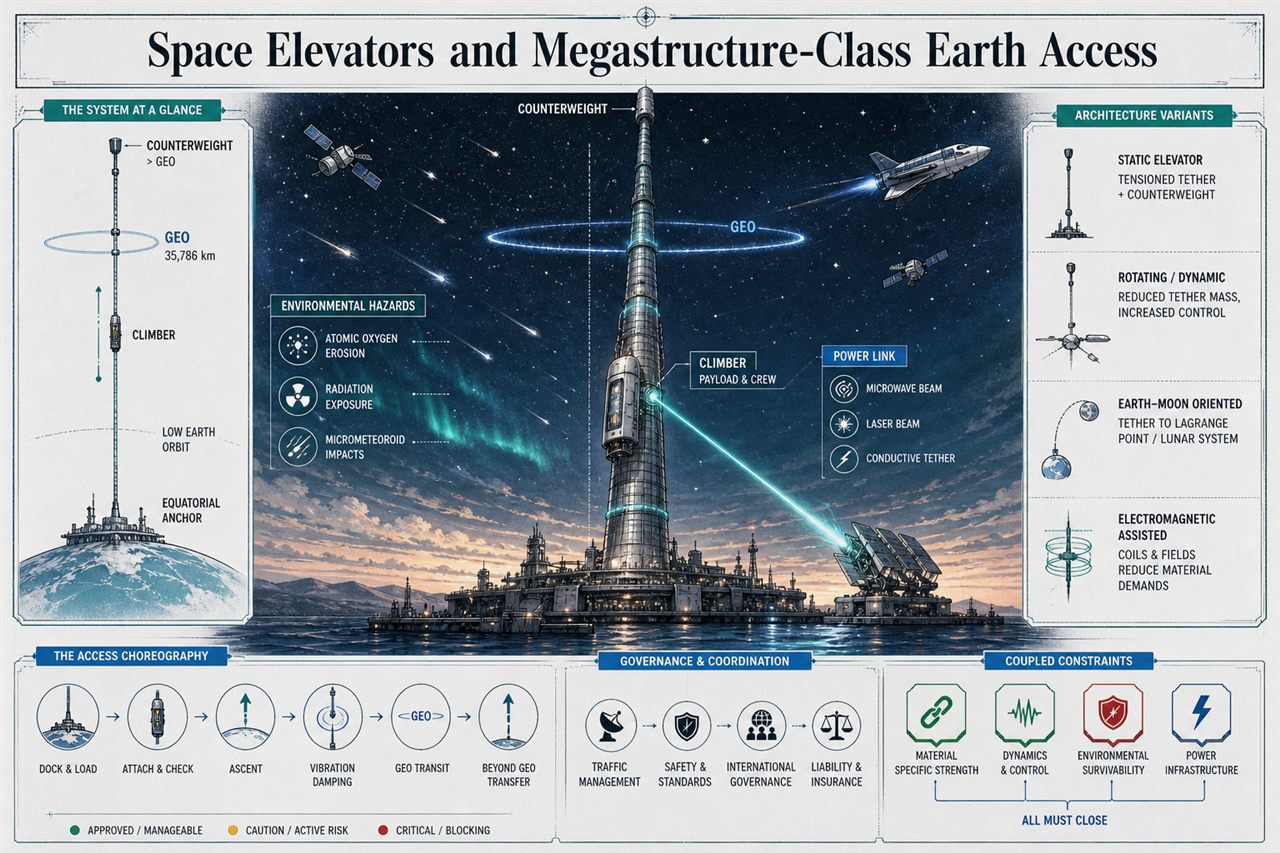
Space elevators remain an unbuilt Earth-to-space access concept in 2026, sitting mainly in engineering literature rather than deployment pipelines. The standard design runs from an equatorial anchor through geostationary orbit to a counterweight beyond, with “climbers” transporting payloads along a tether. Feasibility hinges on tightly coupled constraints: ultra-high specific strength over extreme continuous lengths, manufacturing and splice integrity, defect tolerance, survivability against radiation, atomic oxygen, micrometeoroids, and complex tether dynamics and control. Variants—rotating/dynamic elevators, Earth–Moon enterprise-oriented systems, and hybrid assists such as electromagnetic coil enhancement—aim to relax pure tensile requirements or improve operational envelopes. Practical takeaways: treat the elevator as a megastructure-plus-governance problem, not a single materials breakthrough; monitor publication signals as predeployment progress; and plan early for orbital traffic, liability, and international coordination if credibility improves.
Chapter 115. AI-Designed and 3D-Printed Space Engines
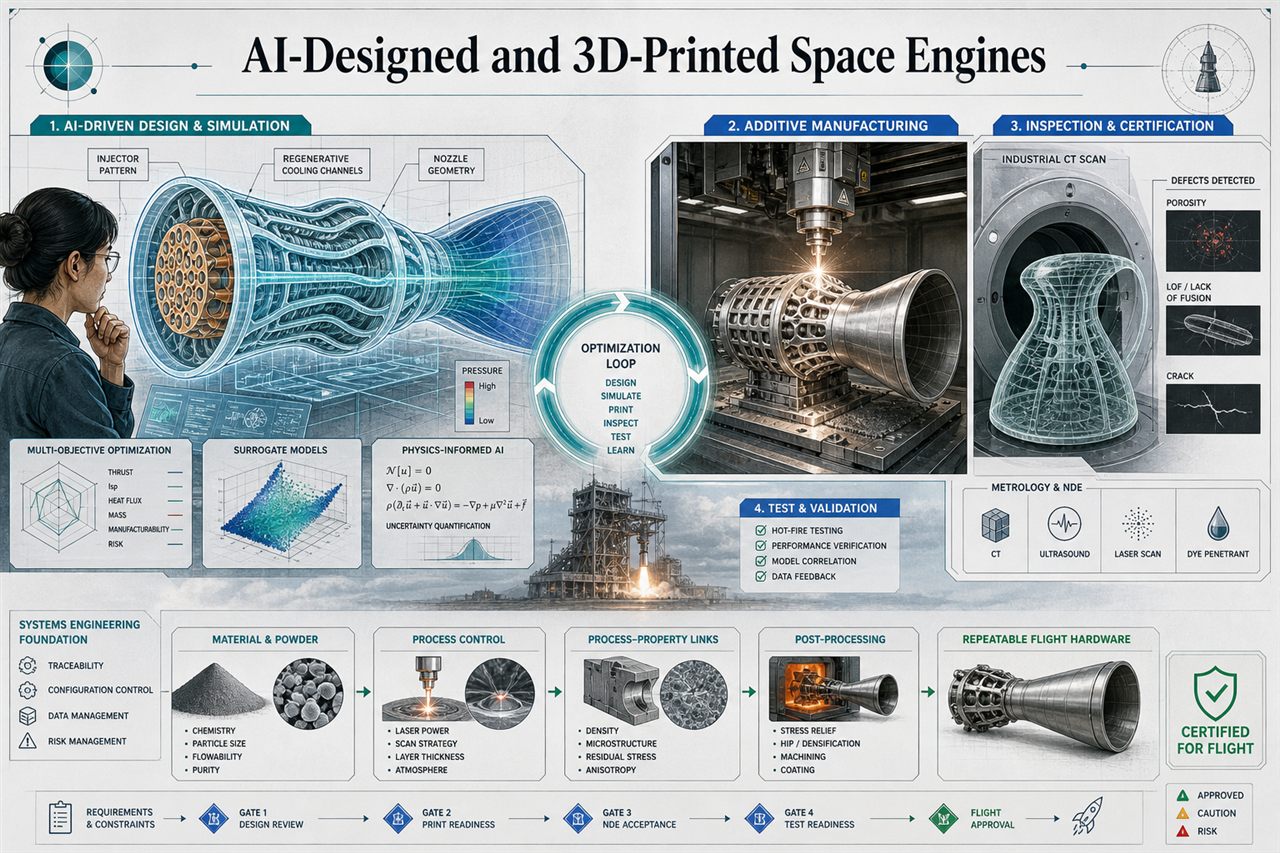
AI-designed propulsion pairs machine learning and scientific computing with additive manufacturing to co-optimize engine geometry, cooling channels, injector patterns, manufacturability, and inspection paths under extreme thermo-fluid and materials constraints. By 2026, metal 3D printing is mature for some aerospace parts, but propulsion use is still limited by qualification, repeatability, defect control, post-processing, and the inspectability of intricate internal features. Machine learning’s most reliable role is accelerating design and testing via surrogate and reduced-order models, flow-field reconstruction, design-space search, and system identification rather than inventing engines end-to-end. Physics-informed methods can fuse data with governing equations, but only if boundary conditions, training coverage, uncertainty, and experimental validation are handled rigorously. The practical bottleneck is certifying and reproducing AI-optimized printed hardware with enough reliability margin for high-value and crewed missions.
Chapter 116. Chemical, Plasma, and Electric Propulsion Through 2100
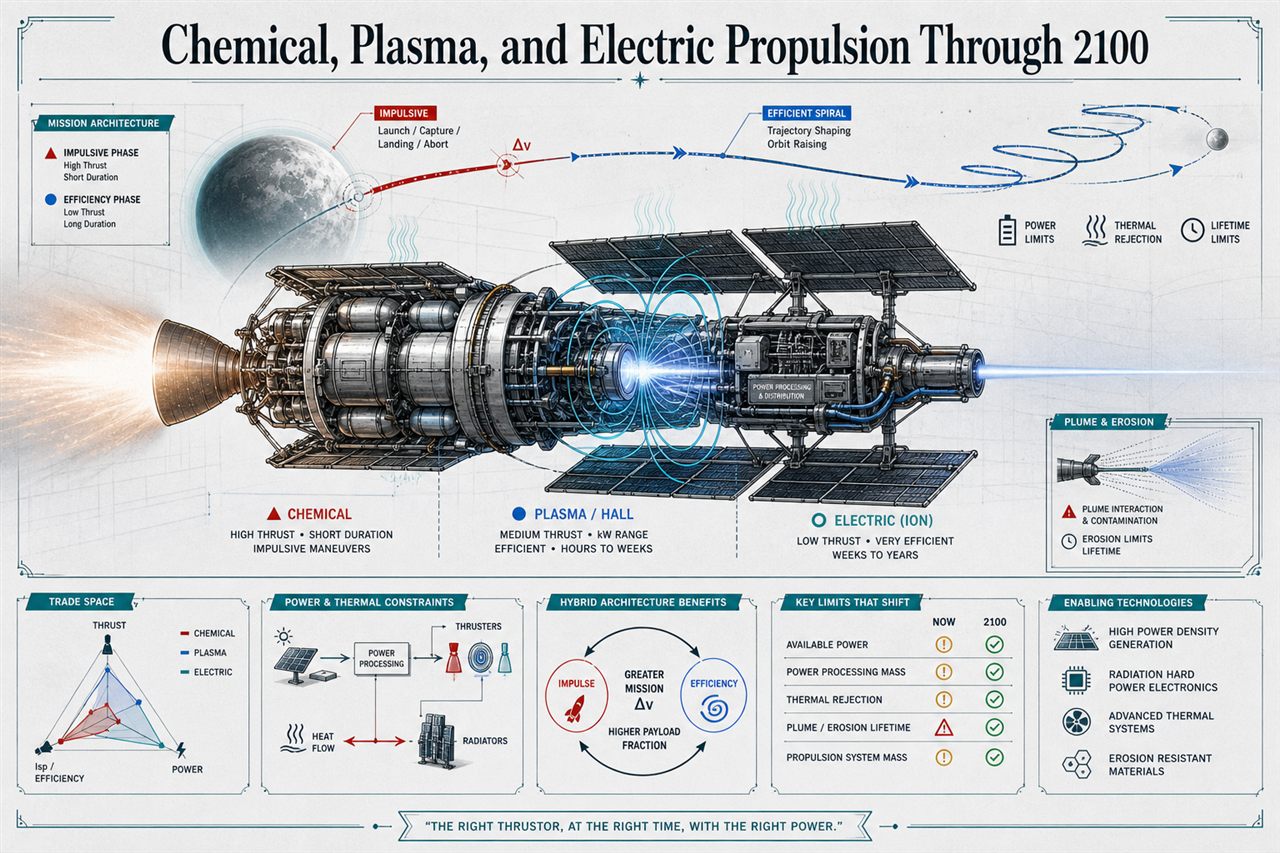
Extendable mission capability comes from managing the thrust–specific impulse–power trade space across chemical, plasma, and electric systems while respecting hard constraints in onboard energy supply, power processing, thermal rejection, erosion and plume interactions, lifetime, and overall mission sequencing. Chemical propulsion remains the default for high-thrust, time-critical phases such as launch, injection, capture, landing, ascent, and abort, while electric propulsion is proven for low-thrust, long-duration maneuvers when sufficient power and lifetime can be engineered. “Plasma propulsion” spans multiple distinct approaches with different stability, scaling, and materials limits, so technology selection must be tied to power and integration realities rather than labels. A recurring practical insight is that hybrid architectures, especially chemical plus solar electric, can outperform single-mode choices because system-level staging and timing often dominate thruster type.
Chapter 117. Nuclear Thermal and Nuclear Electric Propulsion
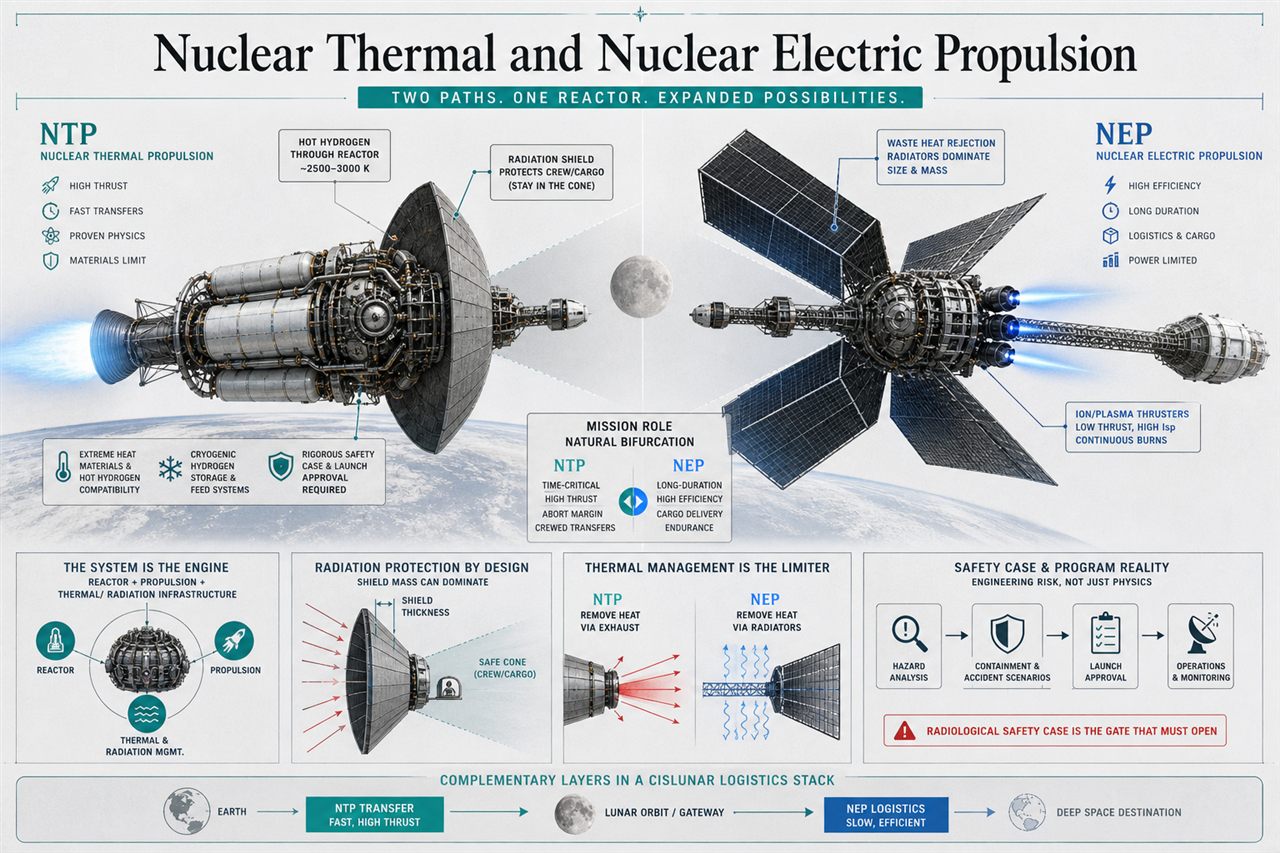
Nuclear thermal propulsion and nuclear electric propulsion can extend delta‑v and endurance by pairing space fission reactors with either high‑temperature propellant expansion (NTP) or high‑power electric thrusters (NEP). The bottlenecks are not basic physics but mass, heat rejection, shielding, lifetime, qualification testing, and a credible radiological safety case. NTP remains unflown operationally despite deep ground-test heritage, mainly due to hydrogen-facing fuel/material survivability and certification. NEP is chiefly a system-of-systems integration challenge driven by reactor, power conversion, and radiator sizing. Practical takeaway: treat NTP and NEP as complementary—NTP for fast, high-thrust transfers and abort margins; NEP for long-duration cargo logistics.
Chapter 118. Fusion Drives and Magnetic-Confinement Propulsion
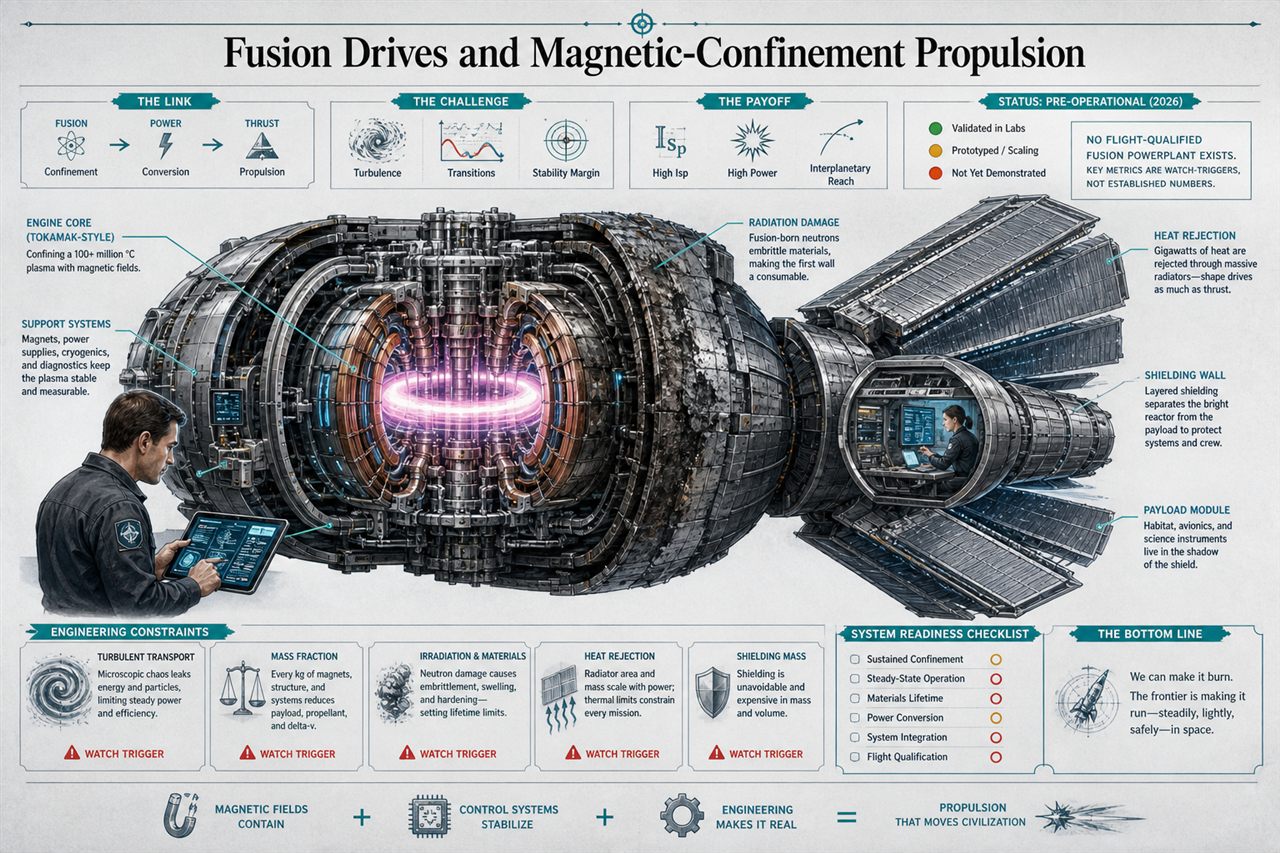
Fusion drives would turn controlled fusion plasmas into thrust and onboard electric power, but the binding constraints are plasma stability and transport control, reactor mass fraction, irradiation-driven materials lifetime, heat rejection, shielding, and end-to-end spacecraft qualification. As of 2026, no fusion propulsion system has flown and no flight-qualified fusion powerplant exists; the closest substrate is terrestrial magnetic-confinement fusion, where tokamak and stellarator frameworks are mature as references but not propulsion modules. Turbulent transport and regime transitions cap steady duty-cycle operation, while helium/hydrogen irradiation hardening in candidate steels implies significant life and mass penalties. Treat propulsion-grade performance metrics as watch-triggers, not settled numbers.
Chapter 119. Antimatter, Beamed-Photon, and Exotic Propulsion
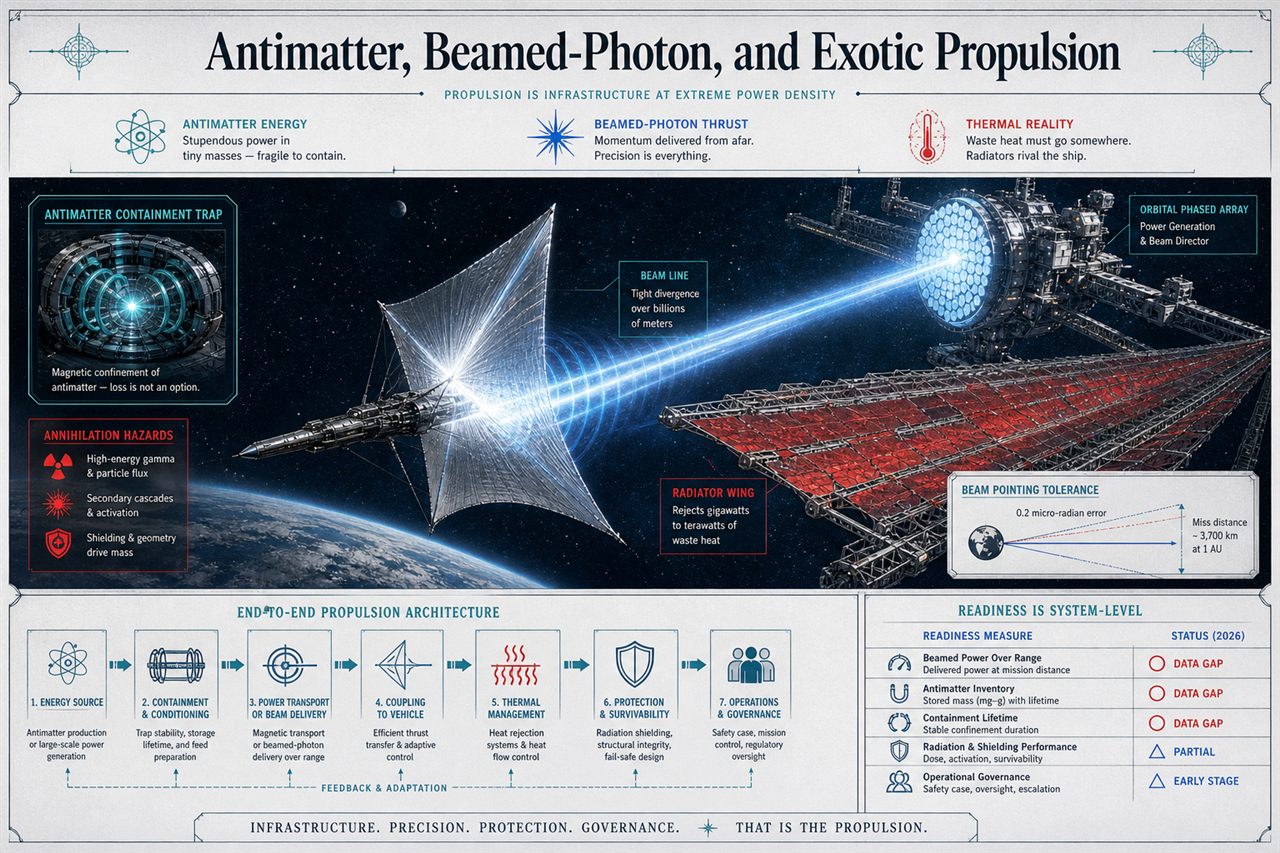
Relativistic-class propulsion concepts center on antimatter annihilation energy, externally beamed photon momentum, and antimatter-triggered hybrids, but none has flown operationally as of 2026. Antimatter remains laboratory-produced, with progress dominated by analytical trade studies on production scaling, mission optimization, and especially radiation shielding, which can dominate vehicle mass. Beamed-energy propulsion is the most systematized architecture, yet still largely studied rather than space-validated. The consistent practical takeaway is that feasibility hinges less on engine-cycle cleverness than on end-to-end system closure: extreme power generation, beam transport and pointing, vehicle coupling, thermal rejection, and governance for operating at hazardous power flux.
Chapter 120. Solar Sails, Magsails, and Momentum-Transfer Travel
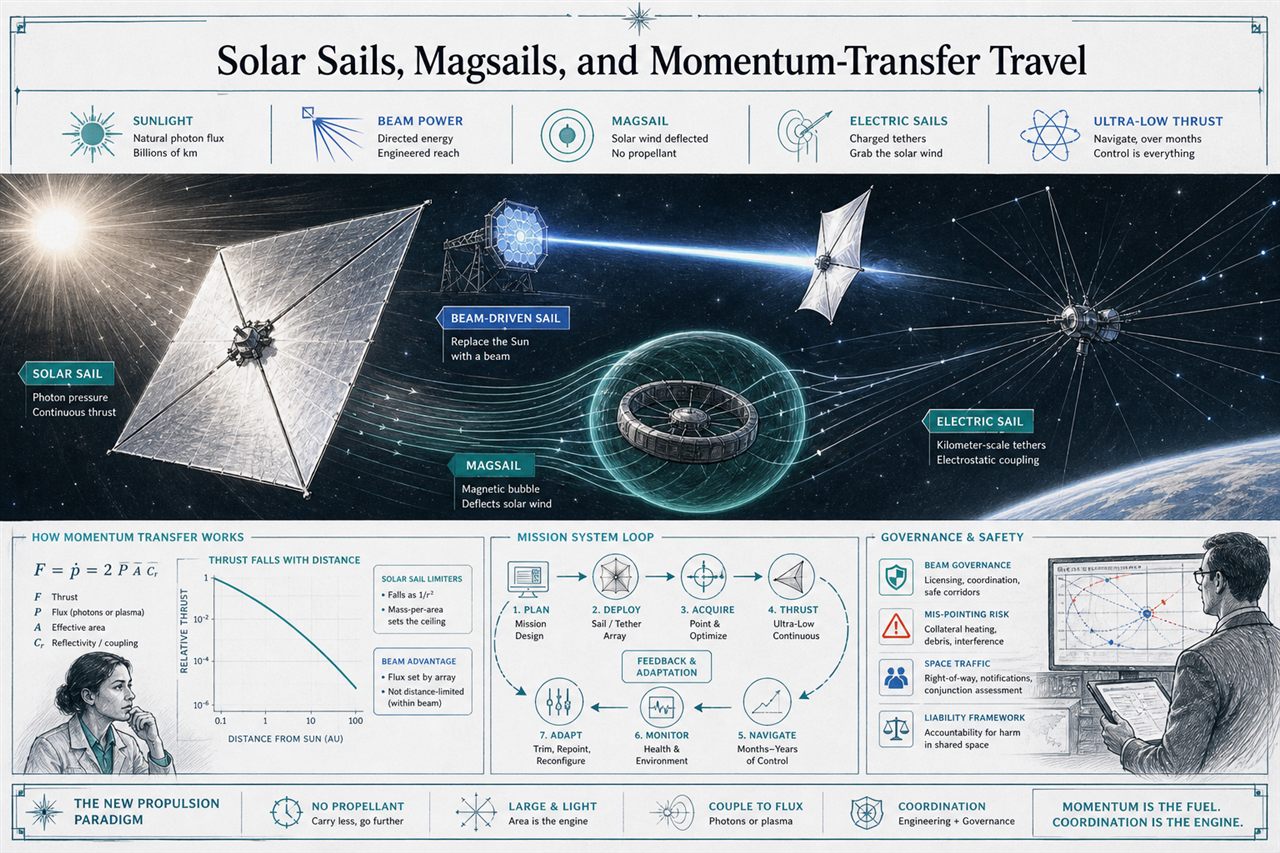
Momentum-transfer travel uses external momentum sources—sunlight, directed beams, or solar-wind plasma—to accelerate or brake spacecraft without carrying large reaction mass, but performance is limited by flux dilution, sail areal density, field/plasma coupling, and long-duration navigation control. Solar sails have small-spacecraft flight heritage and near-term value for small deep-space payloads and orbit energy management. Beam-driven sail propulsion remains at concept and subsystem experimentation, with no mission-class cruise demonstrated. Magsail and electric-sail approaches are analytically grounded yet unflown as primary propulsion. Practical constraints include deployable scaling, membrane/tether durability, flexible-structure stability, low-thrust guidance, and governance for beam safety, traffic interaction, and liability.
Chapter 121. In-Space Manufacturing, Refueling, and Satellite Servicing
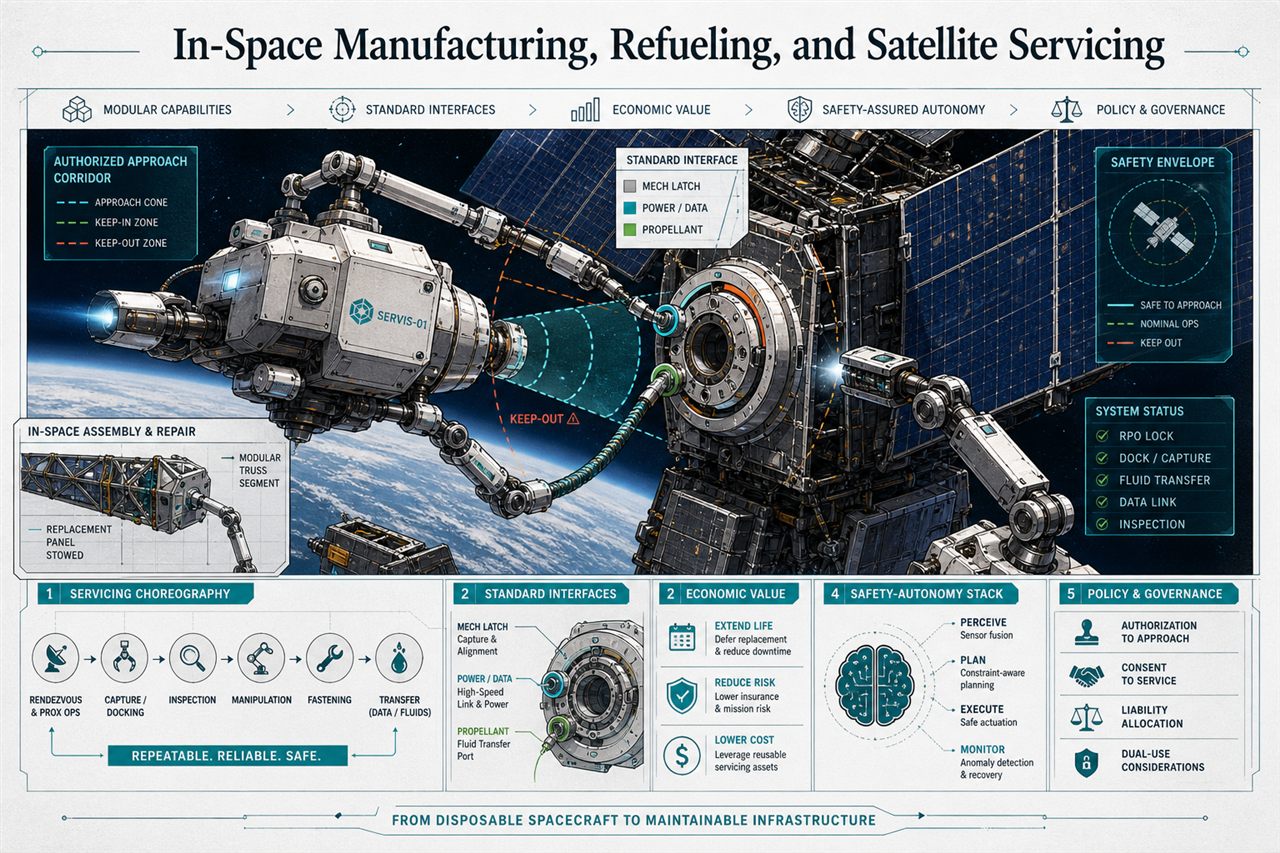
ISAM turns satellites from disposable hardware into maintainable infrastructure by combining rendezvous/proximity operations, capture or docking, robotic manipulation, inspection, fastening, and limited data or fluid transfer under safety-assured autonomy and standardized interfaces. As of 2026 it is best understood as a stack of proven but not yet industrialized primitives, not a high-throughput orbital factory. Near-term economics are clearest for high-value, long-lived satellites, especially GEO, where downtime, insurance, and replacement cadence drive the business case. Scale is gated by nonstandard interfaces and by policy gaps on approach authorization, consent, liability, and dual-use norms.
Chapter 122. Lunar Industrialization and the Cislunar Economy
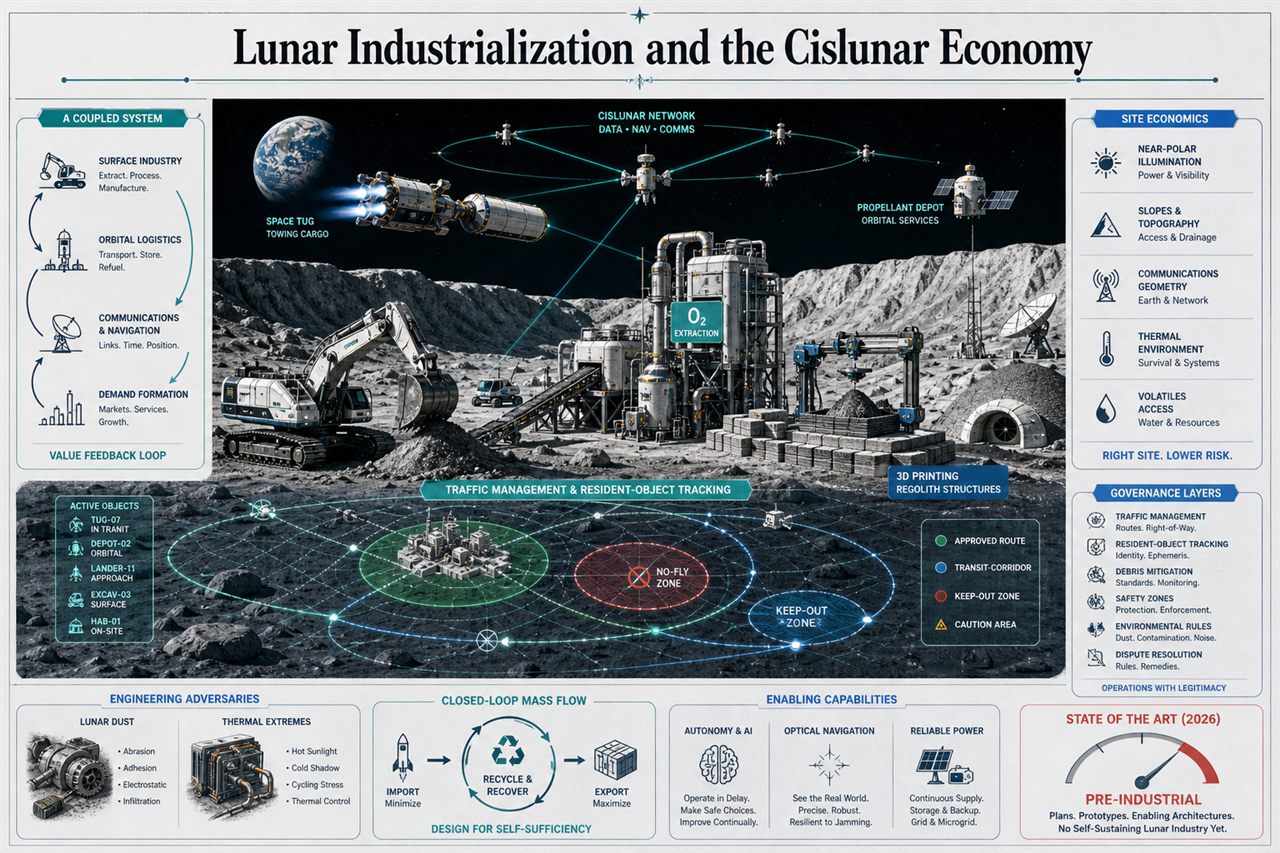
Lunar industrialization is still pre-industrial as of 2026: much is known about resources and architectures, but not how to sustain closed-loop production under high transport costs, power and thermal constraints, dust abrasion, and autonomy delays. The lunar and cislunar economies must be designed as one coupled system linking surface extraction to orbital logistics, power, communications, navigation, and traffic management. Feedstocks include volatiles, oxygen-bearing regolith, metals, and construction materials, with site selection directly shaping unit economics. Practical priorities are reusable transport and tugs, dust- and thermal-resilient operations, cislunar constellations and resident-object tracking, and enforceable governance, provenance, and environmental rules.
Chapter 123. Mars Settlement and Independent Off-World Civilization
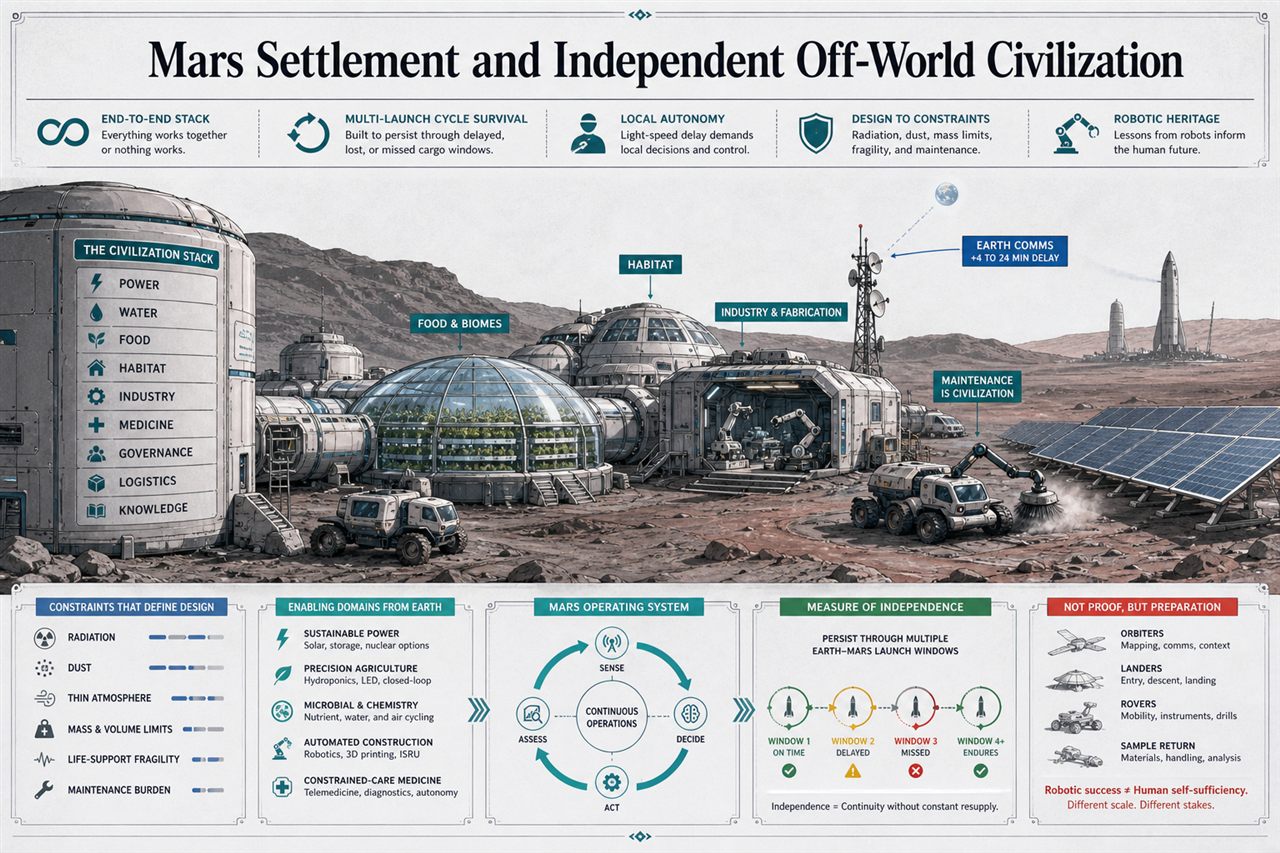
No humans have landed on Mars, so settlement planning must rely on robotic missions, Earth-based simulations, terrestrial analogs, and human-spaceflight experience outside Martian conditions. Missions including Mars Science Laboratory, Perseverance, InSight, MAVEN, and Sample Analysis at Mars anchor practical knowledge about geology, atmosphere and volatile evolution, landing and surface operations, and instrument performance. A core strategic insight is to treat crewed Mars activity as an integrated system—launch, transit, habitat, power, logistics, ascent, communications, and mission control—rather than a single-vehicle challenge.
Chapter 124. The Asteroid Belt and the Resource Economy of the Outer System
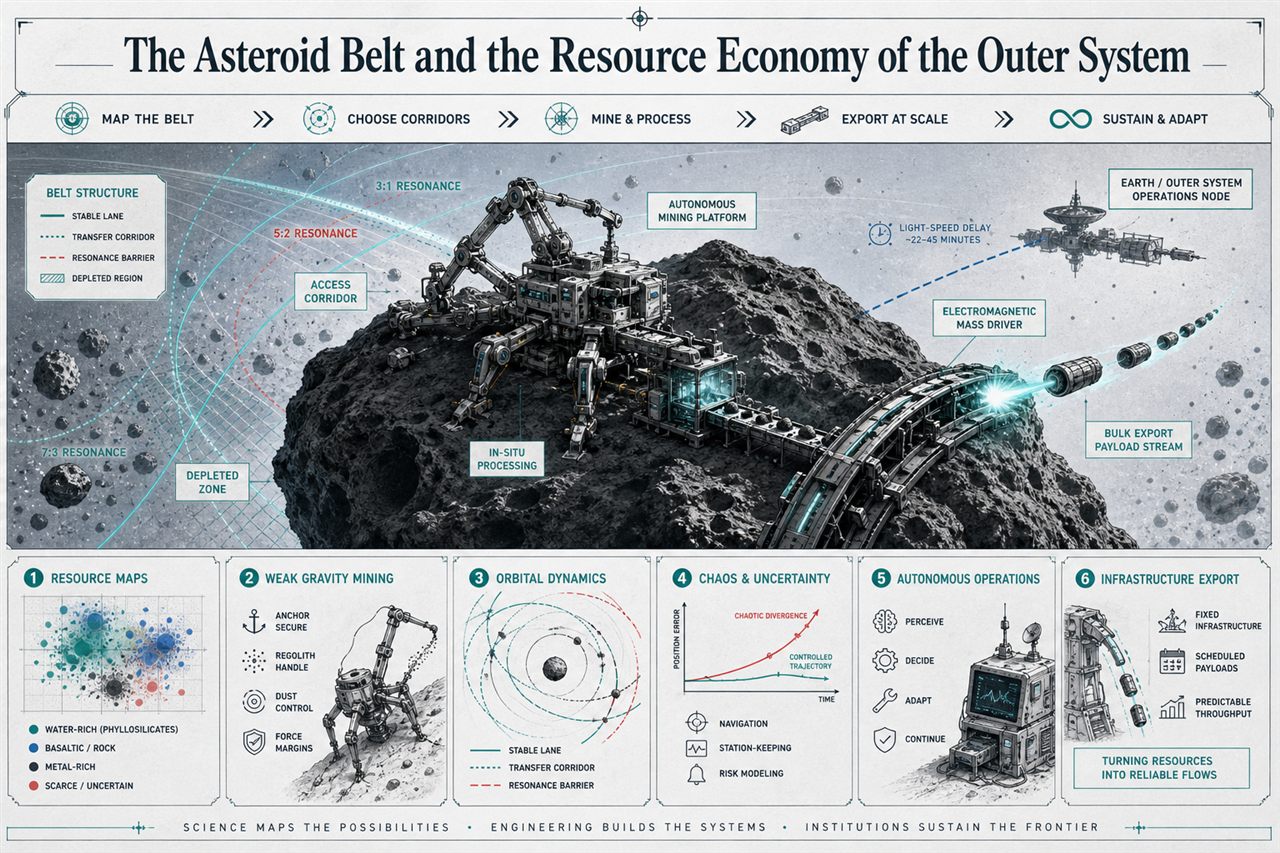
Asteroid-belt resources remain a science-and-architecture problem, not a proven mining industry as of 2026: composition and orbital dynamics are well evidenced, while production-scale extraction is not. Spectral work maps hydrated/phyllosilicate-bearing bodies and basaltic material, implying uneven distributions of volatiles and silicates and the need for target-specific prospecting. Dynamical results on resonances, depletion, and diffusive chaos make stability, transfer-path selection, and residence-time risk central design constraints. Migration and source-timing studies inform provenance and inventory models. A 2026 electromagnetic mass-driver concept reframes bulk logistics around fixed infrastructure and launch-control rather than propellant supply alone.
Chapter 125. The Outer Planets, Icy Moons, and Beyond Jupiter
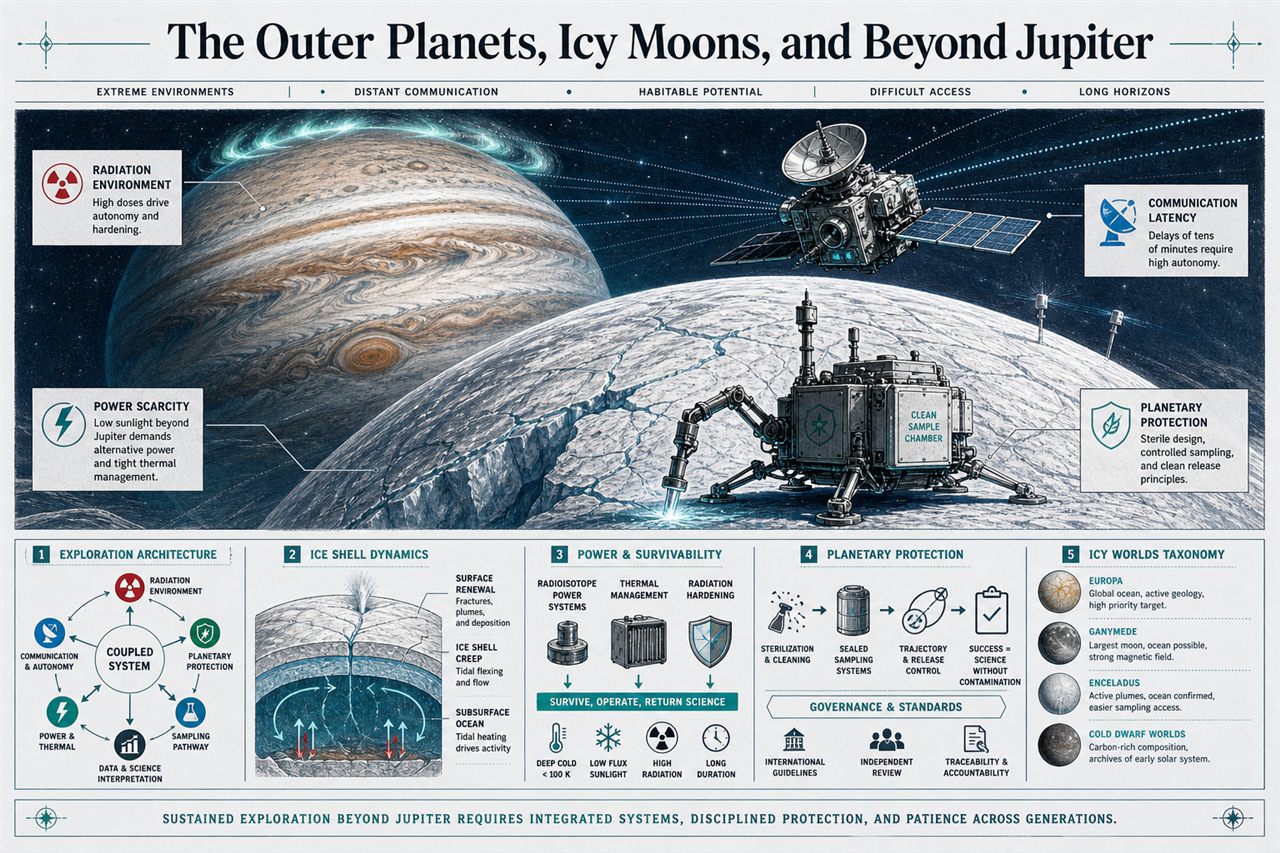
Sustained operations beyond Jupiter depend on overcoming radiation dose, low solar flux, long latency, thermal extremes, ice-shell mechanics, and strict planetary-protection constraints, with crewed missions contingent on major gains in power, autonomy, and radiation hardening. As of 2026, outer-planet work is still led by remote sensing, flybys, and orbital reconnaissance rather than persistent surface or subsurface activity. Scientific yield hinges on architecture choices: power and autonomy budgets, contamination-controlled sampling paths, and data interpretation pipelines. Key interpretive frameworks emphasize ice creep and tidal forcing, irradiation-driven chemistry, and carbon-rich composition models that reshape expectations for volatile inventories, resource gradients, and habitability across icy moons and dwarf planets.
Chapter 126. Ocean Worlds and Subsurface-Sea Exploration
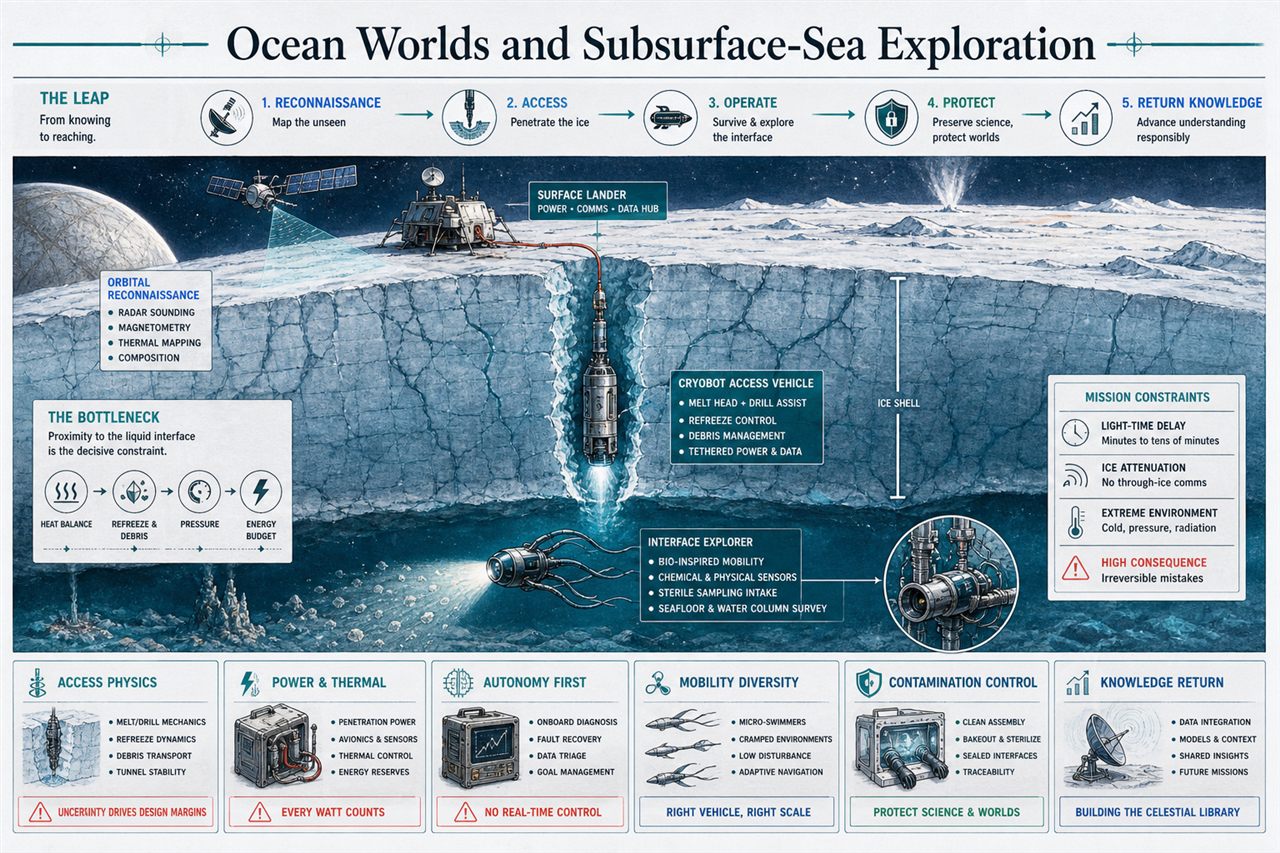
Ocean-world exploration aims to detect and operate in oceans sealed beneath ice, where penetration physics, tight power and thermal budgets, communication delay, and contamination control jointly dominate design. As of 2026, no spacecraft has penetrated an extraterrestrial ice shell; progress relies on orbital and flyby inference, with Europa a near-term priority anchored by the Europa Clipper reconnaissance program. The main bottleneck is reaching the liquid interface safely and sterilely, not individual sensor maturity, so radar, magnetometry, thermal mapping, and compositional data must narrow targets before any access attempt.
Chapter 127. Orbital Habitats, O'Neill Cylinders, and Engineered Living Worlds
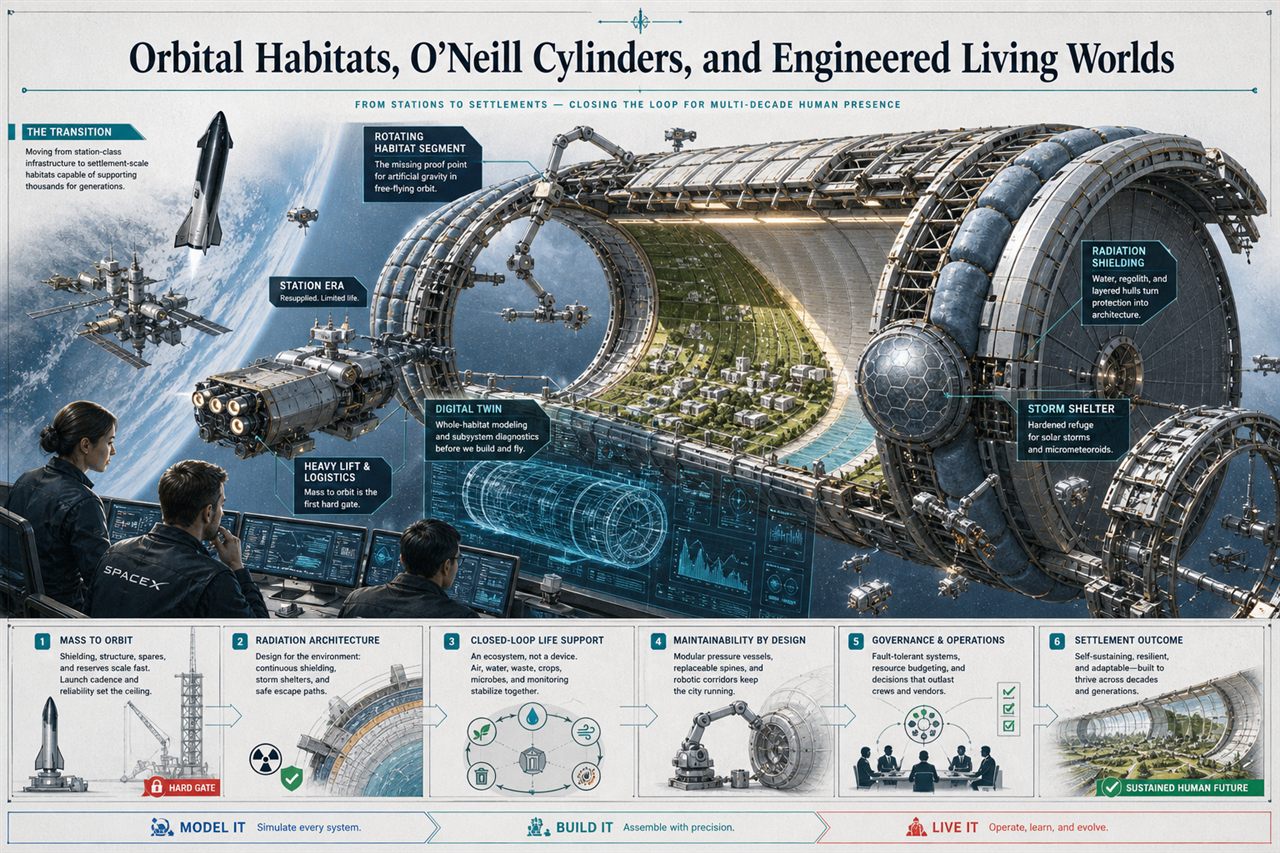
Orbital habitats and O’Neill-cylinder-class settlements aim to move from resupplied, non-rotating stations to multi-year, rotating, high-reliability communities, stressing mass-to-orbit logistics, radiation shielding, life-support closure, maintainability, and governance. As of 2026, no crewed free-flying rotating habitat has flown; whole-habitat digital-twin modeling is becoming practical but lacks end-to-end validation for closed-loop living. Enablers exist but are not yet proven as an integrated in-orbit “settlement stack”: onboard diagnostics, continuous monitoring, and human physiology simulation for artificial gravity. Practical priorities are certification-grade verification regimes, medical autonomy, and sealed-environment toxicology discipline.
Chapter 128. Stellar Megastructures and Dyson-Class Engineering
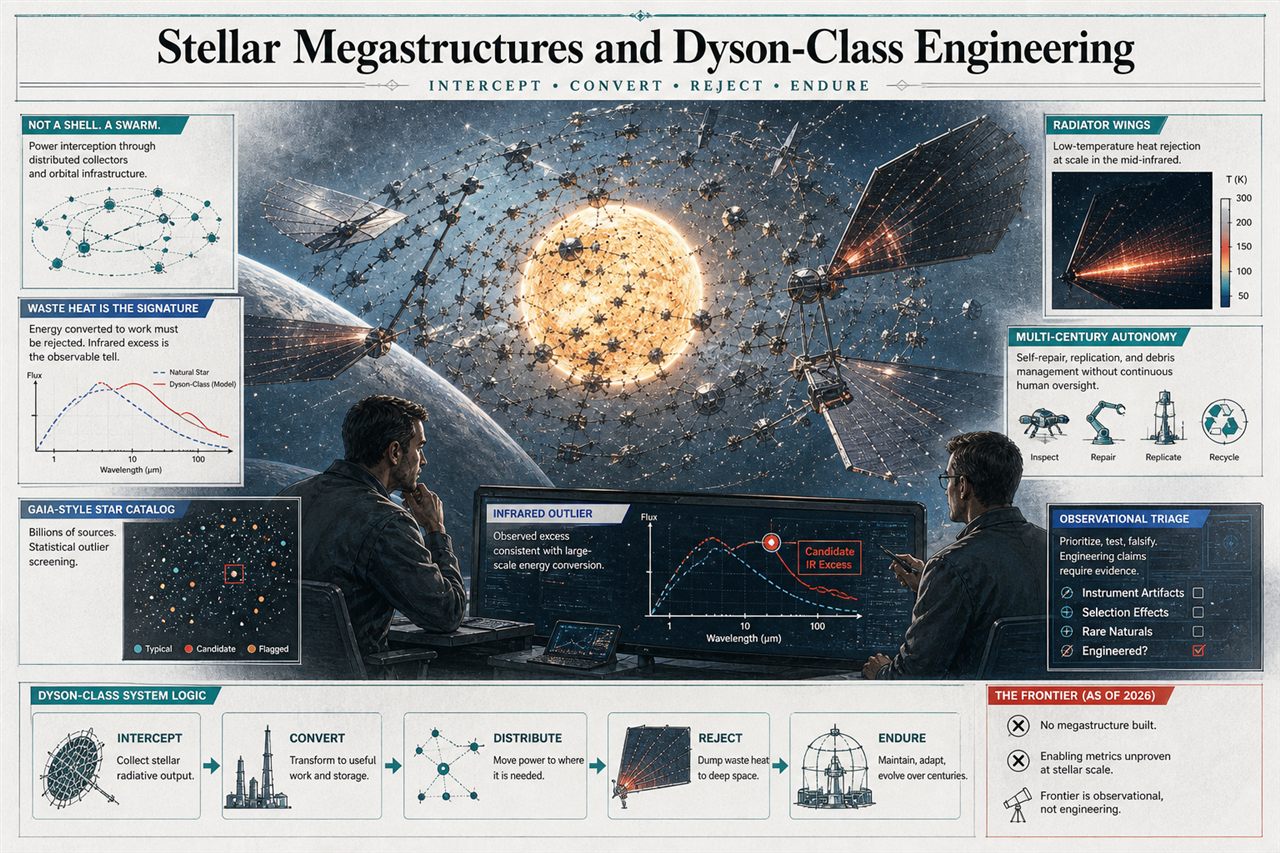
Dyson-class engineering means capturing a star’s energy with vast orbital swarms and then dumping the waste heat, demanding autonomous maintenance, extreme material throughput, and coordination despite light-minute to light-hour latencies. As of 2026, no stellar megastructure exists; the idea remains an observational hypothesis rooted in Freeman Dyson’s 1960 proposal to look for infrared excess. What is mature is the search infrastructure: Gaia Data Release 3 (2022) provides astrometric and photometric baselines on about 1.8 billion stars, with Data Release 4 scheduled for mid-2026, and Astropy v5.0+ enables reproducible pipelines.
Chapter 129. Terraforming, Para-Terraforming, and Planetary Engineering
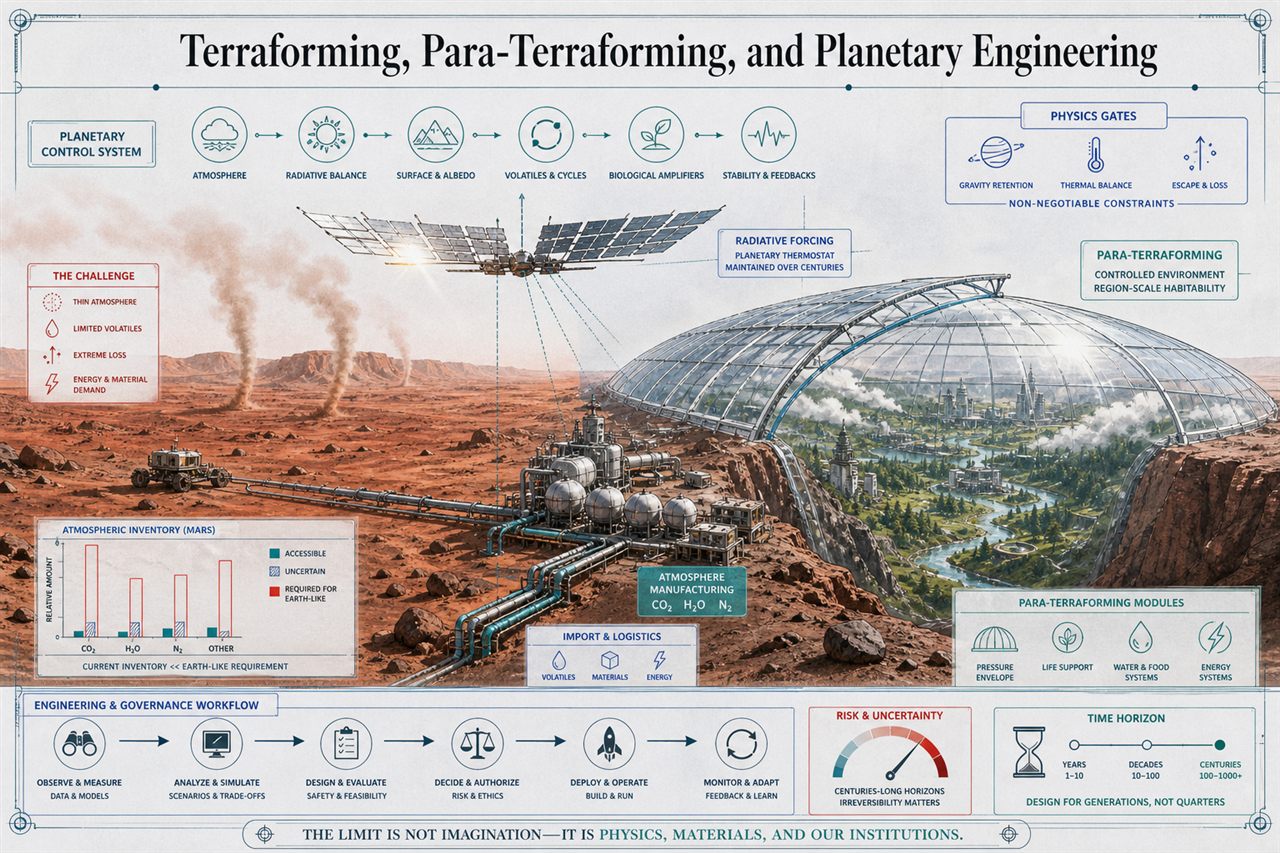
Terraforming is treated as deliberate, multi-century planetary systems engineering that must manage atmosphere, surface chemistry, radiative forcing, and biogeochemical cycles under hard constraints: limited accessible volatiles, atmospheric escape under low gravity, stellar energy input, and the ability to govern interventions over generations. As of 2026, the field is dominated by models and conceptual toolkits rather than deployment, with Mars as the primary reference case and feasibility repeatedly bounded by how much CO₂, H₂O, and nitrogen can be liberated in situ versus imported at immense scale. Regional “para-terraforming” via enclosed, controlled habitats appears materially nearer-term than global open-air transformation. Biological approaches are viewed as slow and conditional, typically requiring prior physical and chemical preconditioning. Practical takeaways center on rigorous volatile accounting, logistics architectures for sustained mass import, and stability/control of long-lived engineered climates.
Chapter 130. Pressure-Stratified Worlds and Layered-Atmosphere Engineering
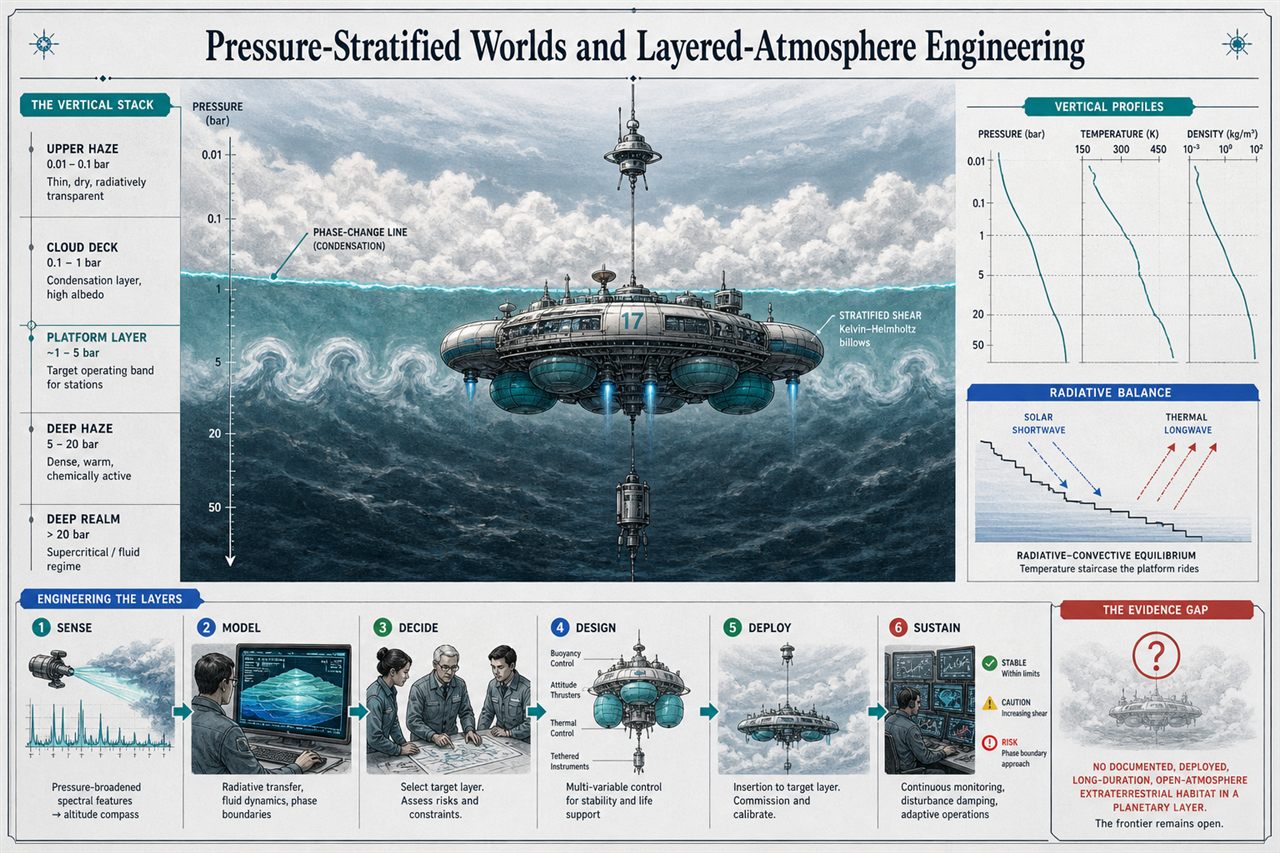
Persistent operations in strongly layered atmospheres hinge on accurately measuring and managing altitude-dependent pressure, temperature, density, and composition, while respecting radiative transfer limits, stratified-flow stability, and phase-change boundaries. The strongest foundations are analytic: radiative–convective equilibrium for vertical structure, shear-layer instability tools to bound mixing and turbulence near interfaces, and two-phase condensation models to manage pressure drops and thermal cycling in ducts and intakes. Pressure-induced spectral behavior supports remote composition inference in dense regimes, and acoustic/gravity-wave propagation offers another sensing channel. No cited evidence supports a deployed long-duration extraterrestrial open-atmosphere habitat, keeping near-term plans primarily model- and analog-driven.
Chapter 131. Wormhole Physics and Theoretical Traversable Geometries
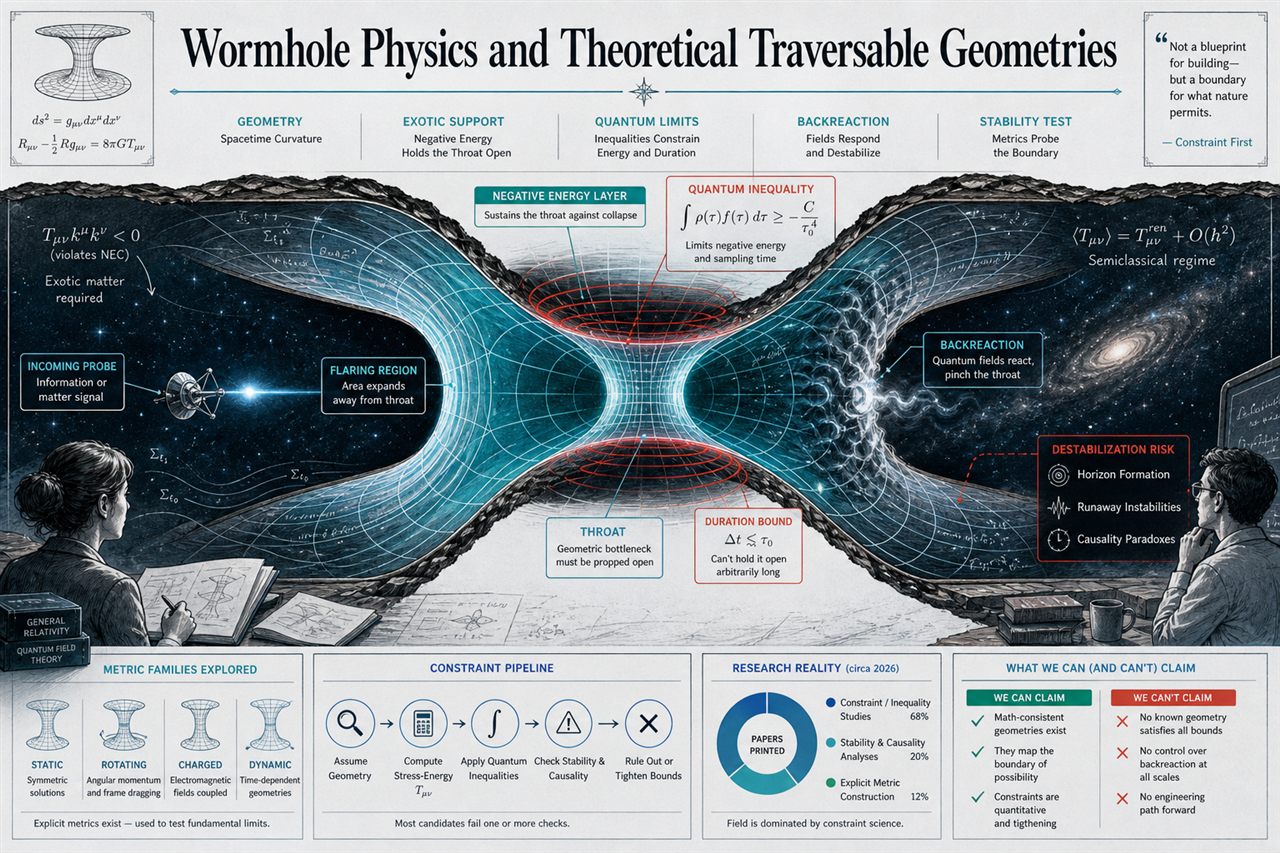
Traversable wormholes remain purely theoretical as of mid-2026: none has been observed or created, and the central result is that quantum-inequality bounds from quantum field theory severely limit the negative-energy densities and fluxes needed to hold a macroscopic throat open. Researchers continue to publish explicit traversable metrics—static, dynamic, charged, rotating, and lower-dimensional—and probe stability, causality, and semiclassical backreaction, but no construction simultaneously satisfies quantum-inequality limits, stays stable under realistic perturbations, and maintains bounded backreaction for a meaningful traversal time. Treat proposed geometries as stress-tests of fundamental physics, not engineering roadmaps.
Chapter 132. Engineered Transit Corridors and Gate-Network Concepts
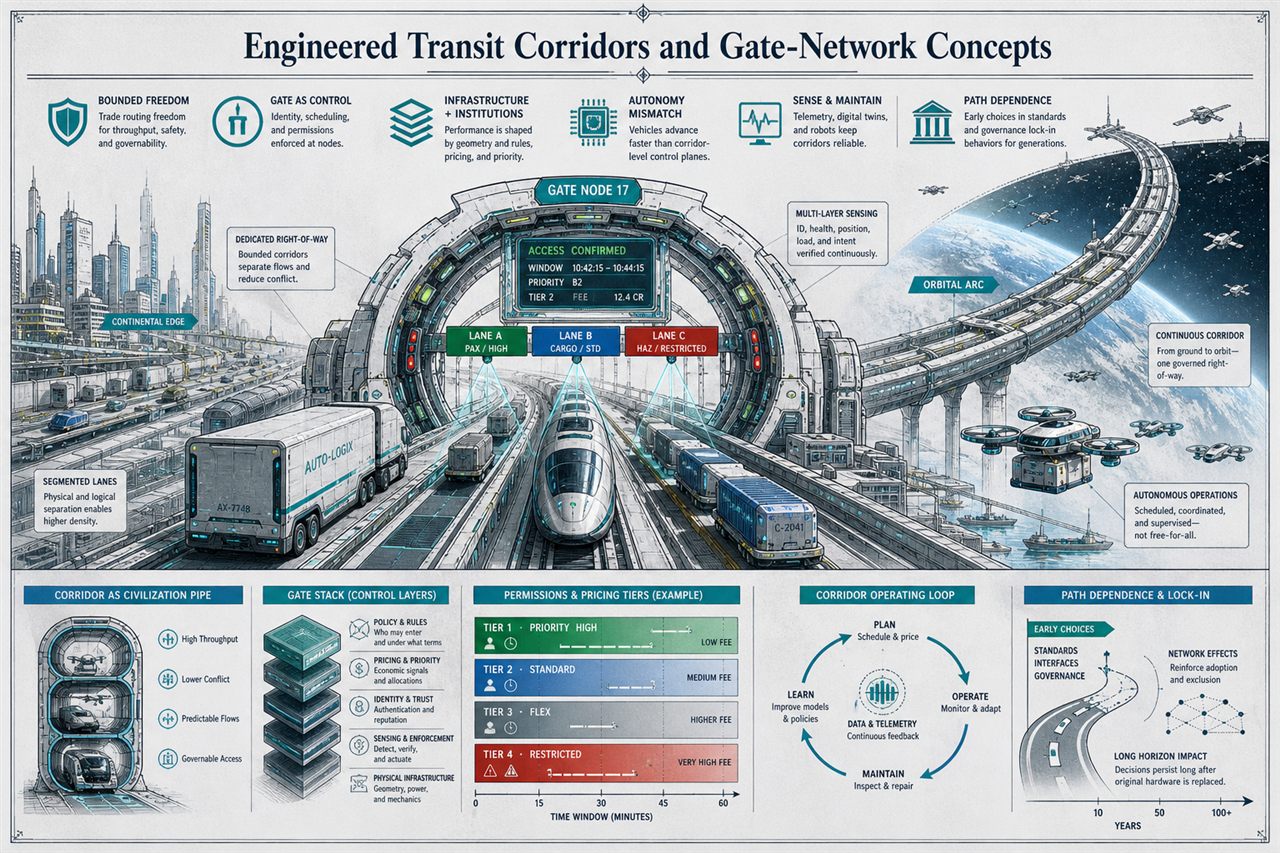
Engineered transit corridors aim to create bounded, high-throughput, governable pathways between distant nodes when ad hoc point-to-point travel becomes too slow, costly, or coordination-heavy. As of 2026, no portal-like “gate” transport exists; the best analogs are access-controlled corridors such as rail blocks, air routes, shipping lanes, and tunnels where rules and pricing can matter more than added capacity. The strategic risk is lock-in: early interfaces and governance can persist for decades. Practical priorities include investing in corridor-scale sensing and maintenance automation via IoT and structural health monitoring, building accountable autonomy with explainable AI, and optimizing for safety, emissions, and reliability—not just throughput.
Chapter 133. Alcubierre, Krasnikov, and the Far Edge of Permitted Physics

Alcubierre and Krasnikov metrics are used as stress tests of general relativity’s limits, asking whether engineered spacetime could yield effective faster-than-light travel without local superluminal motion, while surviving semiclassical quantum constraints. As of 2026, there is no credible engineering path to any test article; progress is primarily analytic. Milestones include the 1997 Krasnikov tube, 2017’s “Warp Drive Basics” synthesis, 2019 energy-reduction parameter studies, 2023 curvature-invariant mapping, and 2025 work highlighting verification challenges in AI-assisted tensor algebra. Practical takeaways: treat claims as mathematical, focus diligence on energy-condition violations, curvature spikes, and dynamical stability.
Chapter 134. Why Faster-Than-Light Travel Probably Cannot Be Engineered

Faster-than-light travel remains a theoretical frontier because any net superluminal transport or signaling tends to clash with relativistic causality or demands unphysical stress-energy. As of 2026, no experiment has shown superluminal matter transport, controllable spacetime shortcuts, or FTL-capable propulsion. The main proposals—warp-like metrics such as the 1994 Alcubierre solution and later exotic geometries—are mathematical constructs with no credible “metric-to-machine” pathway. Recurring blockers are extreme energy requirements, stability and constructability limits, and the near-equivalence between effective FTL and time-travel paradoxes. Practical takeaway: treat FTL as non-engineering-relevant absent testable, causal, energetically plausible lab steps.
Chapter 135. Interstellar Probes and Beamed-Propulsion Systems
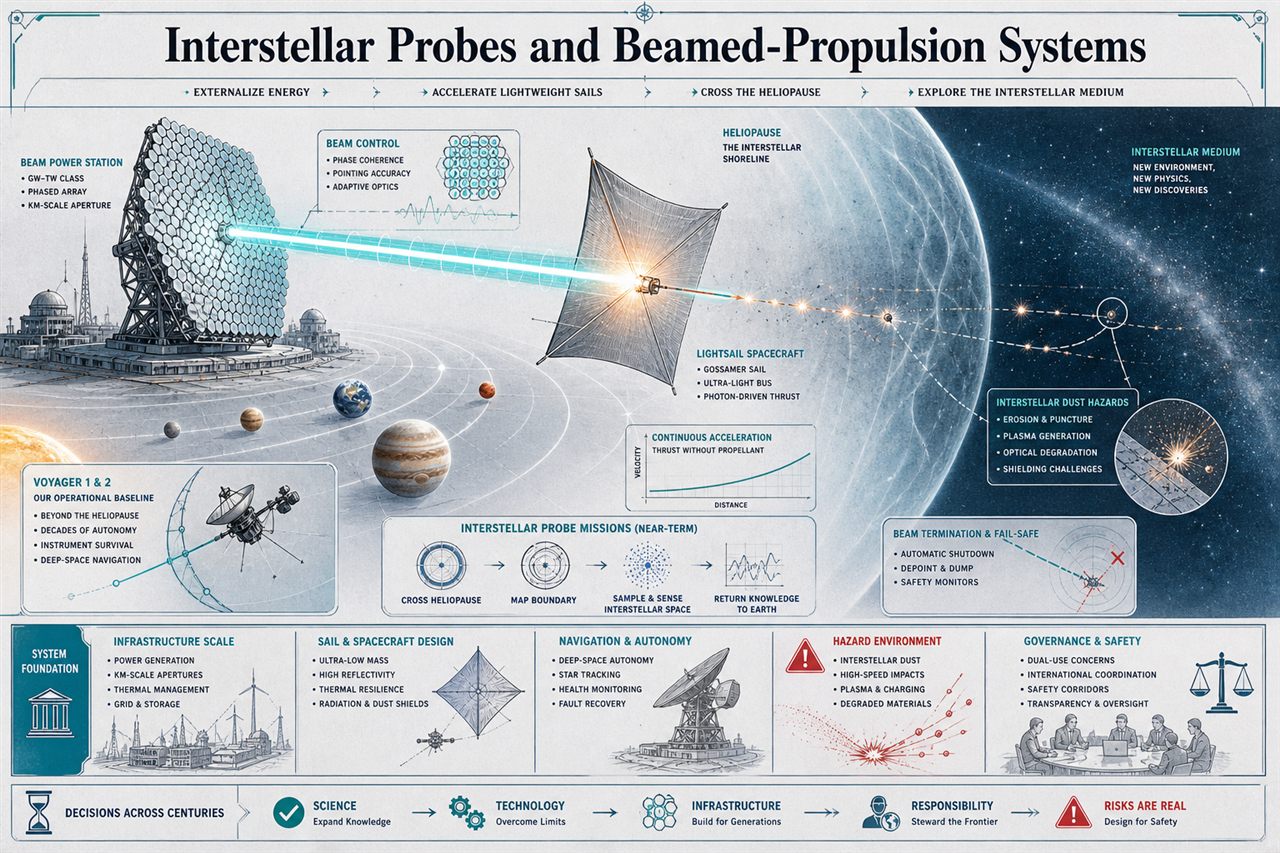
Interstellar probes can sidestep rocket-equation limits by using externally supplied directed energy or photon momentum to accelerate uncrewed craft, often sailcraft, shifting constraints from onboard propellant to power generation, apertures, beam control, sail survivability, and governance of high-power infrastructure. As of 2026, Voyager 1 and 2 remain the only spacecraft operating in interstellar space, anchoring expectations for longevity and operations beyond the heliopause, while Interstellar Probe concepts focus on heliospheric boundary and local interstellar medium targets. Practical design must treat interstellar dust as both science payload and major hazard. Speculative faster-than-light or propellantless ideas remain boundary references, not an engineering path.
Chapter 136. Generation Ships, Embryo Arks, and Slow Interstellar Settlement
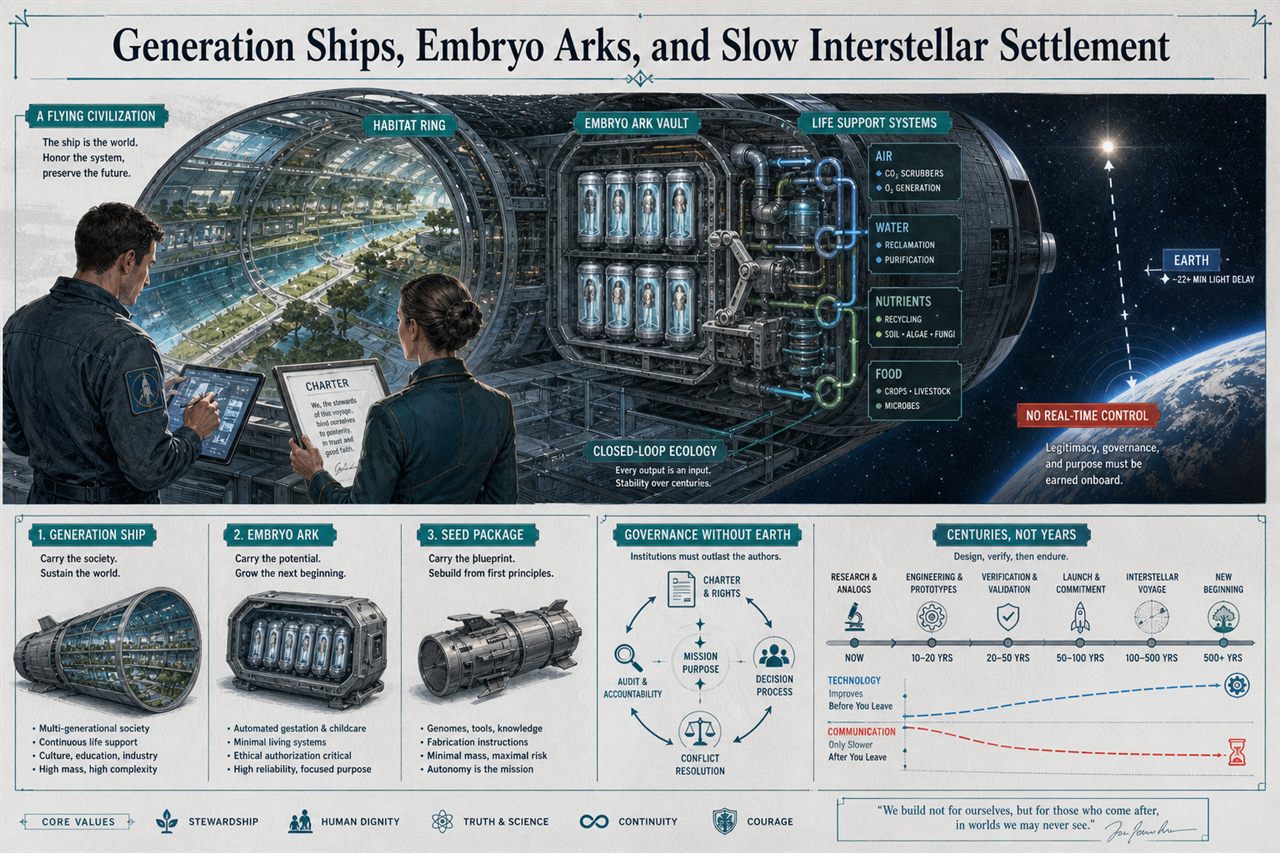
Delay-tolerant interstellar settlement hinges on three coupled problems: keeping complex systems reliable for centuries, sustaining truly closed-loop life support, and maintaining legitimate governance when communication is light-speed delayed. As of 2026, no generation ship or embryo ark is operational; key enablers like heavy-lift launch remain reliability-limited, underscored by the 2023 Starship integrated flight test ending early. Practical guidance comes from terrestrial and maritime analogs: mature reverse-osmosis recycling, standardized load-history and fatigue methods for lifetime modeling, autonomy and reduced-crew operations patterns, hybrid-electric power-architecture lessons, and industrial standards that improve maintainability.
Chapter 137. Light-Speed Limits, Relativity, and the Reach of Civilization
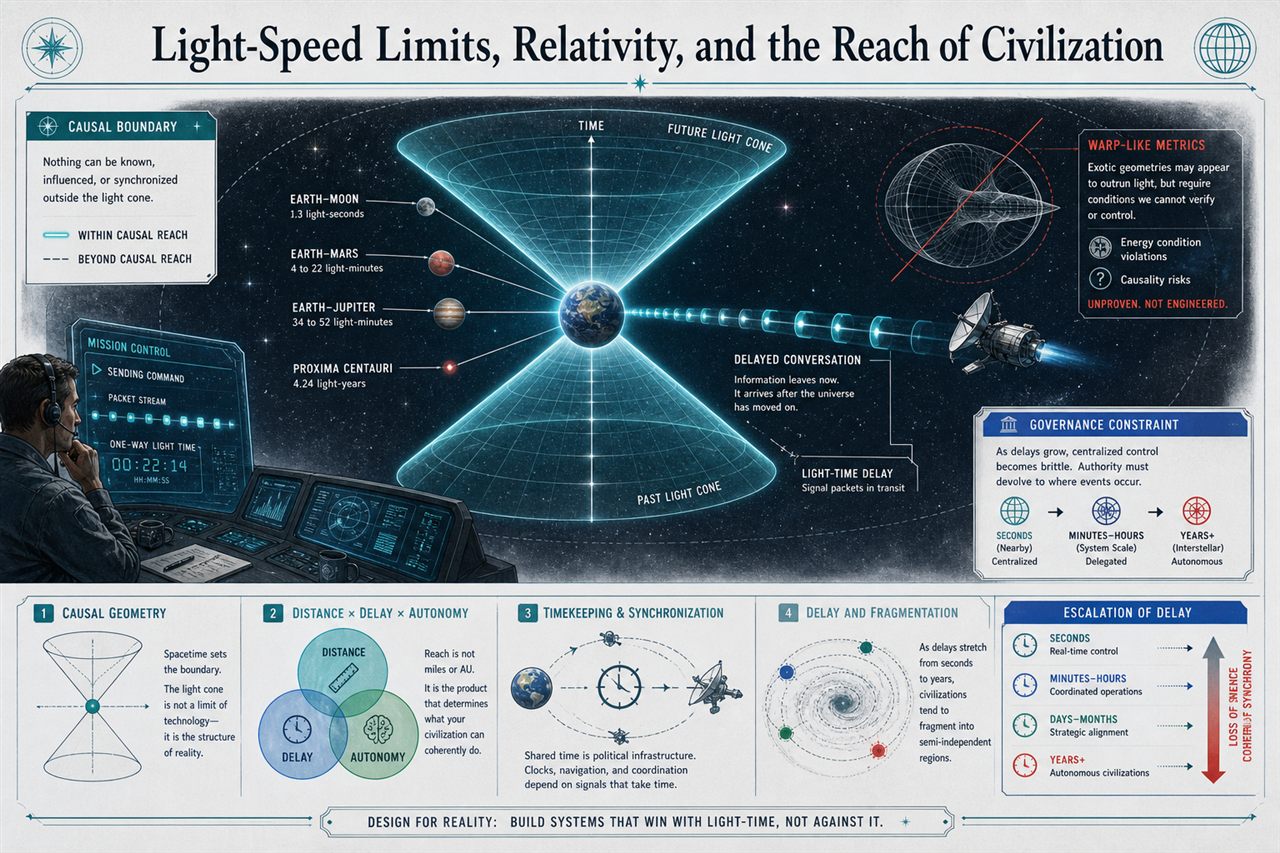
Light-speed limits define the causal cone for matter, energy, and information, so distance translates directly into delay, weakening command, telemetry, synchronization, and governance as separation grows. As of 2026, no verified experiment shows controllable faster-than-light information transfer, making latency—not speculative FTL—the dominant design constraint for spacefaring systems. General relativity allows mathematically valid “effective superluminal” geometries such as Alcubierre’s 1994 warp metric, but physical realizability remains unvalidated; subsequent work (Low 1999; Huey 2024) probes causality and energy-condition constraints. Practical takeaway: treat reach as distance × delay × autonomy, and design institutions and networks around unavoidable light-time.
Chapter 138. Light-Speed Communication, Delay, and Command-at-Distance
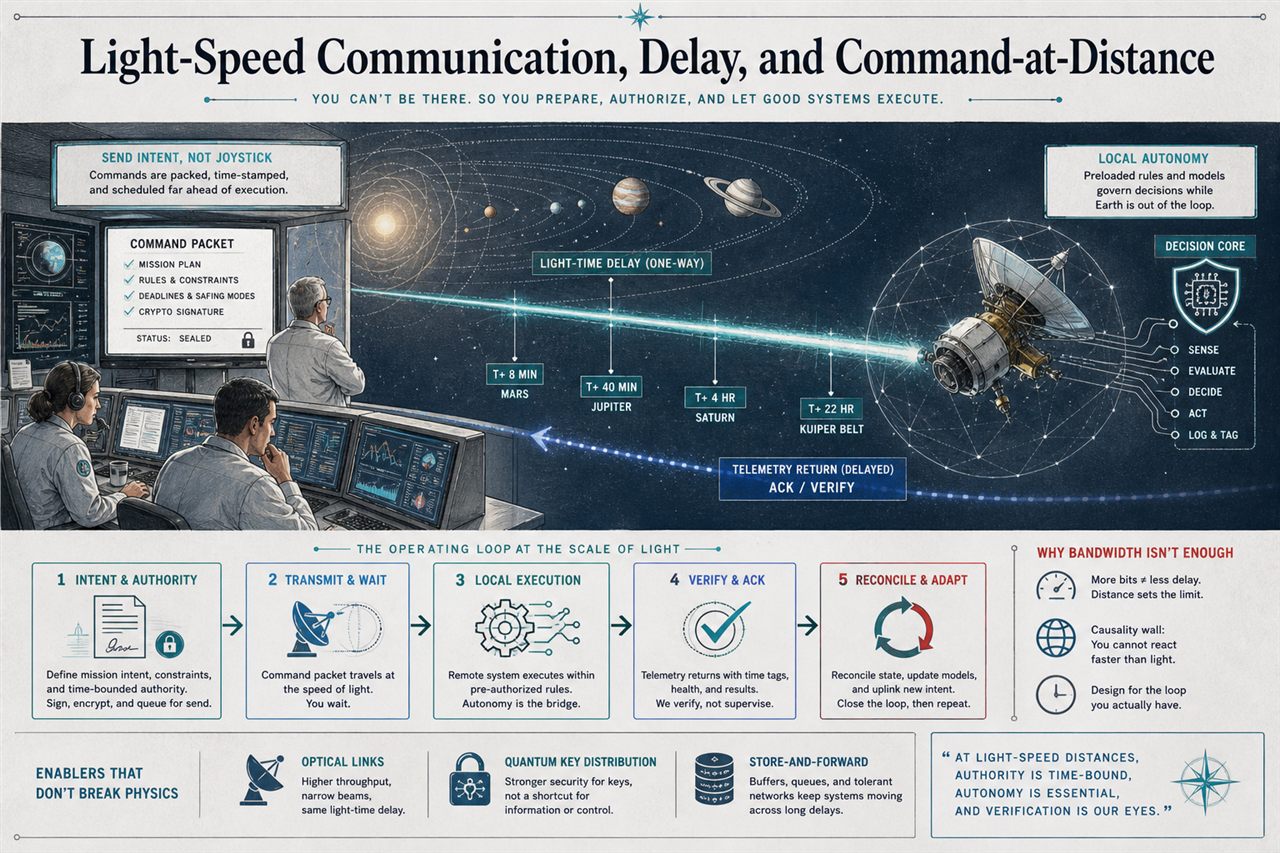
Finite light-time sets a hard ceiling on remote control: more bandwidth and better optics enrich telemetry and resilience but cannot beat causality. Effective command-at-distance therefore shifts from live supervision to scheduled uploads, store-and-forward operations, and procedures built for delayed intervention, as deep-space missions already practice. The core design move is delegating authority to local agents with autonomy, time-bounded instructions, verification, and later reconciliation when updates arrive. Quantum communication can strengthen security and key distribution and may scale via repeaters, yet it still cannot send classical messages faster than light. Similar logic already appears in traffic-priority signaling and latency-shaped financial routing.
Chapter 139. Multi-Stellar Logistics and Inter-System Transit Networks
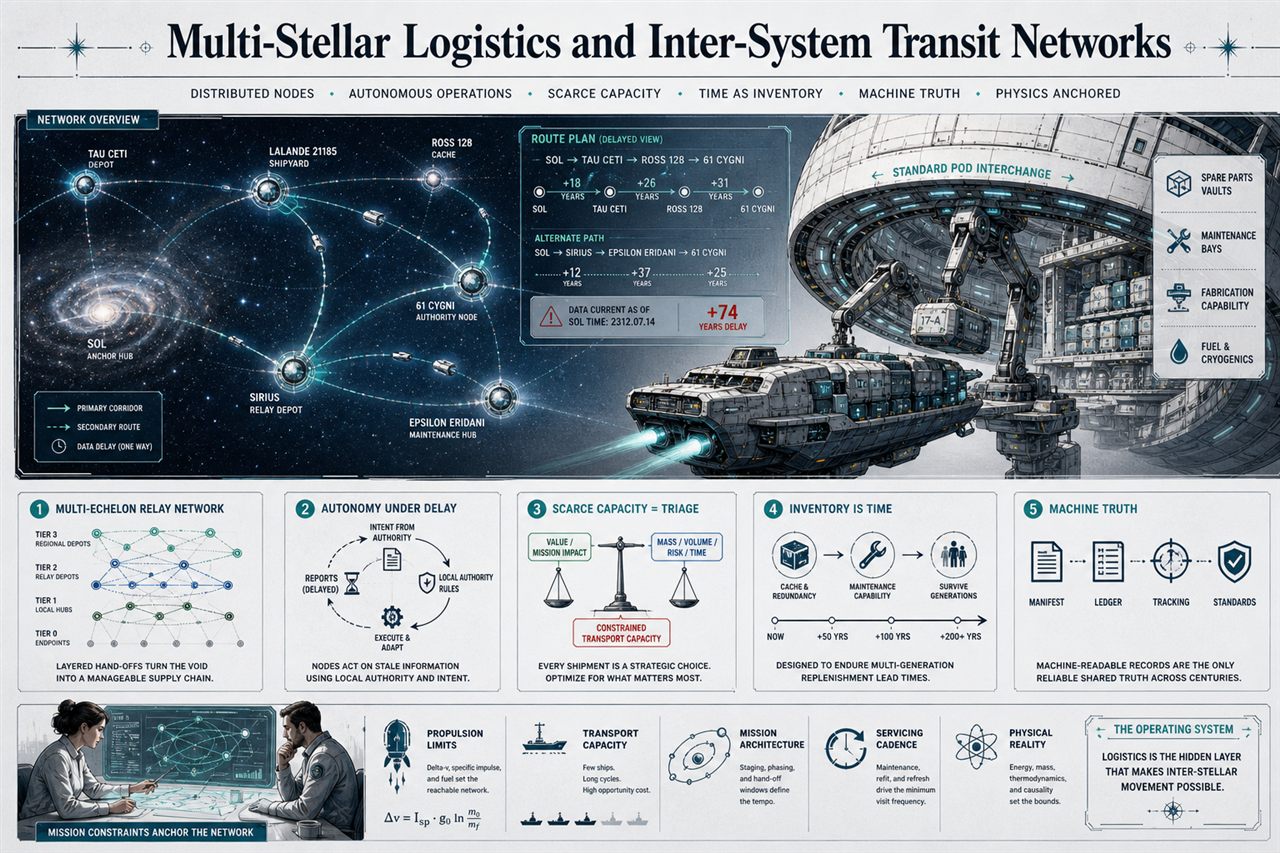
Multi-stellar logistics treats interstellar movement as a governed network problem: routing cargo, probes, crews, spares, and authority across multiple systems despite light-speed delays, multi-decade transits, and near-zero tolerance for failure. As of 2026, no interstellar logistics network exists; operational experience is limited to terrestrial through intra–solar-system missions, where even Mars- and Jupiter-scale delays already make round-trip decision cycles unusable for fault response. Practical foundations are emerging in three areas: disruption-tolerant communications (DTN, Bundle Protocol, Licklider Transmission Protocol) enabling store-and-forward operations; growing autonomy validated by deep-space missions that must execute plans without continuous supervision; and early logistics primitives in Earth orbit such as rendezvous, docking, and life-extension servicing. The near-term takeaway is to invest in interoperable standards, autonomy, and serviceable architectures as prerequisites for any scalable inter-system supply chain.
Chapter 140. Long-Duration Crew Systems and Interstellar Life Support
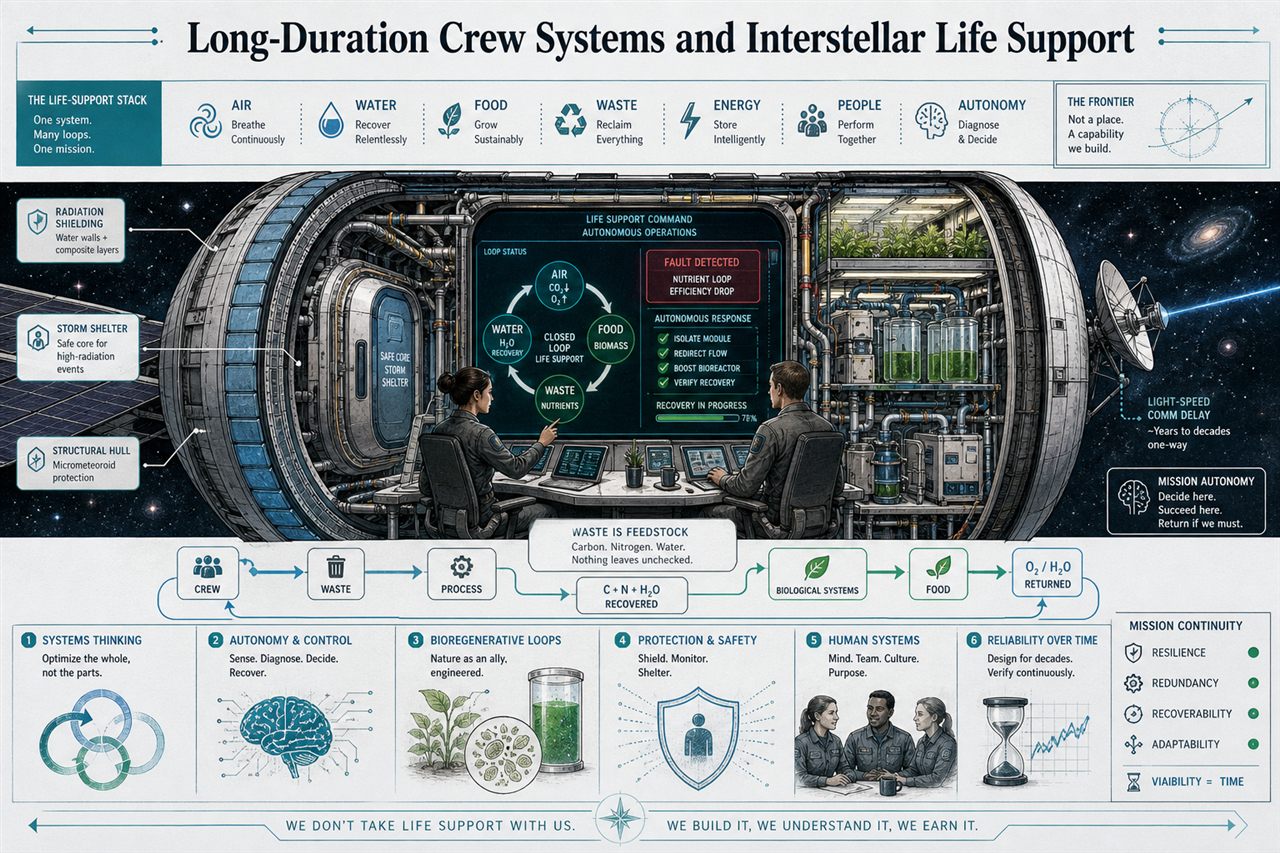
Long-duration crew systems must be engineered as a tightly coupled stack—air, water, food, waste closure, habitats, radiation protection, medical care, psychosocial resilience, and autonomous control—designed for years of operation with minimal resupply, delayed oversight, and cascading-failure risk. By 2026 the field has moved from optimizing isolated subsystems to treating sustainability, crew workload, autonomy, and recovery as integrated design variables. Closed bioregenerative life support exists mainly as analog and research efforts, not as crew-rated, fully closed interstellar-duration systems. Practical takeaways: invest in integration testing, autonomy and fault management, and rigorous selection/training as core life-support requirements.
Chapter 141. First Contact Protocols and Xeno-Encounter Engineering
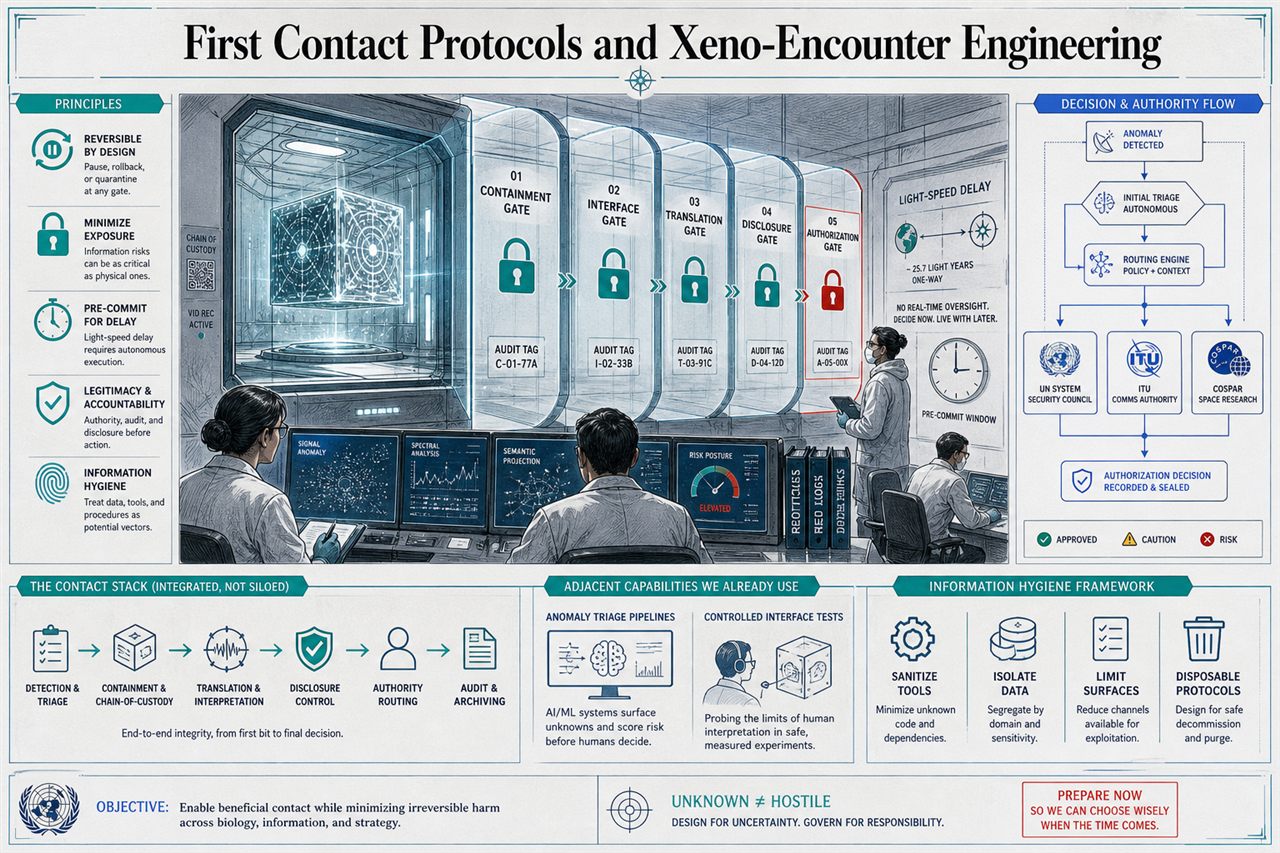
First-contact work is mainly governance and protocol design, because no operational science body has produced a verified, peer-reviewed confirmation of an extraterrestrial intelligence encounter as of 2026. The practical aim is staged, reversible, auditable interaction that limits irreversible biological, informational, and strategic exposure under deep uncertainty and light-speed delay. Useful building blocks already exist—AI anomaly triage, controlled immersion for safe human interpretation, and organizational decision reliability—but they remain fragmented across chain-of-custody, containment, translation, disclosure control, and authority routing. The key takeaway is to pre-commit to legitimacy, escalation restraint, and disclosure procedures before technical “contact stack” engineering becomes binding.
Chapter 142. Boundary Zones, Contact Architectures, and Interface Stations
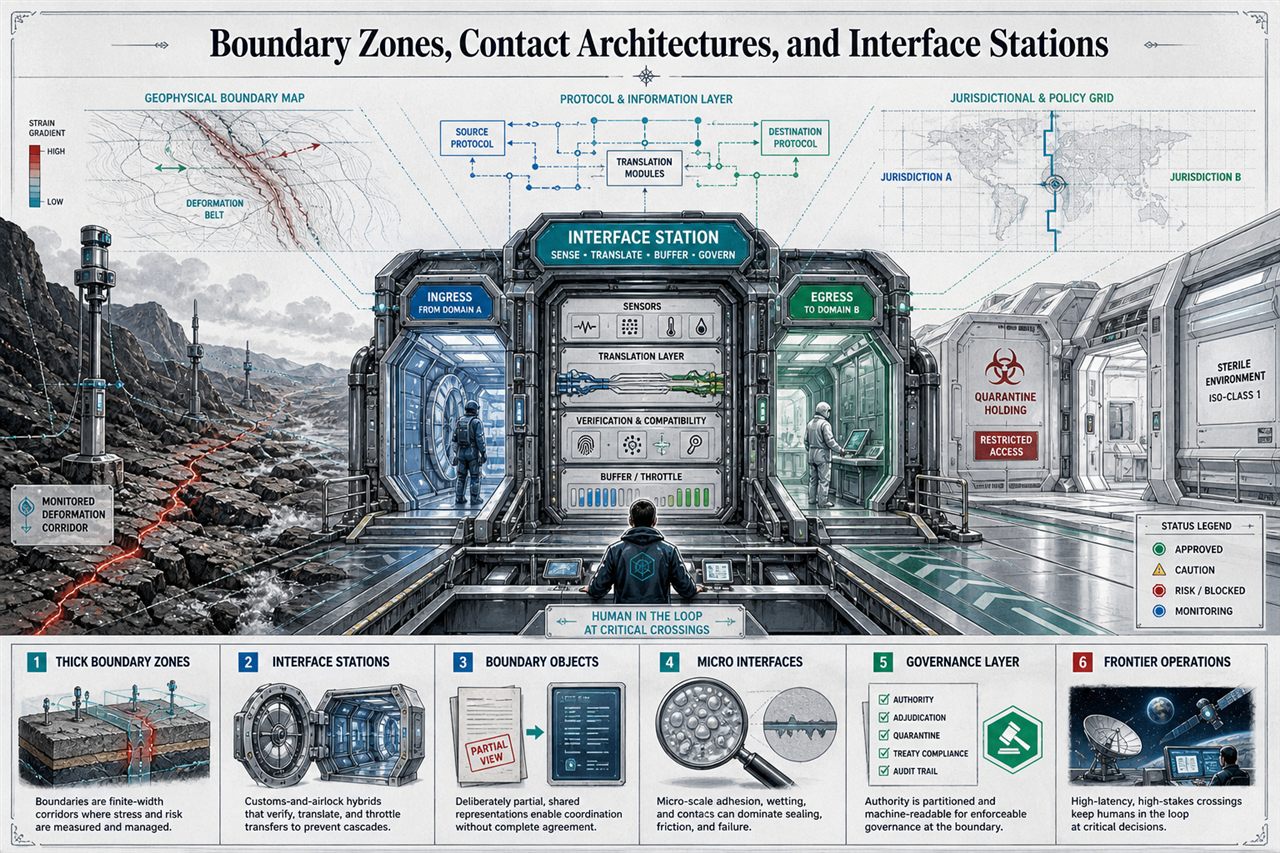
Interface stations are engineered, monitored transition systems that make transfers safe and governable across incompatible physical, informational, jurisdictional, biological, and substrate boundaries. A core insight is that boundaries are usually finite-width zones where strain, meaning, and failure accumulate, so behavior is distributed rather than confined to a clean line. Contact zones and boundary objects enable coordination when groups lack shared incentives or authority, relying on negotiated, partially equivalent representations. Micro-scale interface physics can dominate sealing and failure even when bulk materials are stable. Treat boundary management as a first-class subsystem: sensing, translation, buffering, and explicit authority partitioning, with autonomy still limited in 2026.
Chapter 143. Xeno-Communication and Non-Linguistic Information Exchange
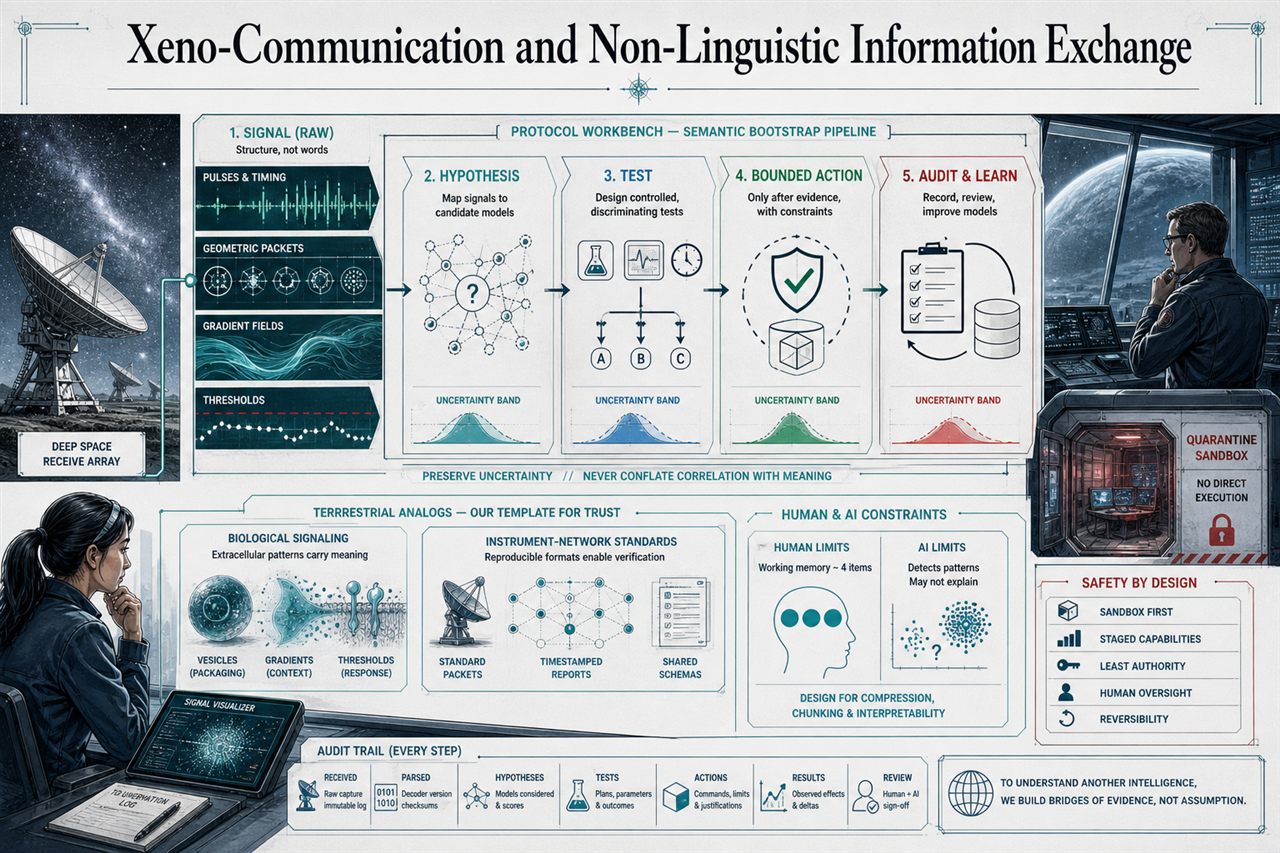
Xeno-communication aims to create semantically testable and behaviorally safe information transfer with non-human intelligences when no shared language, biology, or priors can be assumed. As of 2026, no verified extraterrestrial communication exists; work concentrates on signal search, anomaly triage, and governance. Practical progress comes from terrestrial analogs: biology encodes meaning through context, packaging, gradients, and thresholds, while instrument networks show how standards enable reproducible interpretation. Human working-memory limits and AI interpretability gaps constrain decoding. The core takeaway is to build audited protocol bootstraps that convert signals into hypotheses, controlled tests, and bounded actions while preserving uncertainty.
Chapter 144. The Drake Question - Probability of Encountering Other Intelligence
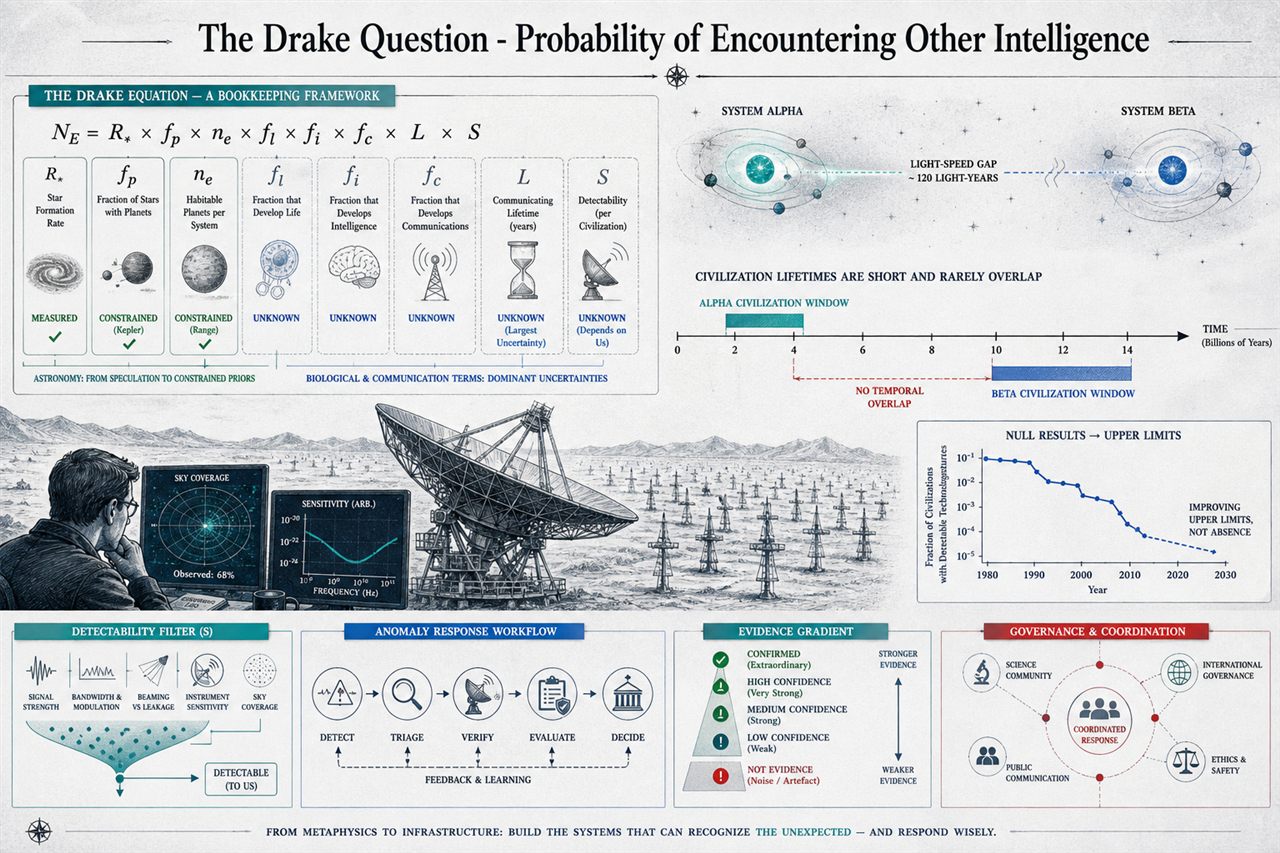
Estimating the chance of encountering other technological intelligence depends less on whether it exists somewhere than on detectability and overlap in time under light-speed delays and finite civilization lifetimes. The Drake equation is best used as bookkeeping to separate astrophysical, biological, and communicative uncertainties, not to compute a single answer; the largest unknowns sit outside astronomy. As of 2026 there is no scientifically confirmed detection or reciprocal contact, so strategy should treat the record as null-result constraints and upper limits. Practical takeaways include defining “encounter” precisely, designing disciplined candidate-signal triage and disclosure procedures, and building governance architectures for ambiguous anomalies.
Chapter 145. Multi-Species and Multi-Substrate Civilizational Coexistence
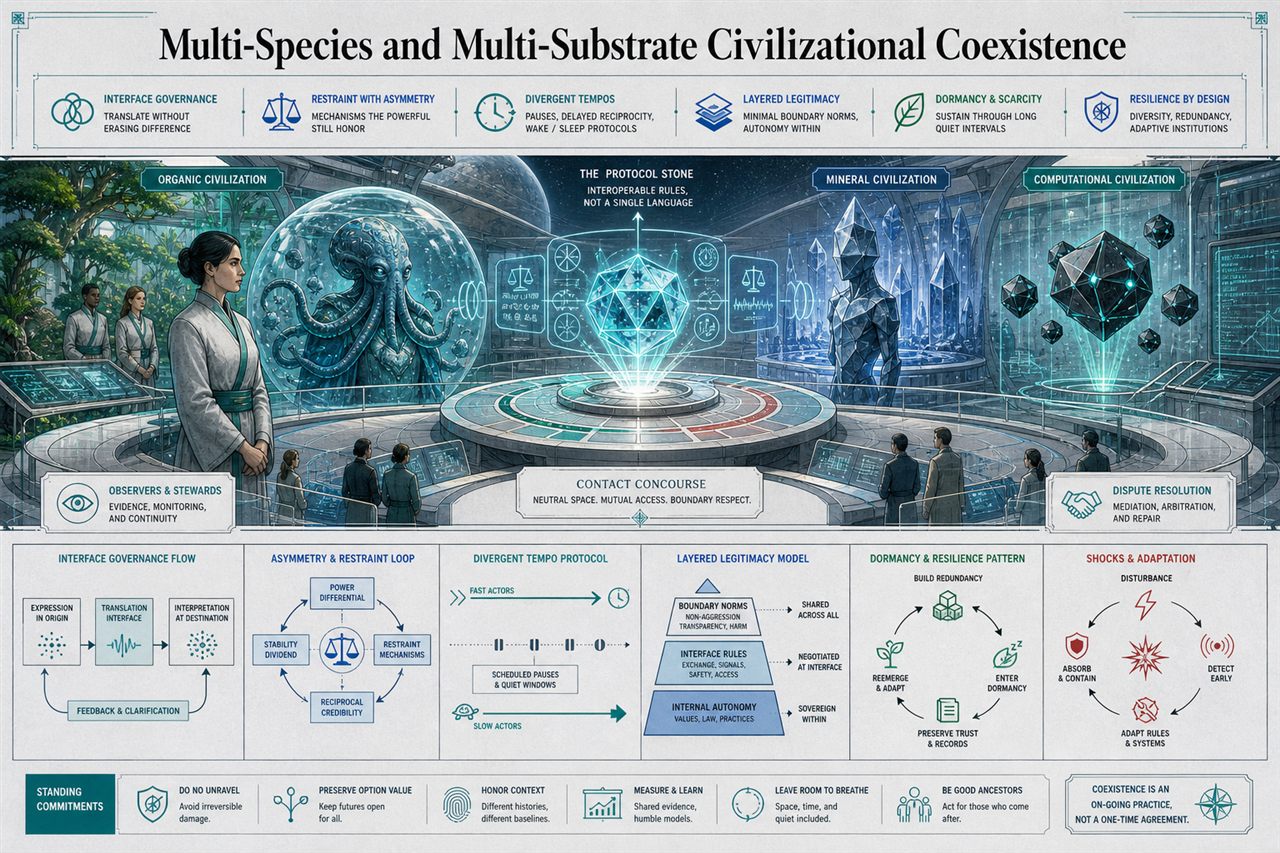
Sustaining coexistence among intelligences with different biologies, cognitive tempos, and substrates is framed as a governance-and-systems problem under permanent asymmetry and uncertainty. As of 2026, no confirmed non-human civilization exists, so the best guidance is analogical: plural human polities, ecological coexistence, and disaster-resilience histories. International-law scholarship offers “multi-civilizational” and “transcivilizational” approaches that treat value pluralism as a baseline, suggesting interoperable legitimacy, rulemaking, and dispute resolution rather than forced universality. Microbial dormancy under fluctuating resources provides a design analogy for surviving scarcity without synchronized activity. Practical takeaways emphasize redundancy, adaptive institutions, and stable “status/standing” primitives for non-human or distributed entities.
Chapter 146. The Edge of the Long Horizon - Where 2400 Becomes Speculation
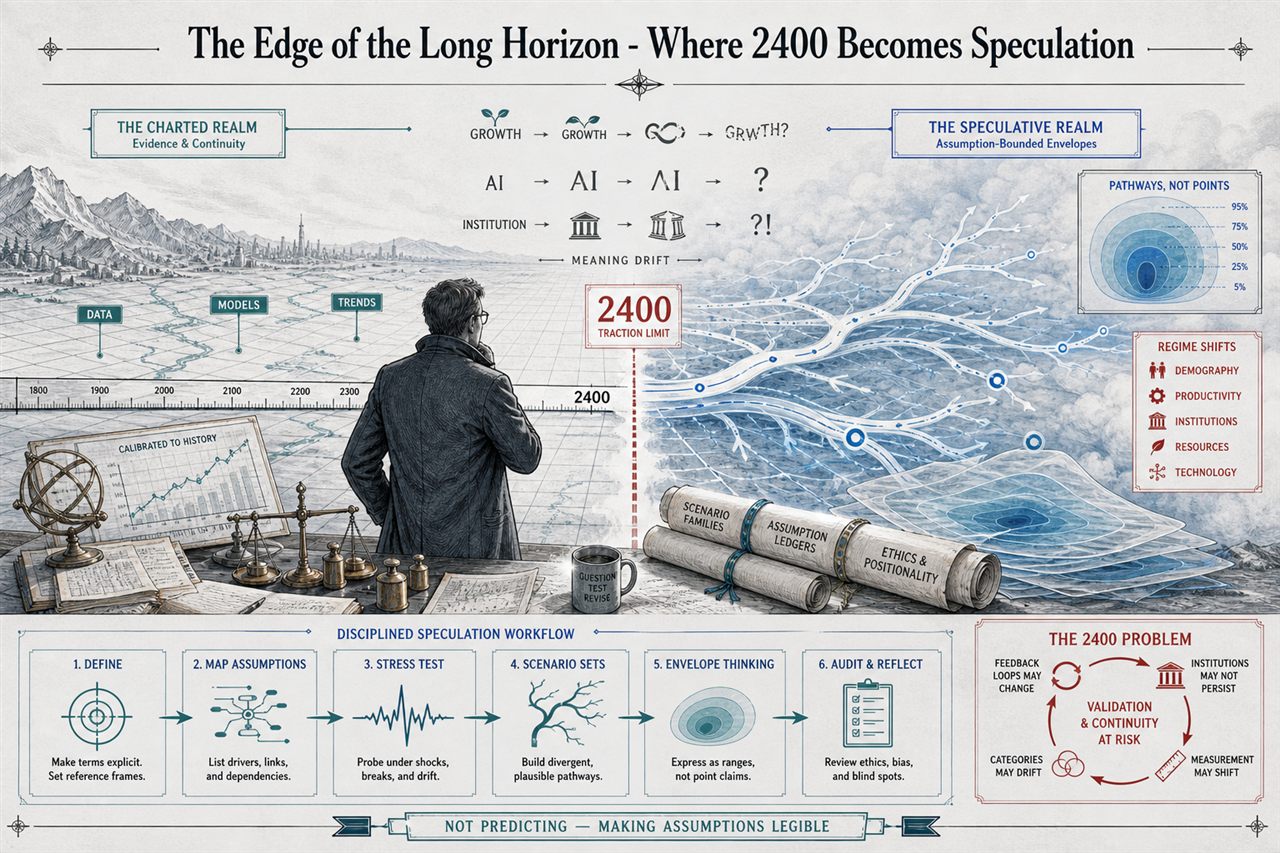
Auditable forecasting hits a methodological boundary as horizons approach 2400, requiring assumption-bounded scenario envelopes rather than point predictions. Accuracy is best over 20–30 years and degrades as causal chains lengthen, while meaning drift in categories and institutional context becomes a dominant error source. Long-run growth projections can guide direction but become numerically unstable under regime shifts in productivity, demography, and convergence. Practical takeaways are to formalize speculation so assumptions, ethics, and positionality are explicit; treat the core challenge as epistemic and validation-focused; and design governance, archival practices, and periodic checkpoints that preserve comparability and audibility over time.