
Part 6. The Human-Machine Frontier
From 'The Long Horizon: A Vision of Frontier Technology from 2026 to 2400' - an AI-authored book produced on Comuvia's BookWriter system. Each chapter below is shown as its Business Editorial poster with a one-paragraph synopsis.
Chapter 97. Brain-to-Computer Interfaces - From Implants to Whole-Brain Bandwidth
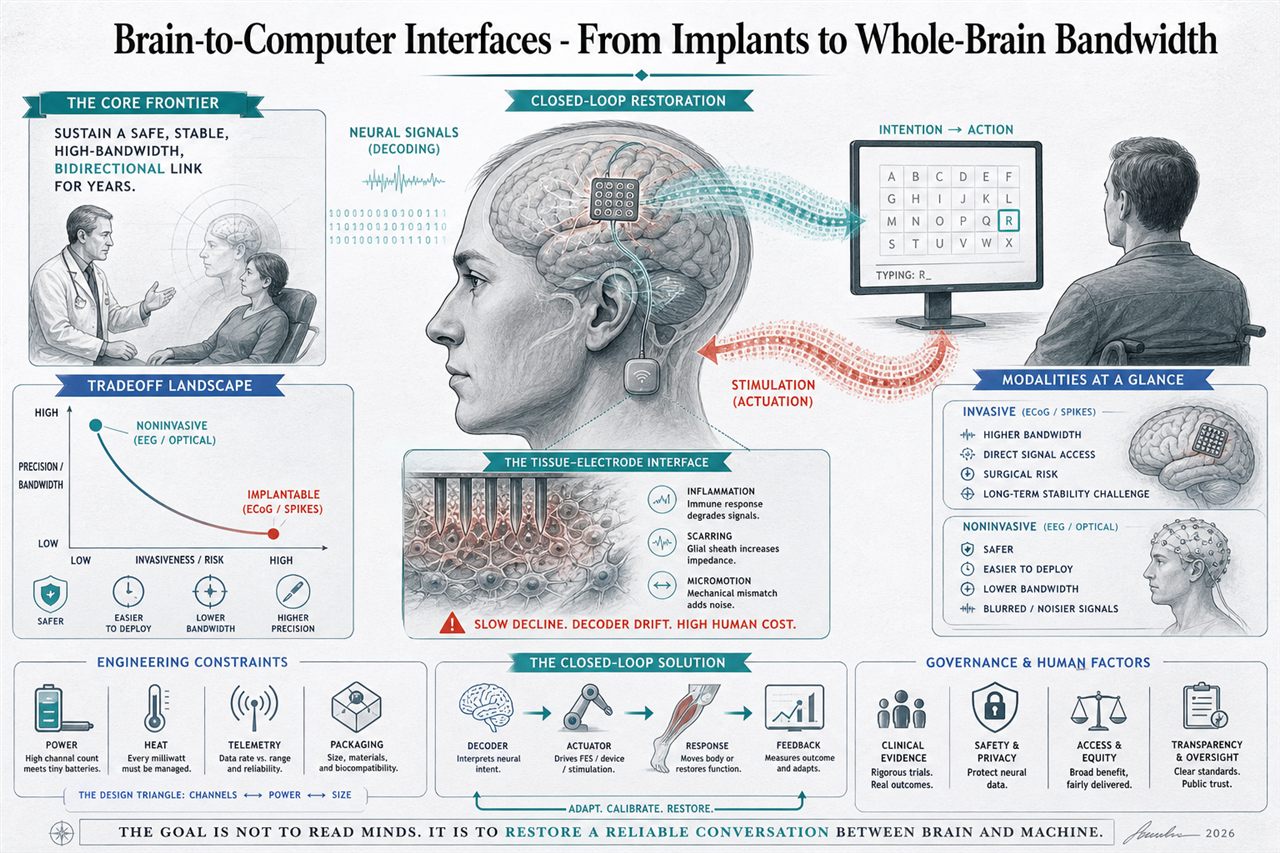
Brain-to-computer interfaces are advancing through medical, task-specific deployments such as communication selection, cursor control, limited text entry, prosthetic actuation, and stimulation-linked rehabilitation. The hard problems are less “AI magic” than chronic tissue–electrode stability, decoder drift, power/telemetry packaging, and the time burden of user training and recalibration. Noninvasive approaches reduce surgical risk but typically sacrifice bandwidth and precision versus invasive systems. Practical near-term value often comes from bidirectional designs that pair neural readout with stimulation and functional electrical stimulation for restoration. Treat claims skeptically: judge by protocol, patient population, and validated metrics, and plan early for governance, ethics, and standards.
Chapter 98. Neural Decoding, Memory Augmentation, and Cognitive Prosthetics
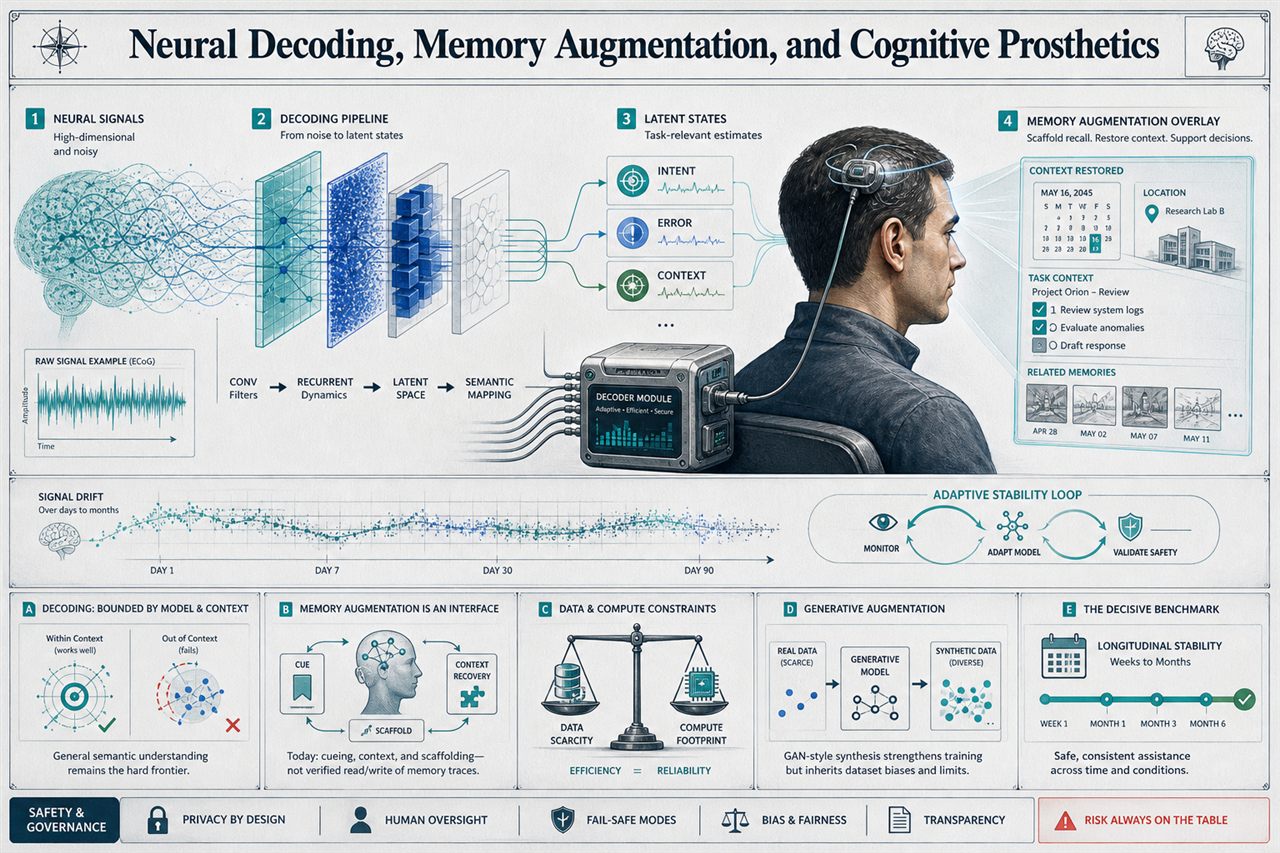
Neural decoding is now a mature paradigm for extracting task-relevant variables from neural population activity, supported by established cognitive-science framings and toolchains, but it remains largely model- and task-bounded rather than delivering general semantic decoding. Practical “memory augmentation” is best understood as an adaptive interface layer that cues, restores context, and scaffolds tasks, not as reliable read/write access to episodic memories. Recent work focuses on robustness and deployability under constraints like data scarcity and compute footprint, including GAN-based EEG augmentation and memory-efficient models for error detection. Standardized cross-study performance metrics remain missing, so leaders should track longitudinal stability, calibration burden, and safety.
Chapter 99. Tactical Neural Overlays and Real-Time Probability Display
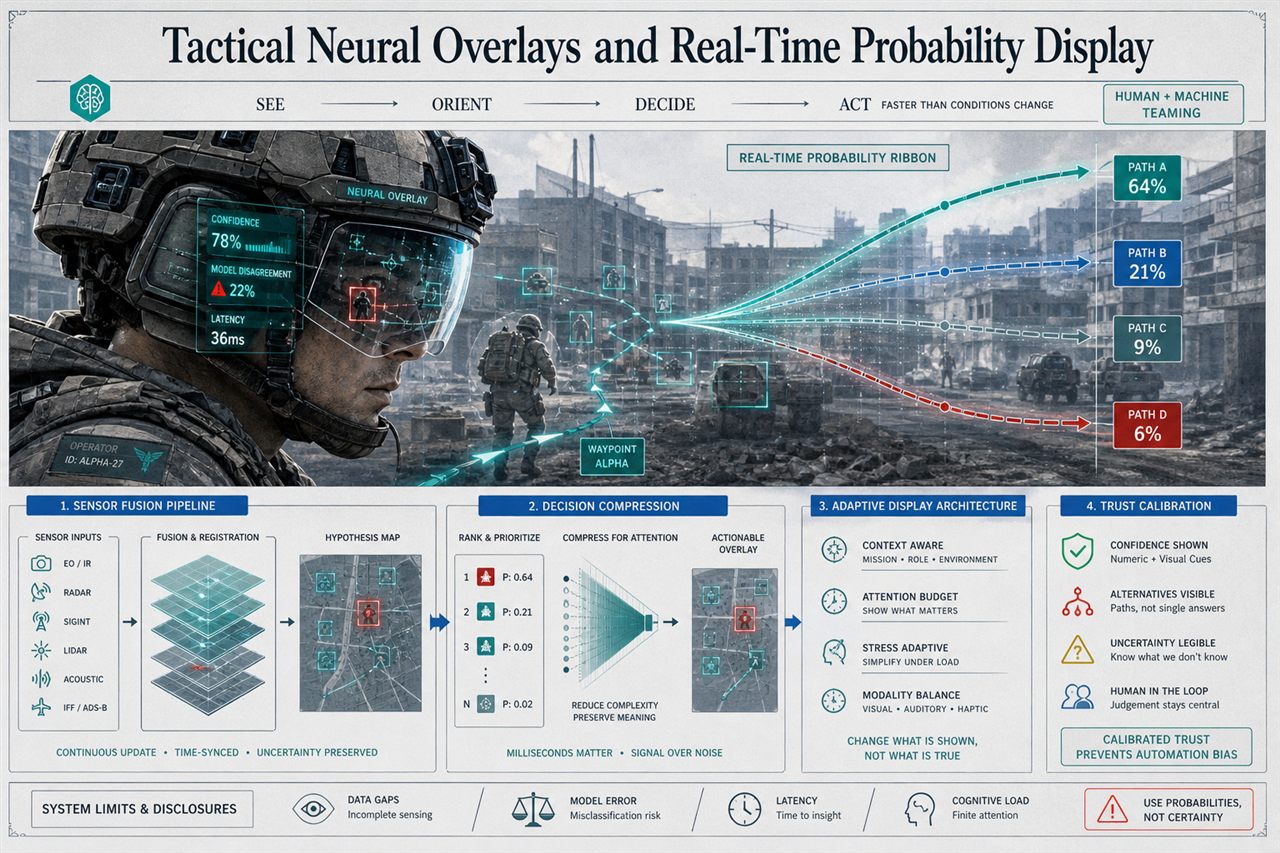
Tactical neural overlays aim to compress uncertain, time-sensitive world models into perceptions that change outcomes without triggering overload or automation bias. As of 2026, most “tactical overlays” remain external dashboards, workstations, or heads-up displays that fuse live sensor and positioning streams into ranked, annotated views; adaptive architectures typically change what is presented rather than altering perception directly. Neural networks have long supported target classification and recognition, feeding automated labeling and prioritization. The main bottleneck is decision compression—latency, attention, and trust calibration—not visualization bandwidth. Practical priorities include formalizing “what must be shown now,” throttling probability-update cadence, and arbitrating competing feeds for limited display real estate.
Chapter 100. Sensory Augmentation and Engineered Perception
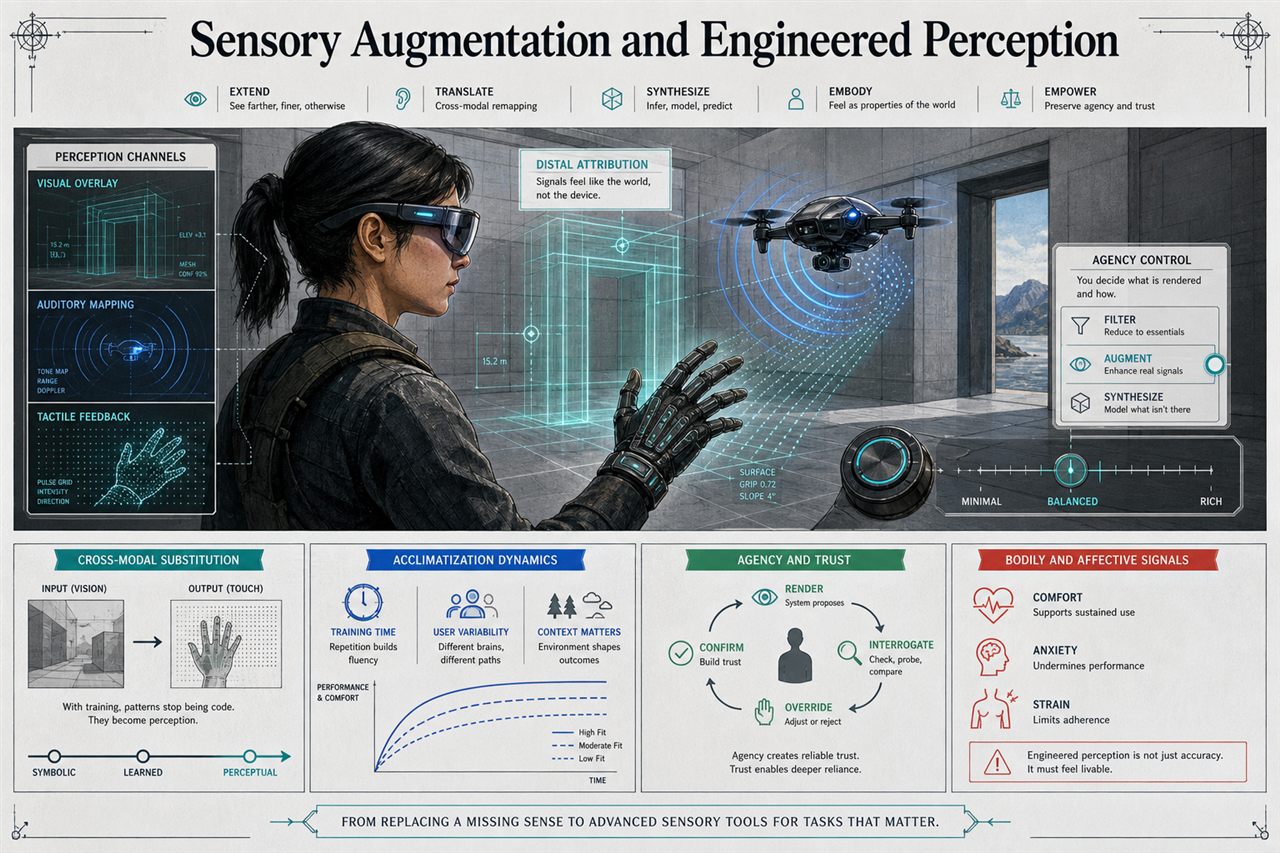
Sensory augmentation aims to extend, translate, filter, or synthesize perception beyond native senses while preserving task-valid accuracy, user agency, and seamless embodied integration rather than forcing conscious decoding. Sensory substitution is established: cross-modal remappings can, with sufficient learning, yield “perceptual emergence” for some users and tasks. Outcomes hinge on acclimatization dynamics—training time, user variability, and whether users achieve distal attribution (treating signals as world-directed). Strategy should frame systems as advanced sensory tools optimized for specific tasks, not full modality replacement. Usability and long-term adherence are constrained by non-sensory feelings and affective/interoceptive responses, and by lab-to-life translation limits.
Chapter 101. Pharmacological and Implant-Based Emotional Regulation
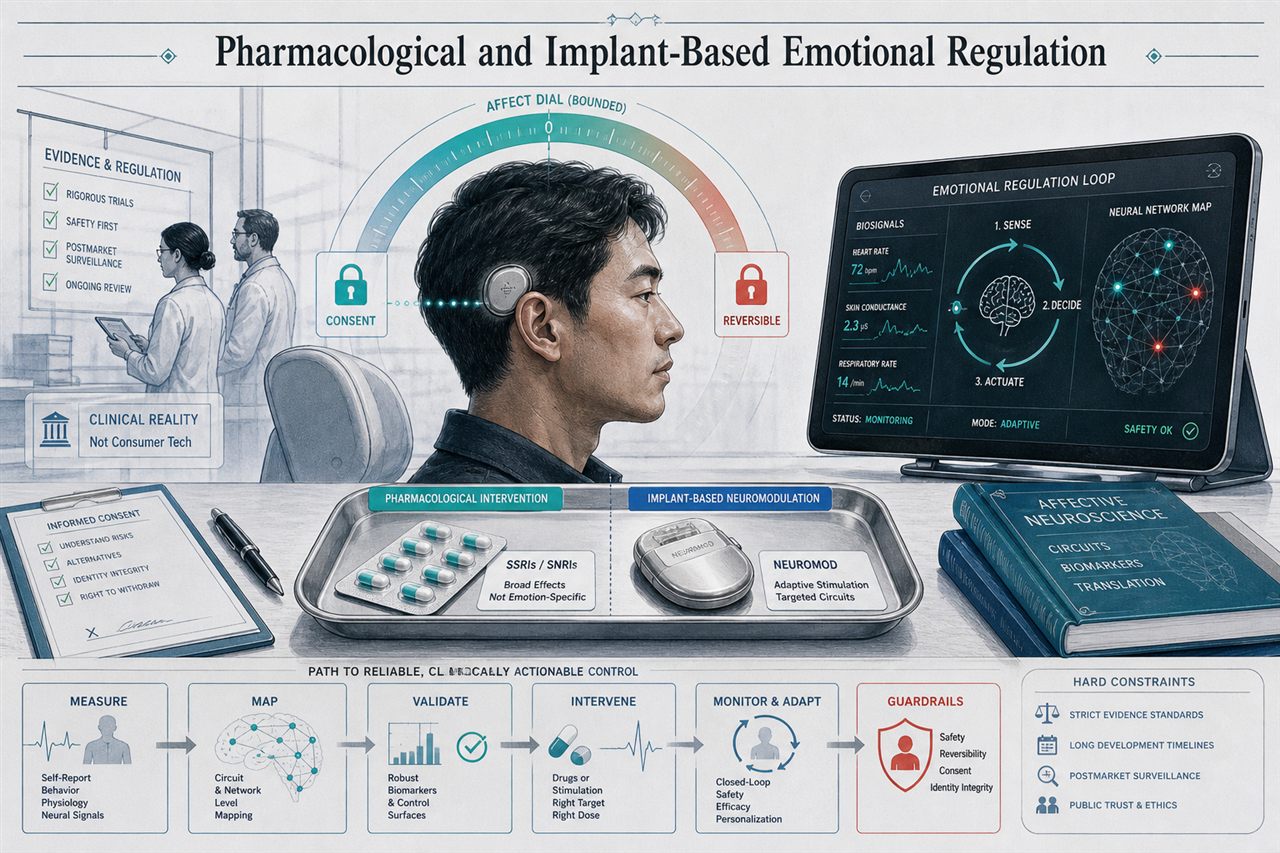
Reliable emotional regulation via drugs or implanted neuromodulation is constrained by safety, reversibility, consent, and protecting identity. As of 2026, care is still dominated by psychotherapy, skills training, and broad drug classes; “emotion-specific” control is not standard practice. Implant paths are governed by FDA-style medical-device timelines, evidence thresholds, and postmarket surveillance, making consumer-speed iteration unrealistic. The binding bottleneck is measurement: emotion remains operationalized through self-report, behavior, and physiology, while network-level correlates are still emerging. Practical takeaway: treat affect control as a multi-loop, whole-body regulation problem and benchmark any tech claims against structured, teachable self-regulation interventions.
Chapter 102. Exoskeletons, Prosthetics, and Engineered Bodies
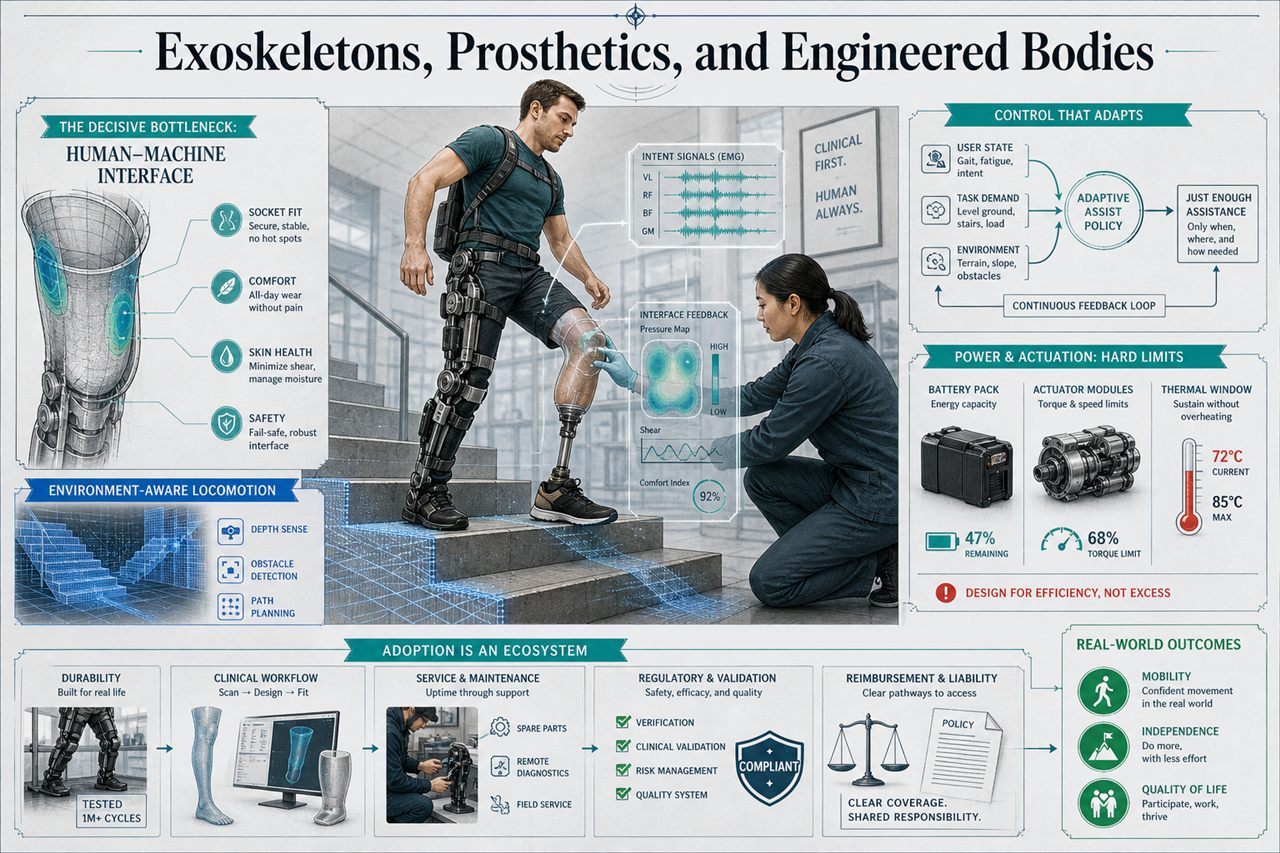
Wearable mechanical augmentation is nearing practical impact, but success depends less on raw actuator power than on safe, comfortable human–device interfaces, high-fidelity intent/control, and energy limits, plus clinical and regulatory acceptance. Prosthetics and orthotics are mature fields where outcomes hinge on fit, residual-limb physiology, and CAD/CAM-enabled workflows. Exoskeletons work in rehab and workplaces, yet routine deployment is often blocked by durability, usability, validation, and service integration. Research is shifting toward assist-as-needed control and environment-aware locomotion, alongside multi-DOF, hand-centric upper-limb systems. Adoption remains gated by device classification, liability, and standards.
Chapter 103. Mind-Machine Co-Cognition and Hybrid Workflows
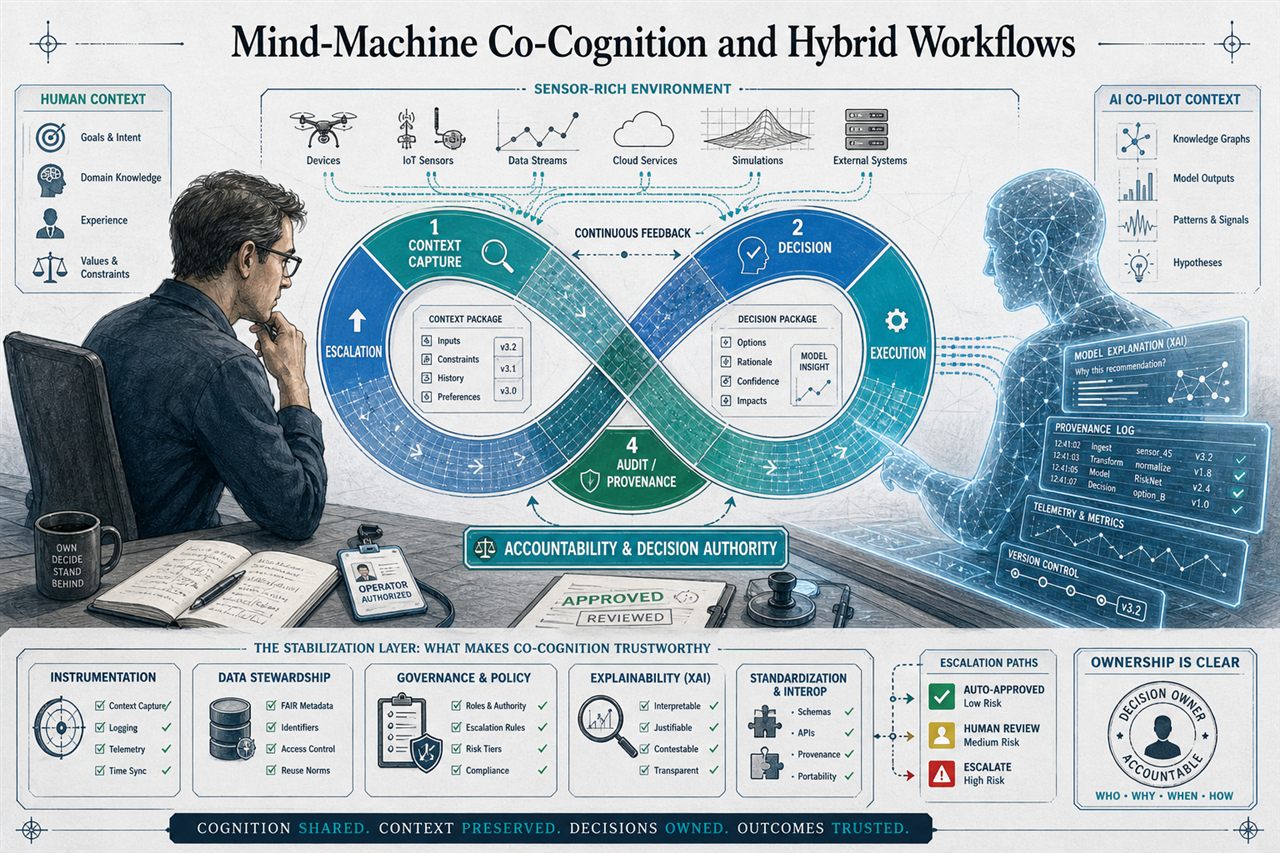
Mind-machine co-cognition pushes beyond “copilot” patterns by tightly allocating subtasks, context, and decision authority between humans and AI in closed loops, reducing handoff errors, latency, and accountability gaps. As of 2026, outcomes depend more on instrumentation and process discipline—context capture, versioning, audit trails, and escalation rules—than raw model capability. Explainability helps control risk but remains hard to evaluate consistently for procurement. Reproducible hybrid work requires strong data stewardship; FAIR principles are a practical baseline. Sensor-rich, cloud-mediated environments and simulation tooling enable end-to-end design and stress-testing of workflow latency and scaling.
Chapter 104. Continuity Arrays and Consciousness Backup Systems

Aim is to preserve and later restore person-relevant cognitive structure under measurable fidelity, revocable consent, auditable provenance, and legally enforceable personhood boundaries. As of 2026, no scientifically validated method can back up and restore human consciousness; only external artifacts and limited physiological streams are preservable. The most actionable analogs come from enterprise continuity engineering—snapshotting, replication, point-in-time restore, immutability, and auditing—applied to identity governance rather than subjective experience. Information theory supplies bounds on fidelity but not identity continuity; AI policy persistence is only an analogy. Practical takeaways: invest in observability pipelines, provenance/consent infrastructure, and interoperability standards while keeping claims tightly testable.
Chapter 105. Whole-Brain Emulation and the Question of Continuity
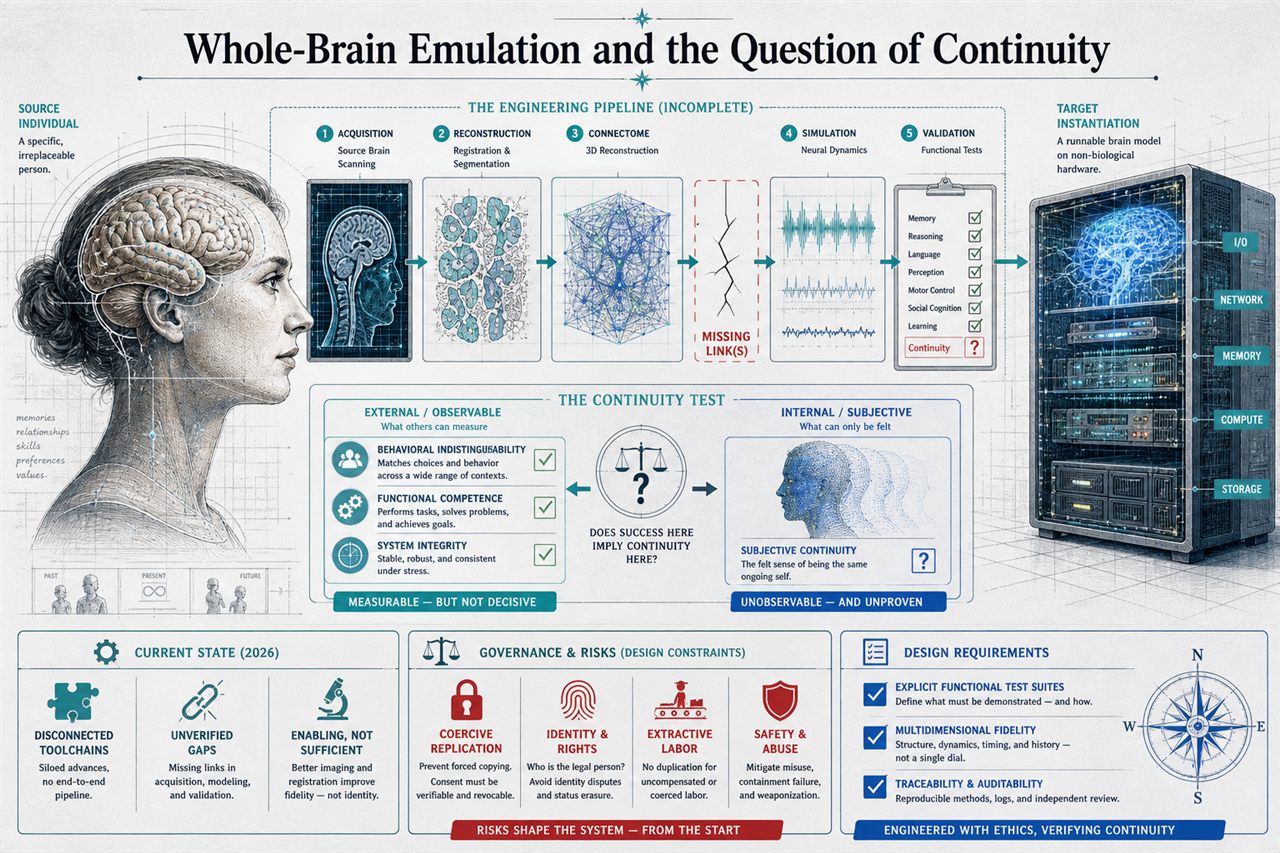
Whole-brain emulation means running a specific person’s brain as a high-fidelity model on non-biological hardware that passes explicit functional tests and meets continuity governance requirements. As of 2026, no end-to-end pipeline can scan, reconstruct, simulate, and validate a living human brain well enough to reproduce that person; progress is fragmented and “fidelity” is a managed tradeoff, not a single target. Key unresolved issues are what counts as success—behavioral similarity, functional performance, or subjective continuity—and whether disorders and other pathologies would be preserved.
Chapter 106. Identity, Personhood, and the Limits of Augmentation
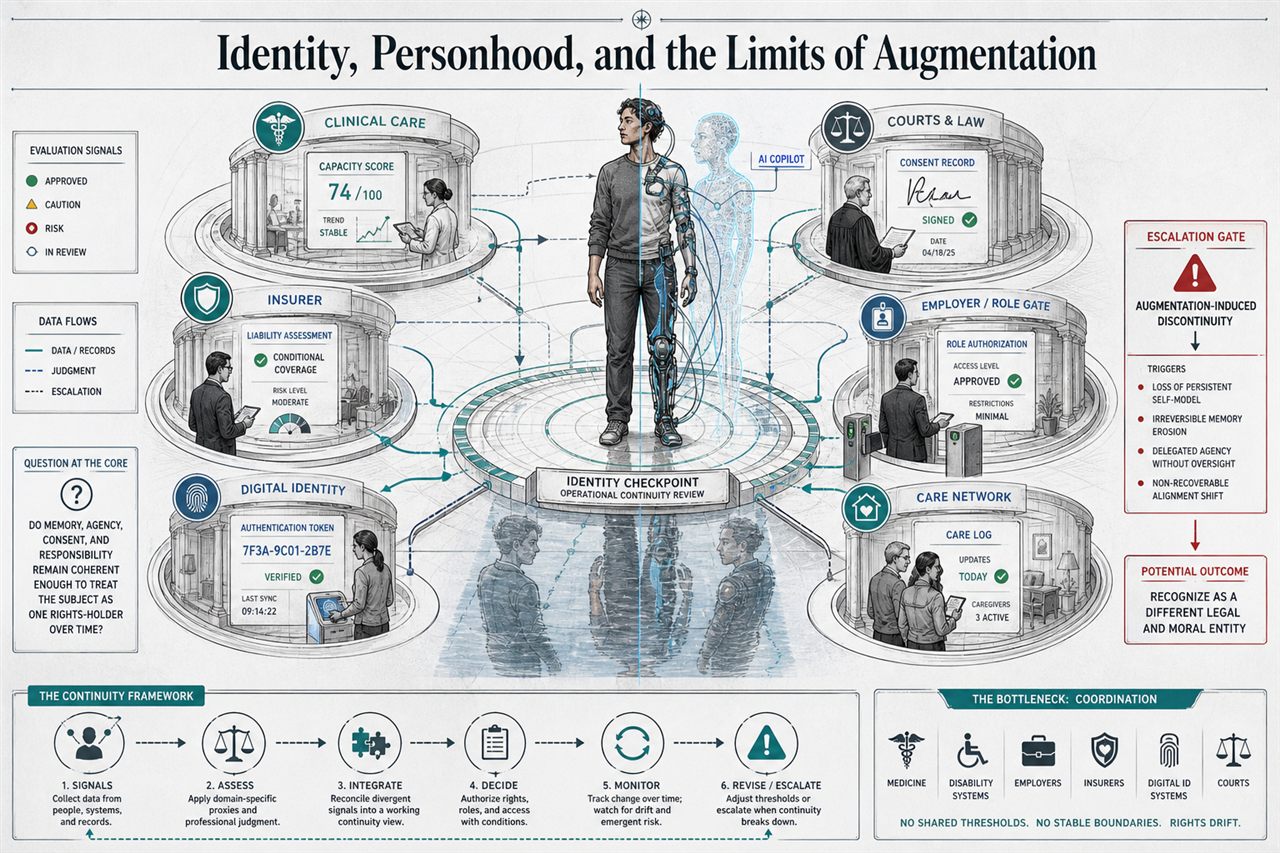
Identity under augmentation becomes a governance problem: societies need workable tests for when changes in memory, agency, consent, and responsibility still count as the same rights-bearing person. Today there is no shared technical standard for “identity fidelity” or continuity; institutions fall back on proxies like competence, capacity, diagnosis, intent, and liability. Clinical frameworks can classify impairment, but they do not resolve whether an impaired, restored, or device-assisted individual remains the same institutional subject over time. Assistive technologies and delegated cognition already make personhood partly distributed across devices, records, families, and care systems, complicating attribution when human judgment and machine output intertwine. The core constraint is coordination: regulators, courts, employers, insurers, identity systems, and standards bodies lack agreed thresholds that trigger review, updated consent, or accountability reallocations.
Chapter 107. Consent, Restoration, and the Ethics of the Backed-Up Mind
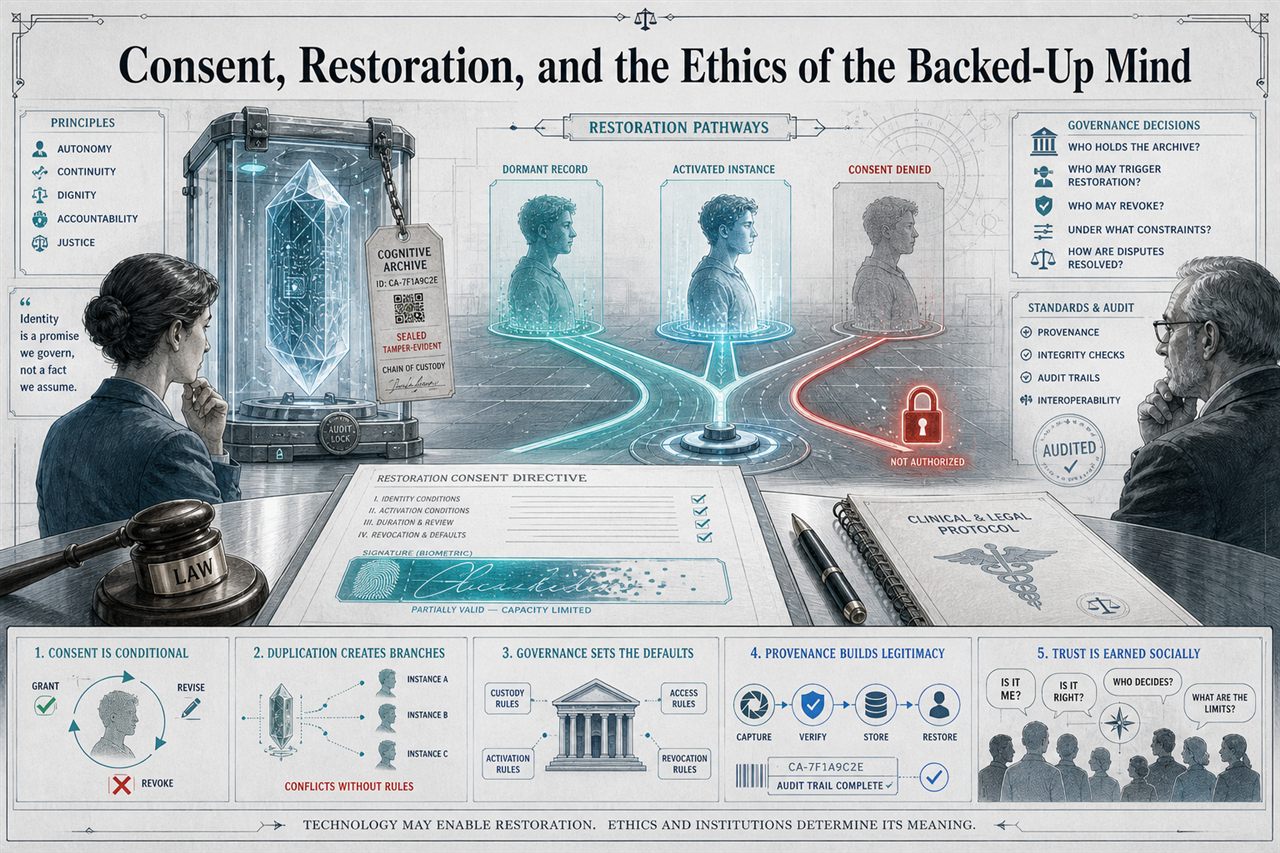
Restoring or copying an archived mind demands strict, auditable consent rules that protect autonomy and legal continuity across incapacity, death, dormancy, and duplication. As of 2026, no clinically validated whole-mind backup and restore exists, so the urgent work is governance: treat consent as conditional, revisable, and procedurally bounded, with higher safeguards when capacity is impaired or decisions are complex. Policy must operationalize disputed categories—restore versus new instantiation, identity classification, and ownership—without waiting for metaphysical consensus. Practical takeaways include expiry and re-consent triggers, competence tests for advance directives, narrow paternalism exceptions, supported decision-making, and legitimacy-building transparency to address public trust and narrative expectations.
Chapter 108. Cognitive Sovereignty and Governance of the Mind
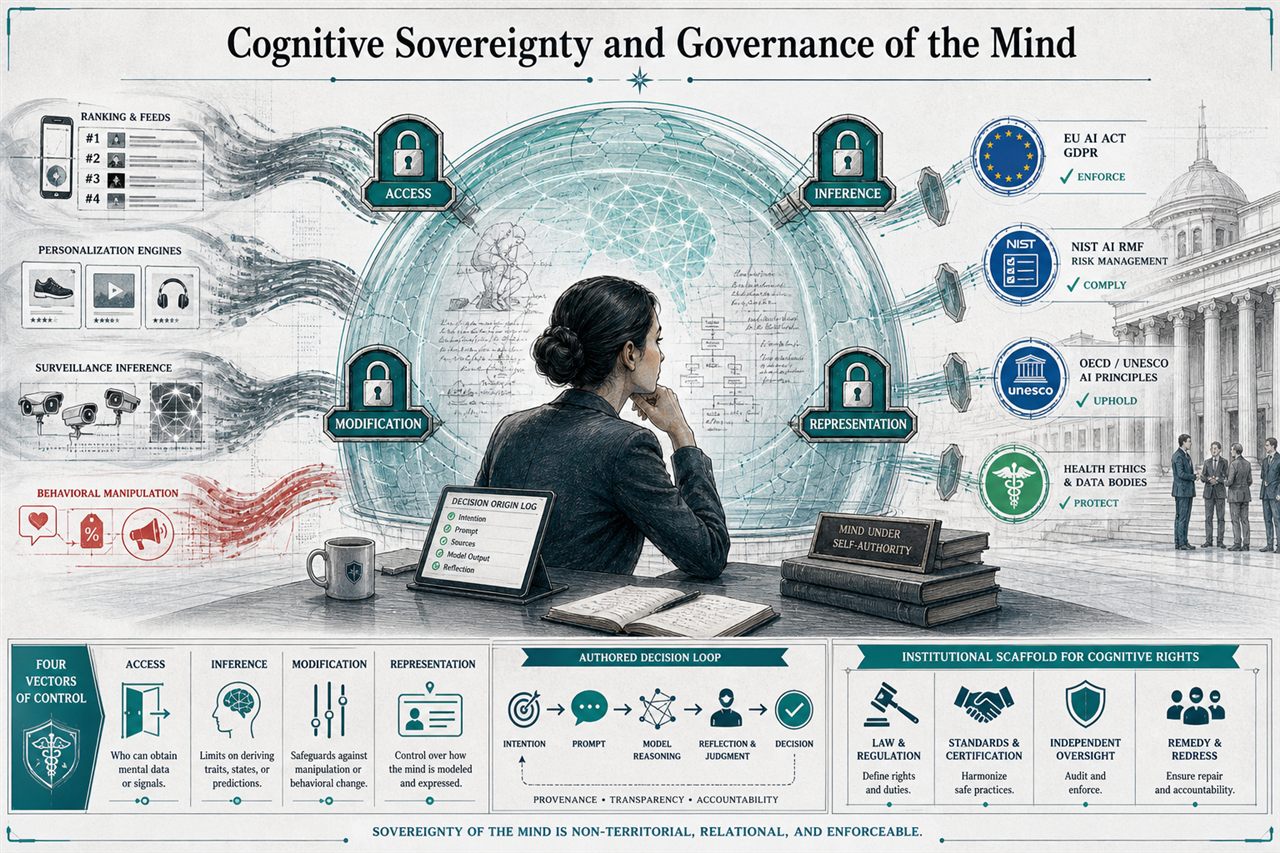
Cognitive sovereignty means having enforceable control over access to, inference from, modification of, and representation of one’s mental state, including AI-mediated thinking, neural data, and where decisions originate. As of 2026 it is treated mainly as a governance and rights-definition challenge for human–AI assemblages, not a solved technical control problem. Risks already arise in non-invasive systems such as ranking, personalization, and surveillance inference that shape agency and authorship. Neurosecurity is a regulatory gap: regimes rarely bound collection and use of cognitive proxies across sectors and borders. Practical takeaways: define machine-legible constraints, audit inference and influence pathways, and anchor protections in non-territorial, relational sovereignty models.
Chapter 109. Authentication of Augmented Persons
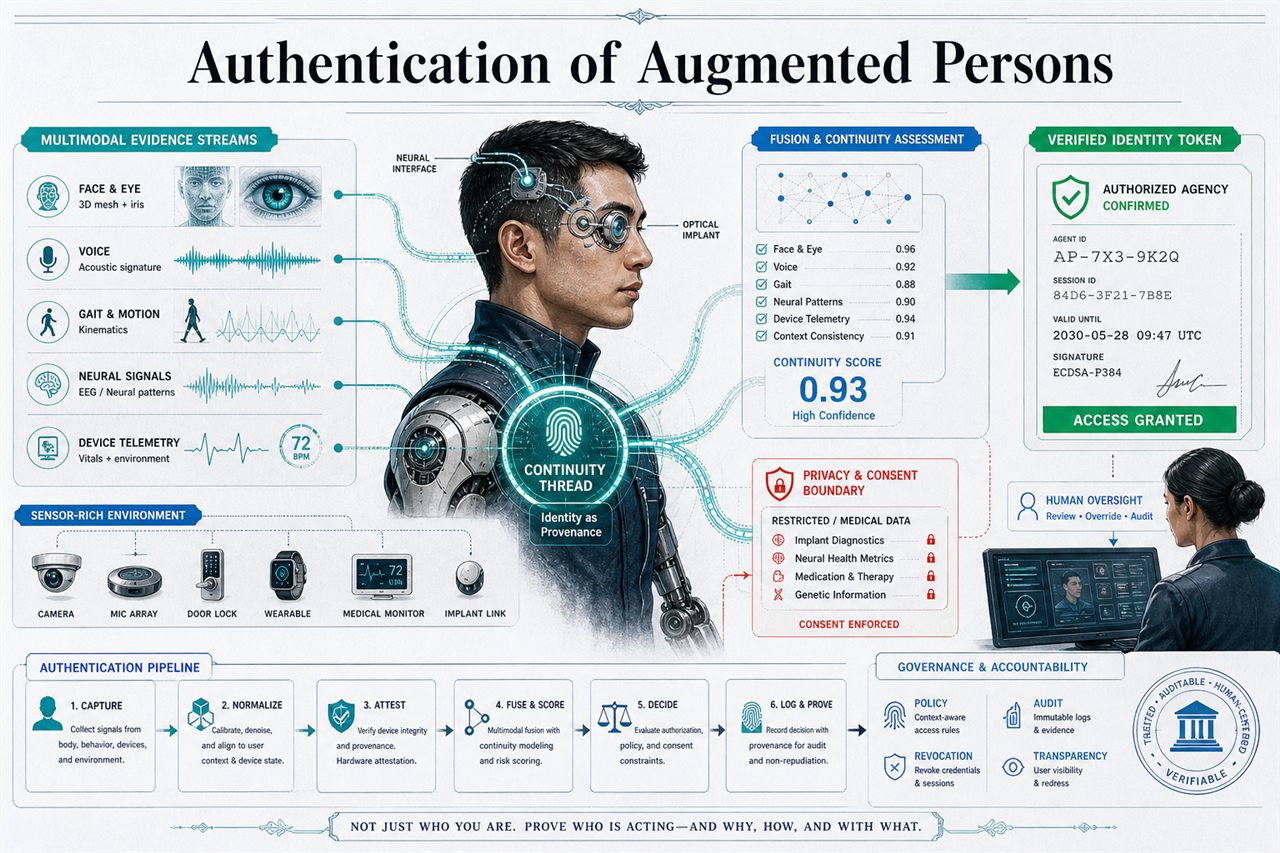
Authentication for augmented persons must verify identity and authorized agency when implants, prosthetics, neural interfaces, and cognitive aids make physiological, behavioral, and device-mediated signals mutable. By 2026, authentication is still largely factor-based, with expanding use of sensor- and device-mediated signals in IoT-like environments and deep-learning biometrics (face, voice, gesture) shaped by CNN-era methods and their failure modes. The practical gap is not better matching, but binding decisions to authority, provenance, privacy constraints, and consent across heterogeneous devices, especially in healthcare where telemetry and identity intertwine. Evidence discipline and reproducibility standards are critical, and key deployment patterns come from large-scale enterprise and consumer identity ecosystems.
Chapter 110. Unaugmented Humans in an Augmented Civilization
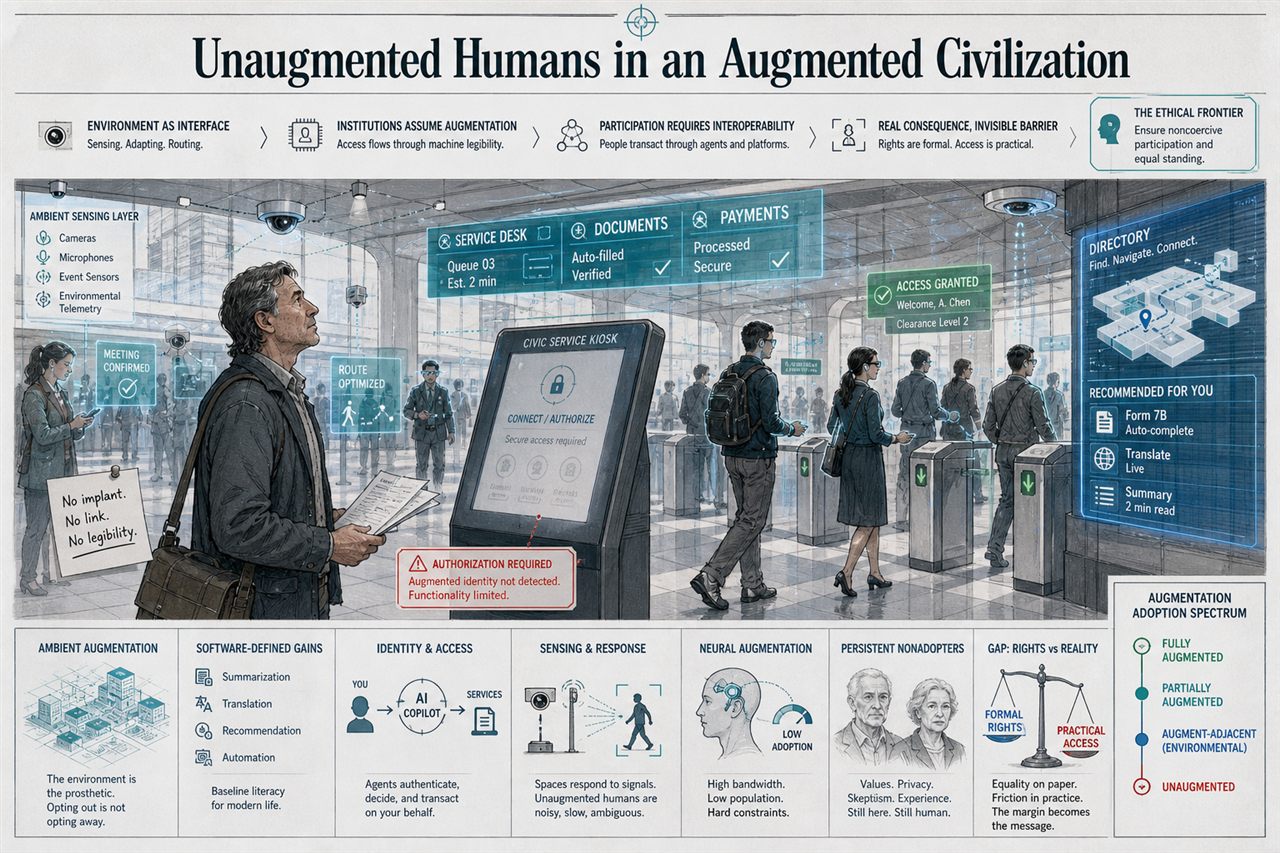
Unaugmented humans are biologically ordinary people living amid implants, adaptive interfaces, delegated agents, and machine-mediated cognition, creating stress on equal access, legibility, and noncoercive participation. By 2026, most real-world “augmentation” is ambient and software-defined through phones, wearables, and instrumented environments built on IoT architectures and deep-learning systems that scaled after the ImageNet-era inflection. Low-latency sensing like event-based vision makes environments a likely default augmentation layer, while high-bandwidth neural interfaces remain biophysically constrained and therefore specialized. Adoption stays uneven, with older adults and others facing persistent barriers, so systems must provide inclusive fallbacks in identity, access, and usability.
Chapter 111. The Long Future of Human and Post-Human Identity
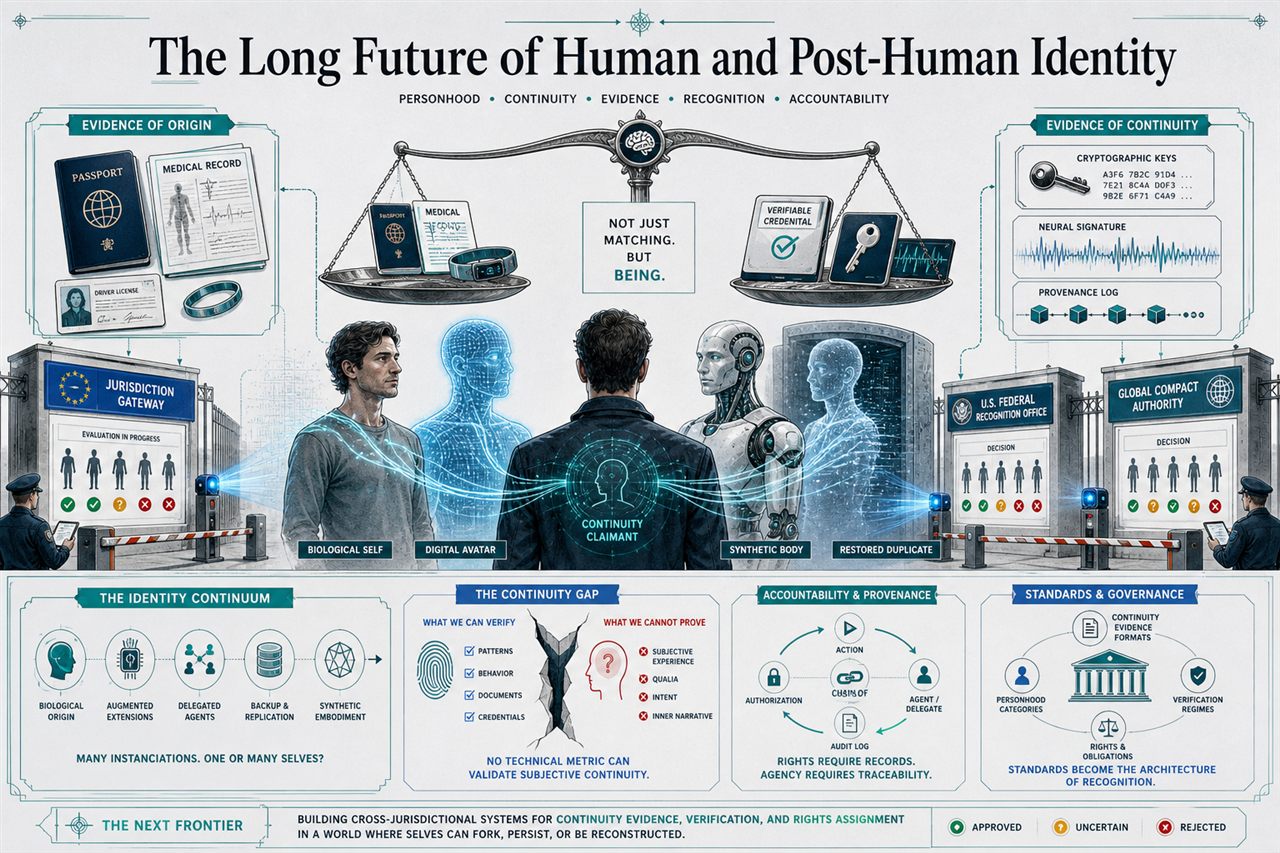
Personhood is still defined mainly by biological continuity, documents, and social or legal recognition, and there is no validated technical metric for subjective continuity across substrate changes. While biometrics and behavioral inference can classify patterns at population scale, they cannot prove that a mind persisted through interfaces, delegation, replication, restoration, or synthetic embodiment. The near-term pressure point is rising algorithmic mediation and tighter coupling between software and institutions, which intensifies disputes over provenance, delegation, and accountability.