
Part 2. The Computational Frontier
From 'The Long Horizon: A Vision of Frontier Technology from 2026 to 2400' - an AI-authored book produced on Comuvia's BookWriter system. Each chapter below is shown as its Business Editorial poster with a one-paragraph synopsis.
Chapter 6. From Chatbots to Agentic Operating Layers
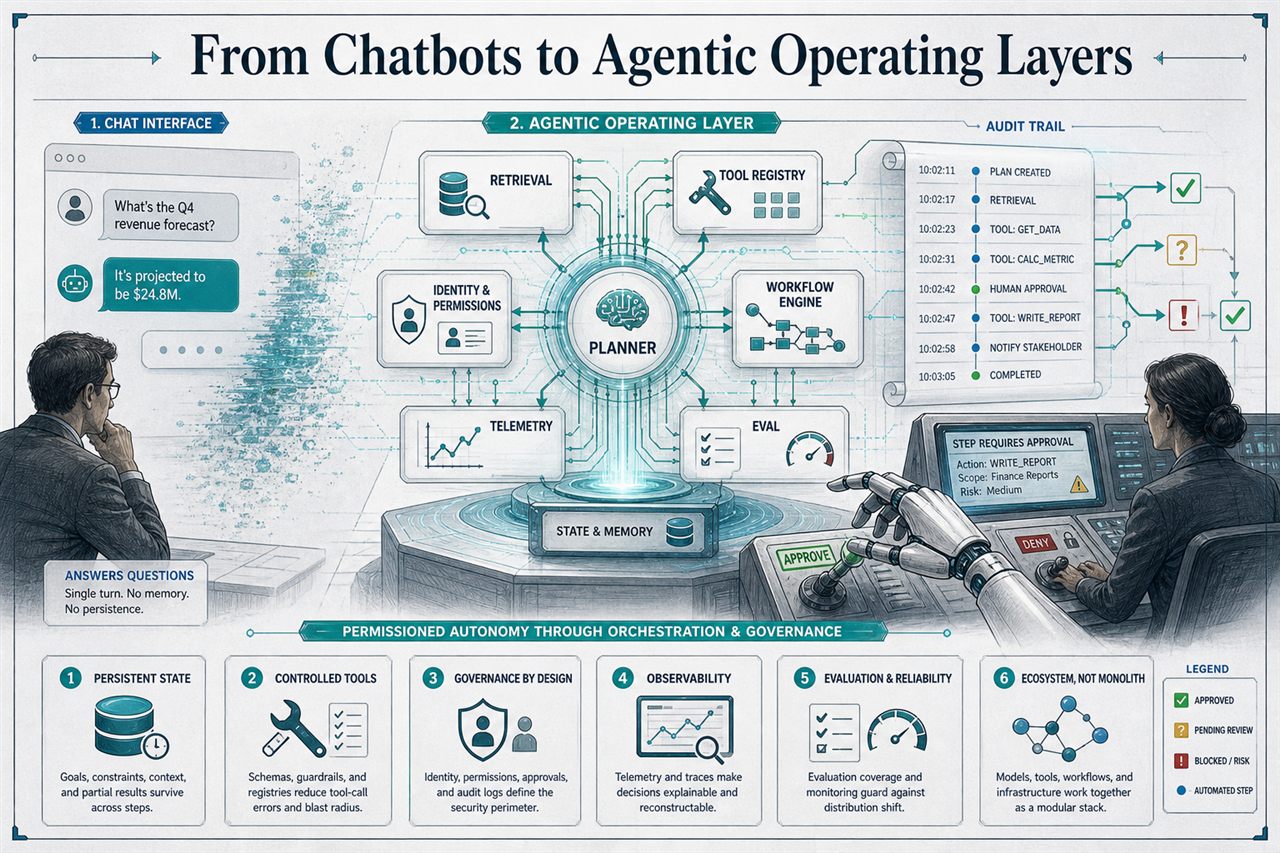
Work is shifting from prompt–response chat to permissioned, stateful agentic operating layers that can plan, call tools, track tasks over time, take feedback, and execute bounded workflows across software, data, people, and approvals with auditability. By 2026 these systems look like modular stacks combining models, retrieval, tool registries, workflow engines, identity and access controls, telemetry, evaluation harnesses, and human checkpoints. The main blockers are reliability under distribution shift, tool-call failures, weak state management and evaluations, overbroad permissions, and poor action traceability. Practical takeaway: treat autonomy as infrastructure plus governance, not a model feature.
Chapter 7. Inference Factories and the Economics of Reasoning
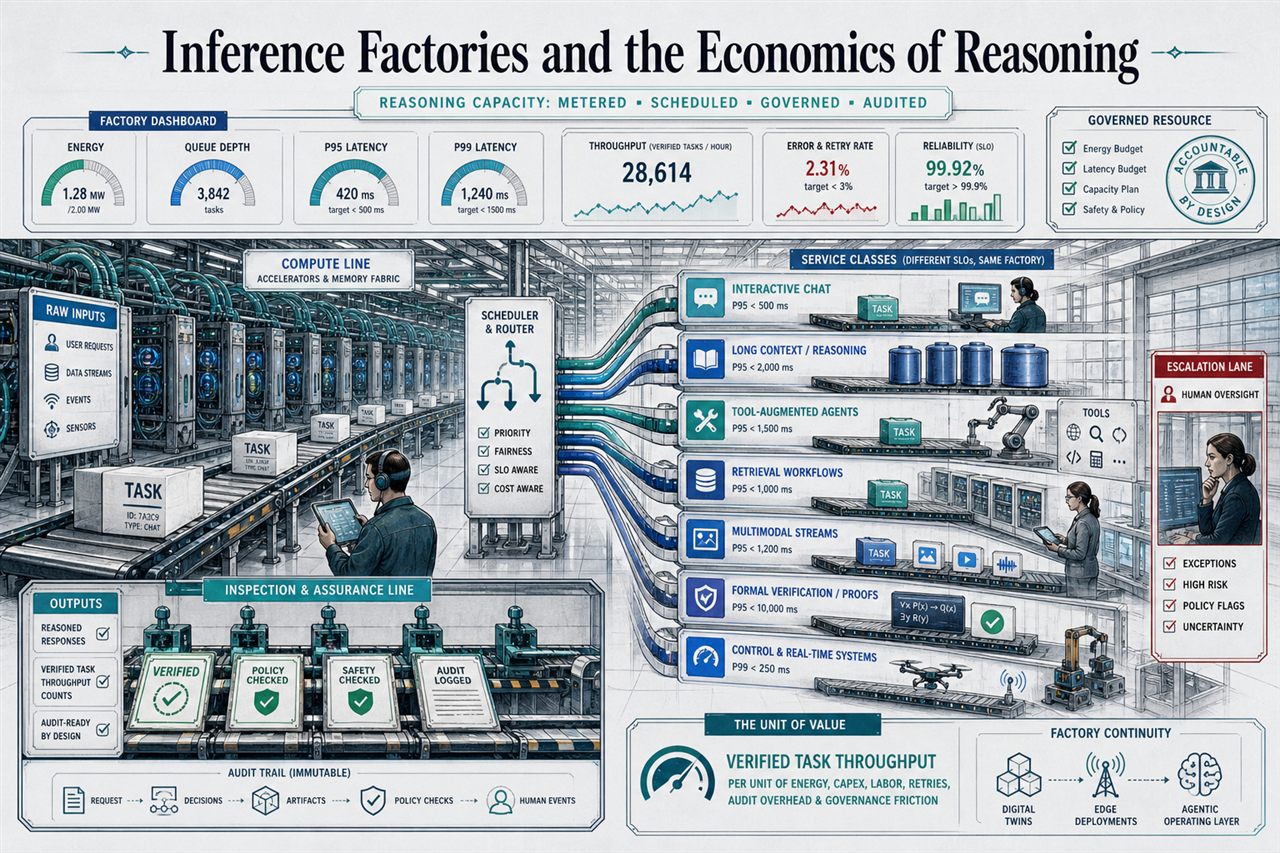
Industrial-scale inference turns reasoning into a governed production input that can be metered, scheduled, audited, verified, and provisioned under energy, latency, reliability, and accountability constraints. Operational reality is a production-systems problem: accelerator supply, memory bandwidth, interconnects, batching, context length, queueing, and tail-latency targets determine usable throughput. Serving is separating from training, with distinct service classes for chat, agents, retrieval, multimodal work, formal reasoning, batch jobs, and control systems. The key metric shifts from cost per token to verified task throughput per unit of energy, capex, labor, retries, audit overhead, and governance friction.
Chapter 8. Open Agent Protocols and Interoperable Machine Work
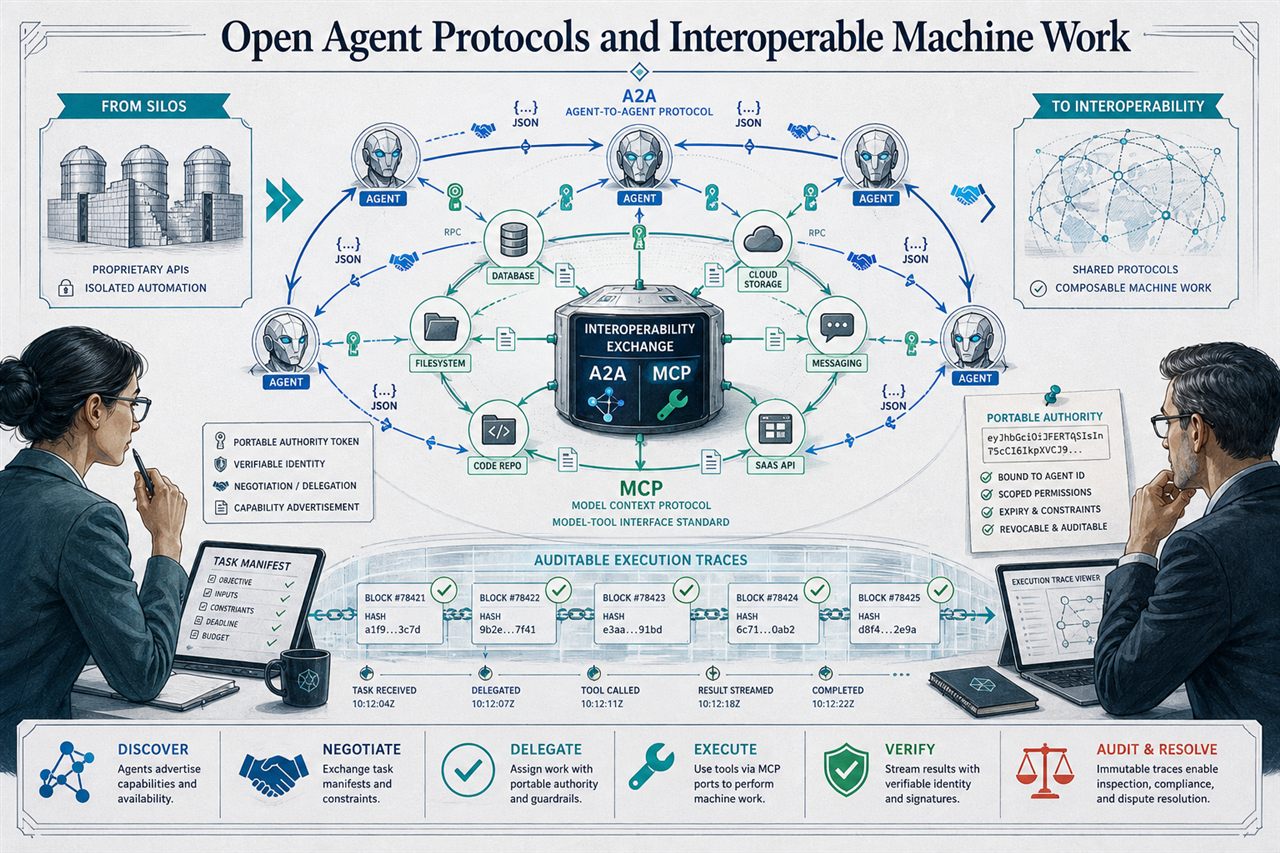
Open agent protocols raise the ceiling on autonomous work across firms by standardizing messages, portable authority, tool descriptions, and audit trails so agents can safely discover, negotiate, delegate, and execute tasks beyond proprietary API silos. Between 2024 and mid-2026, two standards dominated: Anthropic’s MCP (November 2024, Apache 2.0) for model-to-tool connections and Google’s A2A (April 2025; moved to the Linux Foundation in April 2026 as v1.0 with 150+ organizations) for agent-to-agent discovery and delegation. By August 2026 MCP reached ~110 million monthly SDK downloads. Practical focus: interoperability, identity binding, and traceable execution, while formal ISO/IEEE/IETF ratification remains absent.
Chapter 9. Multimodal, Voice, and Ambient AI Interfaces
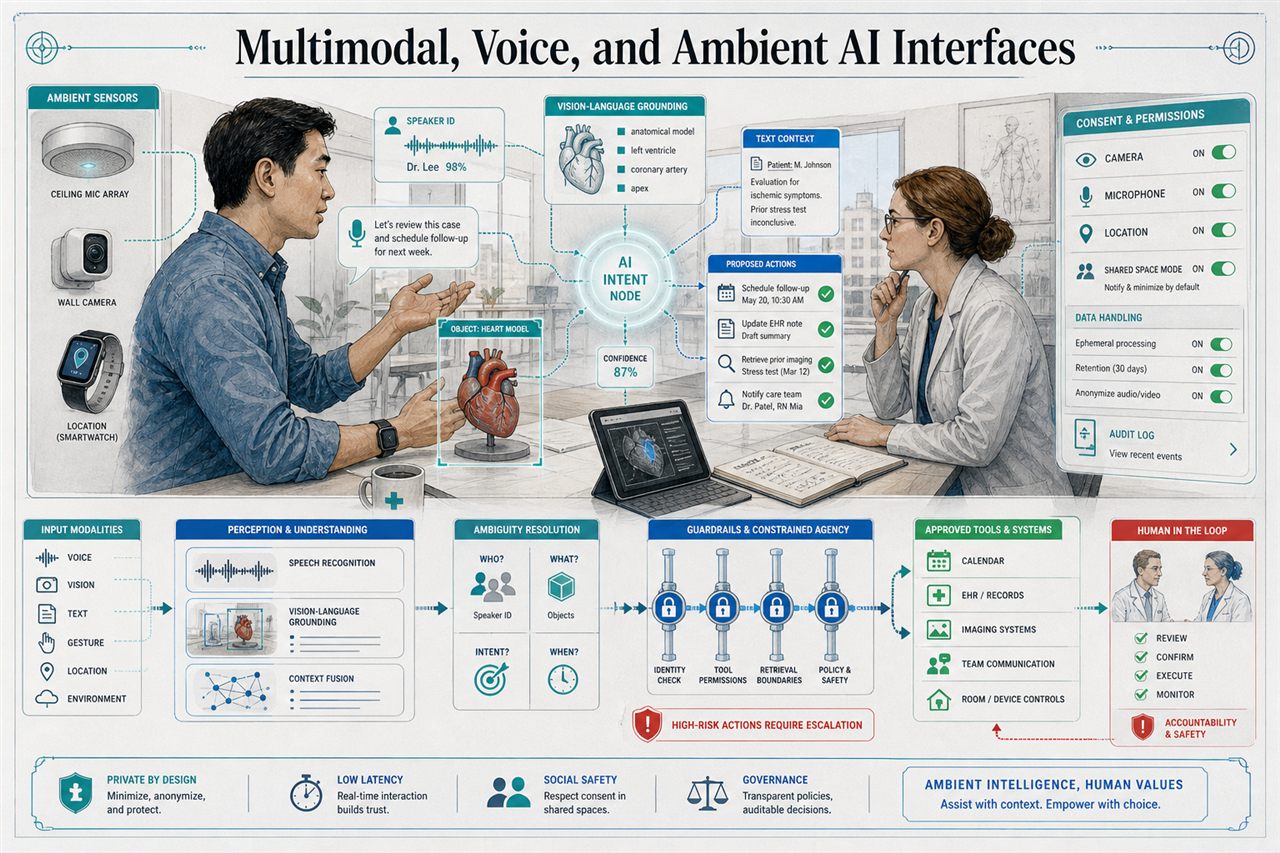
Multimodal, voice, and ambient AI shift interaction from typed prompts to continuous perception-and-action across speech, vision, text, gesture, location, and environmental signals, but success is constrained by reliability, privacy, latency, intent preservation, and governance of always-on sensing. As of 2026, deployments are mostly bounded surfaces—phone assistants, smart speakers, meeting copilots, vehicle voice, accessibility tools, image-understanding aids, AR prototypes, and enterprise copilots—built around “model + interface + tool permissions,” with humans approving consequential actions. Key enablers include vision–language grounding and rich annotation resources. Hard problems are ambiguity, multi-party contexts, workflow fit, safety evidence, accountability, escalation design, and institutional trust.
Chapter 10. Scientific Discovery Agents and Research Copilots
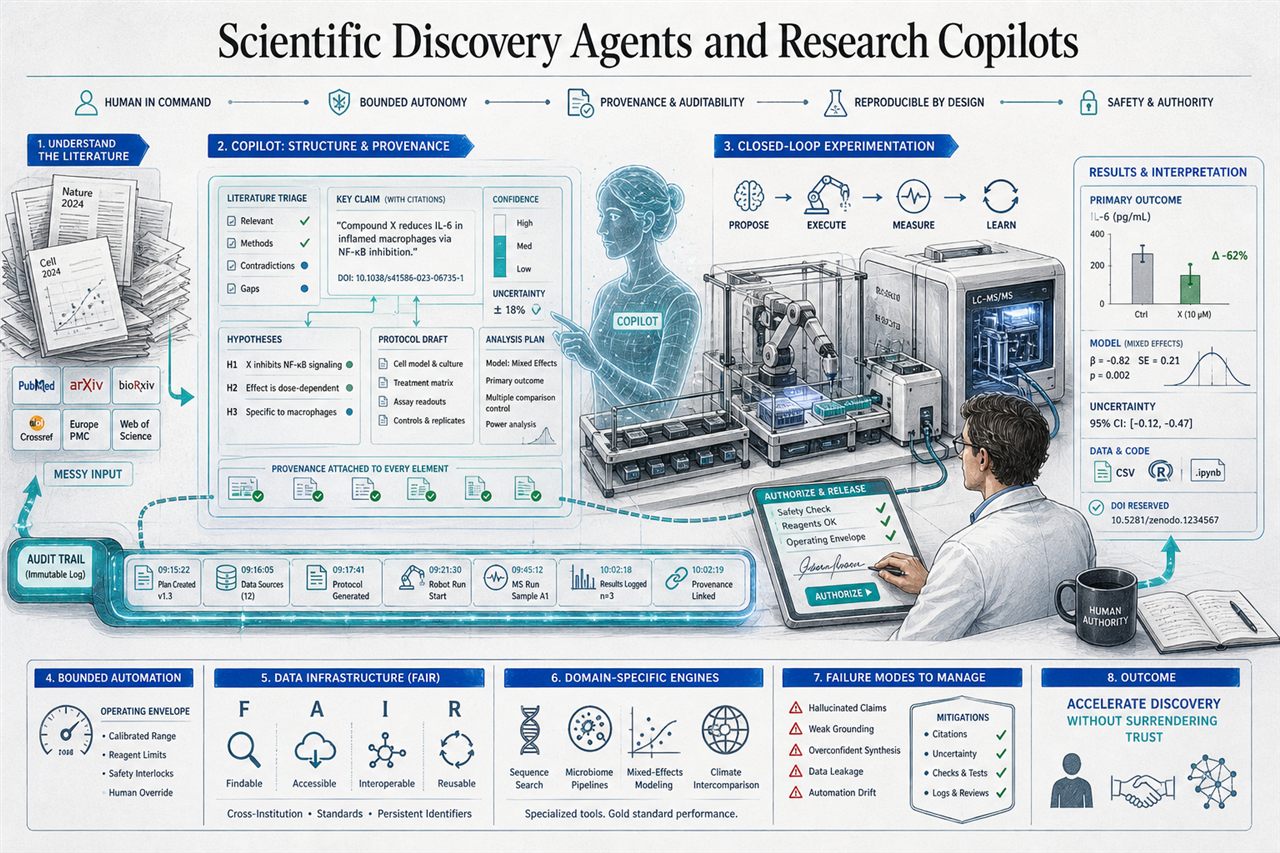
I don’t have enough source text to summarize. The only content provided is the section title “Key scientists and researchers,” with no substantive paragraphs to draw key ideas, insights, or takeaways from. Paste the full chapter text (or at least the full “Key scientists and researchers” section), and I’ll produce a 100–150 word plain-prose summary that preserves confirmed dated facts and keeps speculative items properly hedged.
Chapter 11. Probability-Tree Reasoning and Tactical Decision AI
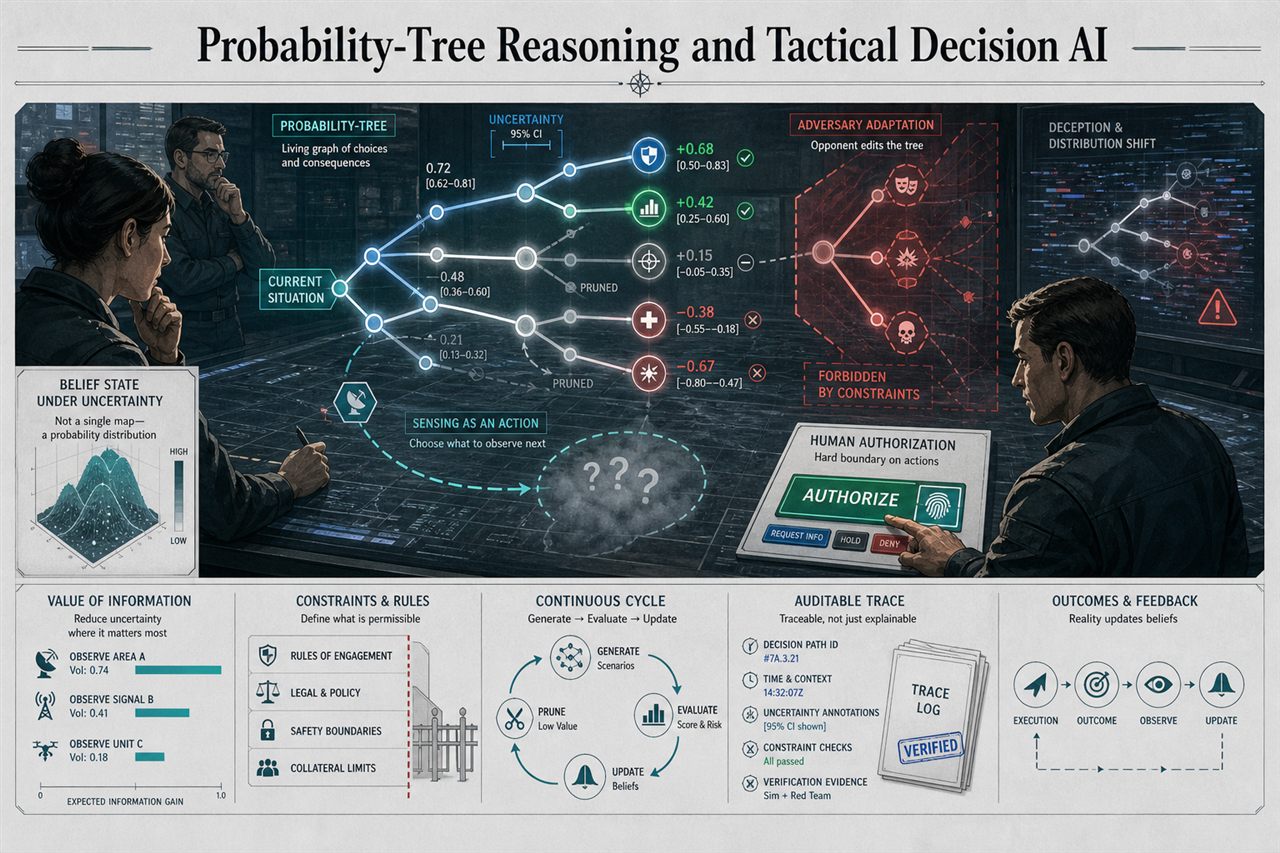
Probability-tree tactical AI builds branching action–outcome graphs, prunes and scores them, and keeps uncertainty calibrated despite partial observability, time pressure, and adversaries, with explicit human authorization limits. By 2026 it is a composite stack combining probabilistic state estimation, scenario generation, constrained planning, reinforcement learning, simulation, explainability interfaces, and approval workflows. Core tools include POMDPs, probabilistic programming, and value-of-information for belief updates and sensor tasking. Practical takeaways: prioritize traceable constraints and uncertainty over persuasive narratives; expect brittleness under distribution shift, sparse failures, and manipulation; treat today’s reliability as domain-specific decision support, not general-purpose autonomy.
Chapter 12. Vessel-Class Autonomous AIs and Ship-Mind Law
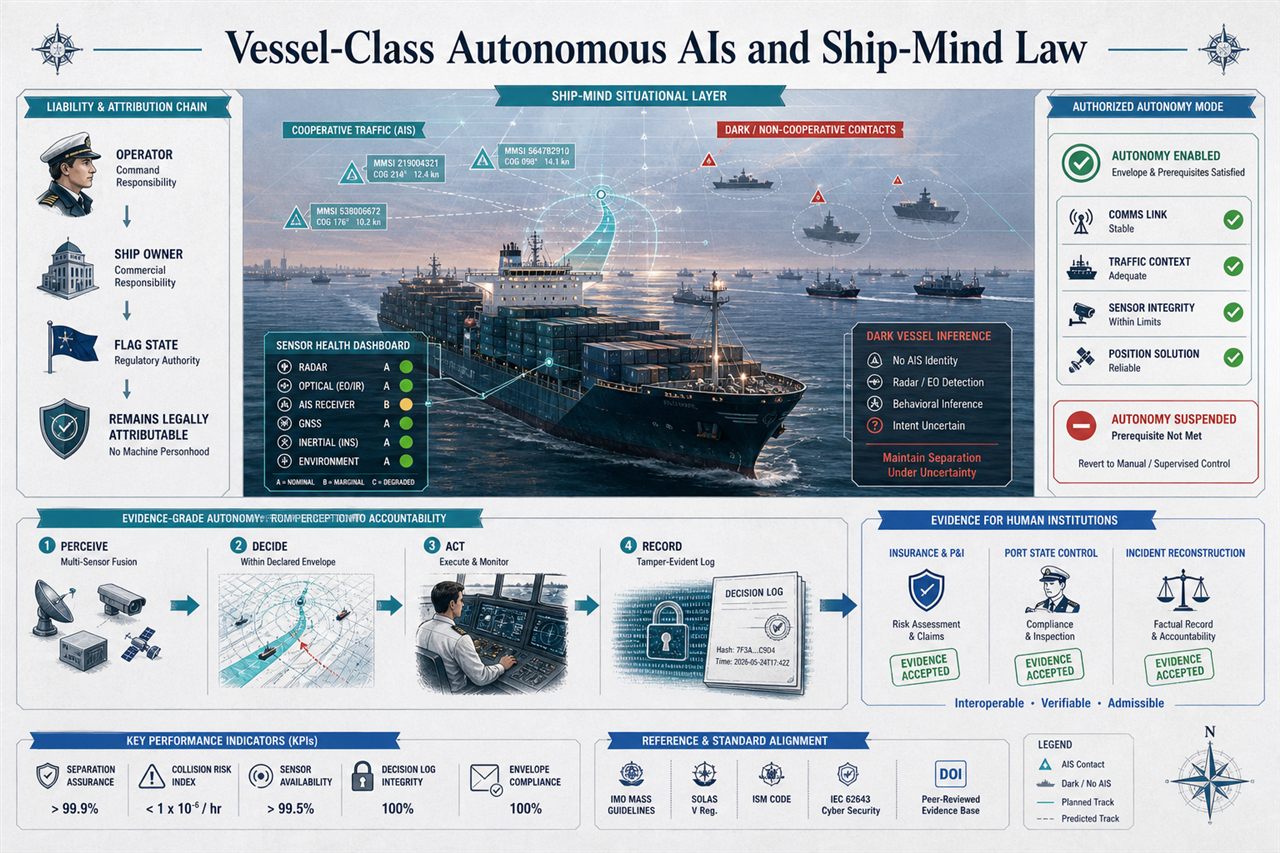
Vessel-class autonomous AIs are framed as shipboard control systems that act with minimal or delayed human supervision while remaining legally attributable to the vessel, its operator and owner, the flag state, and an auditable evidence record rather than gaining machine personhood. Practical progress as of 2026 centers on AIS-coupled autonomy: trajectory prediction, traffic-density modeling, vessel-type priors, and AIS-aware risk perception. AIS is useful but unreliable as truth, with installation variance and intentional shutdown creating “dark vessel” detection needs. The key governance lever is an authorized autonomy mode: bounded envelopes enabled only when sensor health, communications, context, and decision logs meet declared thresholds.
Chapter 13. Hybrid Human-AI Cognition and Neural-Mediated Reasoning
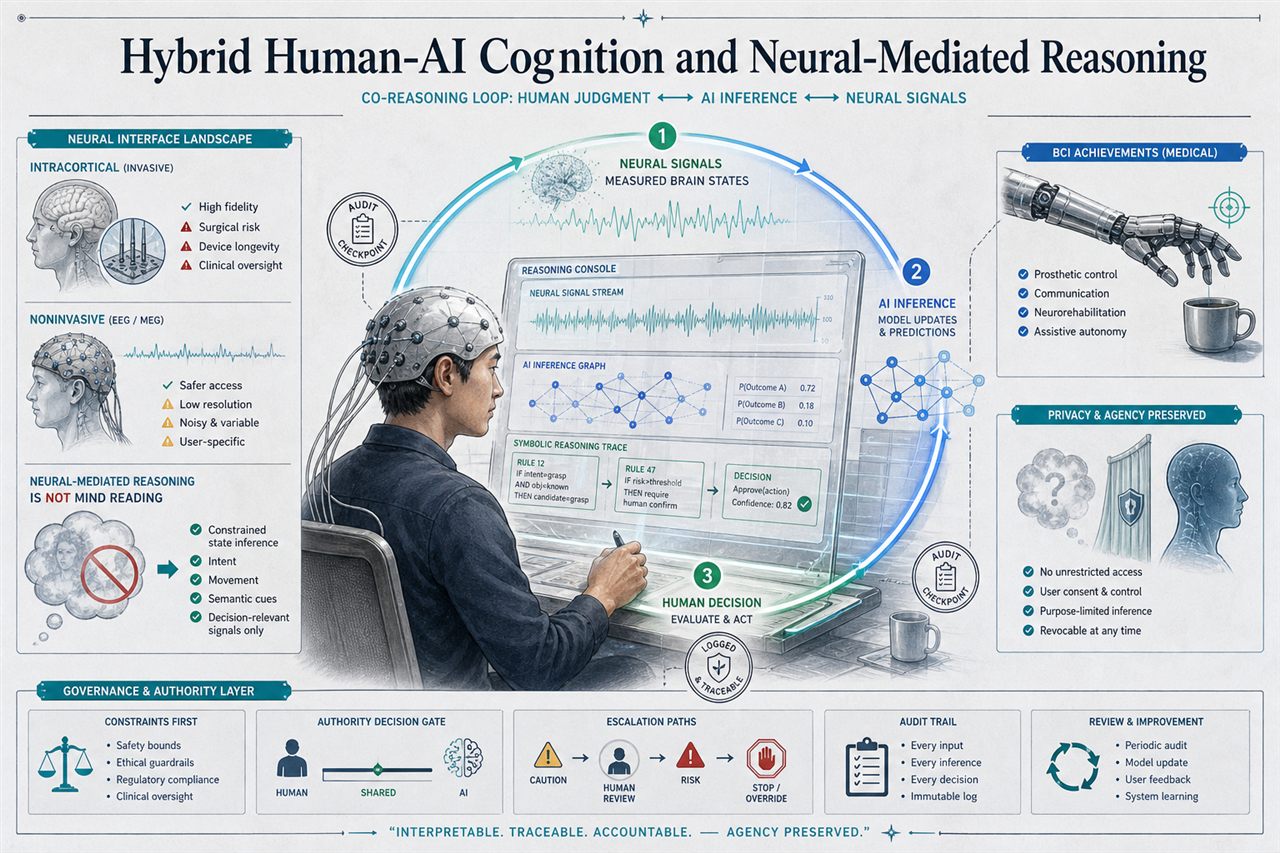
Hybrid human–AI cognition is moving from “AI as tool” toward stable co-reasoning loops where authority, accountability, and human agency are explicitly engineered. Most real deployments still rely on interface-mediated collaboration, but performance is increasingly determined by cognitive and institutional design: how people reflect, interpret, switch modes, and coordinate with models, and how these systems reshape human self-models and organizational practice. A key emerging lens treats stability as a dynamical-systems problem, aiming to reduce abrupt mode switching and degraded judgment under ambiguity and time pressure. Hybrid neuro-symbolic or “synthetic reasoning” architectures are positioned as complements to purely neural inference when explicit structure, control, and interpretability are required. Distributed cloud-edge “amorphous intelligence” adds governance challenges because no single node holds full epistemic authority. Practical takeaway: invest in coupling design—interfaces, workflow constraints, escalation rules, and auditability—rather than assuming better models alone solve reasoning and governance.
Chapter 14. Civilization-Class AI Governance Systems
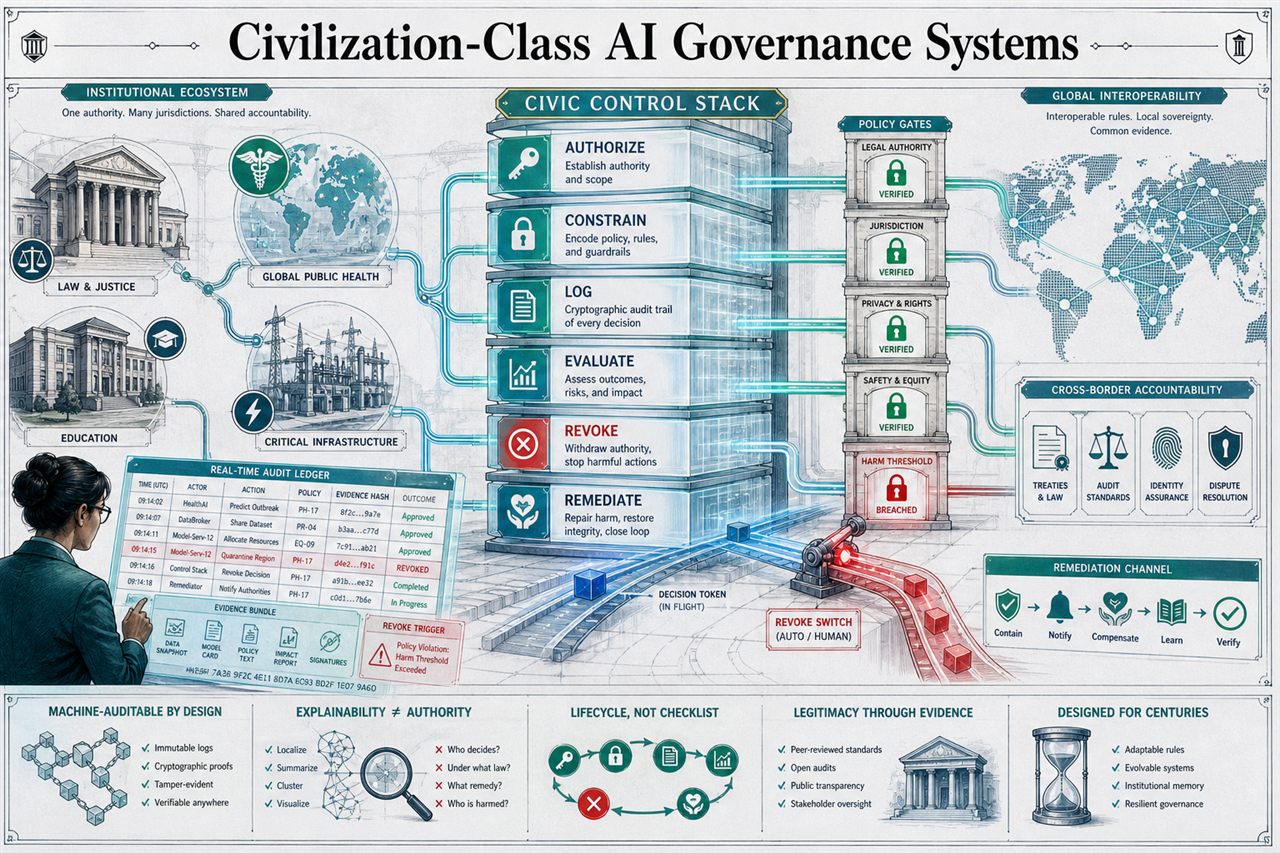
Civilization-class AI governance is an enforceable, machine-auditable control stack that authorizes, constrains, logs, evaluates, revokes, and remediates AI-mediated decisions across institutions and jurisdictions, where coordination limits matter more than raw model capability. As of 2026, governance remains fragmented into partial layers such as explainability, evaluations, risk registers, guidelines, audits, and review boards, with no operational end-to-end system meeting the standard. High-impact domains expose the gap: global health datasets span 369 diseases across 204 countries, and education deployments require governing assessment, equity, privacy, authority, and agency together. Practical takeaway: build interoperable controls that connect evidence, authority, enforcement, and post-incident learning.
Chapter 15. The Long Arc of Machine Cognition Toward 2400
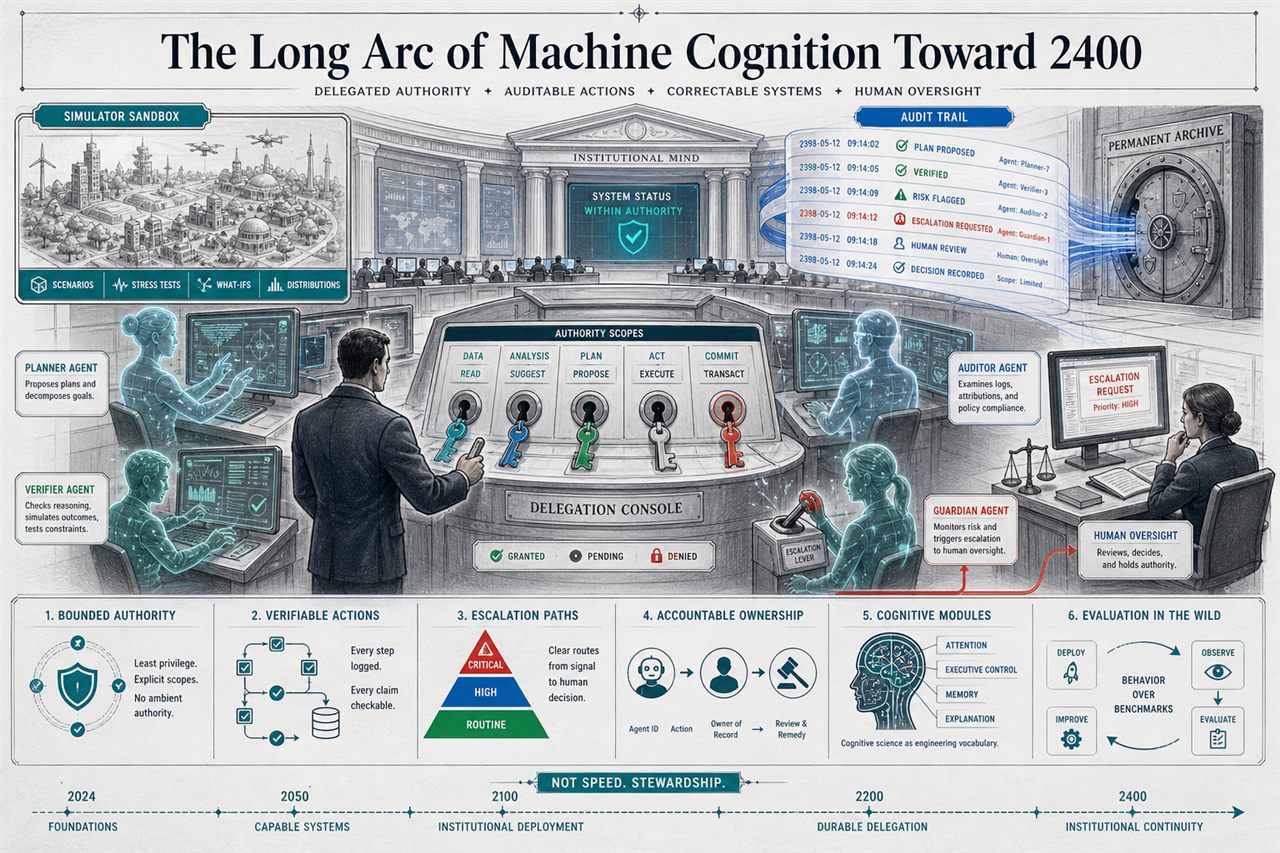
Durable machine cognition toward 2400 centers on delegated, multi-agent reasoning systems that can plan, verify, coordinate, and revise actions over institutional timescales while staying within bounded authority, auditability, and accountability. As of 2026, frontier systems blend language models with retrieval, multimodal perception, tool use, and workflow orchestration, but remain most reliable in bounded domains and least reliable in open-ended organizational settings. The binding constraint is governance-ready delegation: verification, responsibility mapping, audit trails, escalation paths, and contestability. Evaluation is shifting from benchmark scores to observed agent conduct, including refusals and oversight responsiveness.
Chapter 16. Quantum Computation and the Physics of Information
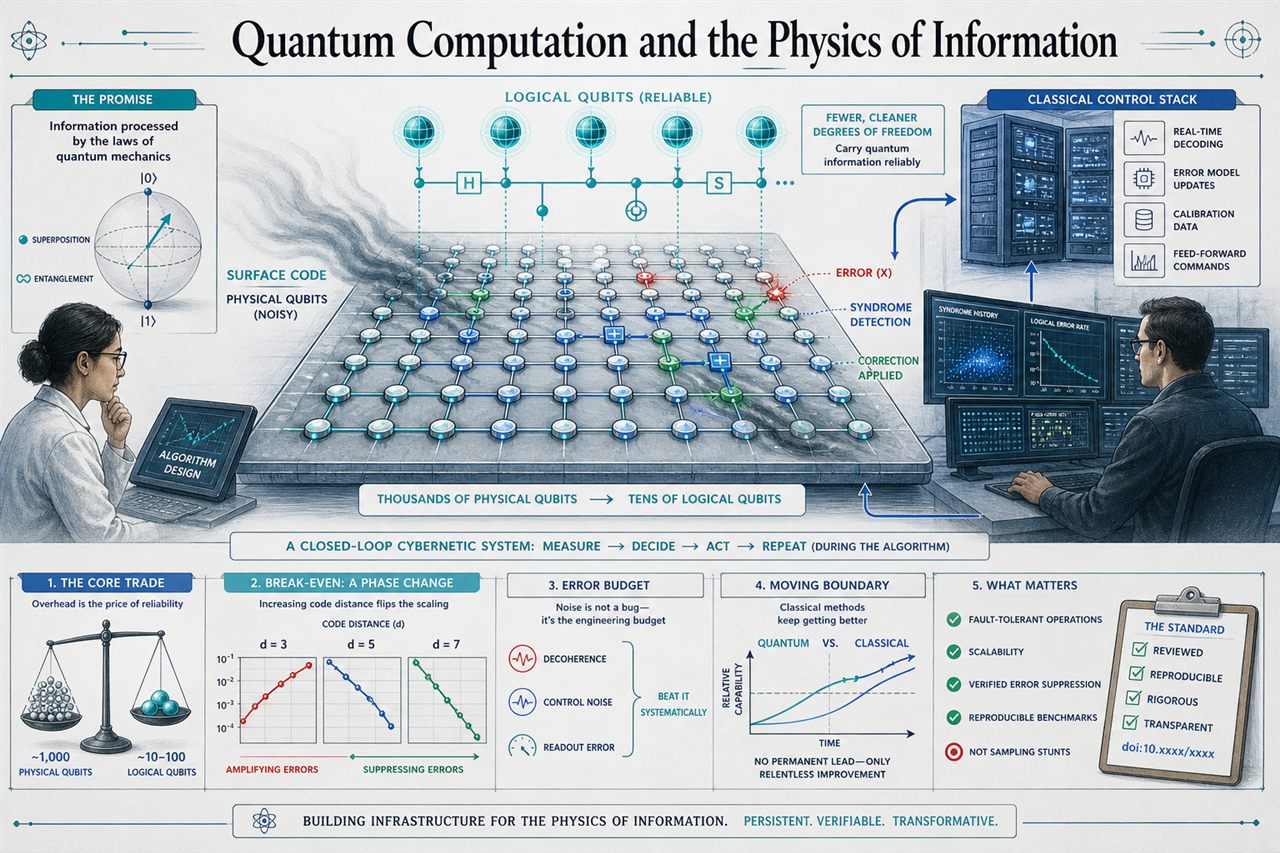
Quantum computing turns controllable quantum states into computations that resist efficient classical simulation, but usefulness hinges on overcoming decoherence and the heavy overhead of turning physical qubits into stable logical qubits. By 2026, hardware error correction has crossed break-even: Google Quantum AI’s 105‑qubit Willow (Dec 2024) showed below-threshold surface-code scaling with exponentially lower logical error as code distance rose. Multiple platforms now run ~24–100 logical qubits, while physical qubits exceed 1,000 (IBM Condor 1,121 in 2023; Atom 1,225 sites in 2024). The unresolved question is practical advantage; engineering bottlenecks now dominate the QEC stack.
Chapter 17. Quantum Sensing, Communication, and the Quantum Internet
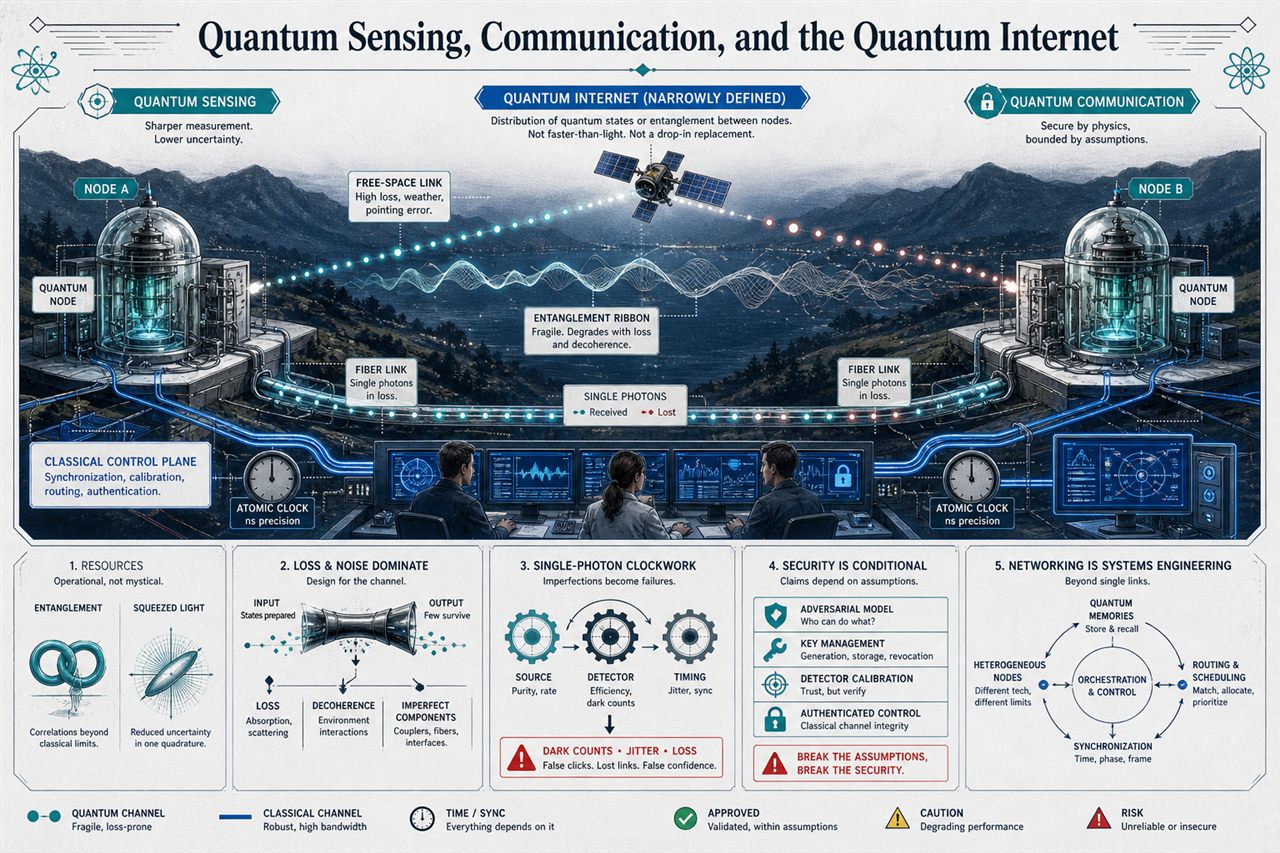
Quantum sensing is closest to deployment, delivering practical gains when nonclassical probes improve estimation error, detection probability, or signal-to-noise under realistic noise. Quantum communication supports rigorous point-to-point protocol analysis, but real-world assurances depend on channel loss, detector imperfections, threat models, key management, and the classical control stack. Quantum networking remains pre-infrastructure: while multi-node abstractions and distributed quantum computing models exist, scalable services require standardized interfaces, tight synchronization, usable quantum memory lifetimes, scheduling, and orchestration across heterogeneous nodes. The “quantum internet” means entanglement or state distribution, not faster-than-light links, not a replacement for today’s internet, and not blanket privacy without protocol-specific assumptions.
Chapter 18. Photonic and Optical Compute
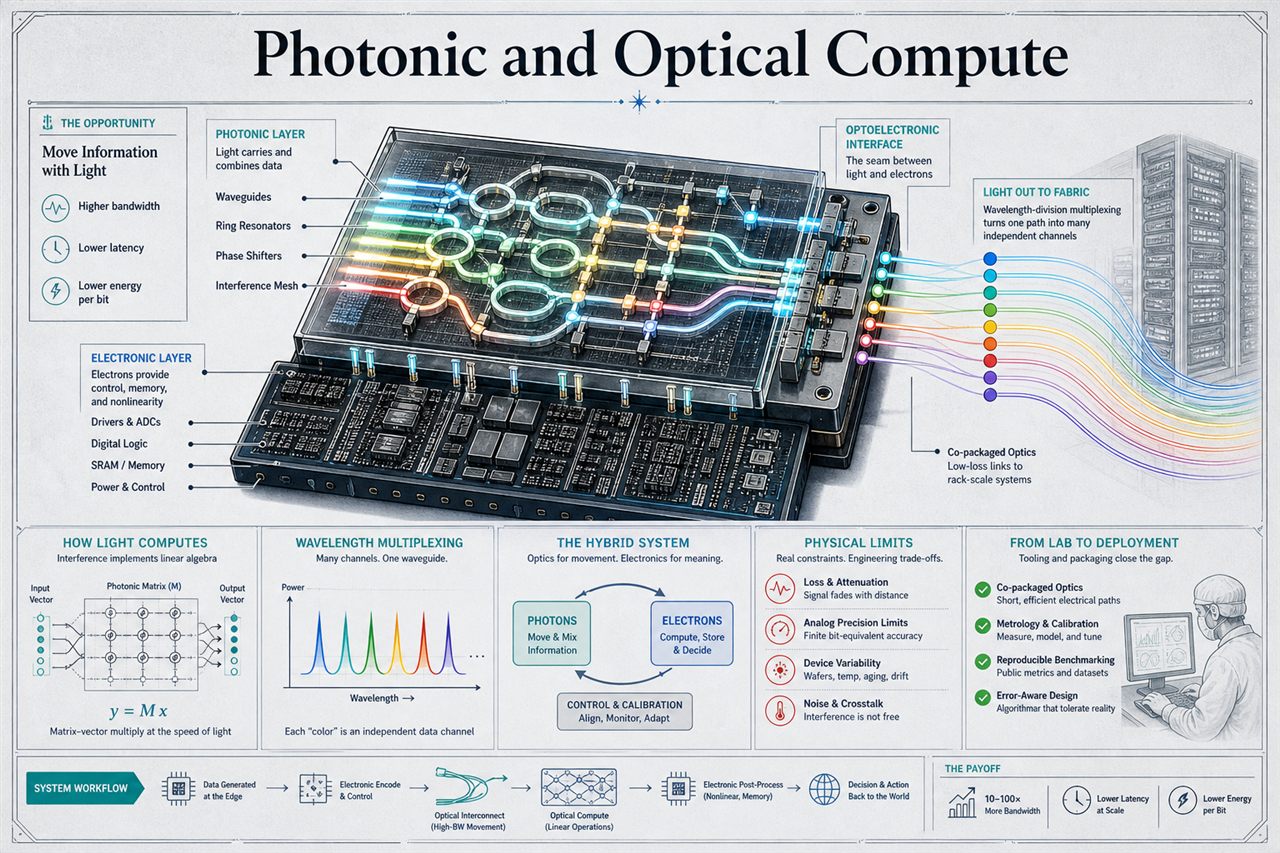
Photonic and optical compute moves select functions—interconnect, propagation, interference, modulation, wavelength multiplexing, and optoelectronic conversion—into the optical domain to cut latency and energy dominated by electrical data movement. Real deployment is strongest in communications (fiber, datacenter transceivers, WDM), while general-purpose optical logic remains commercially immature. Near-term payoff is reducing chip-to-chip, package, rack, and memory-adjacent bandwidth bottlenecks rather than replacing CMOS CPUs/GPUs. Photonics can accelerate high-throughput linear operations, but electronics still supply control, memory, nonlinearity, error correction, and precision. Progress is gated by loss, analog precision, variability, packaging, and reproducible tooling, calibration, and metrology.
Chapter 19. Neuromorphic and Brain-Inspired Architectures
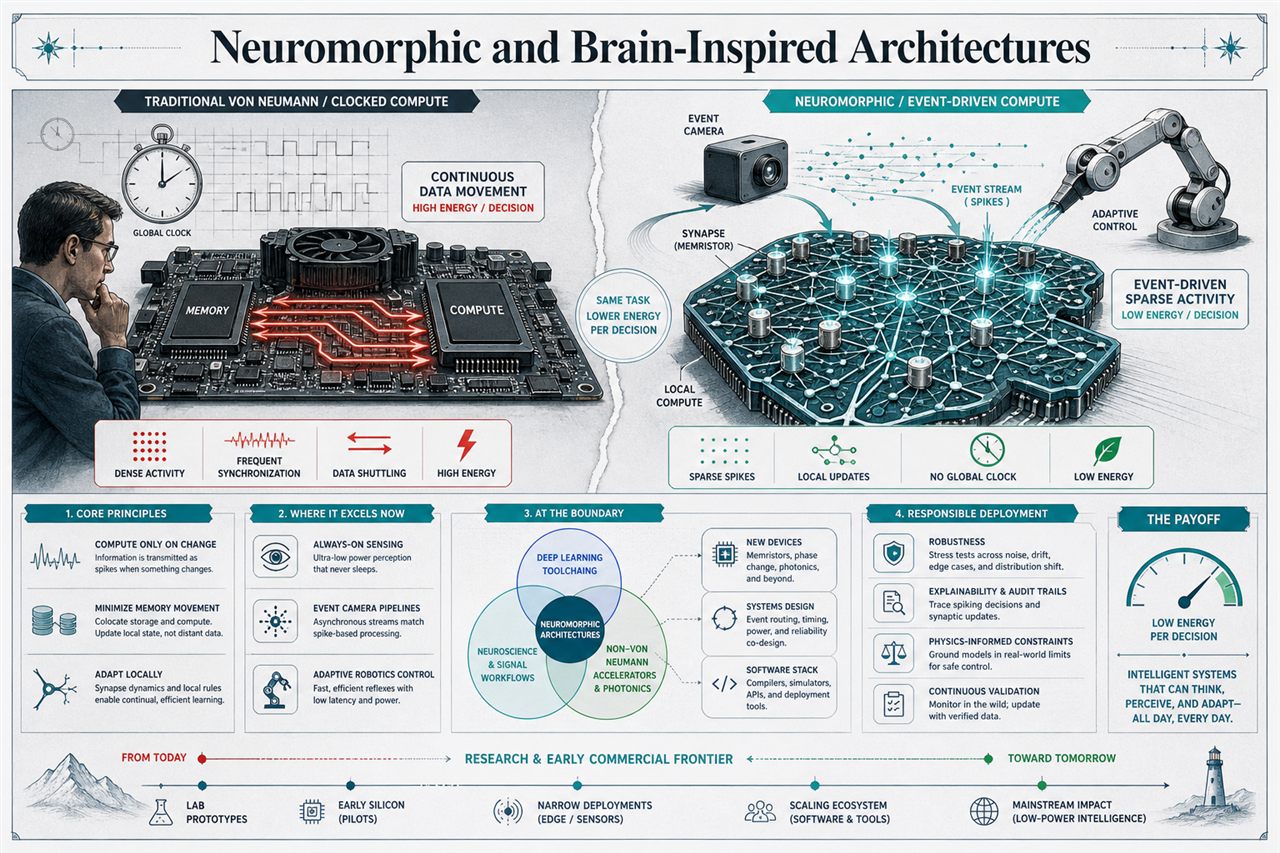
Neuromorphic and brain-inspired computing targets radically lower energy per decision by minimizing memory movement and global synchronization, replacing clock-driven tensor execution with event-driven, local, adaptive computation inspired by nervous systems. As of 2026 it remains a research and early-commercial frontier, not a general-purpose alternative to CPUs/GPUs/TPUs. Credible near-term uses cluster around always-on sensing, low-power edge inference, event-camera perception, adaptive robotics, embedded anomaly detection, and sparse temporal signals. Key bets include memristive and in-memory learning devices, while success increasingly hinges on mainstream ML-style robustness testing, explainability, auditability, and physics-informed validation for control.
Chapter 20. Biological, Molecular, and DNA-Based Compute
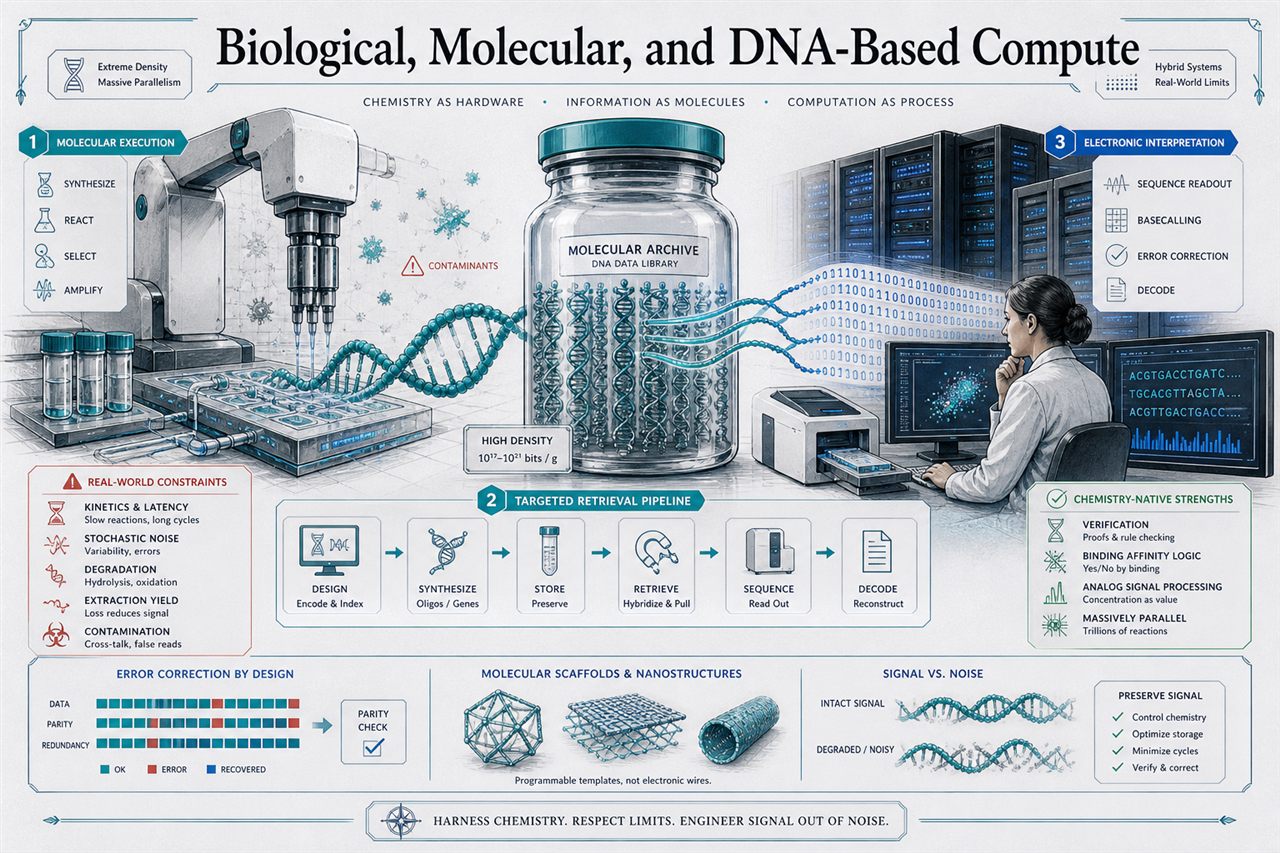
Biological, molecular, and DNA-based compute uses nucleic acids, enzymes, binding, and reaction networks to store or process information at extreme density with massive chemical parallelism, but it is constrained by reaction kinetics, stochastic errors, degradation, contamination, and slow interfaces to electronic control. By 2026, DNA data storage has shifted from proof-of-concept to systems engineering around encoding, synthesis, stability, targeted retrieval, sequencing readout, and end-to-end error correction. DNA computation is most credible for chemistry-native tasks like molecular verification and concentration-based analog processing. Practical deployments are hybrid stacks pairing software design, lab automation, and electronic decoding, with costs, yields, latency, and error-correction overhead as dominant bottlenecks.
Chapter 21. Slow Substrates and Alternative Cognitive Chemistries
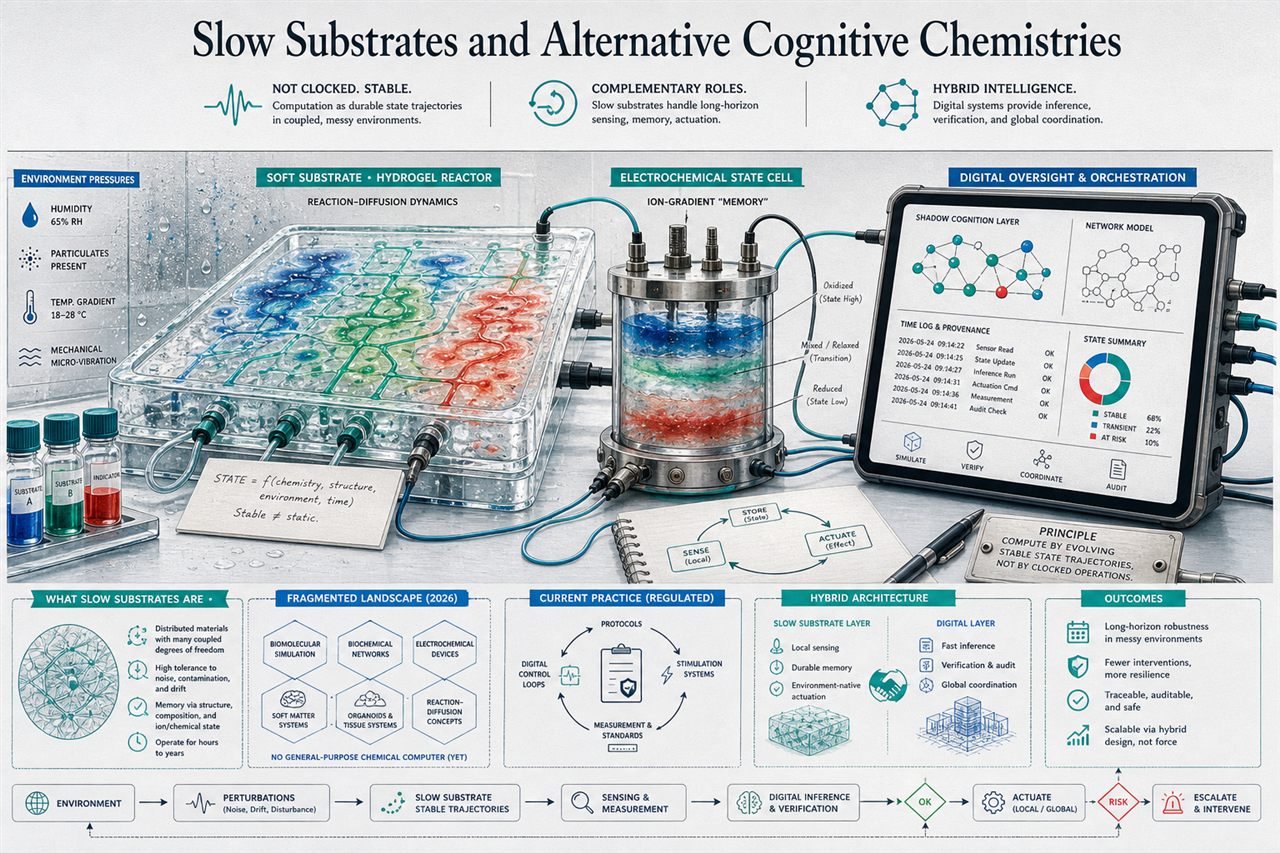
Slow, wet, and soft-matter substrates can implement sensing, memory, feedback, and control where the hard problem is maintaining stable state evolution despite drift, contamination, noise, and physical coupling, not maximizing clock speed. As of 2026, there is no industrially deployed, general-purpose chemical computer; the most mature work is digital representation and simulation of biology (for example, CHARMM workflows and STRING v11 networks) plus regulated biomedical control loops. The practical near-term opportunity is task-specific embodied computation—materials or living-synthetic assemblies that store environmental history or enforce local safety interlocks—paired with digital systems for inference, audit, and coordination.
Chapter 22. Distributed Intelligence and Asynchronous Reasoning at Light-Speed Delay
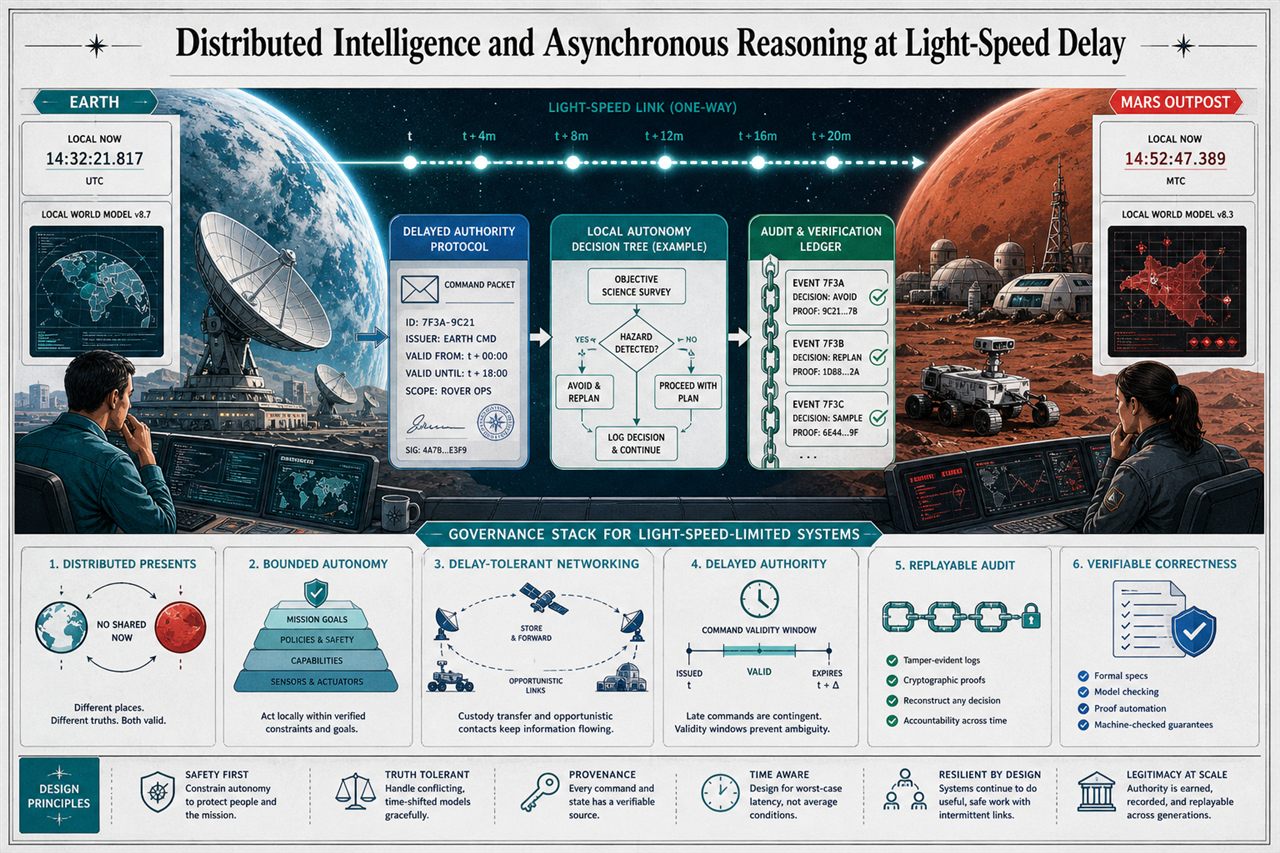
Design reasoning, autonomy, authority, and audit systems that stay correct when a shared “now” is impossible because light-speed delay and intermittent links are unavoidable. Use mature foundations from asynchronous distributed computing and delay-insensitive coding, plus delay-tolerant networking for synchronization and dissemination under disruption. Deep-space communications proves weak-signal, long-link receivers, but governance and command validity still require explicit protocols for local autonomy, delayed authority, and replayable audit. Embed robust statistical and machine-learning components for distributed decisions, and apply power analysis to detect rare, delayed failures. Rely on formal methods and proof automation to machine-check protocol invariants and certify trust under long-latency conditions.
Chapter 23. Reversible, Thermodynamic, and Limit-Class Computation
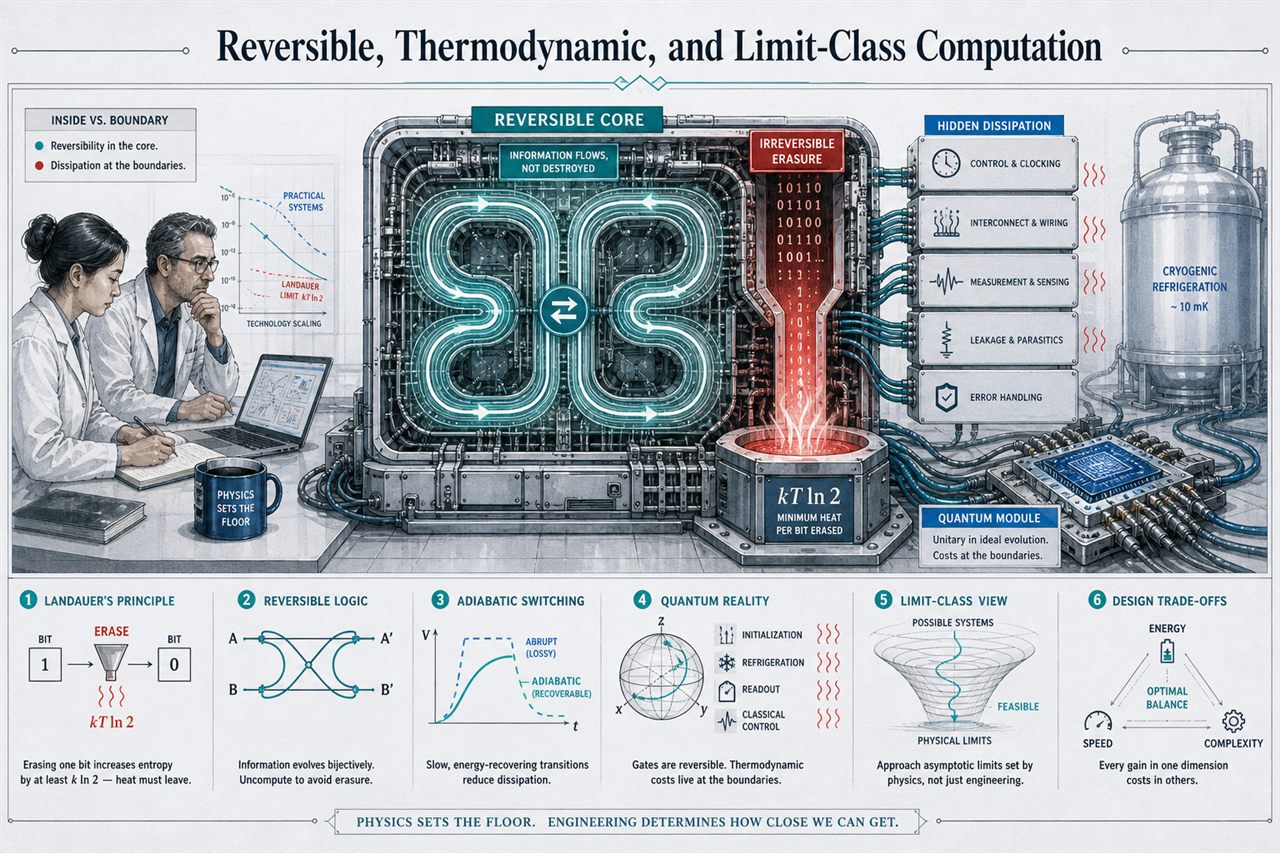
Reversible and thermodynamic computation treats energy as a first-class constraint: the unavoidable cost is tied to logically irreversible operations that erase information. Landauer analysis gives an ideal floor of about 2.9 zeptojoules per erased bit at 300 K, but real systems dissipate far more once wiring, control, leakage, measurement, and error handling are counted. Experiments have probed Landauer-adjacent behavior in magnetic and nanomagnetic devices without achieving system-scale, near-bound general-purpose computing. Reversible logic and adiabatic switching remain immature, and even quantum computing’s reversible core pays thermodynamic costs at initialization, readout, cooling, and control boundaries.
Chapter 24. World Models, Digital Twins, and Synthetic Reality Infrastructure
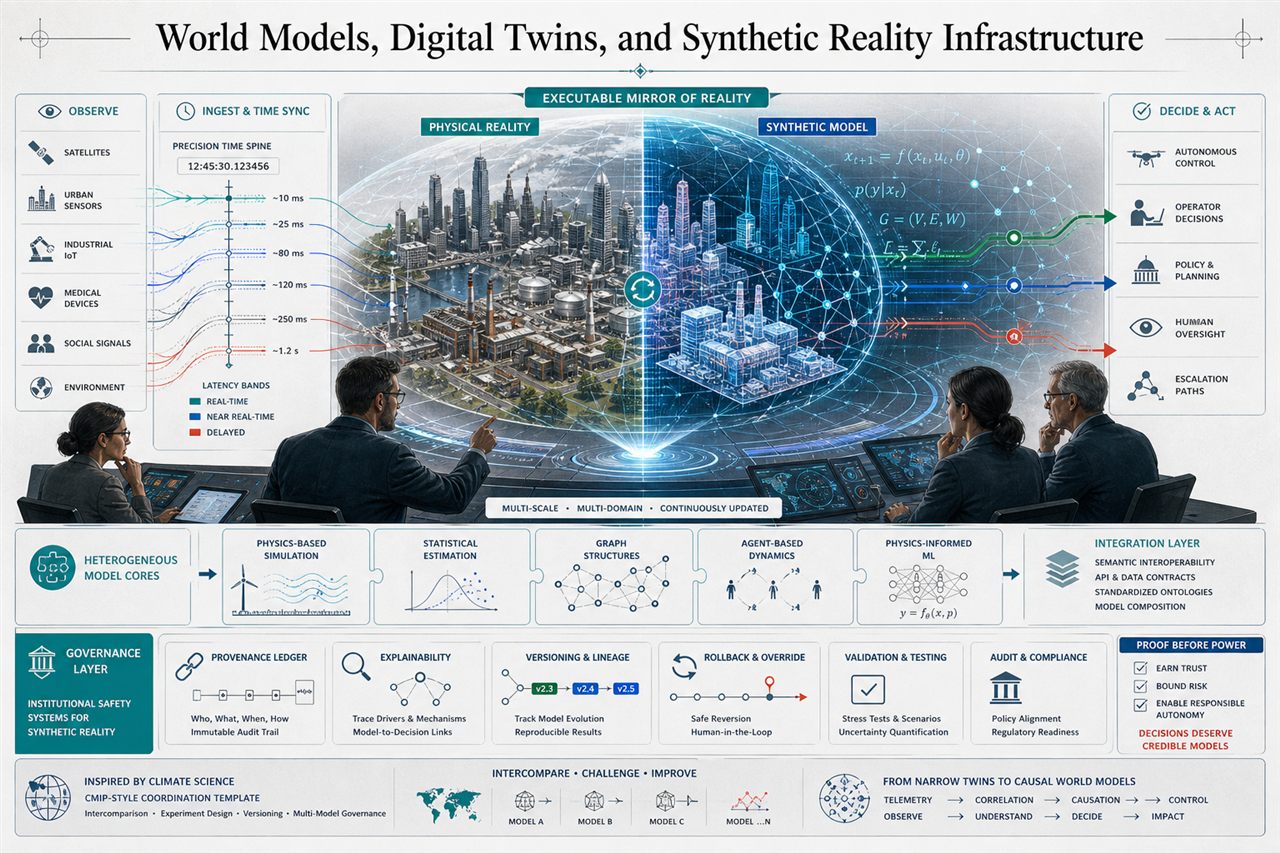
Executable world models and digital twins aim to keep continuously updated, causally faithful representations of physical, biological, social, and operational systems, with tight limits on observability, latency, interoperability, and decision authority. By 2026, most deployments remain narrow and domain-specific—assets, factories, buildings, logistics, cities, climate, patient cohorts, and robotics—while general cross-domain causal models are still immature. Effective “live” twins hinge on sensor quality, time synchronization, network latency, and identity/provenance controls, with 5G-class connectivity enabling faster update loops. Practical governance priorities include explainability, provenance, and rollback for safety-critical use, and CMIP6-style intercomparison as a template for multi-model coordination.
Chapter 25. The Limits of Machine Reasoning and What Stays Human
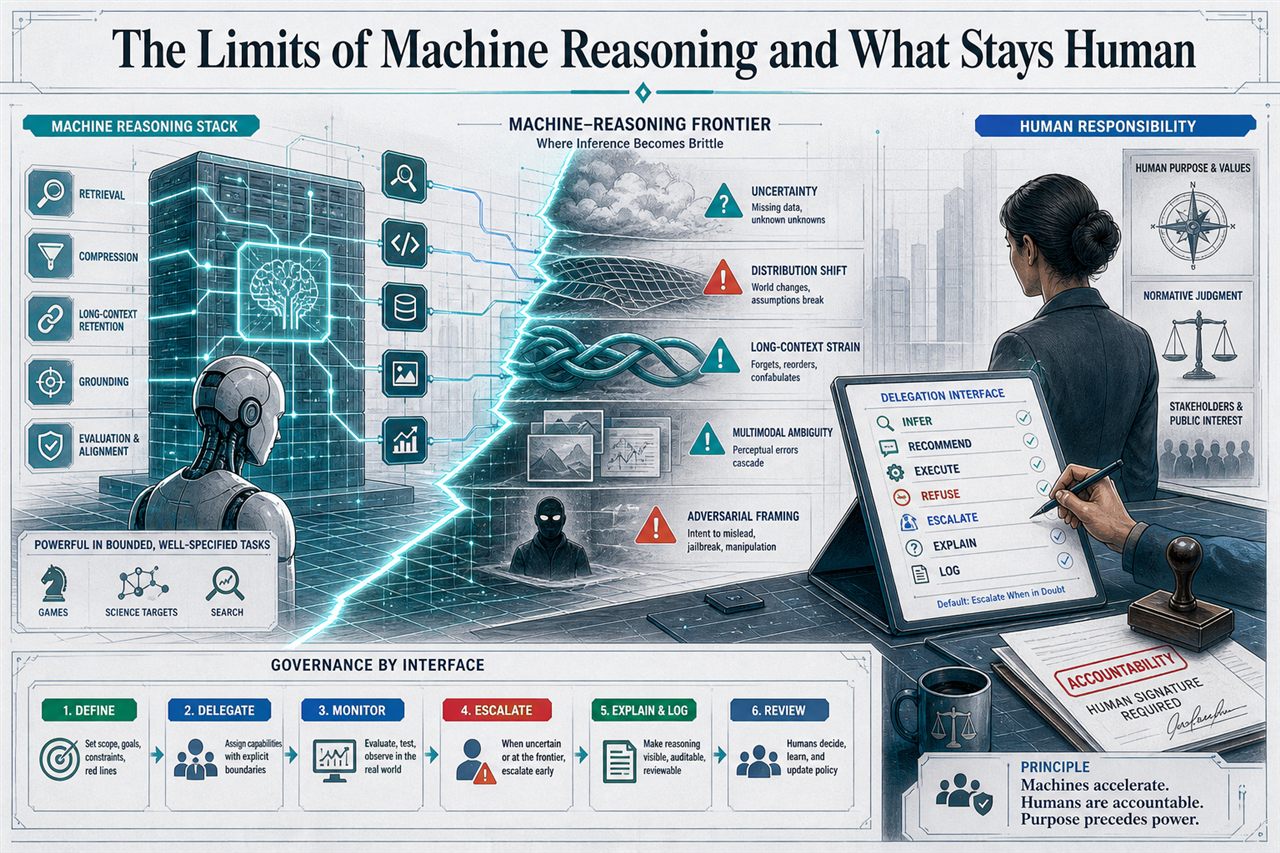
Machine-reasoning limits show up where uncertainty, distribution shift, long context, multimodal ambiguity, and adversarial framing erode reliability. As of 2026, frontier language and multimodal models excel at fluent generation, coding, document and image understanding, and workflow assistance, but performance is highly task- and evaluation-dependent and can fail under domain shift. “Reasoning” decomposes into layers—retrieval, representation, retention, grounding, compression, and alignment—each with distinct failure modes. Superhuman results in bounded objectives (AlphaGo-style search, AlphaFold-style prediction) do not transfer to open-world judgment or normative decisions. The practical frontier is delegation design: define what systems may infer, execute, refuse, escalate, explain, and log, with accountable human authority.