
Part 10. Synthesis - Building Toward 2400 and Beyond
From 'The Long Horizon: A Vision of Frontier Technology from 2026 to 2400' - an AI-authored book produced on Comuvia's BookWriter system. Each chapter below is shown as its Business Editorial poster with a one-paragraph synopsis.
Chapter 187. The Convergence - Where the Frontiers Meet
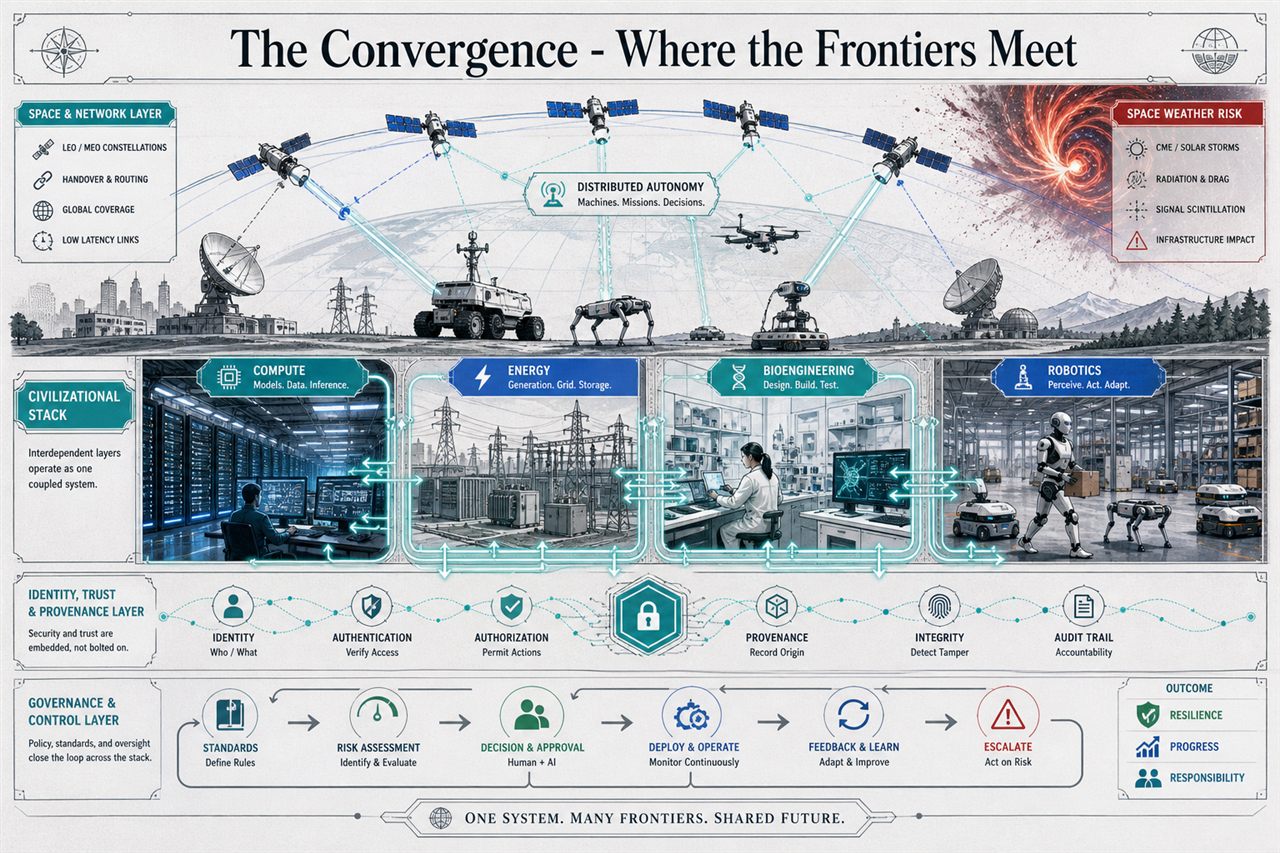
Compute, robotics, bioengineering, energy, identity, trust, and governance are becoming a single coupled “civilizational stack” that must be provisioned and secured as one system. As of 2026, AI is already embedded in scientific and operational workflows, including hybrid physics/ML in geoscience; NGSO satellite constellations are a mature architecture for low-latency distributed sensing and autonomy; open-source materials simulation toolchains connect compute to materials and energy; and space-environment data systems enable resilient space infrastructure operations. Practical takeaways: plan cross-domain dependencies end-to-end, use standards bodies and identity/control planes for interoperability, and ground risk baselines in peer-reviewed benchmarks and burden metrics.
Chapter 188. Scenarios for 2050 - The First Quarter-Horizon
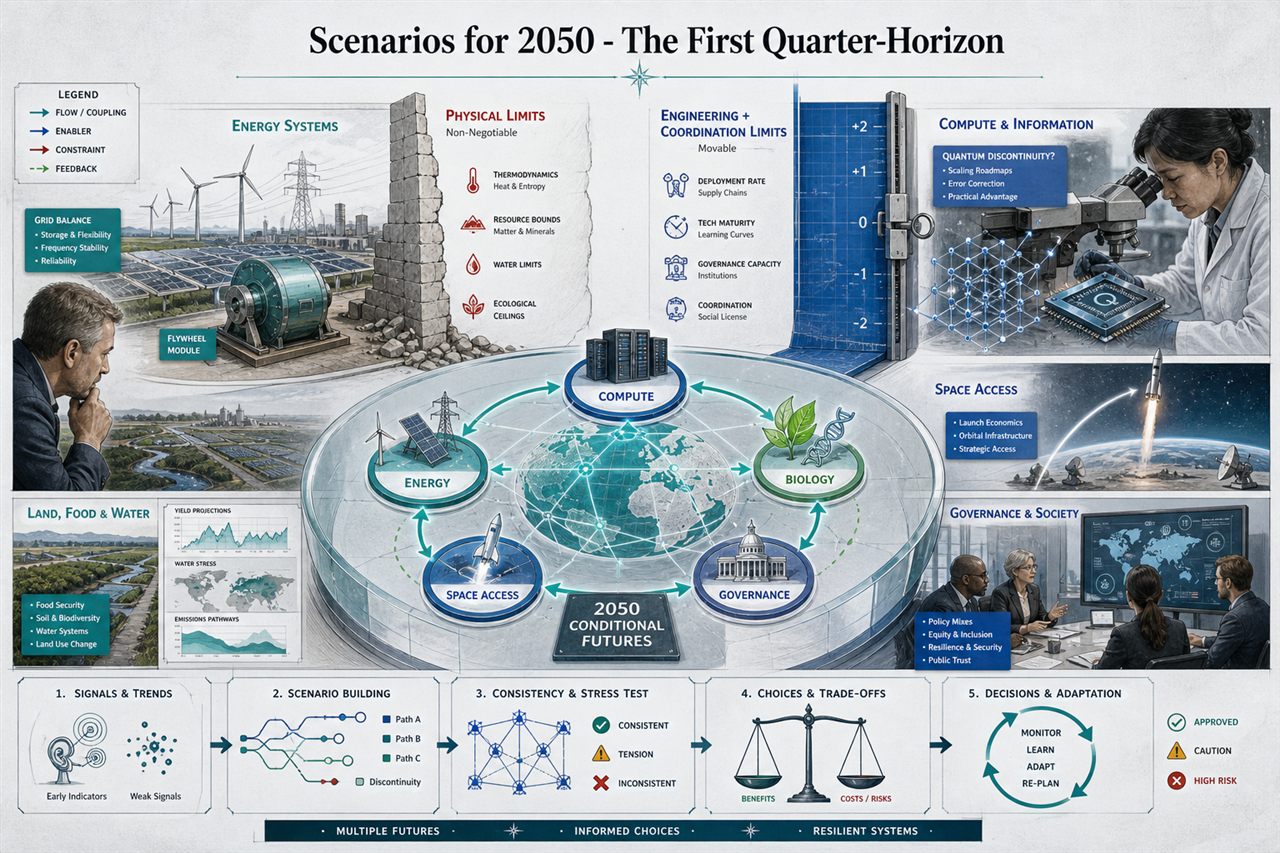
Decision-useful 2050 scenarios require internally consistent conditional futures across coupled systems—compute, energy, biology, space access, and governance—while separating hard physical limits from engineering and coordination limits over a ~24-year horizon. By 2026, energy-to-2050 frameworks are mature and widely reused, with multi-path, policy-conditioned pathways now standard and expanding into economy, land-use, agriculture, and environmental planning. Comparisons show that shared goals can still yield divergent outcomes because of differing technology mixes and assumed coordination capacity. Reliability analysis increasingly treats storage and flexibility (including flywheels) at whole-system level. Quantum computing is tracked as a discontinuity, but relevance hinges on scaling and error correction, not qubit counts.
Chapter 189. Scenarios for 2100 - The First Century
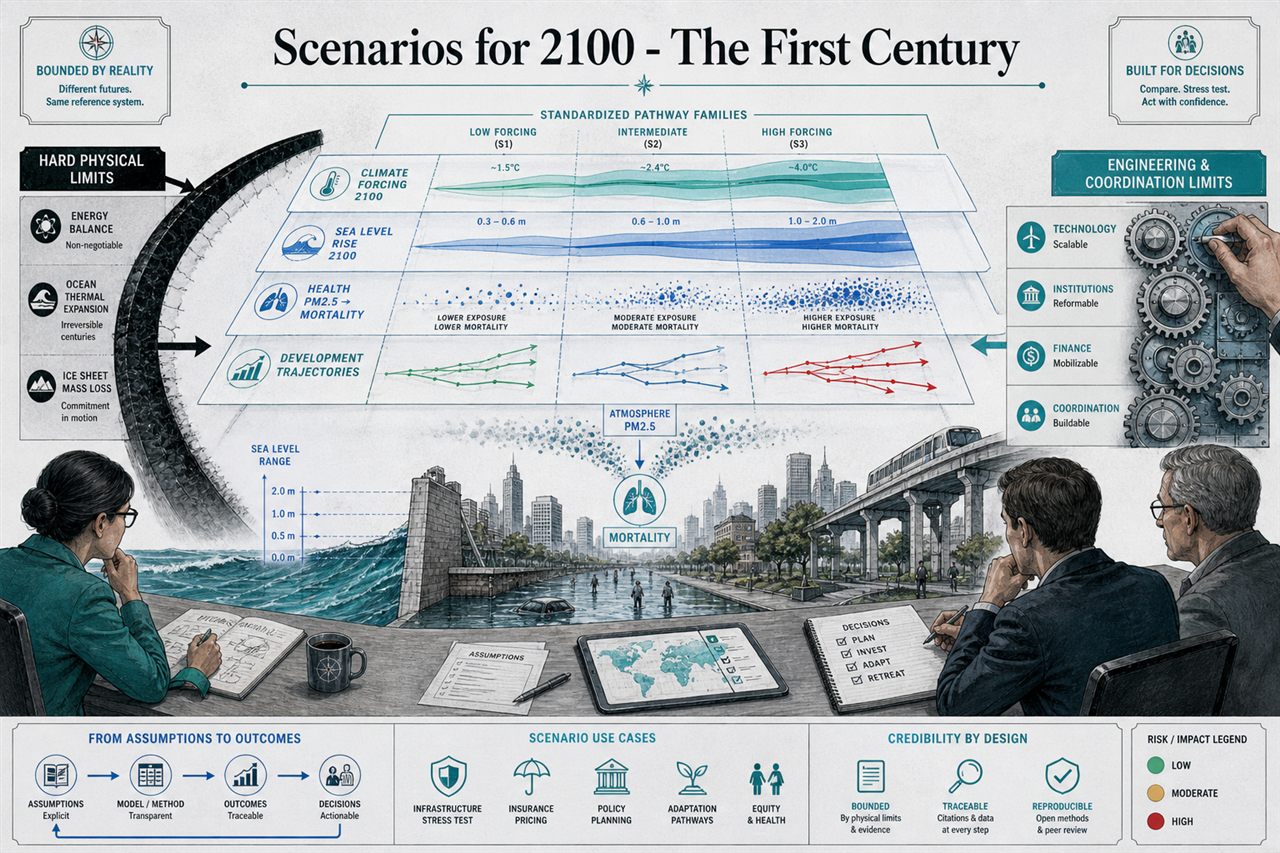
Disciplined 2100 scenarios should be bounded, citation-traceable, and decision-relevant, separating hard physical limits from engineering and coordination limits. Planning practice in 2026 relies on standardized climate pathway families (RCPs/SSPs) and scenario-dependent sea-level rise ranges, with century-scale health and development projections increasingly linked to climate drivers such as PM2.5 exposure and mortality. Divergence among futures is framed less as fate than as institutional persistence and “active policy” versus “passive” trajectories. Practical takeaways: keep scenario families interoperable without double-counting assumptions, design threshold-based sea-level decision triggers, integrate health baselines consistently, and translate wellbeing-oriented narratives into auditable KPIs for capital allocation.
Chapter 190. Scenarios for 2200 - Two Centuries Out
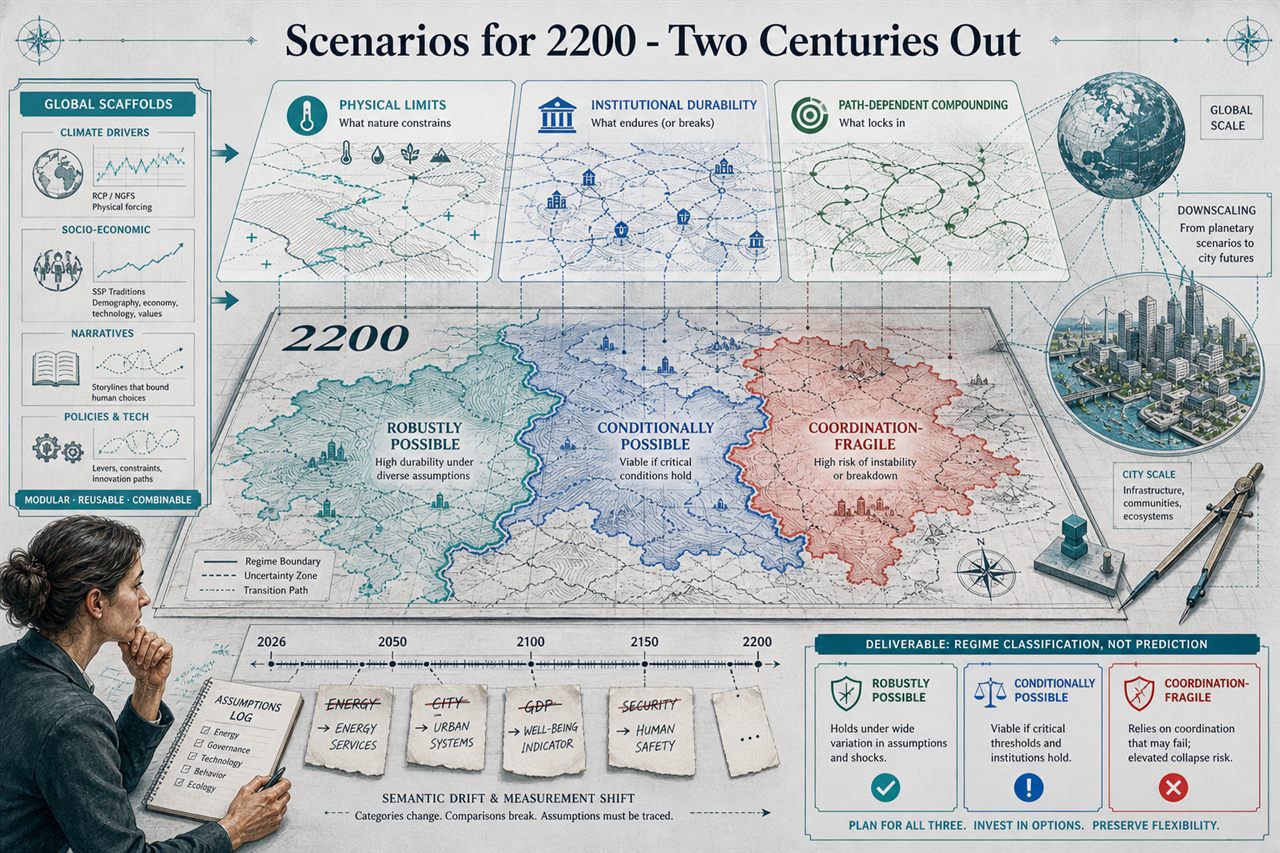
Scenario work for 2200 should map bounded, citation-traceable regime spaces rather than predict outcomes, stress-tested against physical limits, institutional durability, and path-dependent compounding. Best practice comes from climate and socio-economic modeling: beyond ~2100, uncertainty control and explicit assumptions matter more than accuracy. Reusable scenario families (SSP/RCP-style scaffolds) help explore stabilization versus delayed or fragmented coordination, but downscaling to cities remains highly assumption-sensitive. The biggest failure modes are semantic drift, changing measurements, and institutional discontinuity, so planners should classify futures as robustly possible, conditionally possible, or coordination-fragile/unstable and invest in standards and continuity mechanisms.
Chapter 191. Scenarios for 2400 - The Far Edge of Disciplined Forecast
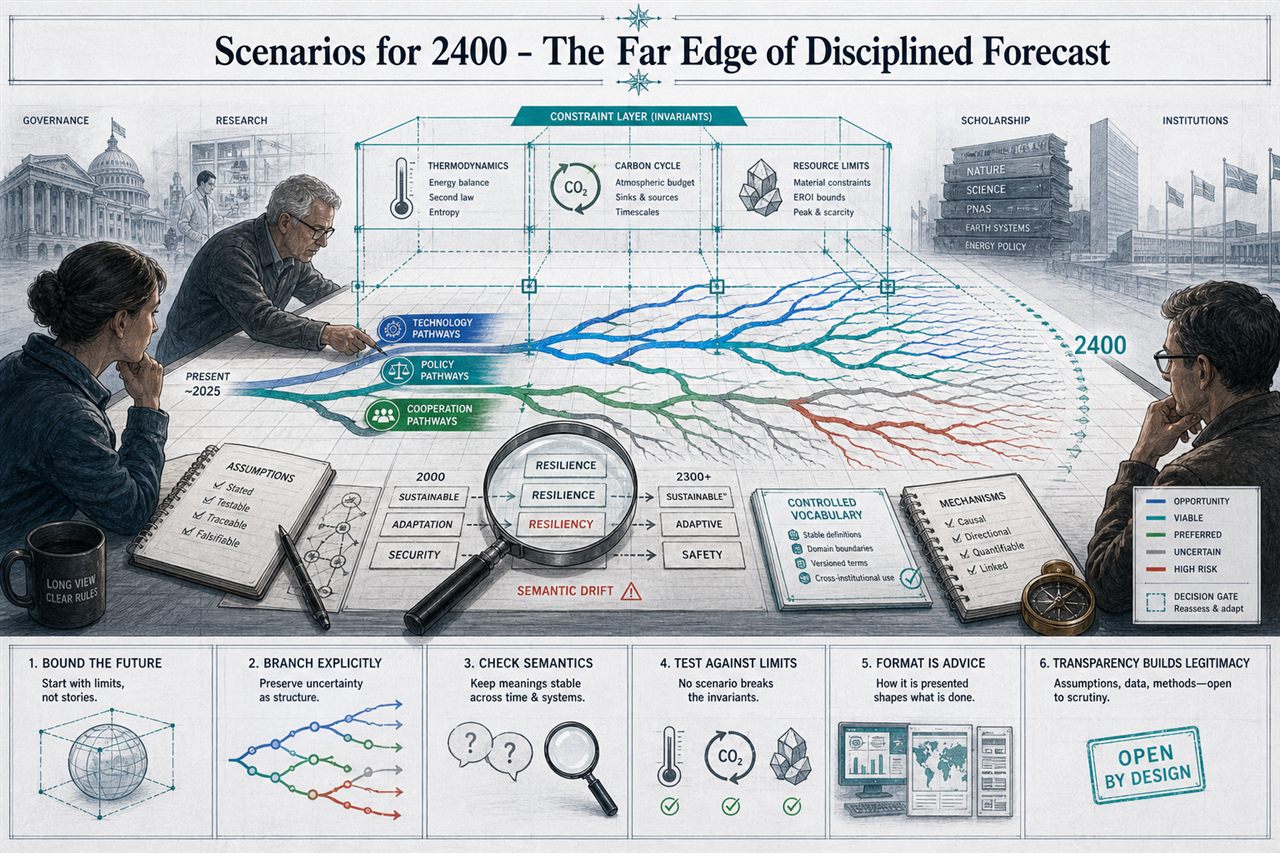
Disciplined scenarios for 2400 rely on explicit mechanisms, traceable assumptions, and hard constraints to avoid “fiction drift.” Work is strongest through 2050–2100; beyond that, outcomes become highly sensitive to framing and semantics, so vocabulary control becomes a core technical problem. Branching pathways—policy, technology, and cooperation regimes—beat point forecasts for decision-making under deep uncertainty, and how scenarios are packaged can change decisions as much as their content. Practical takeaways: enforce invariant bounds where they exist, treat semantics as a primary risk, and design scenario outputs as actionable advice channels, not just narratives.
Chapter 192. Beyond 2400 - Where Speculative Fiction Begins
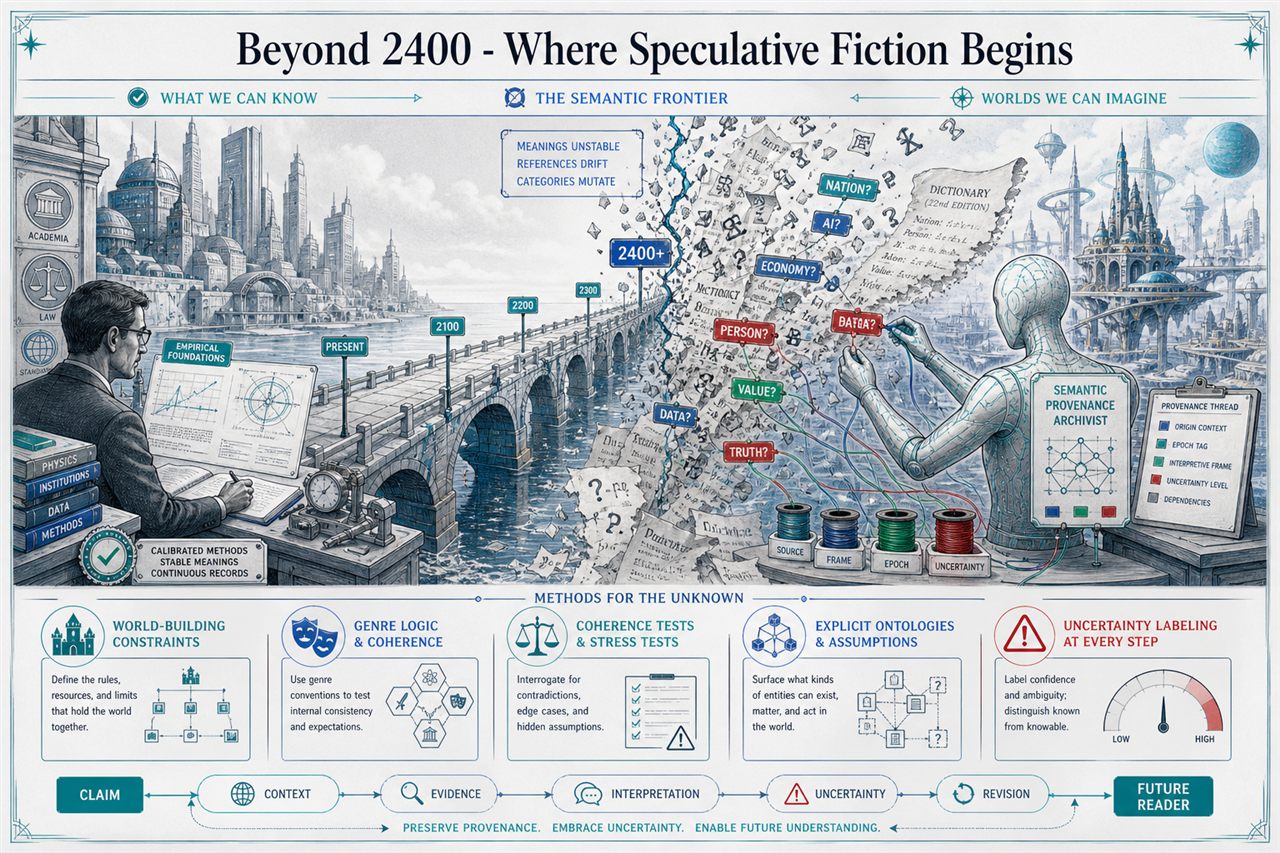
Past 2400, uncertainty is driven less by physics than by semantic drift and institutional discontinuity, so claims should shift from forecast to structured speculation. Long-horizon work often fails because categories, word meanings, and interpretive frames mutate, breaking reference classes and causal traceability. Use speculative fiction scholarship as a disciplined “speculation mode”: world-making methods to enforce internal coherence, and genre/community analysis to flag interpretive limits. Treat speculative realism as a tool for ontological testing, exposing hidden assumptions about what entities exist. For AI-assisted analysis, prioritize semantic provenance, stable taxonomies, and explicit uncertainty labels over story generation.
Chapter 193. Sovereign Strategy and Long-Horizon Statecraft
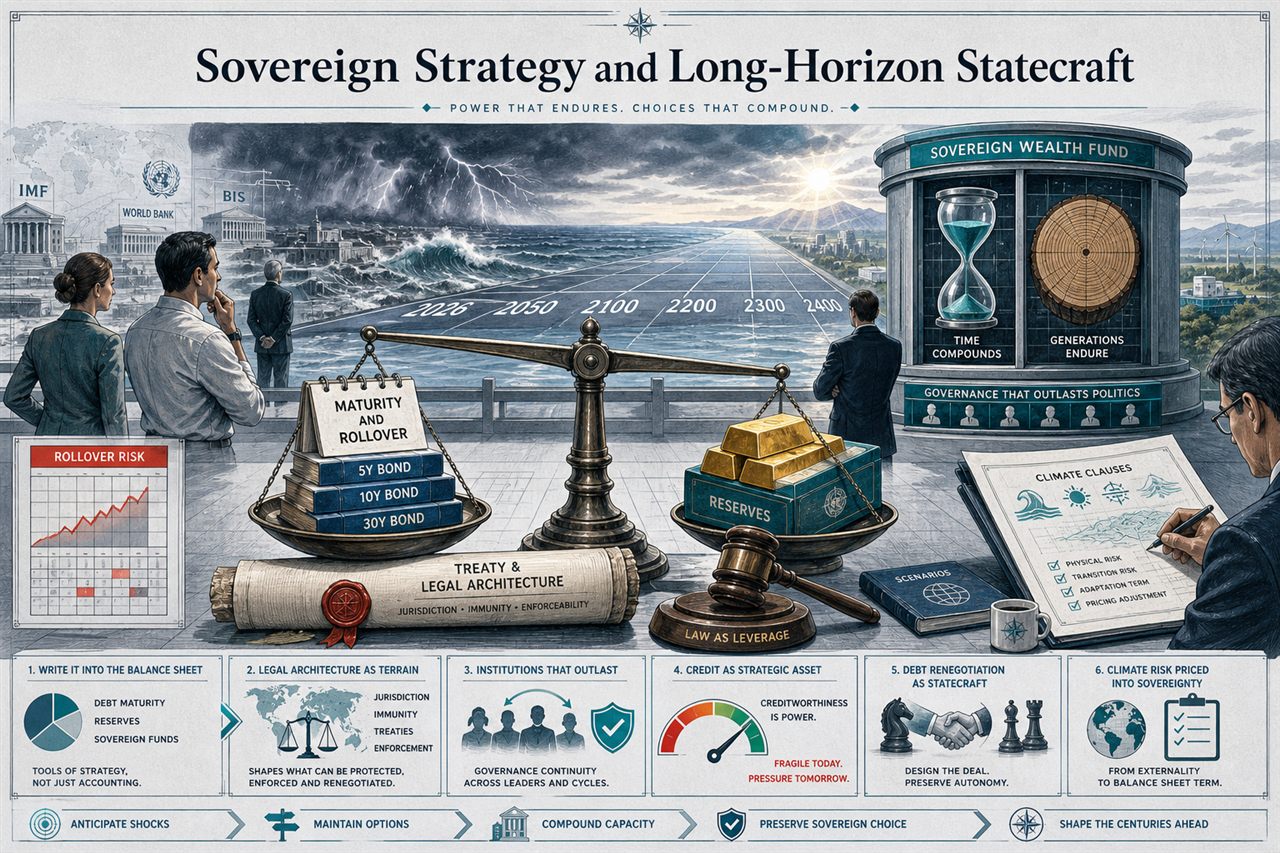
Sovereign statecraft is shifting from mainly diplomacy and force to managing balance sheets, legal architecture, and market access so states preserve fiscal capacity, command continuity, and legitimacy through long shocks. Treat debt structure, reserves, and sovereign funds as strategic assets: convert volatile windfalls into durable national capital and design governance to survive political turnover. Creditworthiness depends on borrowing strategy, rollover risk, and credible policy consistency, while debt renegotiation is a recurring tool with negotiable structures and bargaining posture. Climate risk is moving into sovereign finance via contractual clauses, turning climate from an externality into a balance-sheet term.
Chapter 194. Long-Horizon Investment and the Capital of Centuries
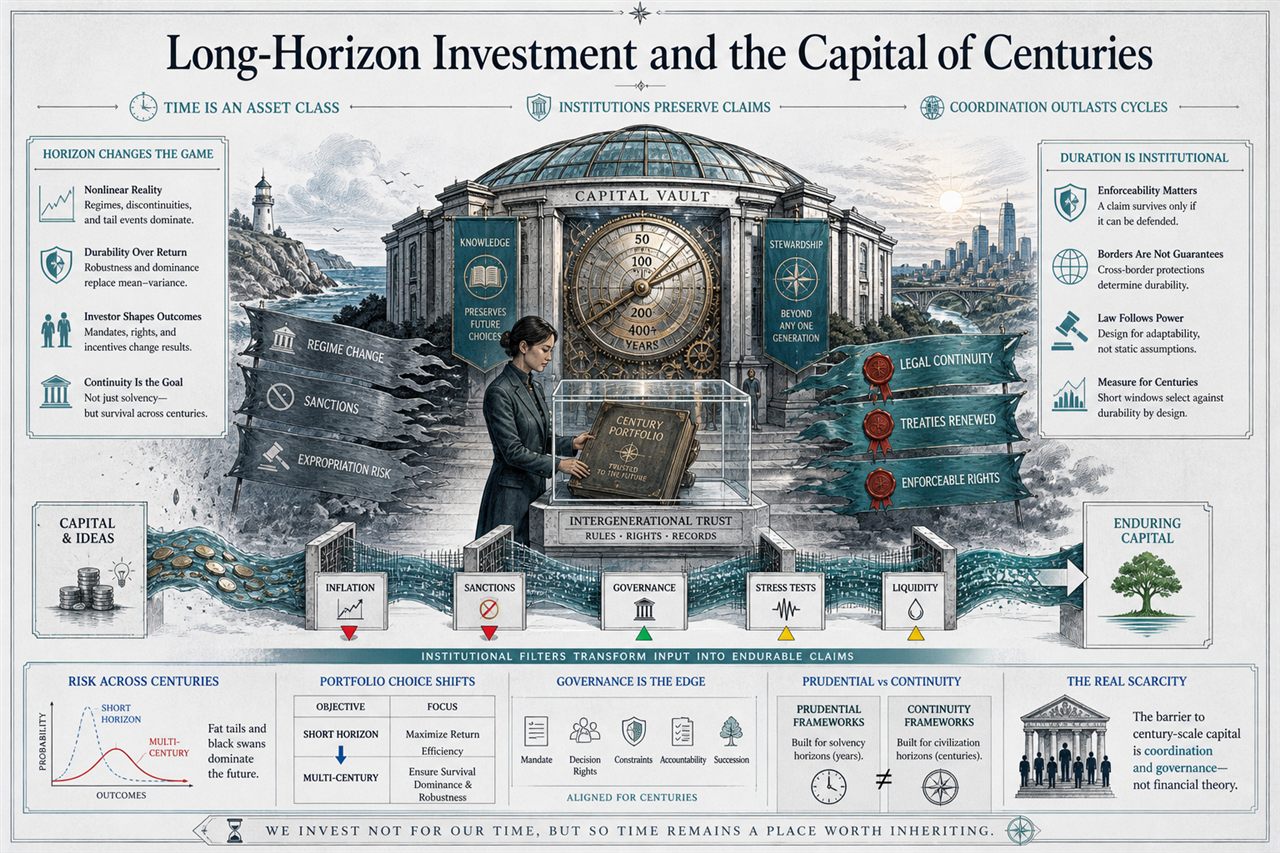
Long-horizon investment aims to preserve real productive capacity and institutional continuity over 50–400+ years despite regime, technological, and legal uncertainty. Research shows horizons change return distributions, make simple short-to-long risk scaling unreliable, and can shift optimal portfolio choice from mean–variance intuition toward dominance-based rules. Investor horizon also affects behavior and realized outcomes, so governance design matters as much as asset selection. Prudential capital frameworks formalize long-dated exposures but were not built for multi-century continuity, and political enforceability can determine whether claims remain claims. Practical takeaway: redesign discount-rate policy, benchmarks, and incentives to avoid short-horizon metric capture.
Chapter 195. Cross-Civilizational Coexistence as a Long-Horizon Design Problem
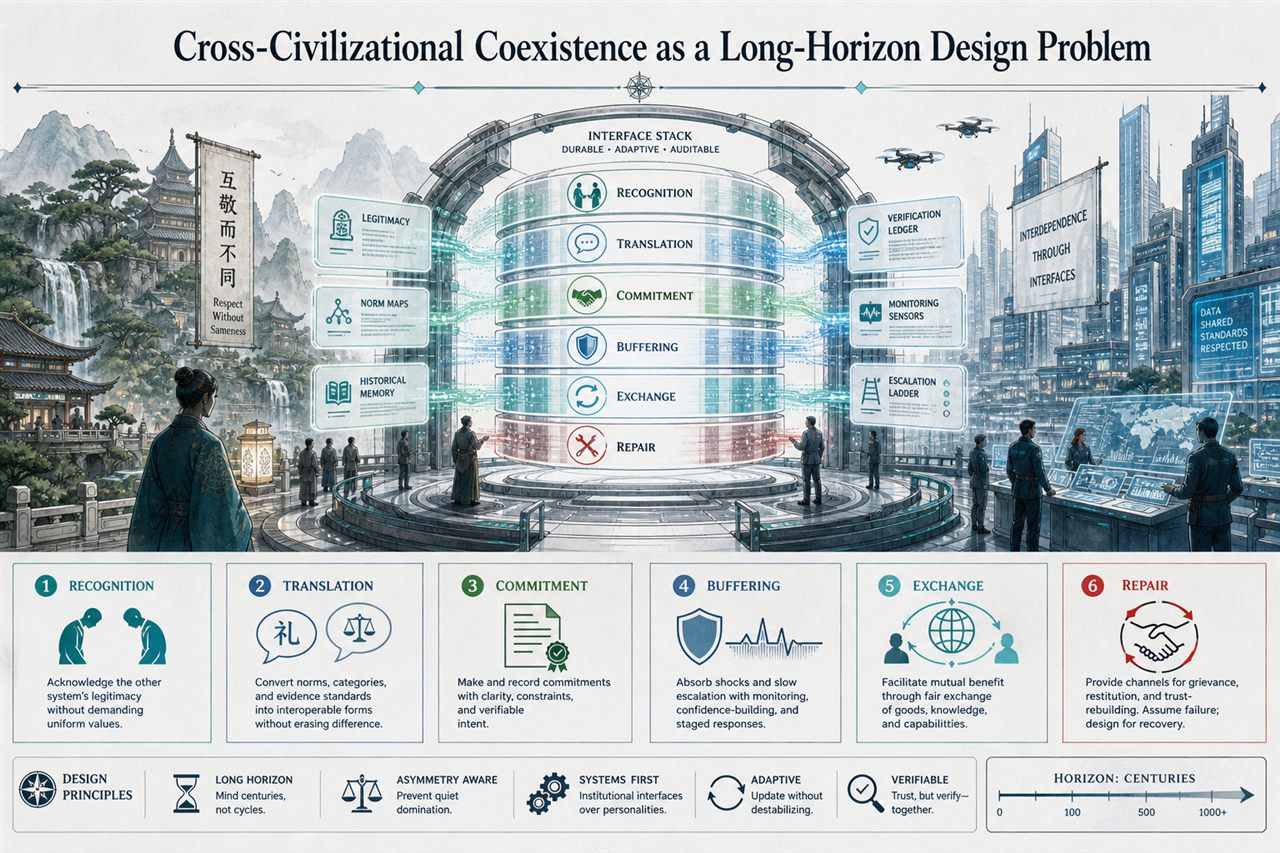
Cross-civilizational coexistence is treated as an engineering problem: building durable institutional interfaces for recognition, translation, commitment, buffering, exchange, and repair that limit domination and escalation under power asymmetry and long time horizons. As of 2026, practice relies on diplomacy and law rather than measurable, portable “interface stacks,” with theory emphasizing pluralism, legitimacy versus legality, and bridging categories. Stability depends on dialogue across civilizations and internal cohesion within them. Technology shifts what governance is feasible. Practical models include UDHR-based minimum constraints, non-assimilationist coexistence, city-level governance patterns, and ritual-identity levers such as Ukraine’s church calendar reform.
Chapter 196. The Boundary Between Civilization and Its Frontier
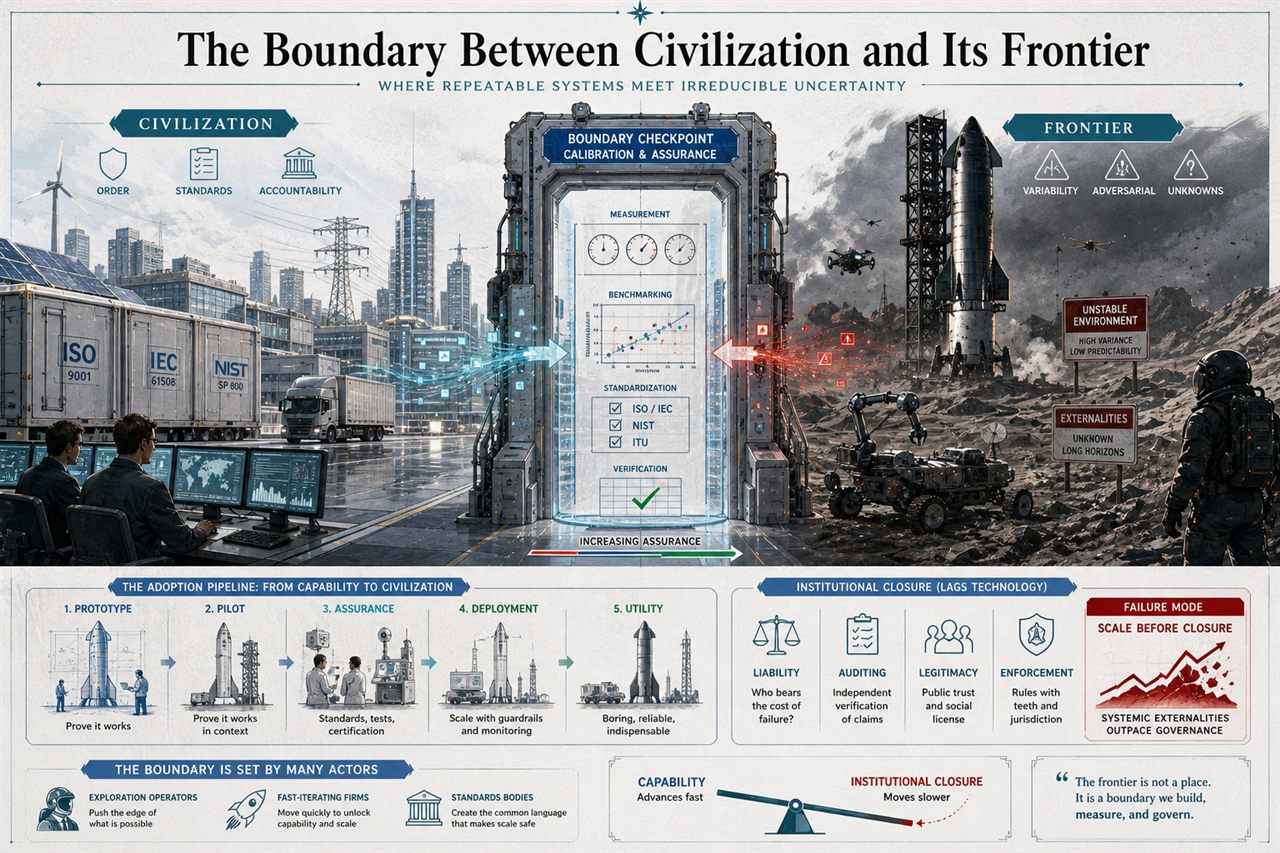
Civilization’s frontier is where repeatable, governable operations meet irreducible uncertainty, unstable externalities, and incomplete institutions. The practical pattern for crossing that boundary is prototype to pilot, then standards and assurance, then mass deployment, and finally utility-like infrastructure, but governance, liability, audit, and legitimacy usually lag compressed technical cycles. Measurement and benchmarking are decisive levers because standardized tasks and datasets turn qualitative progress into comparable performance, as seen in Pascal VOC (2009). A recurring failure mode is scaling before institutional closure, illustrated by 2023 Starship test reporting: rapid learning at large scale also amplifies public-risk interfaces and externalities.
Chapter 197. Worlds That Hold Together vs Worlds That Fall Apart
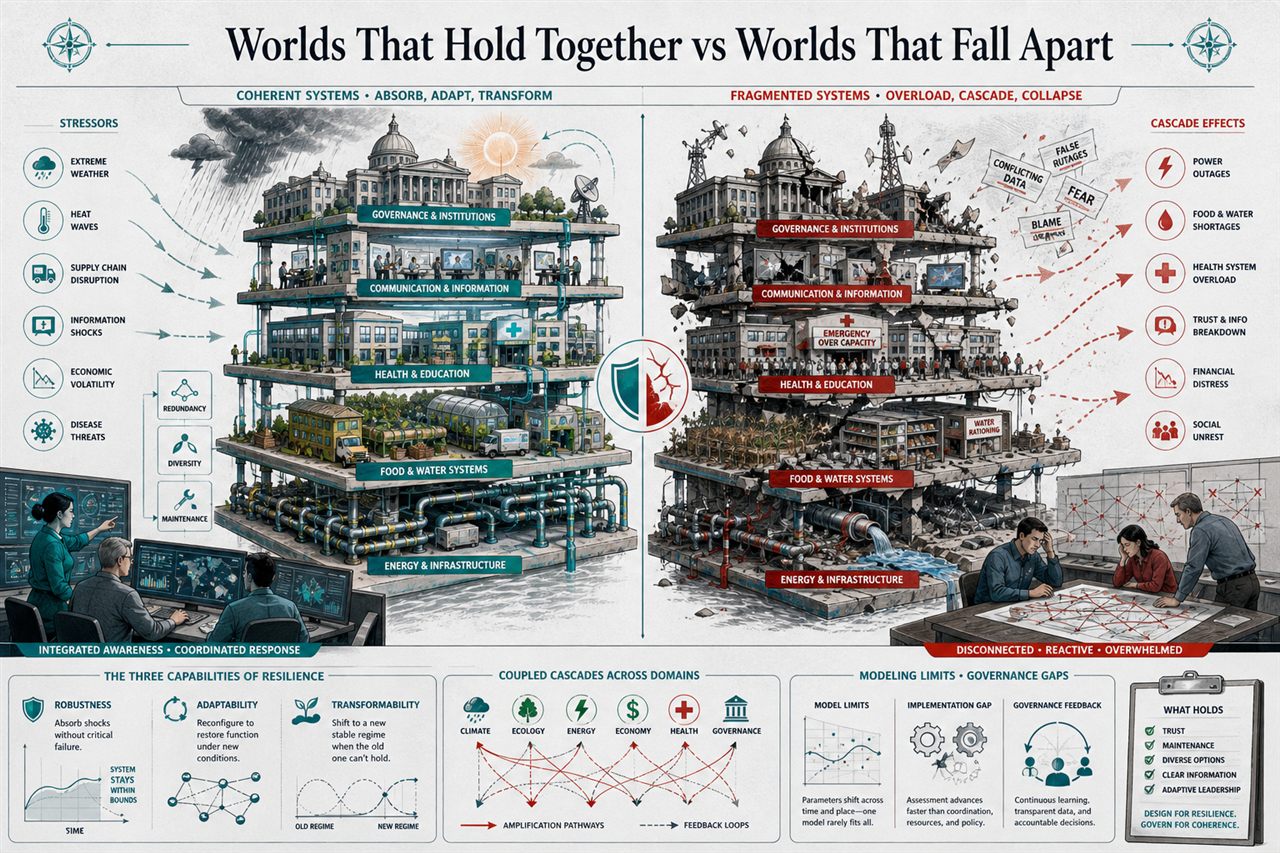
Coherent worlds are built by engineering and governing multi-layer socio-technical systems to resist cascading failure when energy, trust, maintenance capacity, or information quality erodes. Resilience is best treated as a trio—robustness, adaptability, transformability—rather than a single score, and climate risk should be modeled as coupled shocks across physical, ecological, economic, and institutional domains, even if local enforcement is uneven. Practical levers include raising population “health literacy” to reduce stress loads, protecting biodiversity as redundancy, and using mixed-effects and nonlinear calibration to model heterogeneity without overfitting. Standards bodies and resilience institutions provide coordination scaffolding.
Chapter 198. Why Some Frontiers Take Longer Than Expected
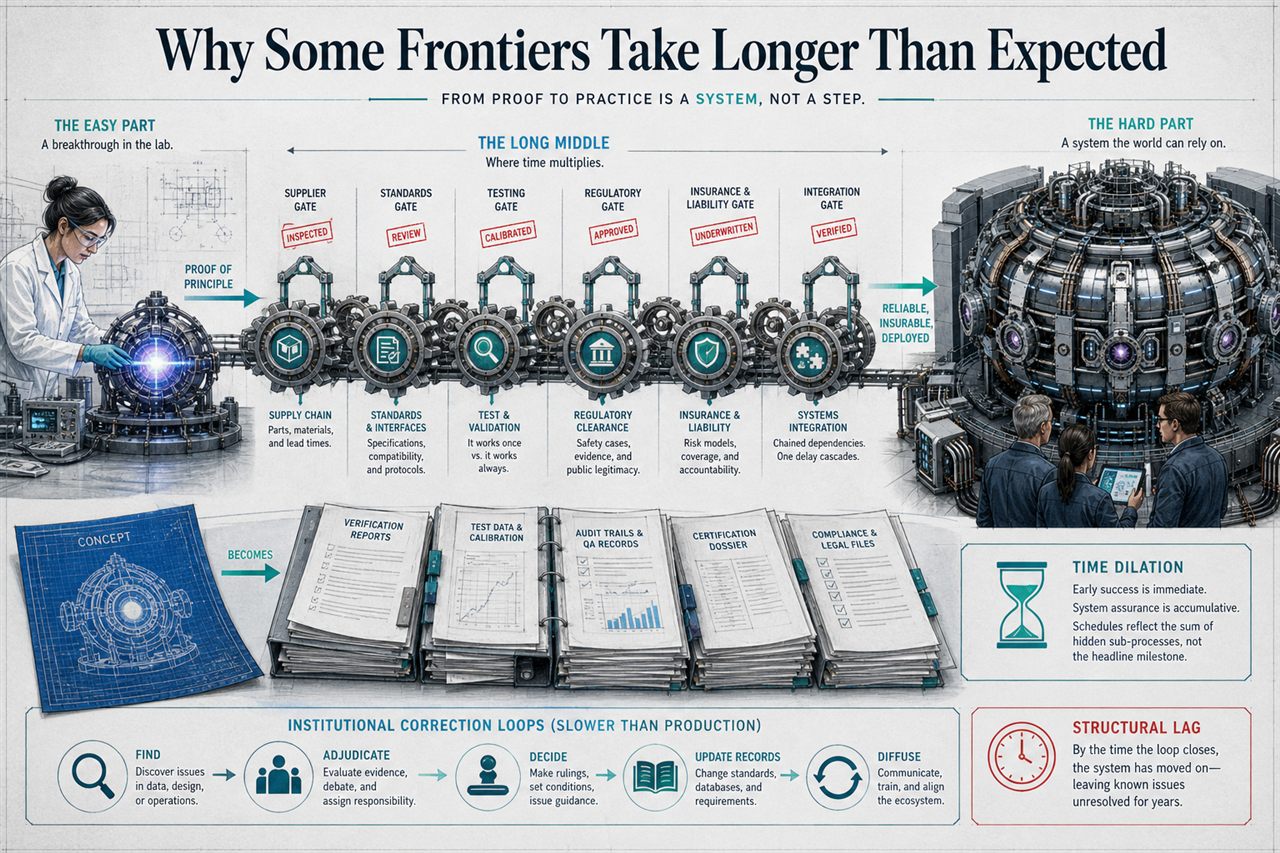
Frontiers often disappoint timelines because early demonstrations hide maturation latency: the work shifts from invention to scaling, integration, validation, legitimacy, and durability. Delays usually come from chained dependencies—supply chains, interface engineering, regulatory clearance, liability, standards, and institutional adoption capacity—rather than a single blocker, making megaprojects and high-assurance systems especially variance-prone. Correction loops can be slower than production, so known errors persist while records catch up. Practical takeaway: decompose schedules into hidden sub-processes, plan for multi-actor coordination and auditability, and treat “fielded and insurable” as a separate milestone from “works in principle.”
Chapter 199. Why Some Frontiers Arrive Sooner Than Expected
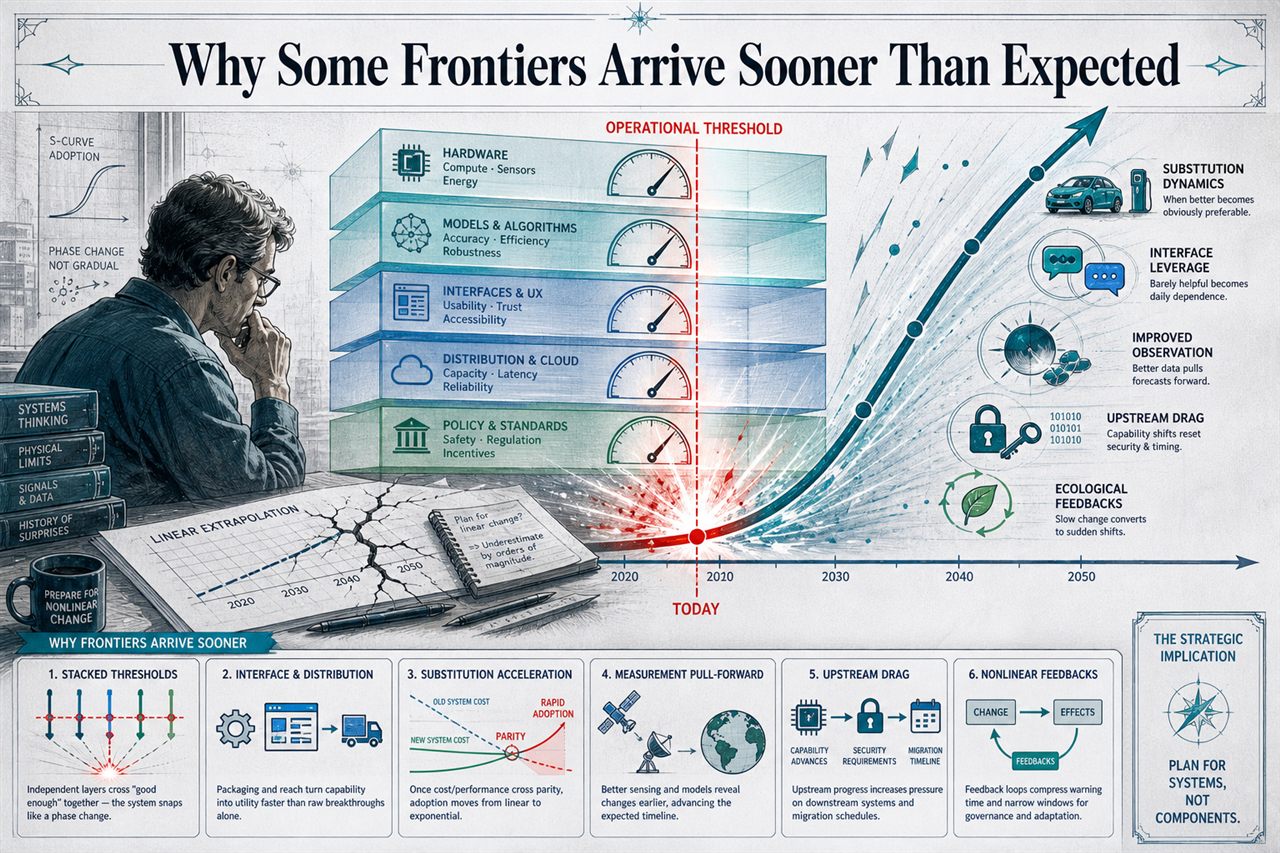
Frontiers arrive early when several complements—capability, interface, distribution, standards, financing, and supply chains—cross operational thresholds together, collapsing adoption timelines beyond linear forecasts. Examples include voice assistants becoming broadly useful via product packaging in the mid‑2010s, repeated pull-forward of EV mass-market viability in the 2010s through learning curves and substitution dynamics, and 2023 revisions to an earlier/stronger solar maximum as observations improved. Similar pull-forwards appear in quantum advantage debates (2020) and quantum cybersecurity urgency (2023), while ecological feedback loops can abruptly shorten governance warning time. Practical takeaway: monitor parallel complement gains, keep flexible capacity, and treat “sooner” as a risk accelerator too.
Chapter 200. The Disciplines That Outlast Their Founders
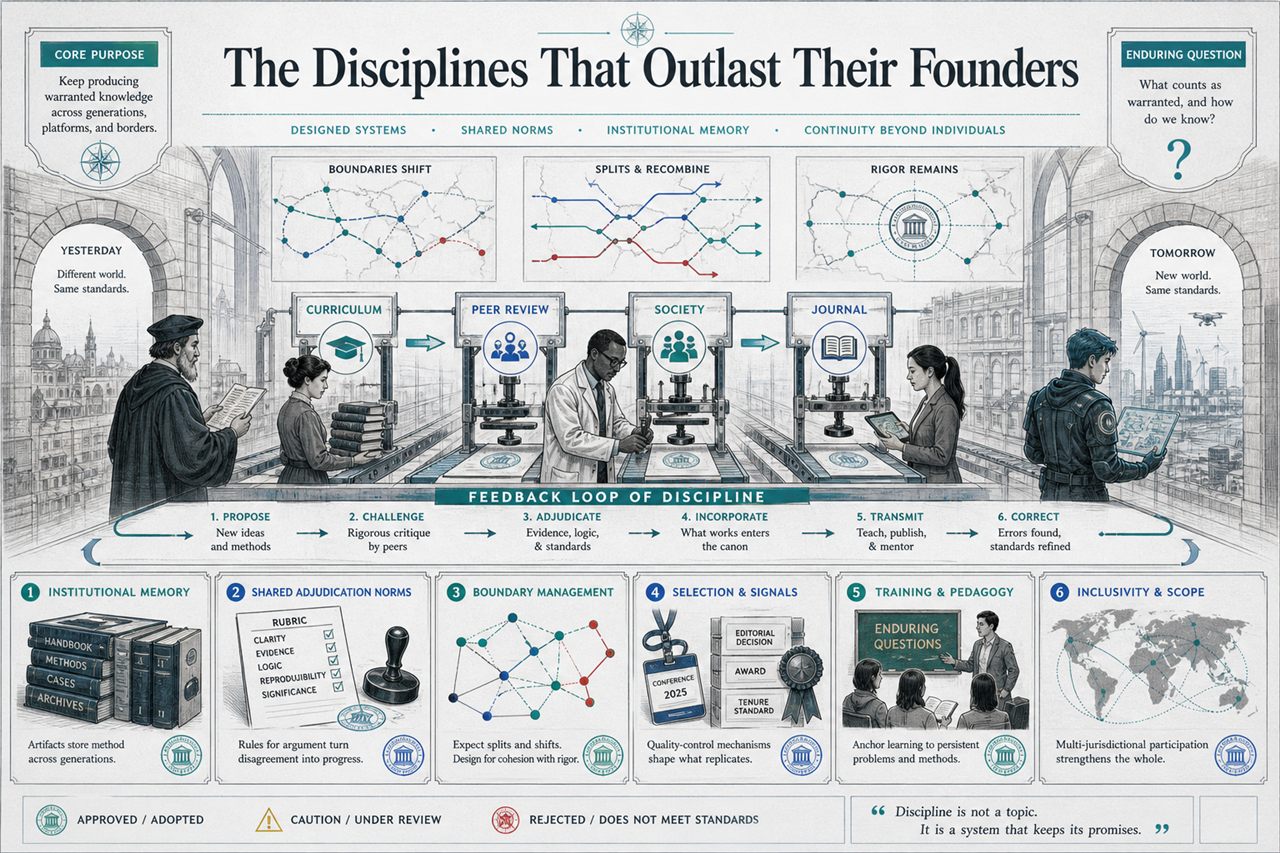
Durable frontier progress comes from designing disciplines as social-epistemic systems, not just naming topics. What lasts is a transmissible method: shared standards for warranted claims, challenge and adjudication protocols, pedagogy, and institutional memory that survive founder exits, platform churn, and regime turnover. Persistence is engineered through journals, societies, curricula, peer review, archives, standards, and incentive design by funders and accreditors, while recognizing disciplines naturally split, merge, and shift boundaries under selection pressures. Practical priorities include building durability architectures, codifying justification norms, teaching boundary maintenance and integration, detecting drift versus healthy evolution, and using “sibling disciplines” as external audits against blind spots.
Chapter 201. Building for Generations Who Will Not Thank You
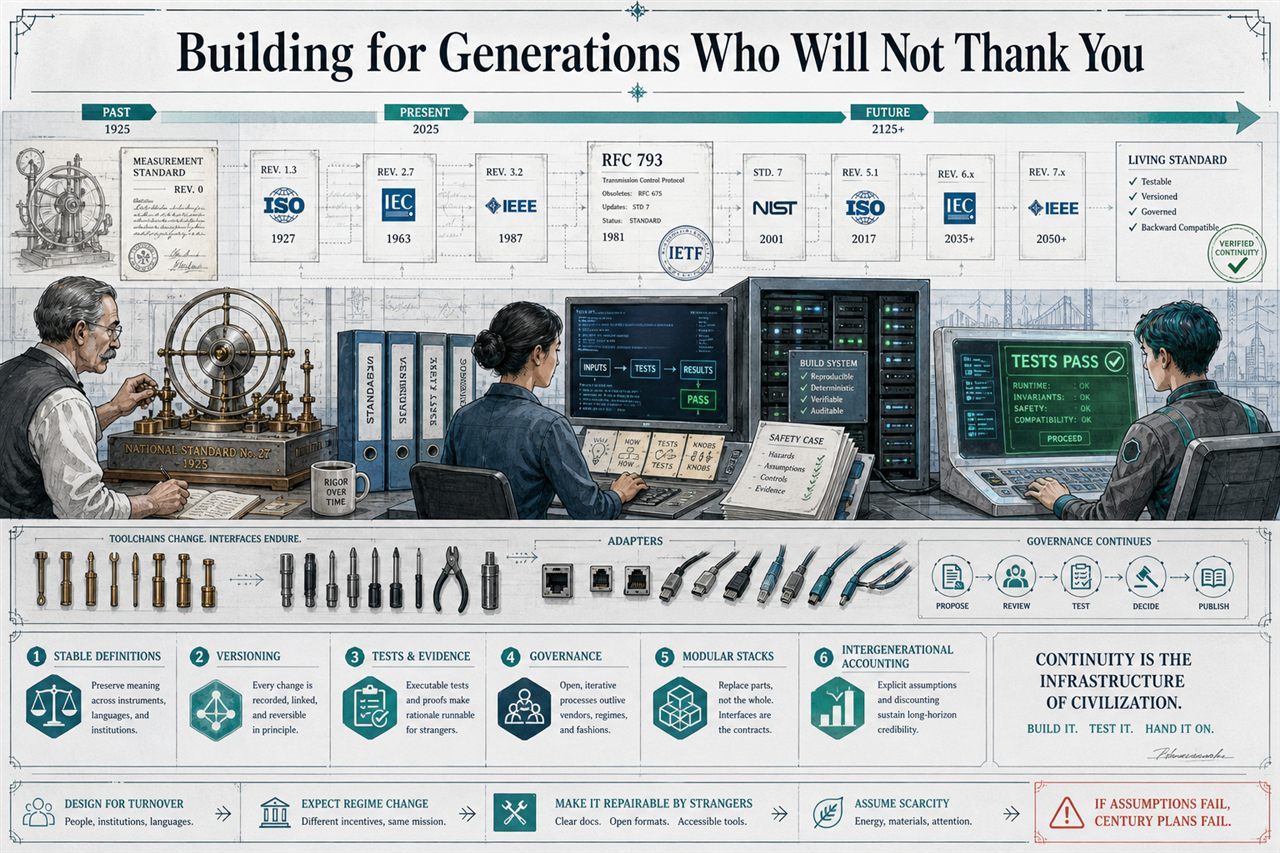
Build institutions, infrastructure, and technical systems to stay useful and governable for 100–400 years despite turnover, regime change, language and toolchain drift, and evolving threats. Continuity exists in standards bodies, regulated safety cases, and scientific software, but is rarely treated as a core engineering deliverable. The most reliable pattern is stable definitions plus versioning and governance, seen in long-running measurement programs and instruments like the 1992 Addiction Severity Index and the 2018 Global Burden of Disease pipeline. Open, modular stacks show how interfaces, reproducibility, and community governance preserve capability. Prioritize “executable memory” and make discounting and intergenerational accounting explicit to keep century-scale plans credible.
Chapter 202. The Persistent Questions Across Centuries
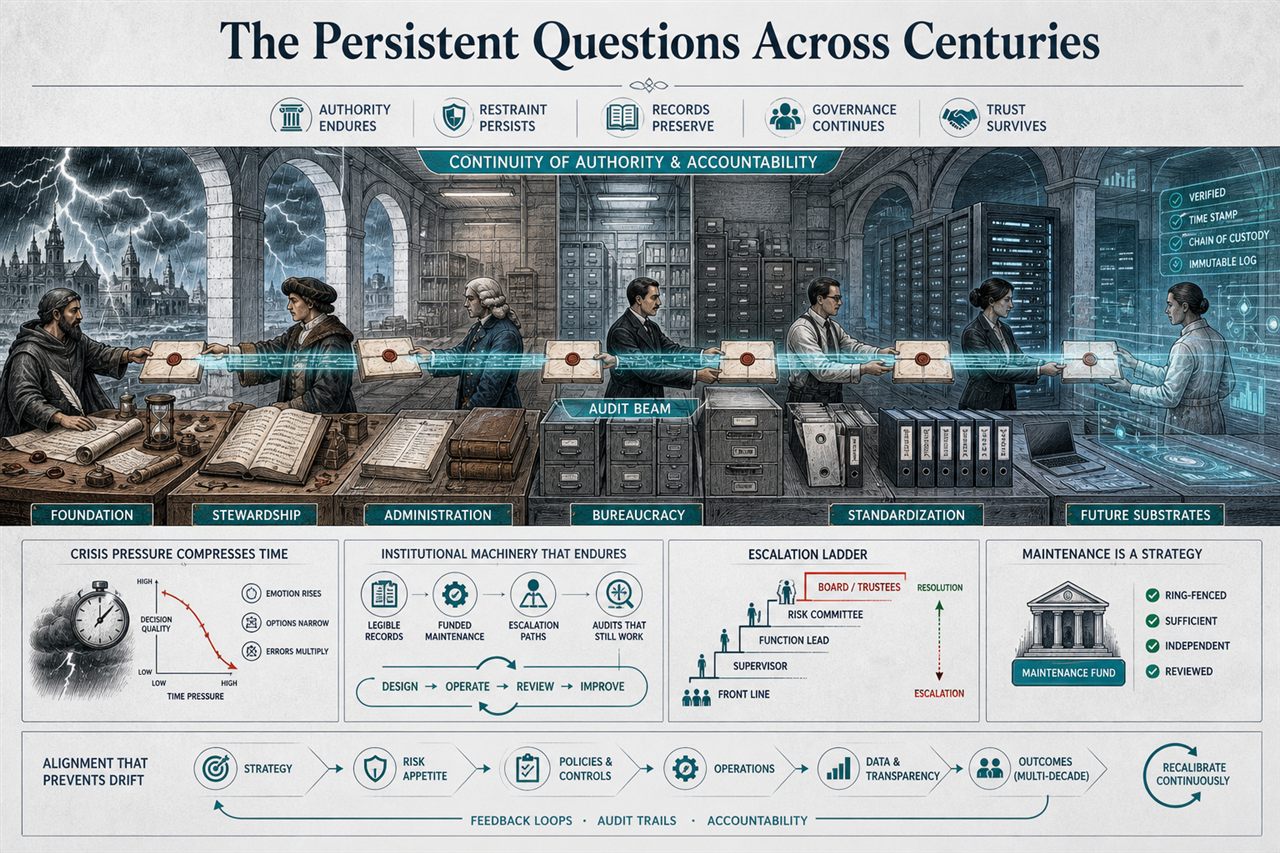
Durable long-horizon performance depends less on breakthrough technology than on institutional design that survives turnover and crisis: legible records, funded maintenance, clear escalation, and auditability. Decision science separates short-term reactions from long-term evaluations, showing that stress, emotion, and compressed time measurably degrade choice quality and raise irreversible-error risk. Long-term orientation can be treated as a staffed, instrumented capability, but adoption is uneven; control systems that bind operations to strategy via risk alignment and transparency better preserve value. Infrastructure history reinforces that continuity and distributional equity shape persistence as much as engineering feasibility.
Chapter 203. The Decisions This Generation Cannot Defer
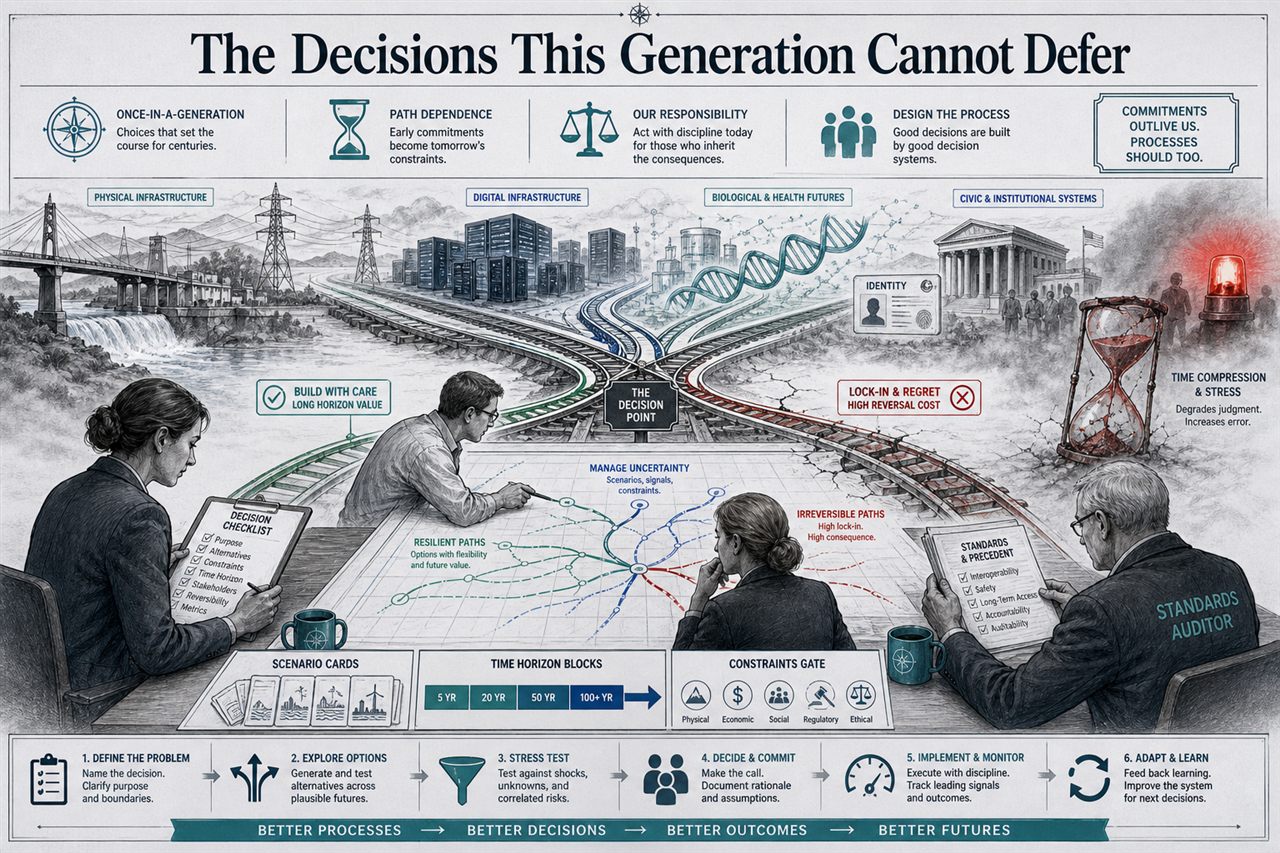
Design and execute decision processes for once-per-generation commitments where path dependence makes reversal prohibitively costly across infrastructure, energy, compute, biology, identity, and governance. Many organizations still rely on short-cycle budgeting and vague procedures despite multi-decade asset lives and long-lived externalities. Evidence shows structured decision processes and well-designed meetings improve implementation consistency, while stress and trauma reliably degrade decision quality under time compression. Deferral is often strategy-driven, creating predictable organizational “delay modes,” not merely weak preferences. Mature planning methods already treat uncertainty, regulatory drift, and technology evolution as decision variables, but adoption remains uneven; constrained domains need strong procedure when transparency and audit are hard.
Chapter 204. The Honest Limits of Long-Horizon Vision
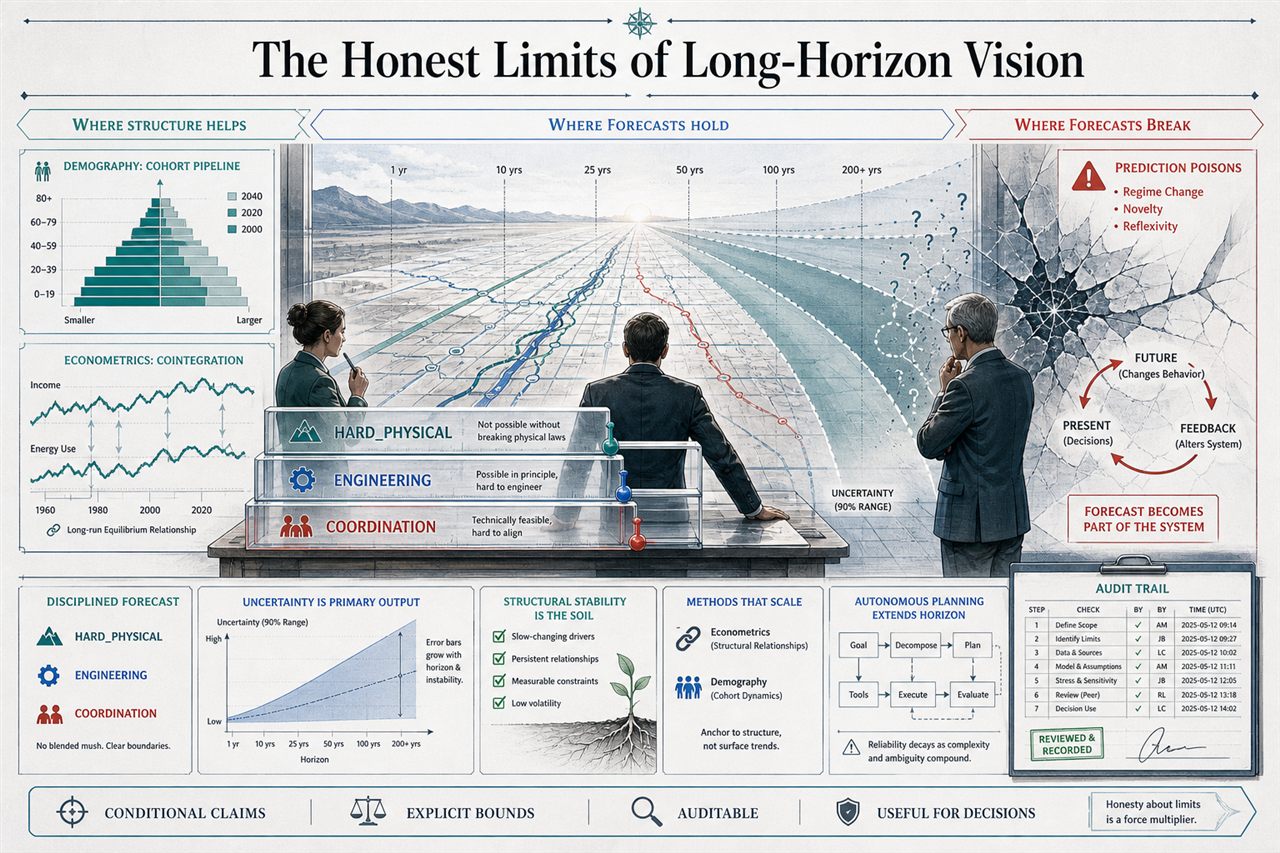
Disciplined long-horizon vision means producing century-scale forecasts with explicit uncertainty bounds and clearly separating hard physical limits from engineering and coordination limits, while keeping conjecture auditable rather than treated as an operating plan. Forecasts are most credible where structures are stable, covariates move slowly, and constraints are measurable; they fail under regime change, novelty, and reflexivity. Econometrics and demography remain the strongest formal tools via structural relationships like cointegration and cohort dynamics, but extrapolation always depends on what is held fixed. More data cannot prevent world-model failure.
Chapter 205. Reading Science Fiction Against the Long Horizon
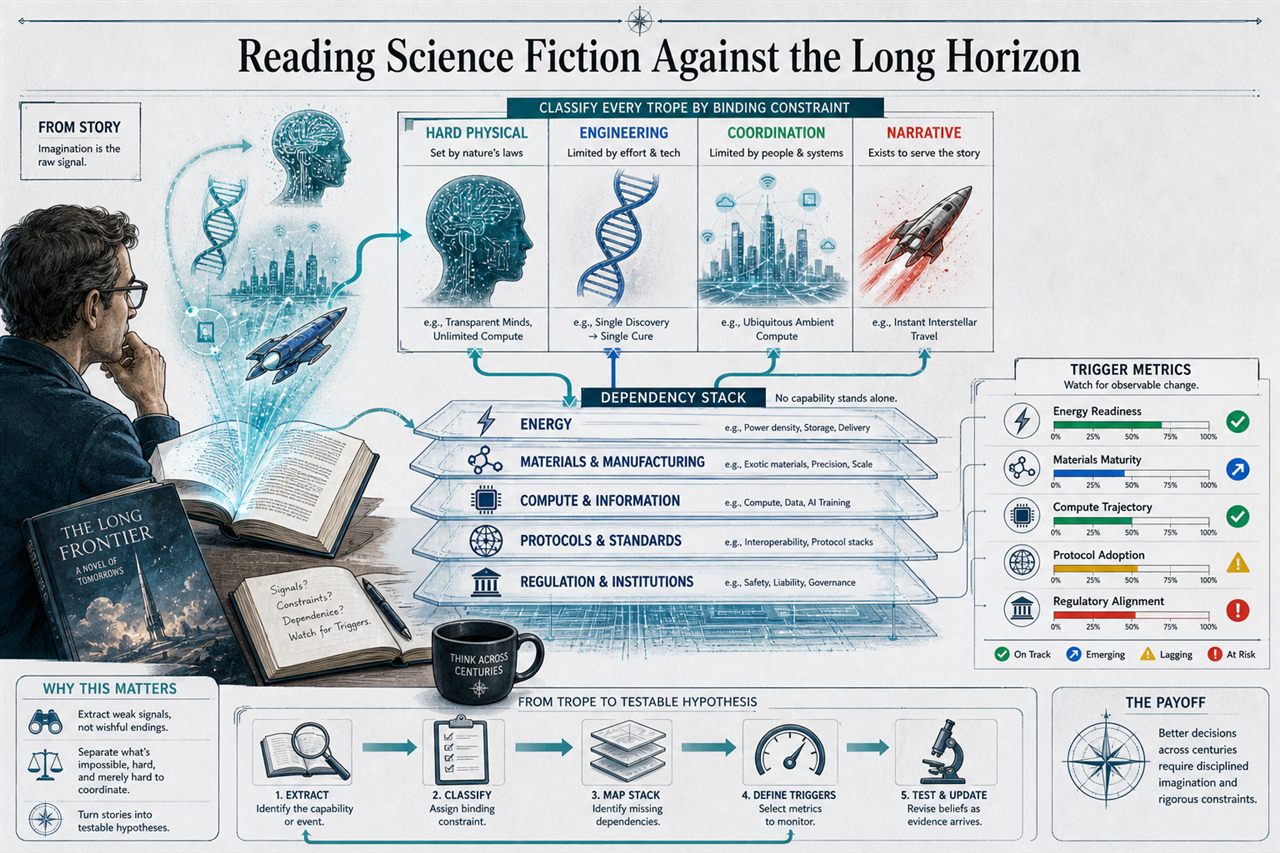
Treat science fiction as a weak-signal dataset, not a prophecy. Extract decision-relevant claims by classifying depicted capabilities as constrained by physics, engineering, coordination, or mere narrative convenience, then map each to a dependency stack and observable trigger metrics. The practical payoff is a repeatable protocol that turns tropes into testable hypotheses, adoption pathways, and procurement or investment conditions. Reality checks matter: AI progress is benchmarked yet interpretability remains hard; biomedicine advances are multi-causal and slow to translate; ambient-compute worlds hinge on interoperability and protocol layers fiction skips, distorting readiness and cost.
Chapter 206. The Architecture of a Continuing Civilization
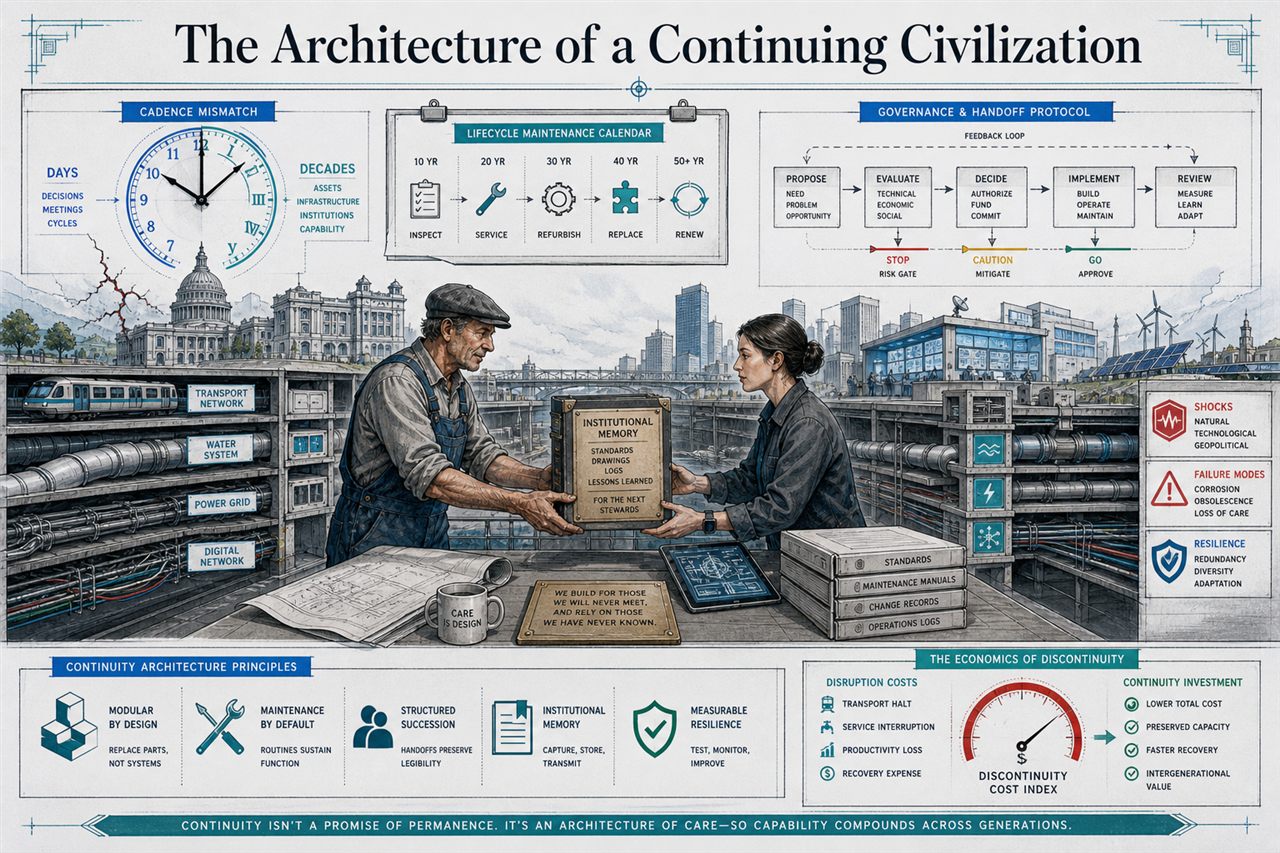
Civilizational continuity is a socio-technical design problem: keep core functions legible, repairable, and governable across generations and shocks, where coordination limits dominate physical limits. Enduring systems persist through routines, maintenance regimes, replaceable parts, and standards, so continuity is operational rather than permanent. The main failure mode is short decision cadences colliding with long asset lifetimes and slow institutional learning, making structured handoffs and institutional memory essential. Long-term performance can be designed via lifecycle planning and care frameworks, and continuity has measurable economic value, as shown by quantified passenger losses from prolonged Tokaido Shinkansen stoppage.