
Part 1. Thinking in Centuries
From 'The Long Horizon: A Vision of Frontier Technology from 2026 to 2400' - an AI-authored book produced on Comuvia's BookWriter system. Each chapter below is shown as its Business Editorial poster with a one-paragraph synopsis.
Chapter 1. The Failure of Short Horizons
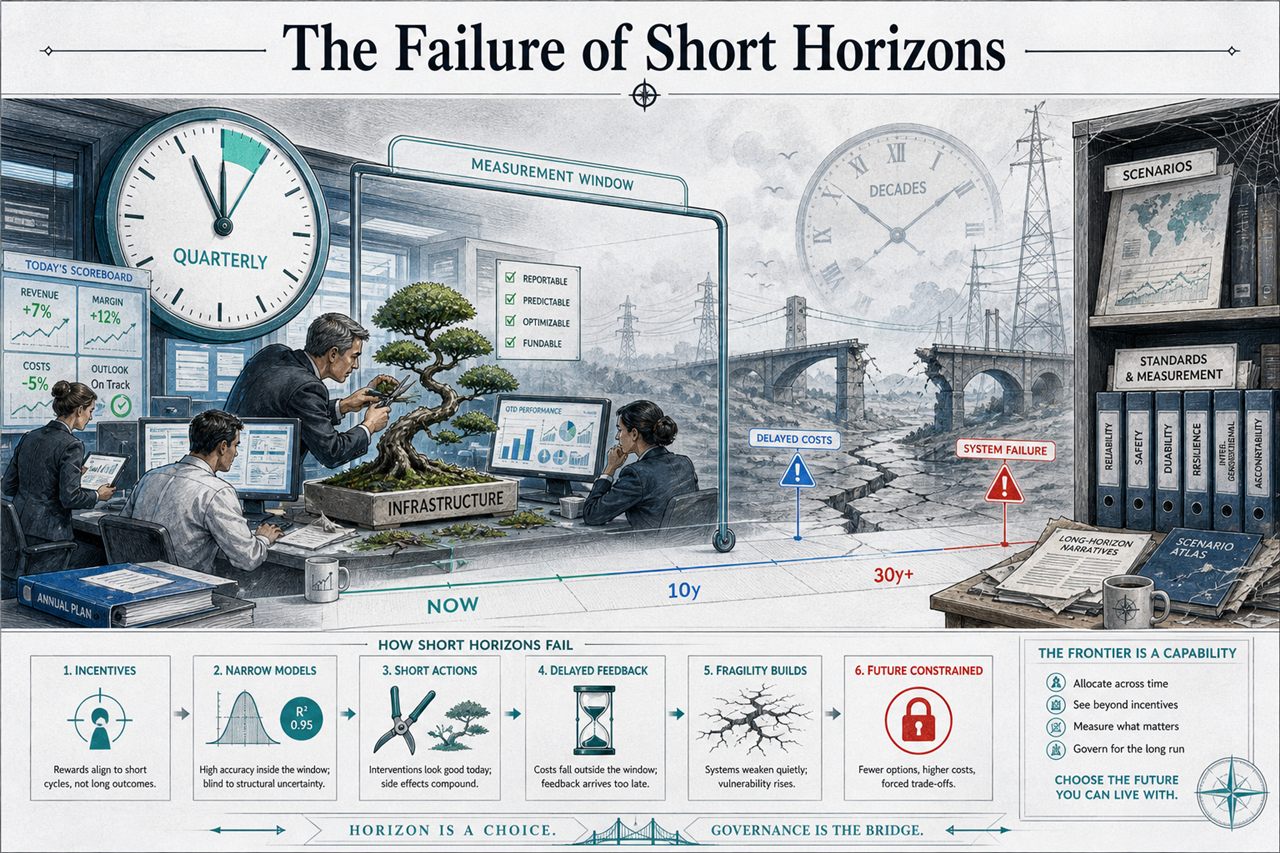
Frontier advantage comes from institutions that can plan, fund, and govern beyond quarterly, annual, or electoral incentive cycles without slipping into excessive discounting or strategic myopia. Operational forecasting often excels at short horizons, while longer-horizon scenario work remains weakly integrated into decision rights, creating a gap between what is predicted and what is governed. Horizon choice reshapes objectives, models, and evaluation standards, so near-term optimization can look successful while hiding long-run failure through “measurement-window blindness.” Practical takeaways are to link short-term calibration with long-term structural uncertainty, encode explicit multi-horizon tradeoffs, and design evaluation windows that reveal delayed attrition and unintended consequences.
Chapter 2. How Civilizations Compound Capability
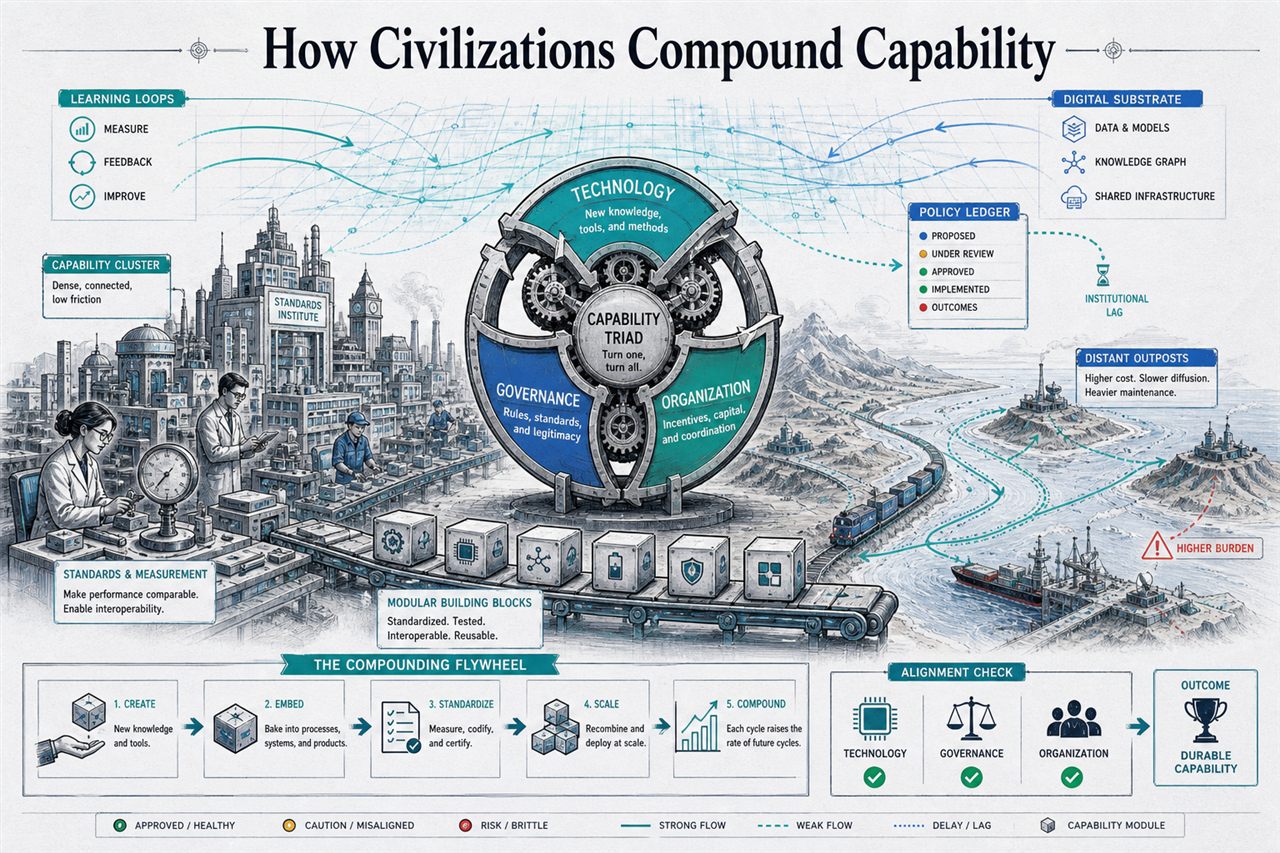
Civilizations compound capability when they reliably turn knowledge, capital, governance, and infrastructure into reusable systems that accelerate future capability creation rather than isolated wins. Compounding behaves like a whole-system property driven by alignment among technology, governance, and economic organization, reinforced through learning-by-doing, integrated production processes, and institutions that preserve operational know-how. Geography, logistics, and clustering shape diffusion speed and maintenance costs, determining whether capability persists after shocks. Digital infrastructure can act as a compounding substrate by improving organizational learning, but advanced AI can outpace governance.
Chapter 3. A Framework for Multi-Century Forecasting
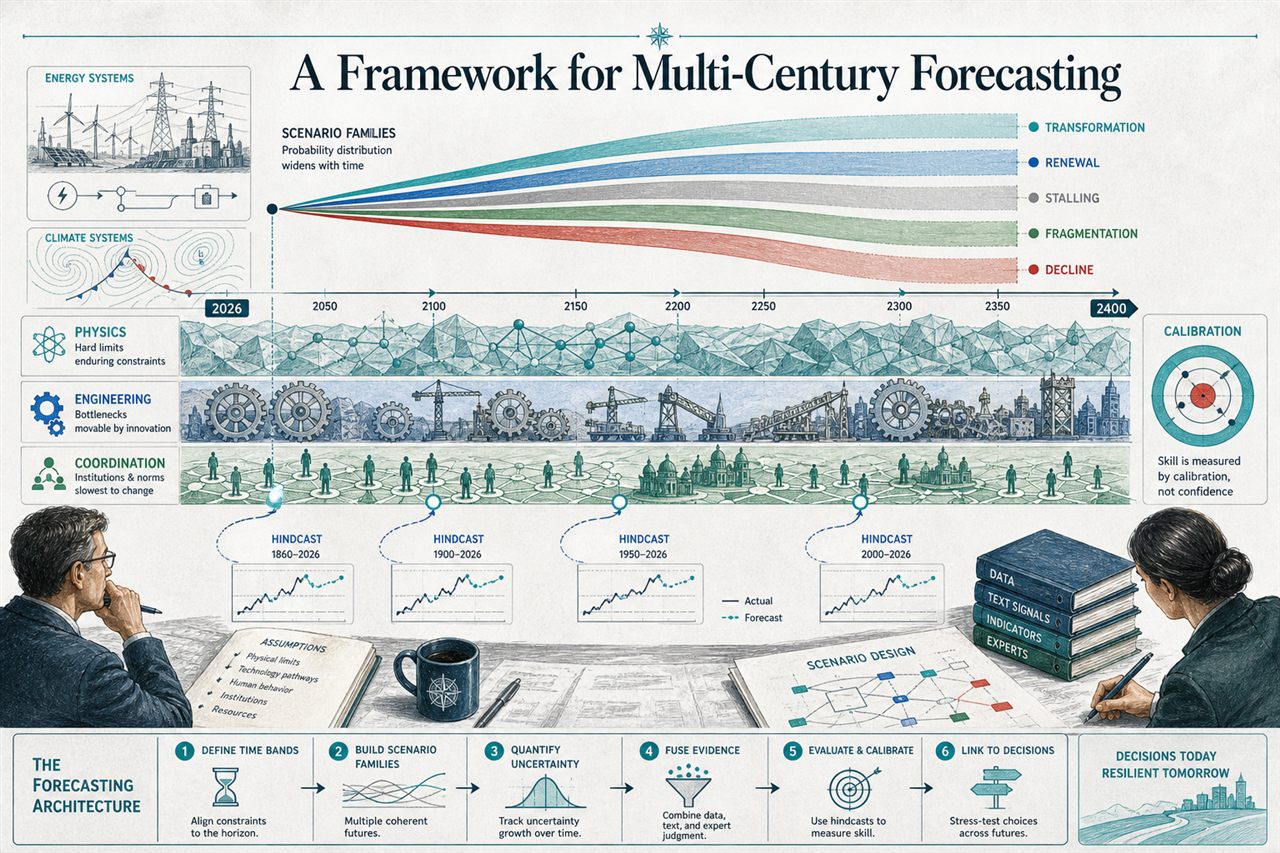
Multi-century forecasting separates what is constrained by physics, by engineering bottlenecks, and by coordination limits across long time bands where institutions can reset. Best practice in 2026 treats the future as distributions over scenarios and judges quality by calibration, not single-point accuracy. Multi-step time-series methods work for bounded horizons but suffer compounding error, reinforcing the need for explicit assumptions and decision-linked scenario design. Mature domains like energy, grids, and climate rely on scenario families and hindcasts. A key practical takeaway is to fuse heterogeneous evidence cautiously, manage spurious signals, and continuously test calibration under shifting regimes.
Chapter 4. Physical Limits, Engineering Limits, and Coordination Limits
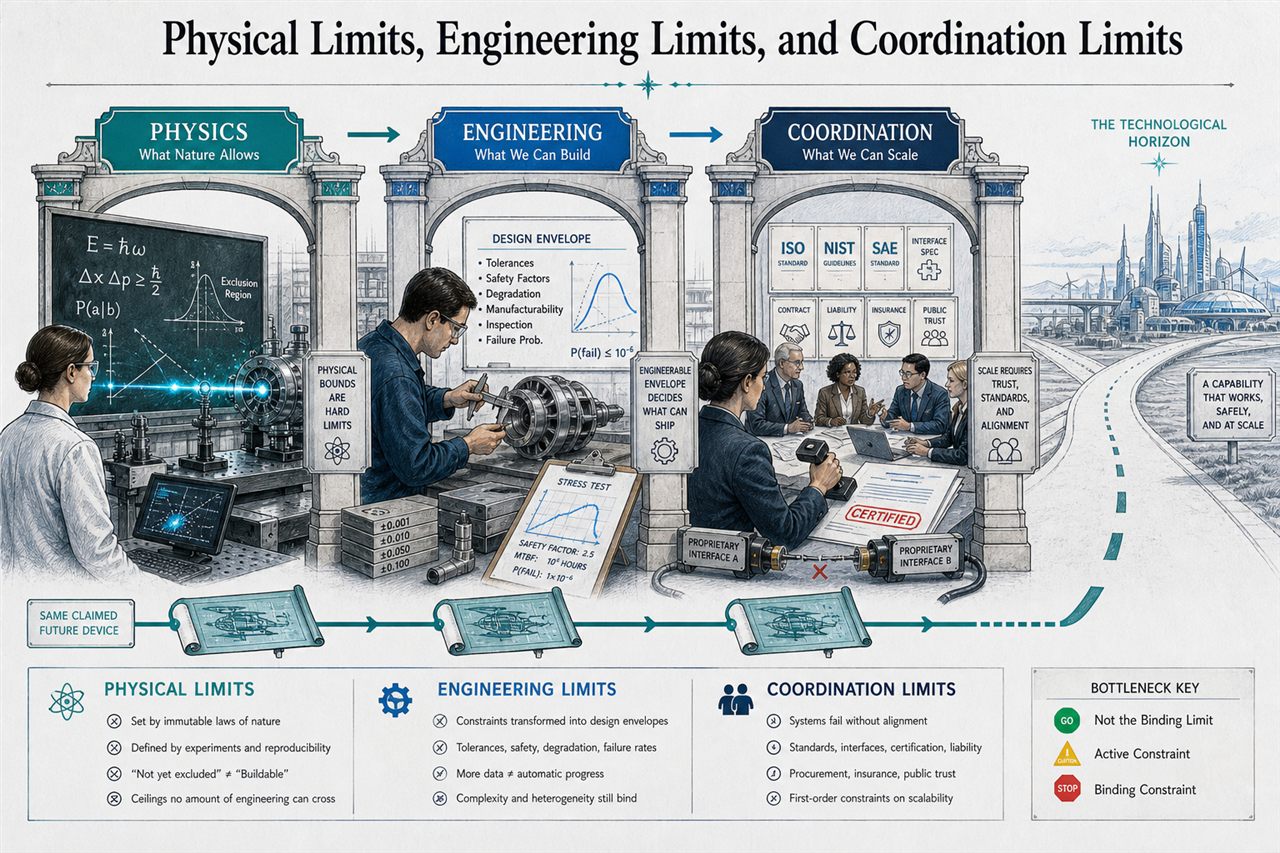
Frontier claims become more actionable when they are classified by what truly binds them: hard physical limits, engineering limits, or coordination limits. Physics sets boundaries through experimental evidence—bounds, confidence intervals, exclusion regions, and reproducibility—so “not yet excluded” should never be treated as “engineerable.” Engineering turns limits into design envelopes governed by tolerances, safety factors, degradation, environment, manufacturability, inspection, maintainability, and acceptable failure probabilities, making reliability and lifecycle constraints central to investment decisions. In biology and medicine, higher measurement throughput does not automatically dissolve complexity ceilings; cancer genomics shows heterogeneity can stay binding even as data generation improves. Some sensing and imaging problems hit physical and information-theoretic ceilings that software alone cannot overcome, as illustrated by single-shot 3D imaging. Even when technology works, scaling can fail on coordination: standards, interfaces, liability, certification, procurement, trust, insurance, legitimacy, and institutional authority.
Chapter 5. The Boundary Between Forecast and Fiction
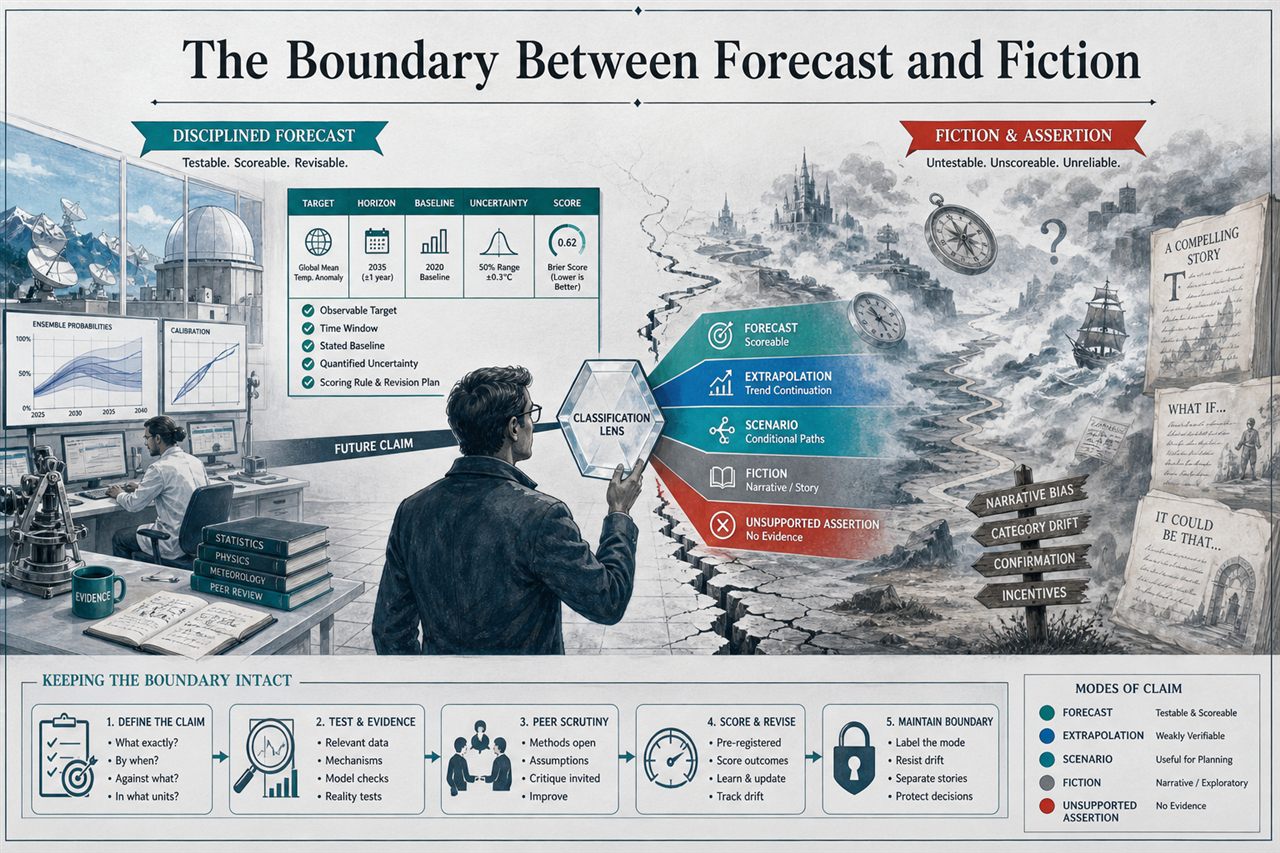
Disciplined long-horizon work separates forecast from fiction by making the reasoning structure explicit—statistical or physical models, expert judgment, scenario logic, or deliberate narrative invention—so decision-makers know what kind of claim they are reading. Uncertainty must be represented in a way that matches the method, ranging from probabilities and confidence intervals to scenario distributions, qualitative confidence labels, or an explicit refusal to assign probability. Credibility comes from validation and revision hygiene: define resolution dates and scoring rules, prestate break conditions, set revision triggers, and keep an audit archive of prior claims. A practical takeaway is to borrow institutional practices from major foresight, standards, and forecasting communities while watching a key failure mode: optimizing for easily measurable near-term questions can crowd out deep structural uncertainty that matters most for capital allocation.