
Introduction, Epilogue + Appendixes
From 'The Long Horizon: A Vision of Frontier Technology from 2026 to 2400' - an AI-authored book produced on Comuvia's BookWriter system. Each chapter below is shown as its Business Editorial poster with a one-paragraph synopsis.
Introduction - Why Long Horizons Matter
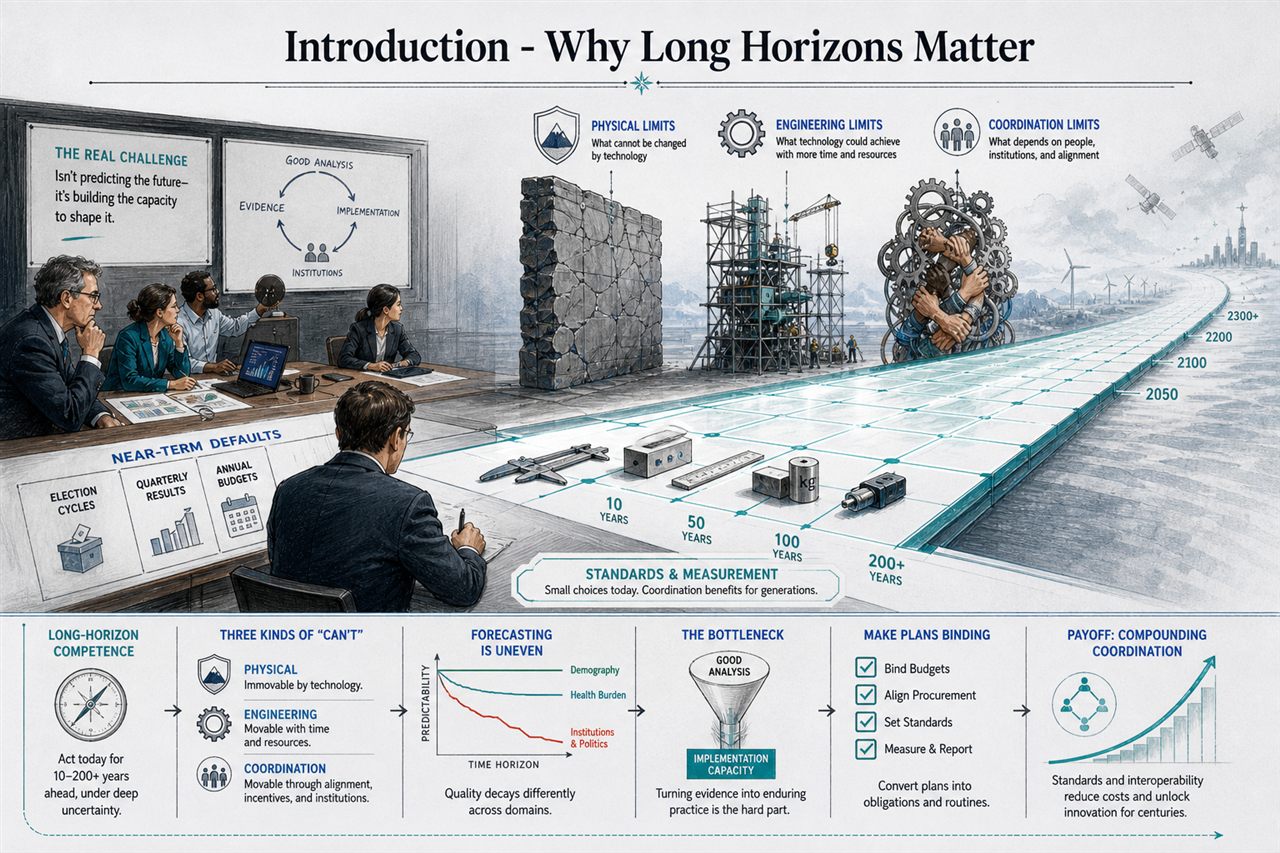
Long-horizon strategy means making credible decisions on 10–200+ year timescales under deep uncertainty while distinguishing physical limits from engineering and coordination constraints. Most institutions still optimize around electoral and quarterly cycles, leaving long-run plans weakly tied to budgets, procurement, and standards. Forecasts worsen with time, but some domains (notably demography and health burden) support disciplined multi-decade modeling; the bigger bottleneck is implementation capacity across organizations and years. Roadmaps often misread adoption as mere feasibility, and architectural shifts can break incumbent optimizations. Standards and measurement, once adopted, become enduring leverage by cutting coordination costs and boosting interoperability.
Epilogue - The View from 2400
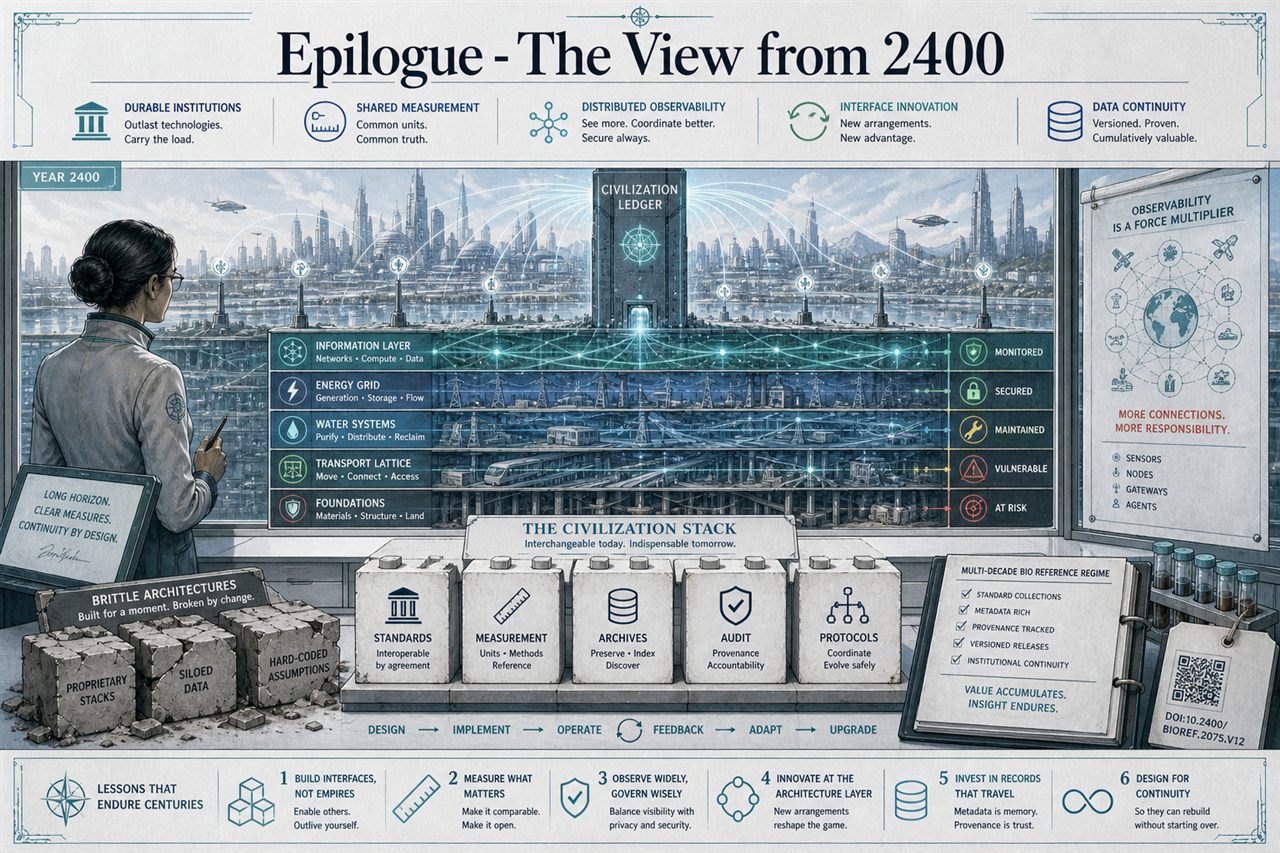
Frontier advantage looks, from 2400, like choosing decisions that produced durable, upgradeable civilization-scale systems rather than brittle ones that collapsed under coordination, maintenance, security, or legitimacy strain. In 2026 the decisive edge comes less from standout inventions than from institutional interface capacity: standards, measurement systems, archives, audit methods, and coordination protocols. Distributed sensing and networks increase control and observability but also expand attack surface and governance burden. Long-lived analytic work depends on stable primitives such as classification, clustering, association networks, and versioned datasets. Architectural innovation repeatedly reshuffles incumbency by changing interfaces. Longitudinal bio and health regimes show how metadata and continuity preserve value across revisions.
Conclusion

Turn multi-century forecasting into an operational discipline that links today’s capital allocation and governance to explicit limits, time bands, and updateable evidence. As of 2026, durable registries and protocols enable multi-decade measurement; large programs can coordinate via shared standards and committed funding; engineered digital-health feedback loops can change clinical processes; and demand-side decarbonization can rival supply-side shifts. Planning must assume nonlinear regime shifts, not smooth trends. Use a repeatable workflow: scope the decision by horizon band, classify limiting factors as physical/engineering/coordination, name evidence anchors, and choose a posture—reversible experiments, compounding platforms, or irreversible commitments with triggers, stop conditions, and auditability.
Appendix 1. Special Reports
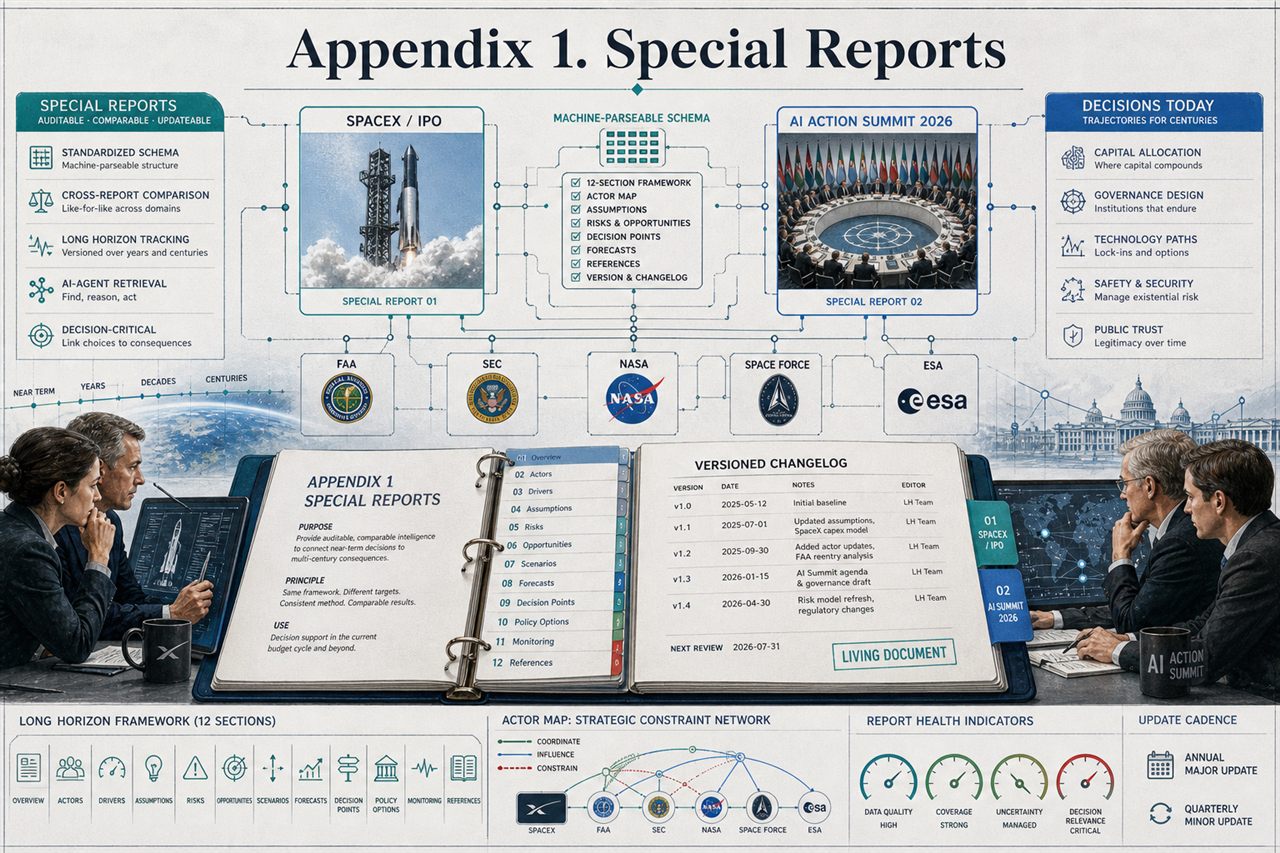
Frontier special reports turn the book’s long-horizon framework into structured, auditable intelligence briefs for near-term decisions with multi-century consequences, illustrated through prototypes focused on SpaceX (including IPO context) and the 2026 AI Action Summit. The key practical innovation is a standardized, machine-parseable schema reused across reports, enabling comparison, longitudinal tracking, and AI-agent retrieval, plus annual updates with versioned changelogs. Topics are chosen where compounding capability, coordination ceilings, and hard-versus-engineering limits collide with current budget-cycle capital allocation and governance. Verified anchors include SpaceX’s 96 Falcon 9 launches in 2023, major Starship progress in March 2024, and major AI governance milestones from 2023–2024.
Chapter 207. SpaceX plans in a context of IPO
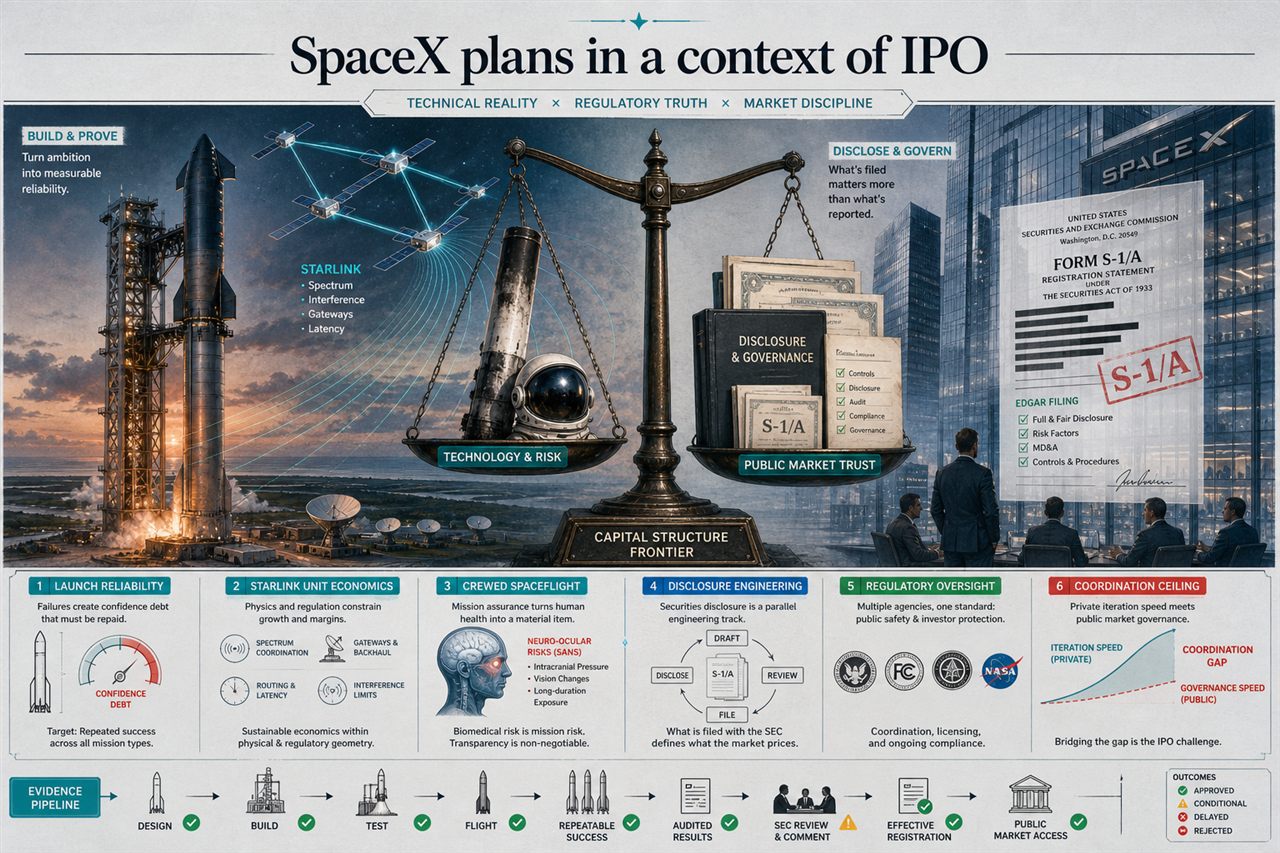
A SpaceX-, Starlink-, or SpaceX-controlled public listing is constrained by the need to align high-variance technical programs with public-market disclosure and governance. Evidence is bounded by public milestones, including a 2015 Falcon 9 failure, 2020 private human-spaceflight achievements, and a 2023 Starship test that ended early. An SEC EDGAR record shows a Space Exploration Technologies Corp. S-1/A dated 2026-06-03, which sets the hard boundary for what is auditable versus market narrative. Reported IPO valuation/raise figures remain unconfirmed absent filed terms. Practical takeaway: separate demonstrated capability, disclosed structure, reported expectations, and speculative future business lines.