
Part 4. Shot Grammar: The Visual Language of Film and Music Video
From 'The Decision Layer: What Actually Matters to Make Movies and Music Videos in the AI Era' - an AI-authored book produced on Comuvia's BookWriter system. Each chapter below is shown as its Business Editorial poster with a one-paragraph synopsis.
Chapter 10. Composition That Means Something: Framing Shots for Screen
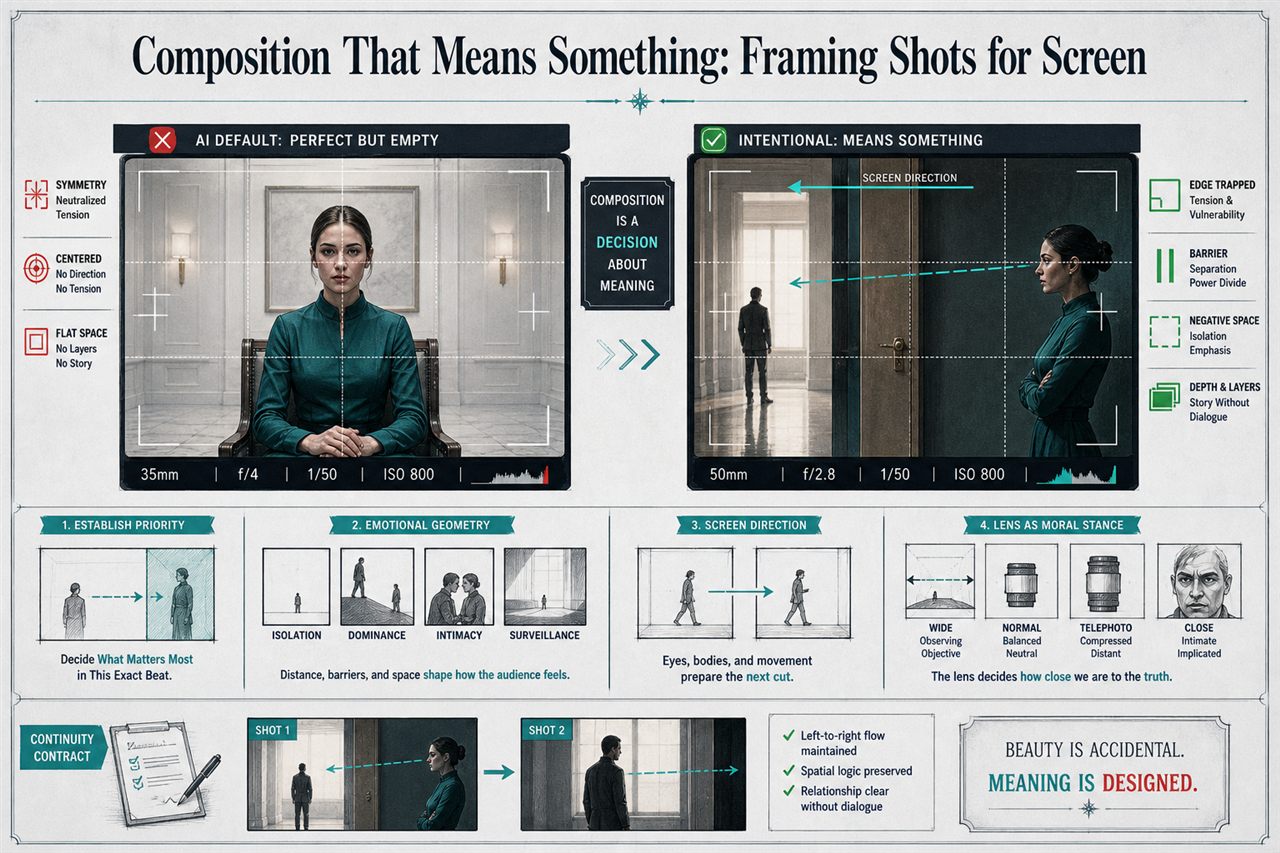
Composition is a meaning-making decision: arranging bodies, objects, negative space, lines, color, and screen direction so viewers instantly understand priority, power, and emotion. AI can generate attractive, “cinematic” frames, but often misses dramatic intent and continuity, yielding polished images with no clear story logic. Start by naming the frame’s dramatic verb, then assign who owns the frame and choose shot size based on what information must land. Use negative space, look room, and headroom as pressure controls; build depth with purposeful foreground/midground/background; frame through architecture and lines; choose lens length as relationship.
Chapter 11. Motivated Camera Movement in Films and Music Videos
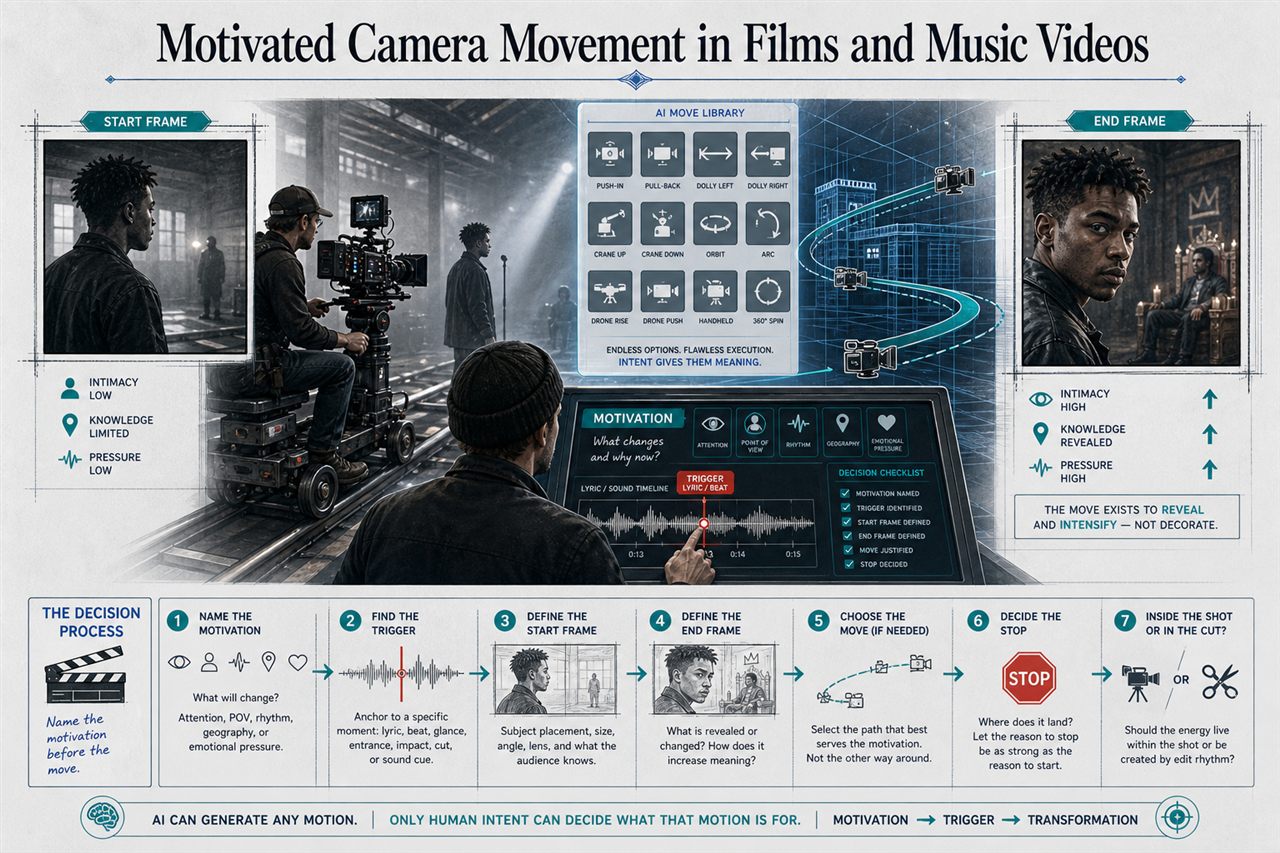
Move the camera only when motion changes attention, point of view, rhythm, geography, or emotional pressure; otherwise rely on framing, blocking, and editing. AI can generate any move, but it can’t supply the reason, so you must define what triggers motion (a lyric, glance, entrance, beat) and whose perspective it expresses. Specify a clear start and end frame so the move has a before-and-after meaning. Use movement to replace cuts only when continuity and real-time tension matter, tie it to performer blocking, match lens choice to intent, protect screen direction, and start/stop precisely when new information lands.
Chapter 12. Coverage and Continuity: Keeping Scenes Coherent
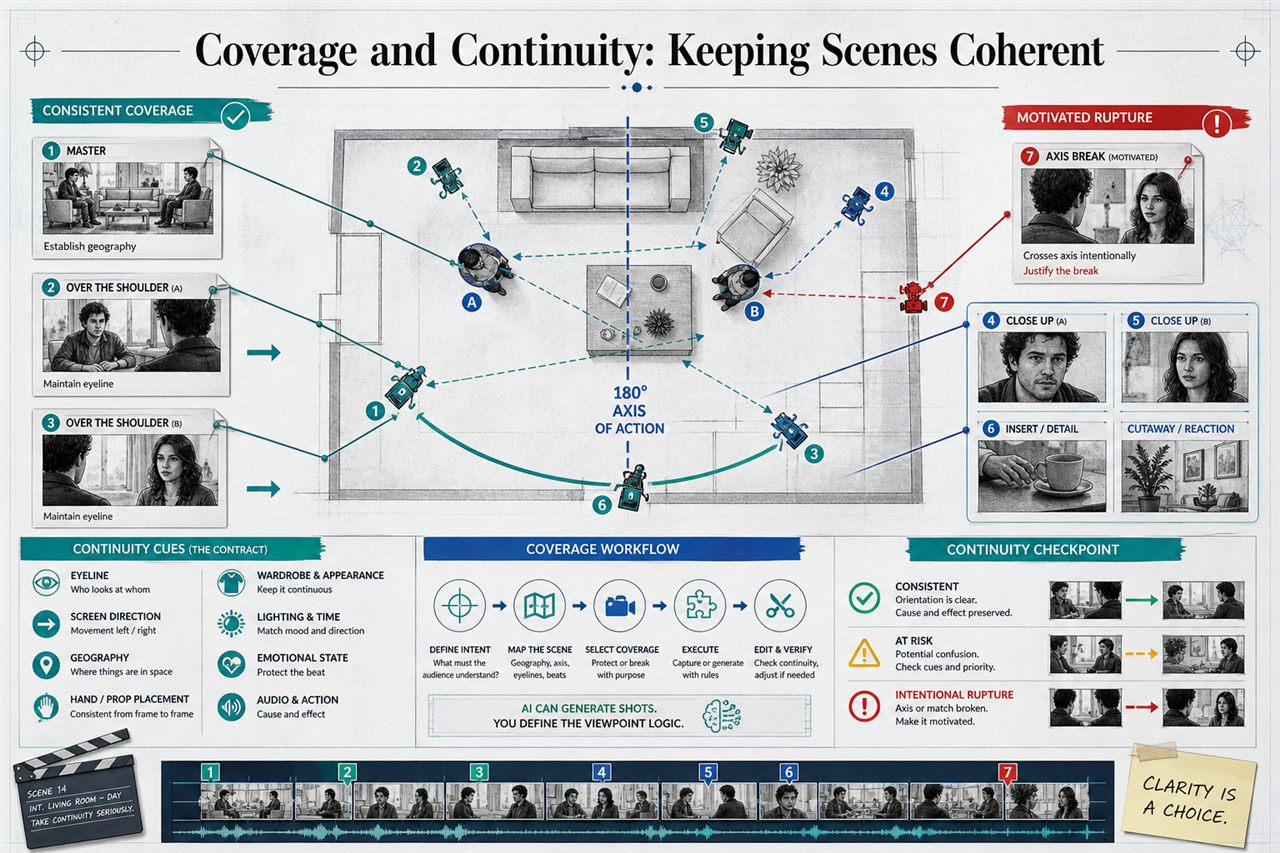
Decide continuity rules before generating or shooting coverage: where the viewer “stands,” how action travels on screen, what must match, and when incoherence is a deliberate effect. AI can cheaply create alternate angles, inserts, pickups, and continuity fixes, but it can’t replace perceptual clarity in geography, eyelines, screen direction, motion phases, and cause-and-effect. Start with a simple top-down continuity map, set and protect the 180-degree axis, and build shots by function (master, singles, OTS, inserts, reactions, cutaways) rather than habit. Match emotion, lens family, lighting logic, and use sound beds to glue edits; break continuity only with a clear rule.
Chapter 13. Directing an AI Camera: Shot Grammar as Prompts
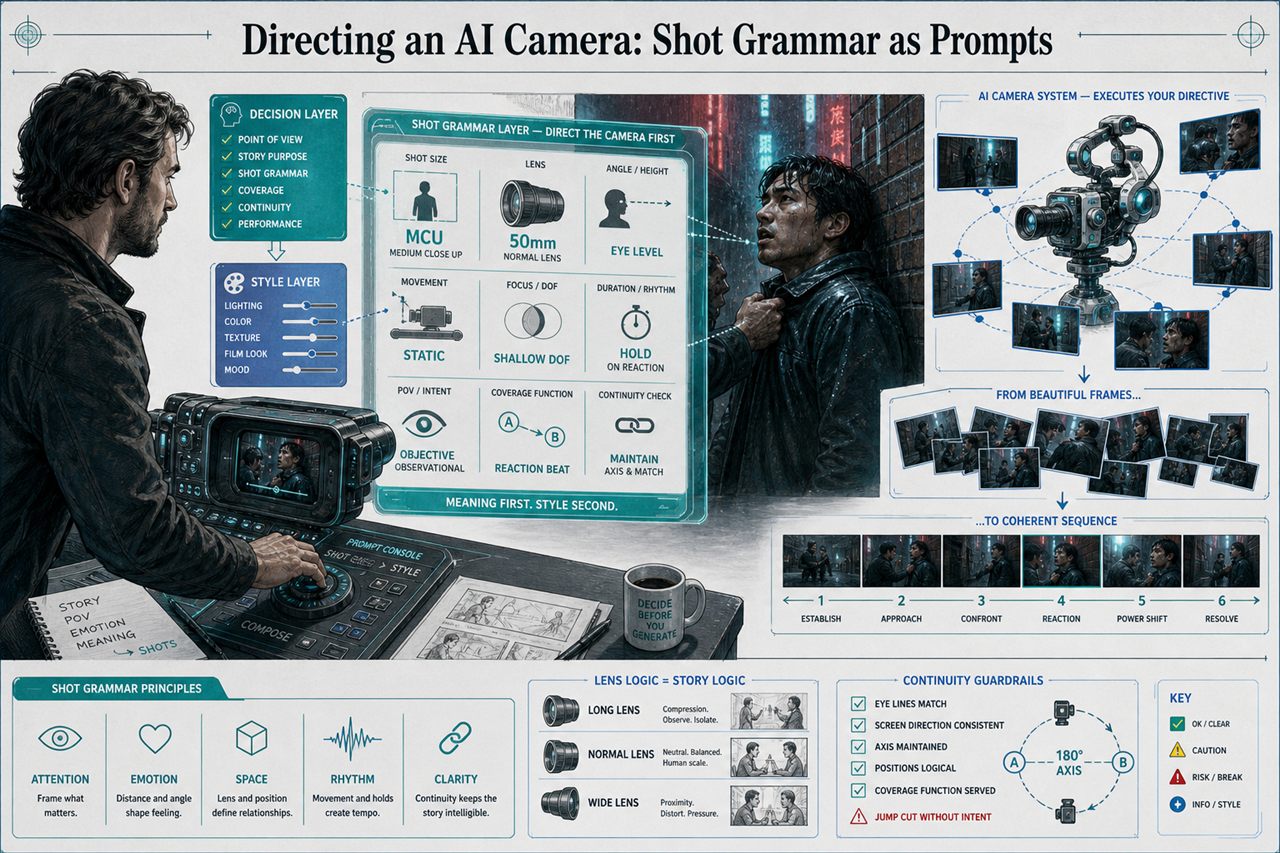
Directing an AI camera starts by prompting shot grammar—shot size, angle, lens, movement, coverage, and continuity—before image style, so AI renders attention, emotion, and spatial logic instead of disconnected “pretty” frames. AI can simulate lenses, lighting, movement, and even approximate continuity, but you must decide point of view, why the camera is close or moving, and what each cut accomplishes. Build prompts as single shot-list units with duration, cut purpose, and continuity anchors. Separate camera instructions from art direction, use references for camera behavior, and add negative constraints to prevent random or impossible camera choices.