
Part 3. The Edit: Where Films and Music Videos Are Really Made
From 'The Decision Layer: What Actually Matters to Make Movies and Music Videos in the AI Era' - an AI-authored book produced on Comuvia's BookWriter system. Each chapter below is shown as its Business Editorial poster with a one-paragraph synopsis.
Chapter 7. Editing Is the Story: Pacing a Film Scene Shot by Shot
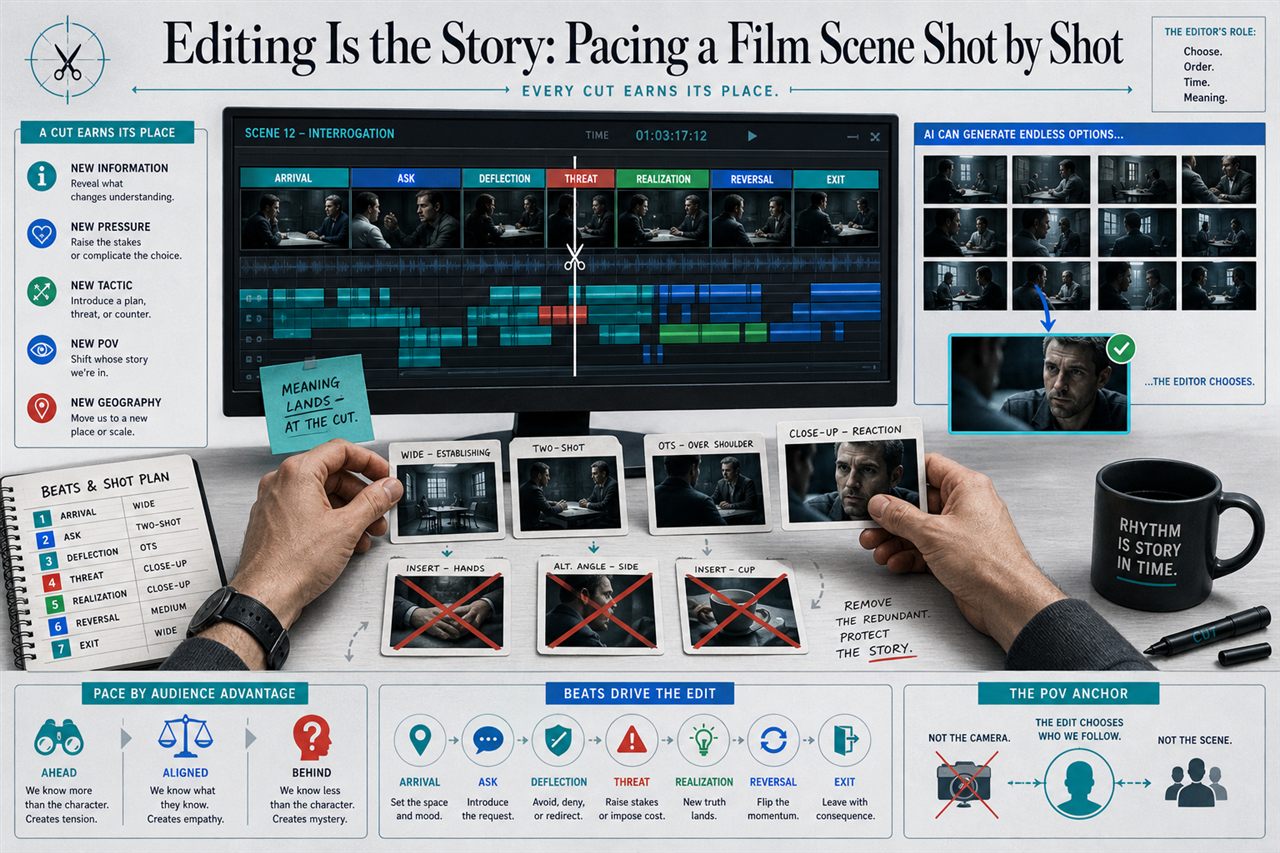
Editing determines meaning by choosing the order, length, and point of view of shots so each cut changes pressure, information, emotion, or perspective. AI can cheaply generate coverage, alternate angles, inserts, and rough assemblies, but it can’t decide when the audience should learn something or whose experience anchors the moment. Build scenes from beats, cut throat-clearing, and use shot size to escalate from geography to psychology. Cut on action and on revealing silences, use listener reactions for subtext, and bridge thoughts with J-cuts and L-cuts. Inserts must function as evidence, and spatial rules should be preserved unless disorientation is the point.
Chapter 8. Cutting to the Beat: Rhythm Editing for Music Videos
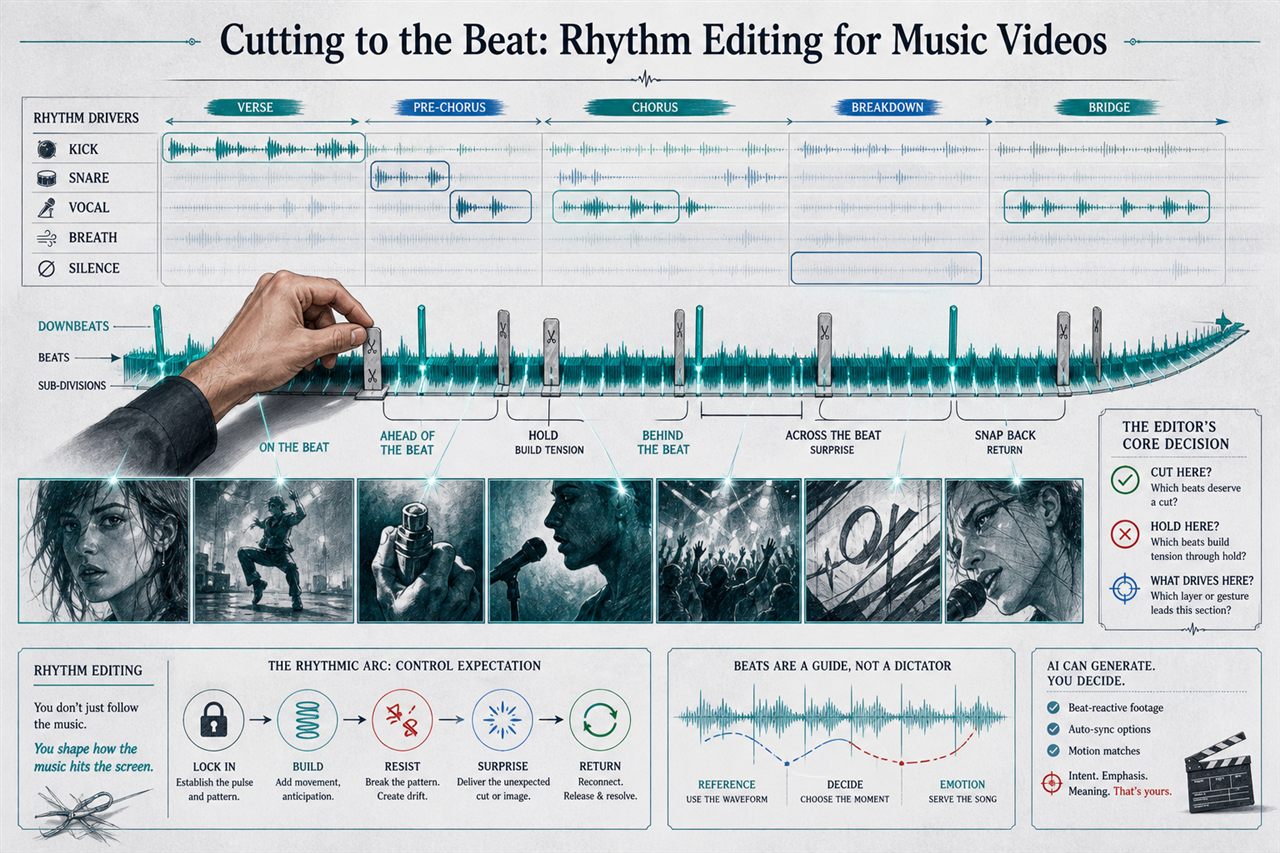
Decide when edits obey the track, when they resist it, and when performance should override the beat so rhythm feels like energy, not metronome work. AI can generate coverage, variations, and auto-sync, but you must choose the musical driver (kick, vocal, lyric, breath, silence), the anchor shot, and how patterns evolve across sections. Build a rhythm map, treat waveforms as guides, and use downbeats as punctuation. Separate beat cuts from phrase cuts, cut on movement, use hard cuts for attack, holds for tension, and off-beat cuts for unease. Protect a repeating performance anchor and a chorus rule.
Chapter 9. Coverage for the Edit: Shooting So the Cut Can Breathe
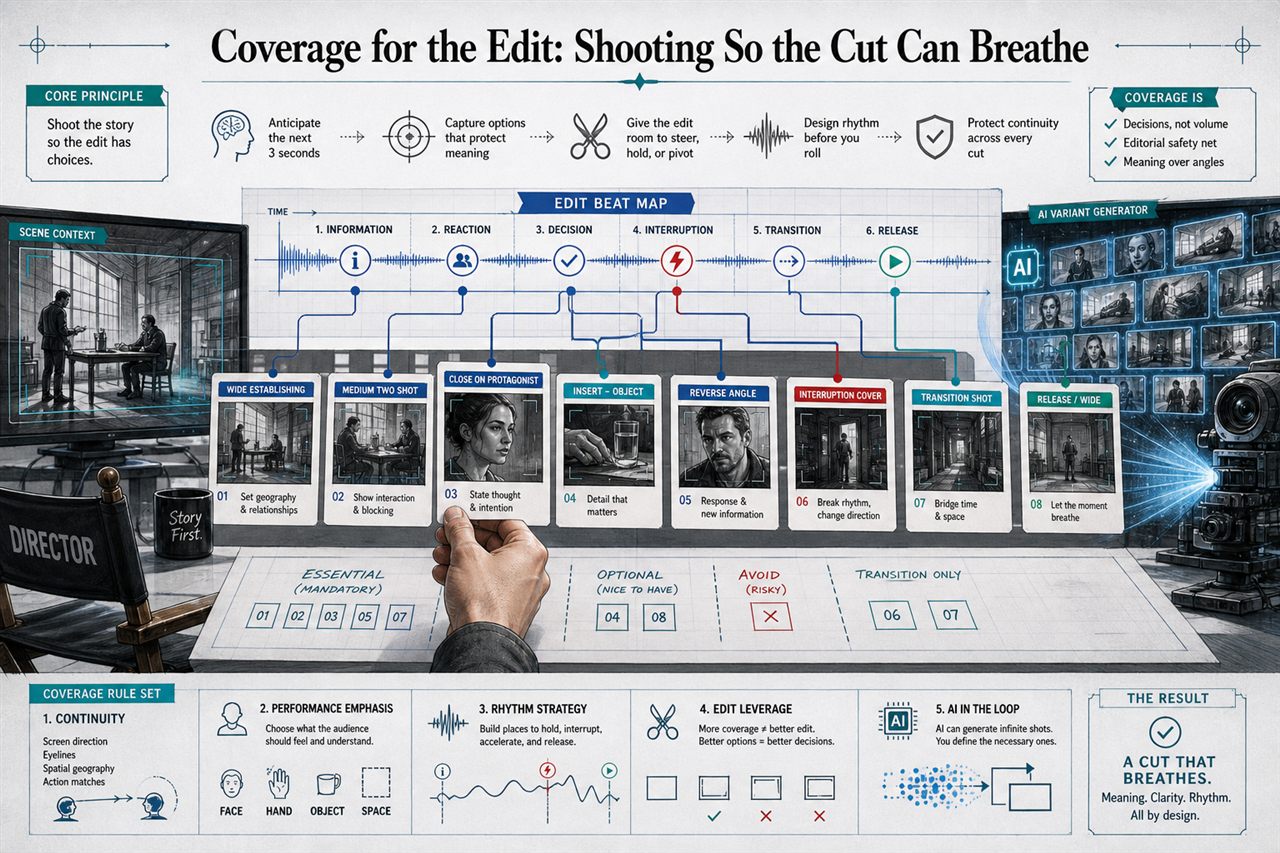
Shoot coverage to serve the edit, not to chase a single “cool” camera idea. Even if AI can generate endless beautiful angles, it won’t predict what the cut needs next, so you must define the editorial spine: whose point of view leads, when information flips, and how rhythm changes. Build minimum viable coverage that protects geography and the axis, includes clean performance options, and captures action matches with usable handles. Treat reactions and inserts as story tools that control consequence and make time elastic. Plan shots for cut types, silence, and breathing room, and give explicit continuity constraints to AI or virtual cameras.