
Part 6. Family, Culture, and Applied Systems
From 'The Social Decision Atlas' - an AI-authored book produced on Comuvia's BookWriter system. Each chapter below is shown as its Business Editorial poster with a one-paragraph synopsis.
Chapter 23. Family Systems and Kinship Roles
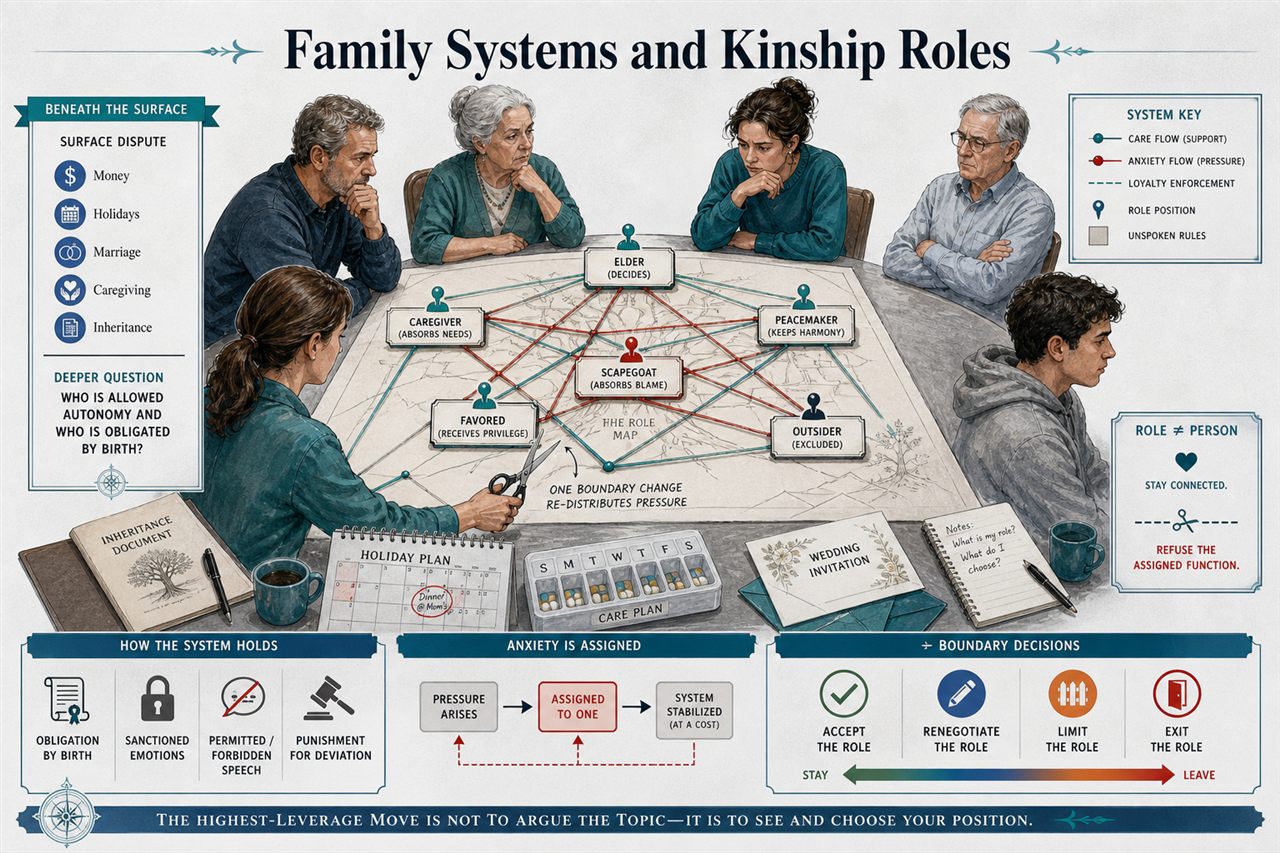
Family decisions run on inherited role assignments more than on the surface dispute. Treat the family as an interdependent governance system: map who has authority, who carries responsibility, who gets protection, and who absorbs consequences, then negotiate from that model. Common roles include stabilizer, enforcer, scapegoat, triangulator, boundary translator, kinship expander, and legacy carrier, each with predictable drivers and response moves. The highest-stakes choice is whether to accept, renegotiate, limit, or exit a role demand while keeping moral regard for the person separate from compliance. Use recurring language and patterns to detect unlimited duty.
Chapter 24. Parenting and Intergenerational Dynamics
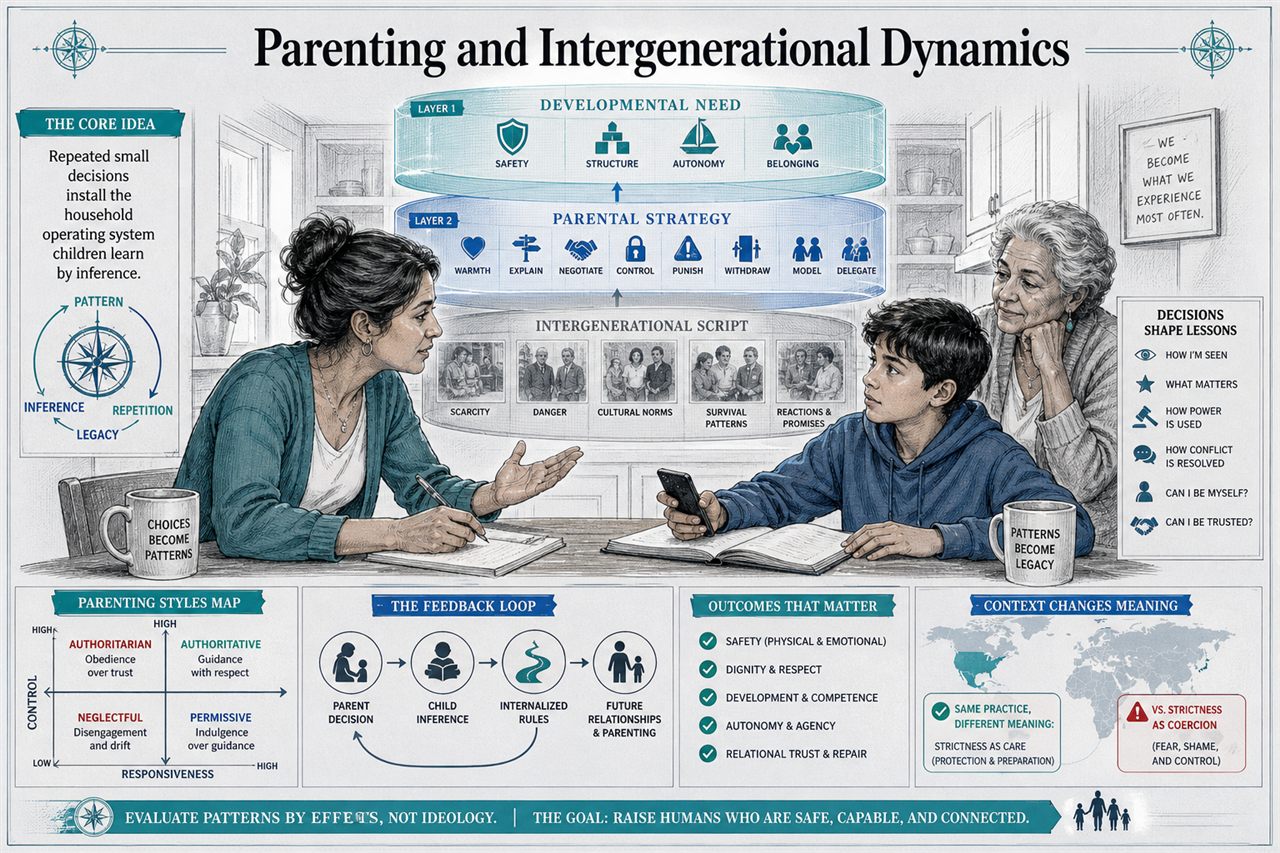
Parenting under intergenerational pressure is a high-stakes role system where repeated responses encode a household “operating system” for safety, belonging, autonomy, trust, and authority. Diagnose conflicts with a three-layer stack: the child’s current developmental need, the caregiver’s strategy for meeting it, and the inherited script driving that strategy. Research on responsiveness and control informs calibration, but culture shapes what “good” looks like; evaluate patterns by observable effects on safety, dignity, development, autonomy, and relational trust. Common failure modes include script-carrying, overcorrecting, boundary conflation, performance parenting, emotional delegation, and elder gatekeeping; aim for principled authority.
Chapter 25. Friendship and Chosen Family
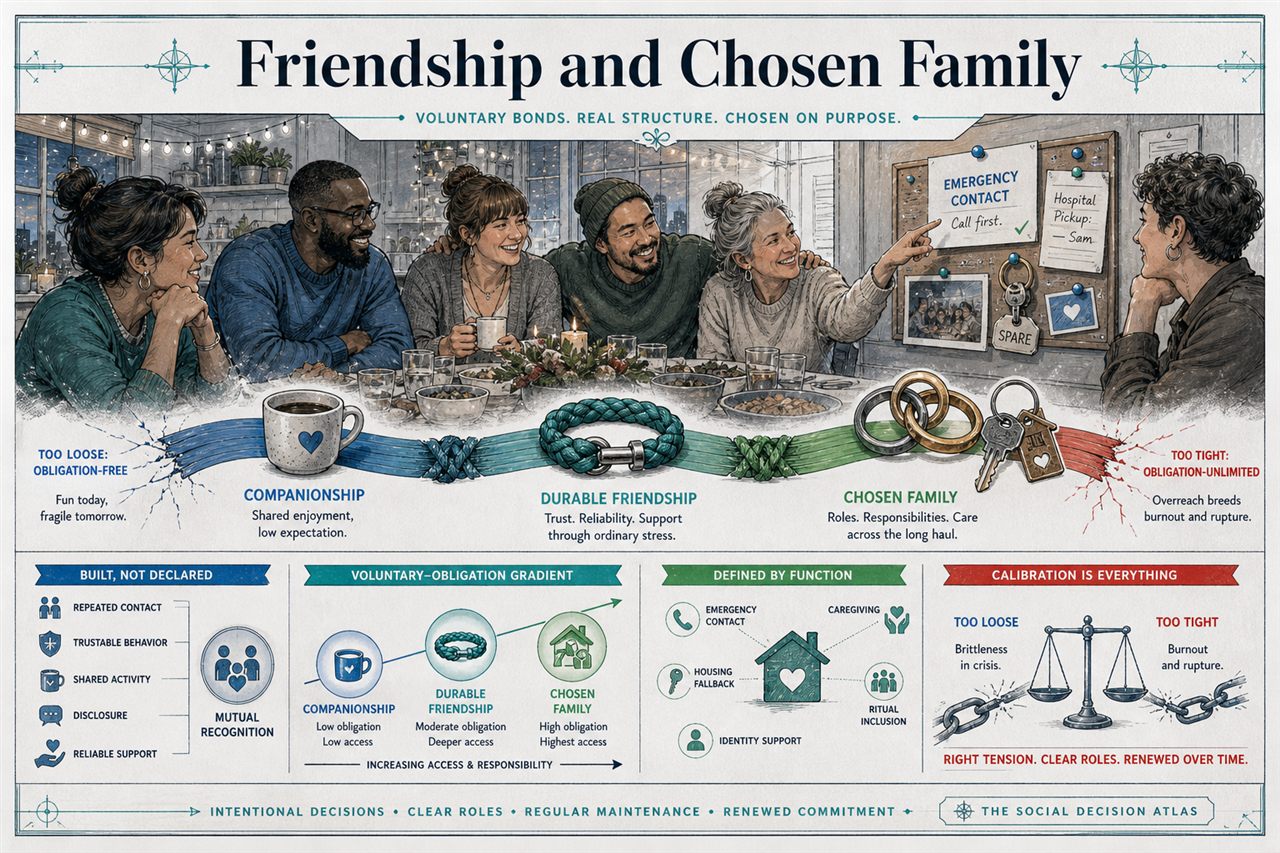
Friendship is a voluntary bond with real structure, best understood on a voluntary‑obligation gradient from lightweight companionship to durable friendship to chosen family, where people function as kin through care, crisis response, and long-term loyalty. The core risk is miscalibrating obligations: treating friendship as obligation-free collapses under crisis, while treating it as unlimited collapses under overreach. Use archetypes to set expectations (steady presence, crisis-only, convenience ally, confidant, connector, boundary blurrer, kinship-substitute). Before escalating to chosen-family roles, verify ordinary-time reliability, multi-domain reciprocity, conflict repair capacity, and specific, bounded requests.
Chapter 26. Cross-Cultural and Cross-Context Reading

Cross-cultural and cross-context reading treats identical behaviors as ambiguous until interpreted through the governing system. Separate what happened from what it might mean, which local rule it confirms or violates, and what consequence follows; most errors come from jumping straight to action or character judgment. Diagnose whether the gap is a norm, role, power, trust, or values mismatch, then respond with translation, re-contracting expectations, protection from coercion, verification, or boundaries/exit. Use cultural-dimensions ideas as prompts, not labels, and watch for archetypal patterns like norm exporting, over-accommodation, cultural shielding, literalism, and status signaling.
Chapter 27. Parasocial and Online Relationships

Parasocial and online relationships are shaped by access asymmetry, signal distortion, and platform incentives that make mediated contact feel continuous and intimate without equal reciprocity. Online disinhibition can push people toward overdisclosure, aggression, or premature closeness because context, authority cues, and accountability are reduced. Use a “reciprocity audit” before acting on felt closeness: identify the channel, the relationship architecture (mutual, asymmetric, or simulated), what has actually been reciprocated (individualized time, obligations, repair), and what an outside observer would conclude. Treat meaning as real while avoiding entitlement, escalation, and boundary mistakes.
Chapter 28. Reputation, Status Games, and Public Life
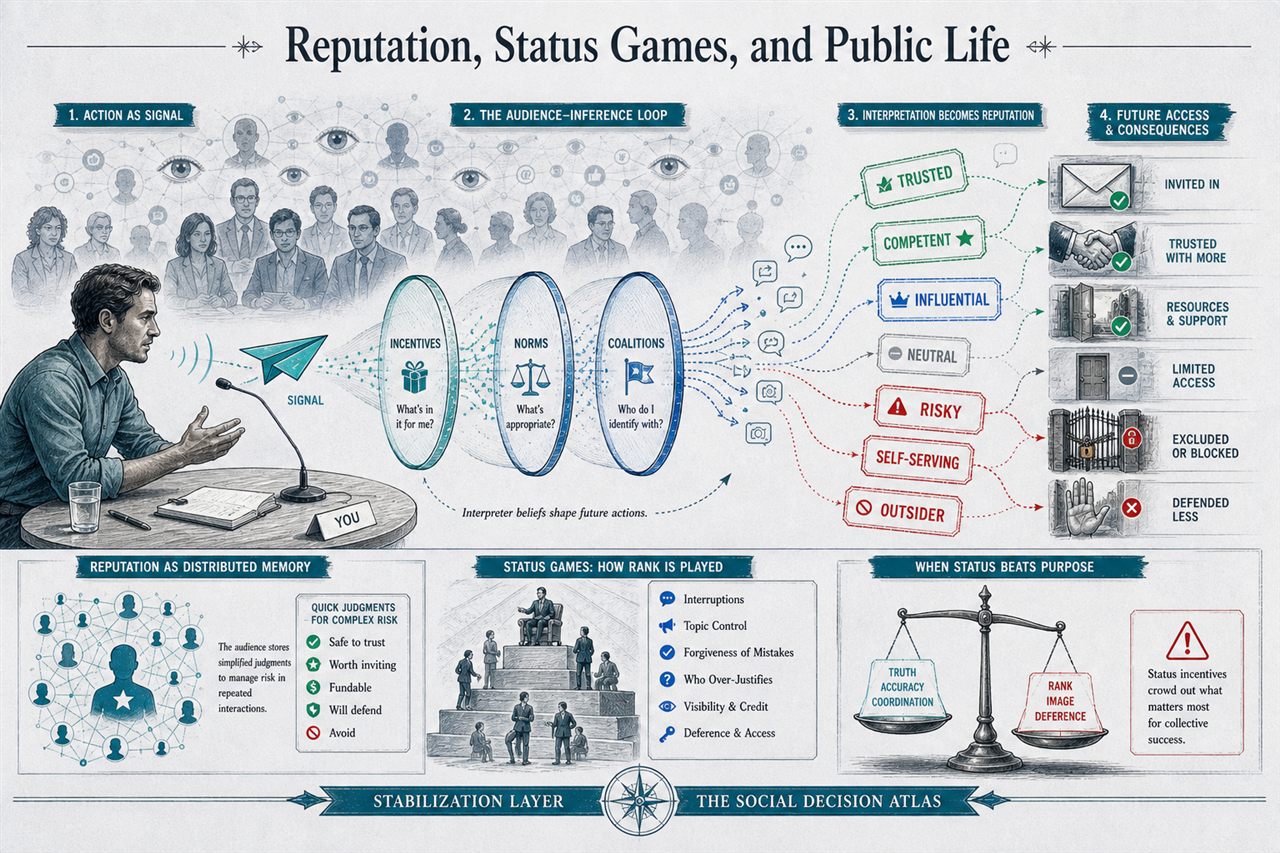
Reputation forms when an audience interprets your actions as signals about your future behavior, creating a distributed “memory” that governs trust, access, and cooperation. Status games are reputation dynamics focused on relative rank; they become harmful when they displace truth, fairness, or coordination. The practical stance is reputation stewardship: act in ways you can defend under review, choose which audiences matter, and separate substantive risk from status noise. Recognize common roles—testers, brokers, moral spotlighters, credit collectors, silent audiences, costly-signal senders, and pile-on amplifiers—and respond by staying calm, documenting reality, correcting once, and shifting disputes into accountable channels.
Chapter 29. Coordination at Civic and Community Scale
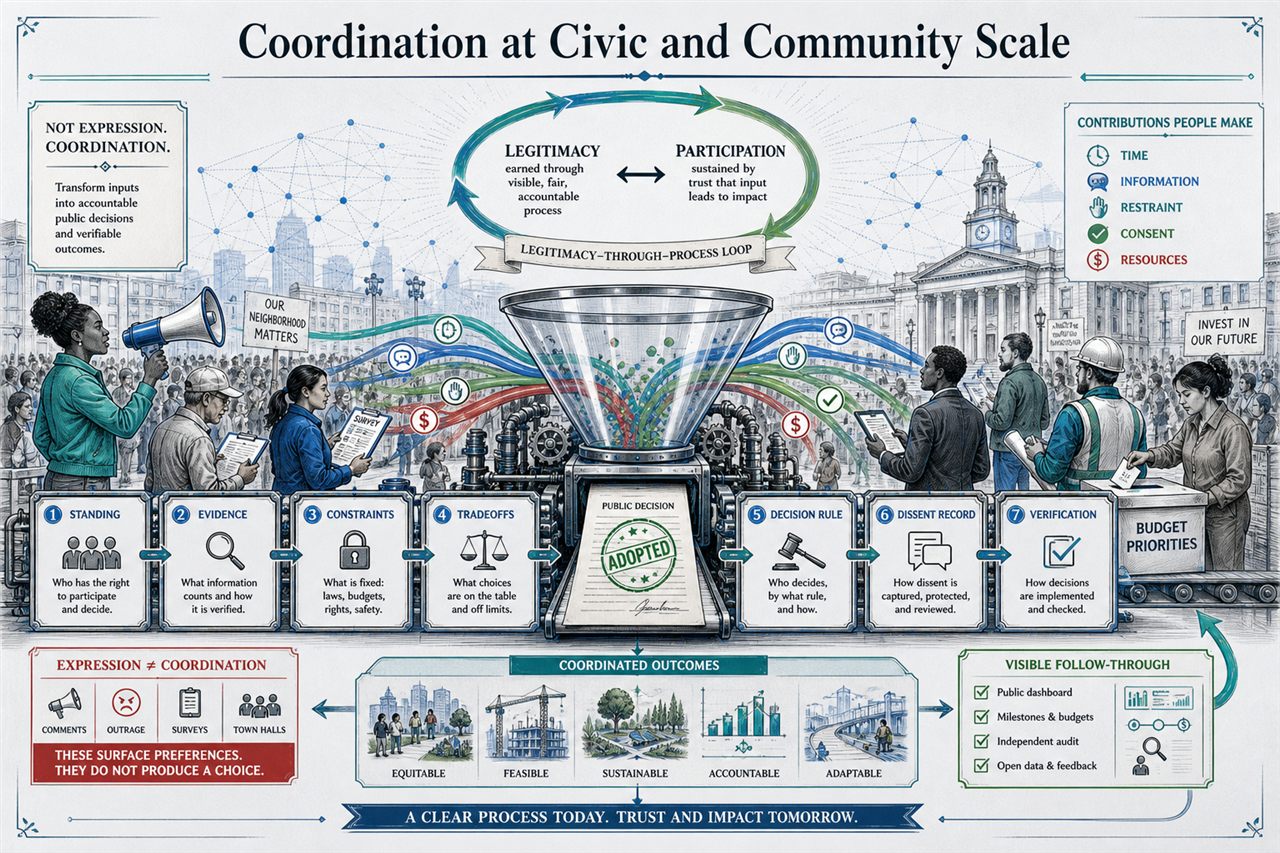
Civic coordination involves many people with unequal resources, conflicting priorities, limited visibility into one another, and shared consequences, so legitimacy comes less from interpersonal trust and more from process design. People participate when a process is open enough to hear them, structured enough to decide, and accountable enough to prove participation isn’t theater. The key failure is confusing expression with coordination: comment and outrage surface preferences but don’t produce choices. Effective processes translate input into explicit decision paths, define roles like process builders, local witnesses, and capture operators, and align people, institutions, and infrastructure by clarifying standing, constraints, and decision rules.
Chapter 30. Conclusion
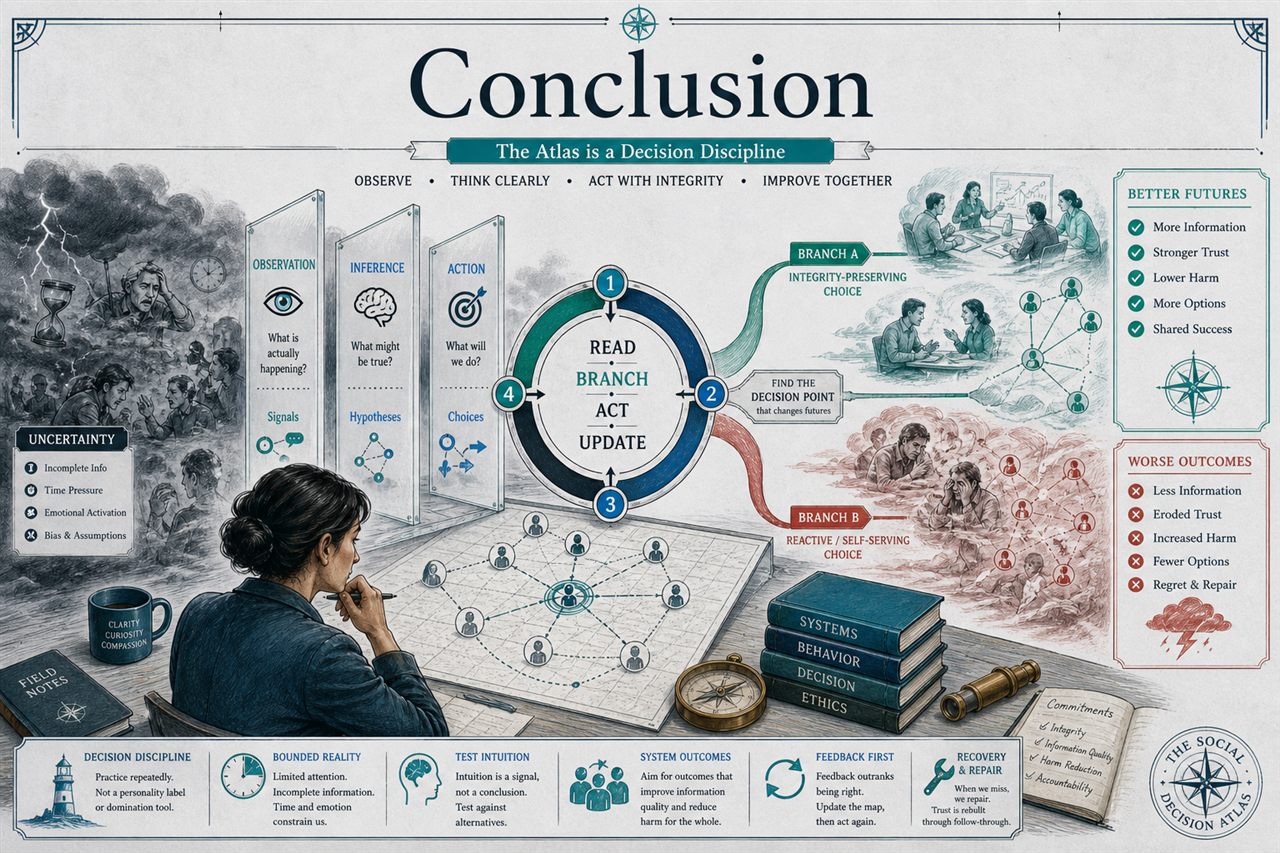
Treat social situations as decision systems, not personality diagnoses or scripts for winning. Separate observation from inference, inference from action, and action from consequence, then iterate with a read–branch–act–update loop under ambiguity and bounded rationality. Define the situation before labeling the person to avoid category errors across domains like work, intimacy, or public conflict. Track signals by type and weight patterns over isolated drama. Use systems explanations to improve choices without turning them into excuses or abandoning boundaries; impacts matter alongside intent.