
Part 5. Deception, Negotiation, and Repair
From 'The Social Decision Atlas' - an AI-authored book produced on Comuvia's BookWriter system. Each chapter below is shown as its Business Editorial poster with a one-paragraph synopsis.
Chapter 17. Deception Detection and Honest Signaling
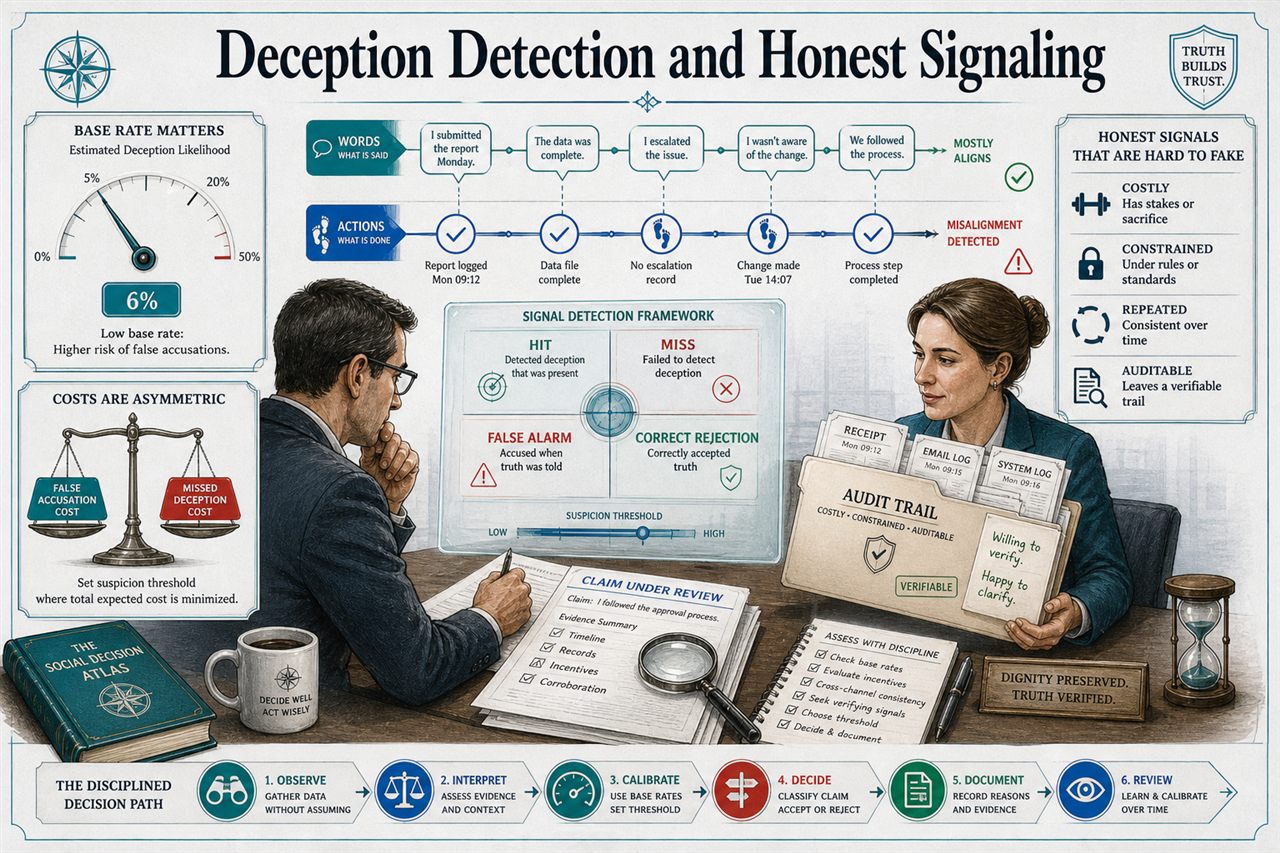
Deception detection is a classification problem under uncertainty, not mind reading. Start by defining the exact claim, the base rate of deception in that context, the costs of false alarms versus misses, and a verification path that preserves dignity. Avoid overreading single nonverbal cues; instead look for cross-channel consistency among verbal precision, contextual incentives, temporal stability, and willingness to support proportionate checks. Use archetype-aware responses to common patterns like deflection, detail-flooding, partial disclosure, and verification resistance, while protecting honest-but-anxious people from misclassification. Strengthen honesty by valuing costly, repeated, auditable signals and aligning conditions so truth is easier than theater.
Chapter 18. Negotiation and Bargaining
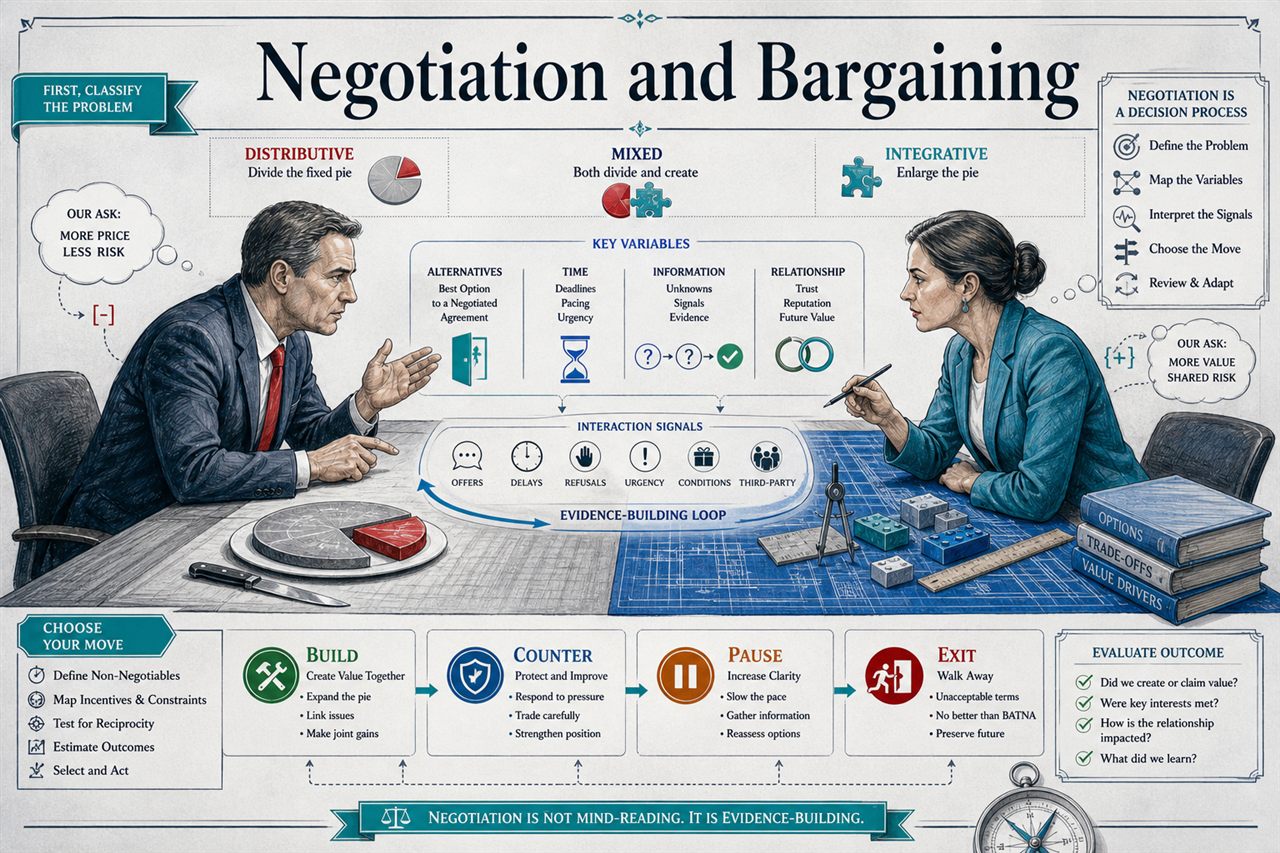
Negotiation is a structured decision process under interdependence, not a force contest, and the first move is to classify whether you’re in distributive, integrative, or mixed bargaining. Misclassifying is costly: you either miss joint gains or give away leverage. Build a usable workflow: define non‑negotiables, infer the other side’s incentives, test reciprocity, then choose to build, counter, pause, or exit. Treat behavior as information and convert ambiguity into decision-relevant evidence without sacrificing respect. Recognize common counterpart archetypes (position-locker, integrator, pressure-closer, hardball, face-saver, hidden principal) and respond with tempo control, criteria, authority checks, and trade design.
Chapter 19. Persuasion and Influence Under Consent
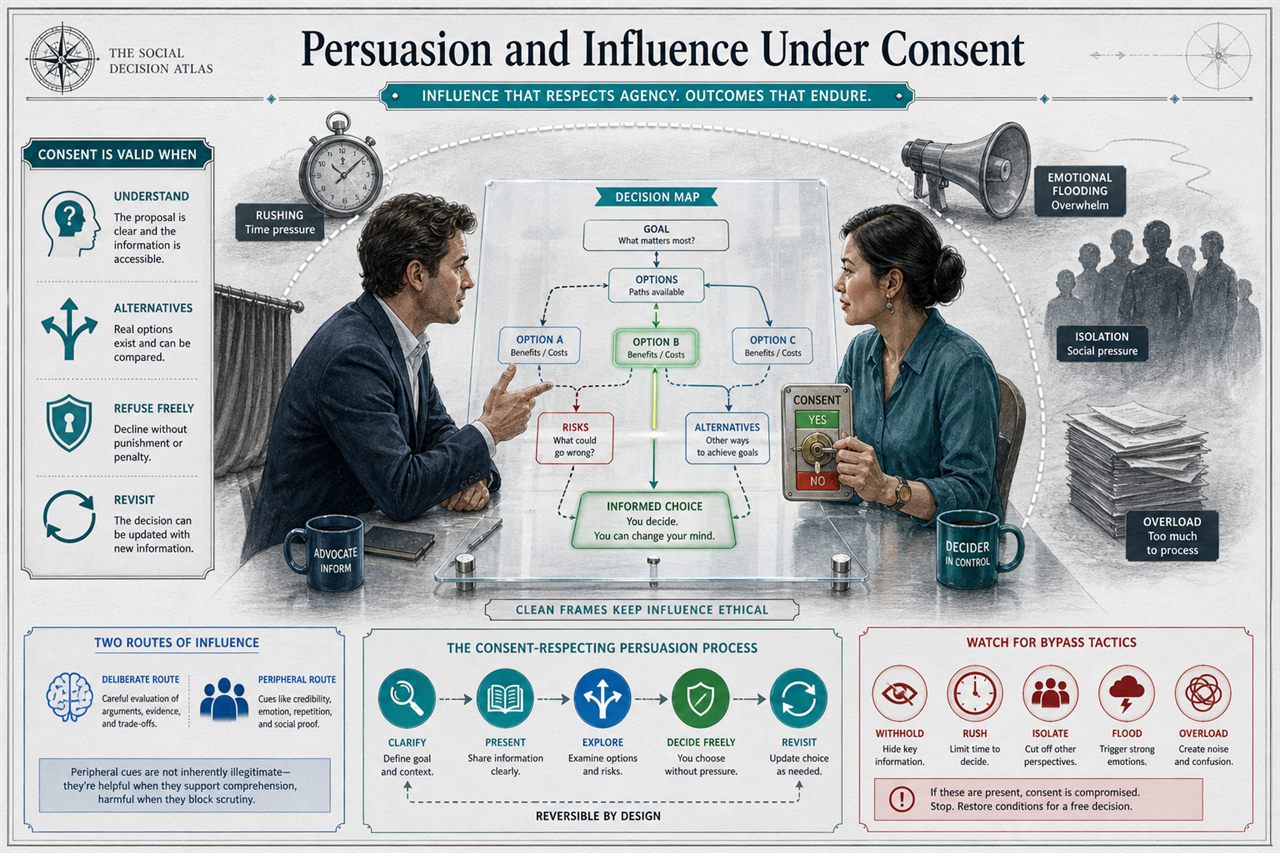
Persuasion under consent aims to change someone’s beliefs or choices while preserving their agency, access to decision-relevant information, and a real right to decline. The ethical test is whether they can understand the ask, compare alternatives, refuse without punishment, and revisit if new information appears. Influence goes off-track when cues like urgency, emotion, repetition, or credibility are used to overload or bypass evaluation. Common patterns include framing control, pressure tactics, information withholding, indecisive cycling, and deflection. Practical moves: make the proposal explicit, disclose material tradeoffs, verify urgency, slow tempo, and do explicit permission checks.
Chapter 20. Apology, Forgiveness, and Reconciliation
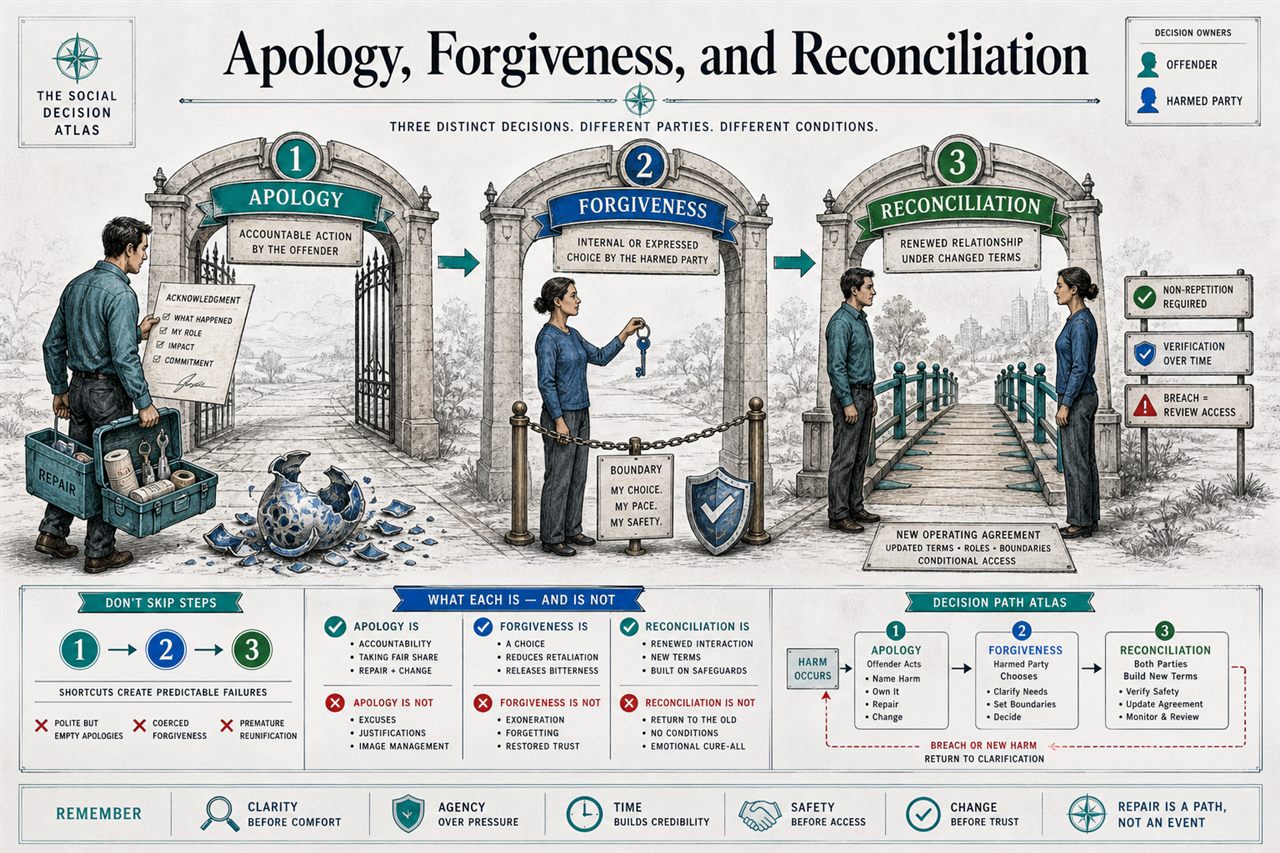
Harm creates three separate decisions: apology (offender action), forgiveness (harmed party’s internal release), and reconciliation (renewed interaction under a new operating agreement). Collapsing them causes errors, so use sequence discipline: classify the harm, evaluate apology quality, then consider safety and non-repetition before restoring access. A functional apology is a predictive signal, not a performance: name the harm, take responsibility, recognize impact, offer repair, and commit to observable behavior change. Forgiveness reduces the urge to retaliate but is not exoneration, forgetting, trust, or access. Reconciliation is highest-stakes because it increases exposure and requires a new reliability model.
Chapter 21. Betrayal, Breach, and Exit
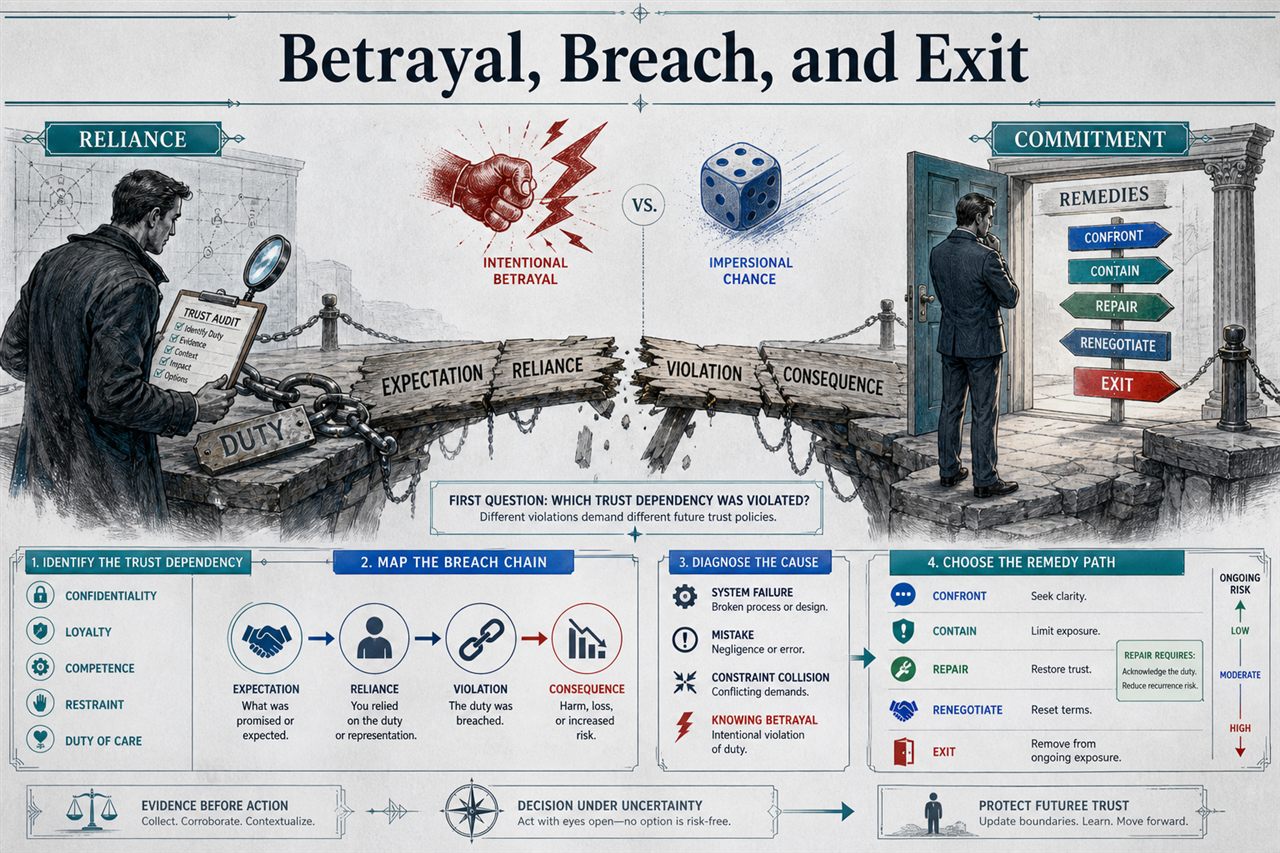
Betrayal is treated as a trust-system failure, not merely emotional injury: identify the violated dependency by specifying expectation, reliance, violation, and consequence. Distinguish mistake, constraint collision, and knowing betrayal because each implies a different future trust policy, especially under high threat and incomplete information. Repair is viable only when the breaching party accepts the record, names the duty, changes conditions to prevent recurrence, compensates where possible, and proves change over time; otherwise expect minimization, drip-disclosure, grievance-ledger deflection, coalition-building, or performative remorse. Use a decision tree to verify evidence, assess materiality, contain exposure, renegotiate, or execute a clean exit.
Chapter 22. Grief, Loss, and the End of Relationships
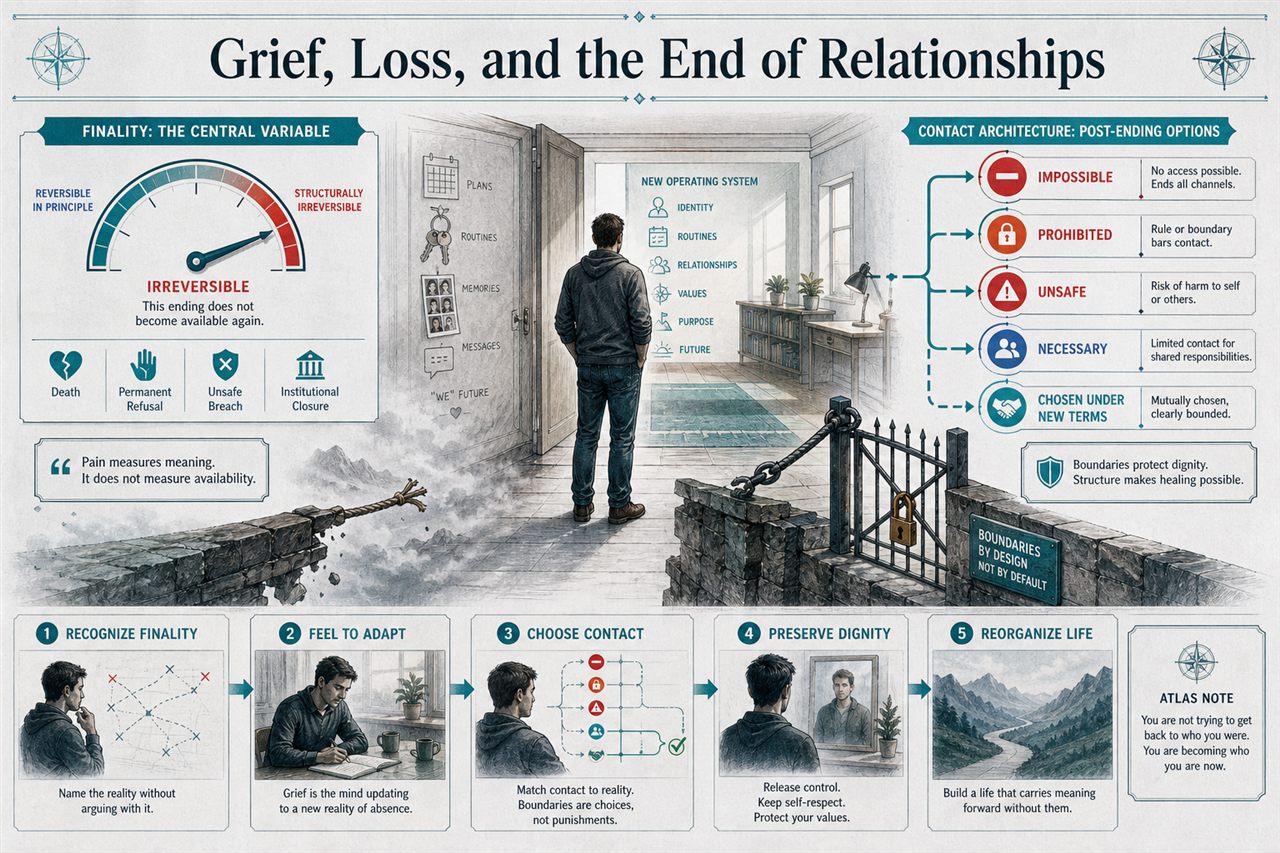
Treat endings as system transitions, not single events: you lose routines, identity labels, access, and imagined futures, so grief is adaptation to absence, not evidence the breakup was wrong or should be reversed. Diagnose three variables: finality (reversible vs irreversible), contact architecture (impossible, unsafe, prohibited, unwanted, necessary, or mutually chosen), and role residue (kids, work, finances, mutual friends). Don’t use emotional intensity to justify contact. Recognize common patterns—negotiating the absence, clean breaks, archiving, rapid replacing, public narrating, frozen loyalty, or practical settling—and apply protocols that protect dignity, set minimal coordination interfaces, and prevent reopening ambiguity.