
Part 4. Bonding, Attachment, and Romance
From 'The Social Decision Atlas' - an AI-authored book produced on Comuvia's BookWriter system. Each chapter below is shown as its Business Editorial poster with a one-paragraph synopsis.
Chapter 11. Attraction and Early Bonding
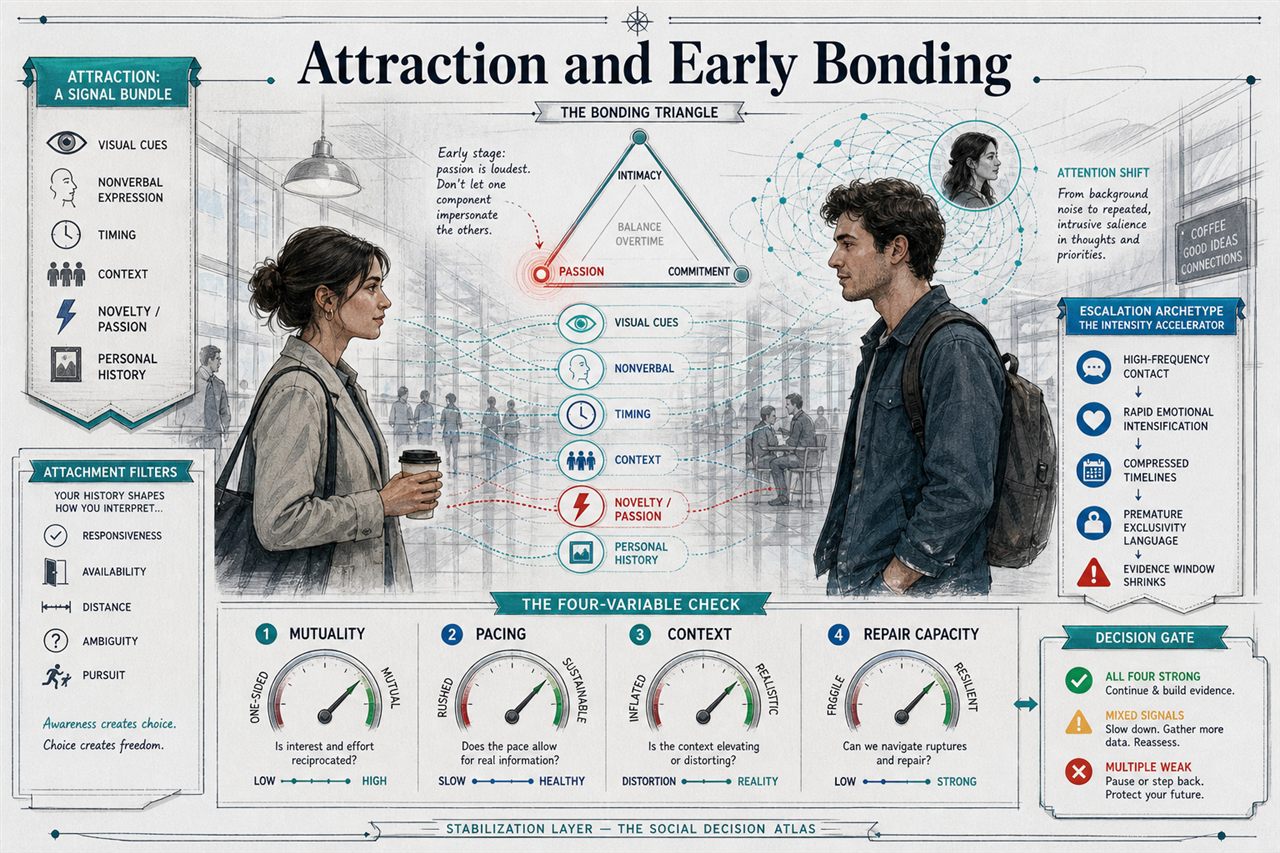
Attraction is a bundle of early signals, not proof of compatibility, and early bonding is attention becoming recurrent before intimacy or commitment is earned. Avoid letting passion-like activation impersonate stability, and remember reactions are filtered through prior attachment expectations. Slow the jump from signal to commitment and evaluate mutuality, pacing, context, and repair capacity. Notice common patterns such as intensity acceleration, novelty chasing, ambiguity about availability, idealization, and how someone responds to boundaries. Treat first impressions as low-resolution and validate signals across contexts using small tests for attention, specificity, boundaries, consistency, context transfer, and repair.
Chapter 12. Attachment Styles and Pair Dynamics
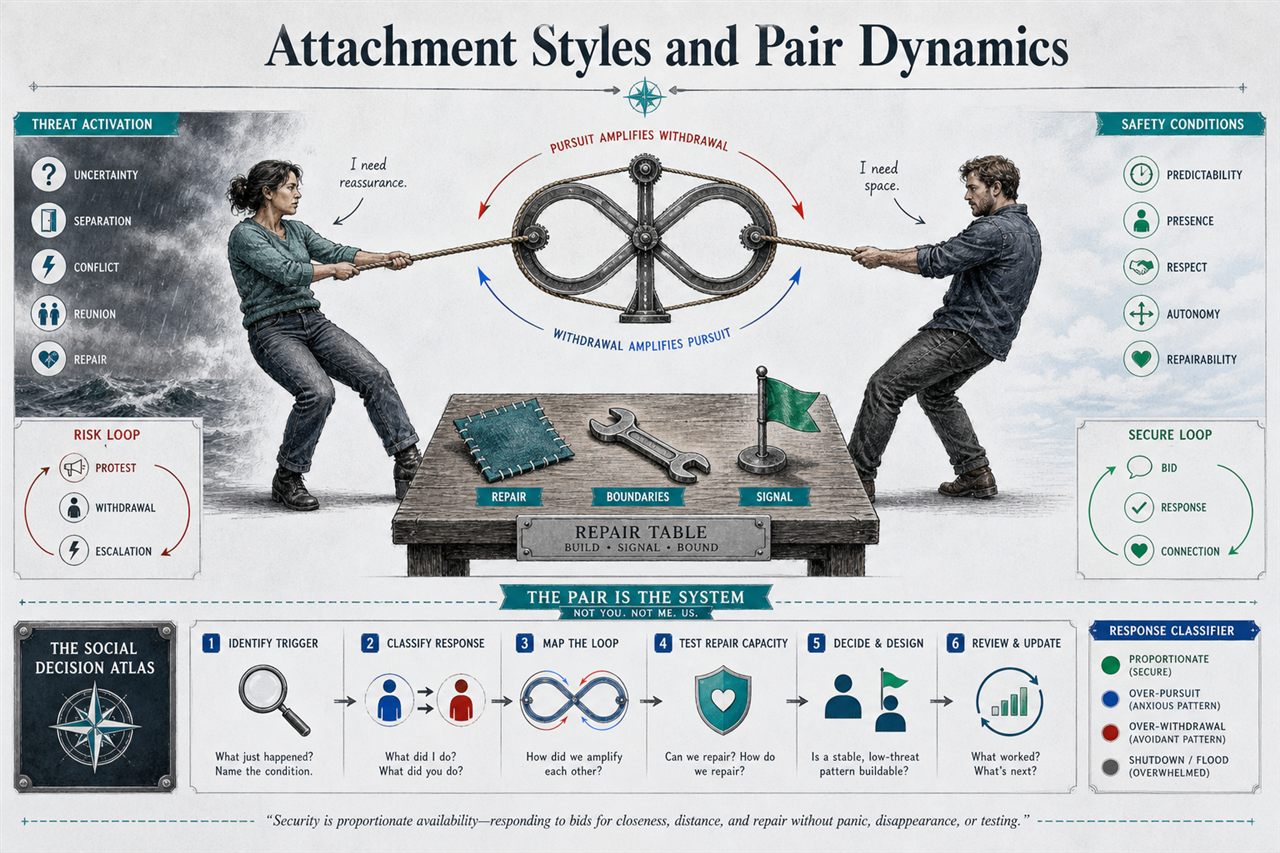
Attachment is a situational regulation pattern under closeness, uncertainty, separation, conflict, and repair, not a fixed personality verdict. Use style labels only as provisional compression; keep updating from observable behavior, especially how two people co-create loops where pursuit amplifies withdrawal and shutdown amplifies protest. Diagnose pair dynamics by separating baseline functioning from activated patterns under threat, and track closeness bids, distance bids, threat events, and repair moments. Practical leverage comes from explicit signaling, predictable timing, clear boundaries, and reliable repair. Stability increases when bids aren’t treated as abandonment or control, and conflict stays specific, time-bounded, and negotiable.
Chapter 13. Courtship and the Escalation of Commitment
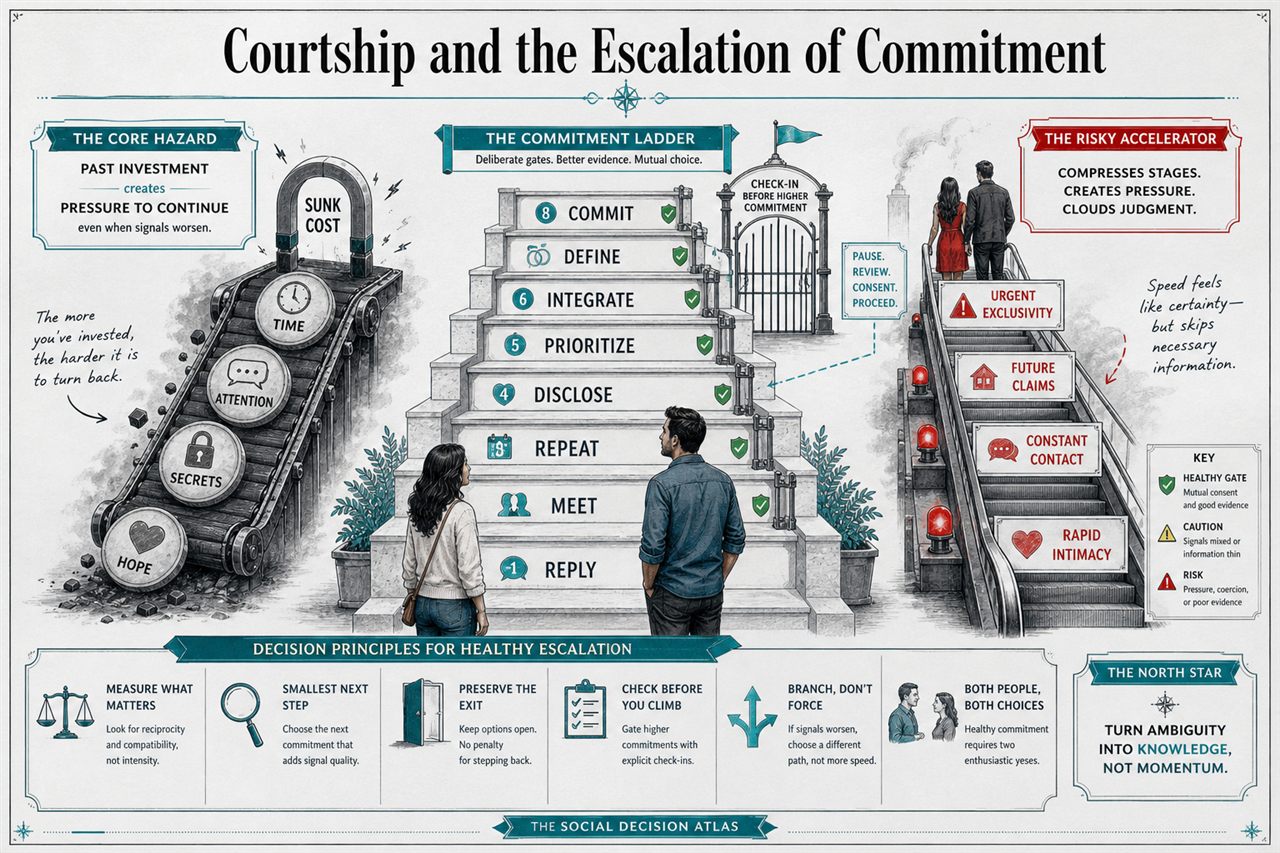
Courtship is a staged commitment system where attraction becomes progressively larger investments, creating a risk of unexamined escalation driven by sunk costs, identity, or pressure rather than current evidence. Treat progress as a commitment ladder and choose the smallest next step that improves signal quality while limiting irreversible costs. Distinguish healthy escalation—reciprocal behavior, compatible actions, and explicit consent—from risky escalation that turns uncertainty into obligation. Recognize common patterns like intensity acceleration, ambiguity keeping, sunk-cost romance, public “audience” momentum, endless evaluation, and resilient repair. Evaluate moves by reciprocity, clarity, pace, reviewability, and observed repair behavior, using check-ins and gating before integrating lives.
Chapter 14. Intimacy, Vulnerability, and Disclosure
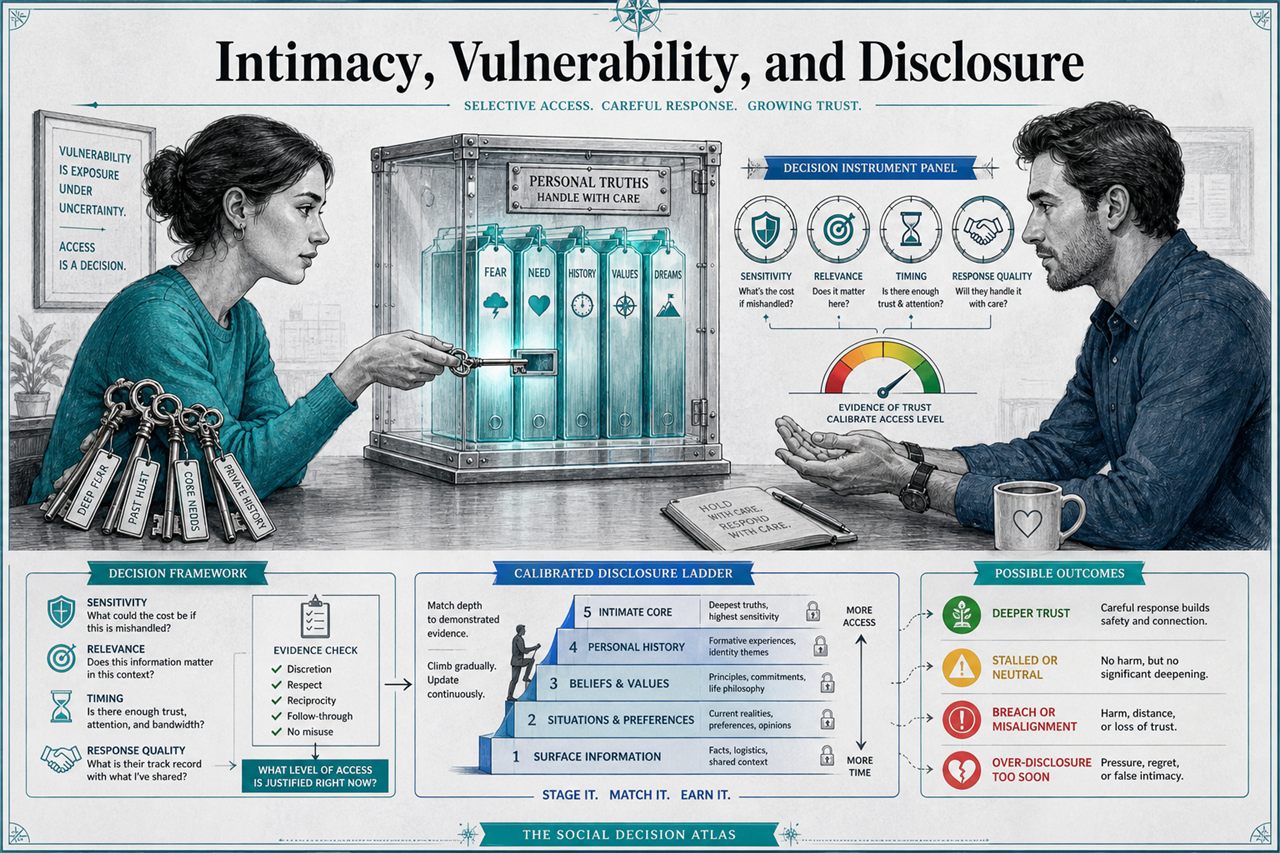
Intimacy is built less by how much you share than by repeated cycles of selective access, considerate response, and trust updates. The practical skill is calibrated disclosure: match what you reveal to sensitivity, relevance, timing, and the other person’s response quality. Treat vulnerability as choosing exposure under uncertainty, not a moral performance. Recognize patterns that distort disclosure—flooding too fast, withholding to create asymmetry, performative vulnerability without behavior change, interrogation for leverage, or minimizing others’ feelings—and respond by pacing, insisting on reciprocity and consent, and requiring follow-through. Use layers of disclosure, moving from preferences to meaning, history, and explicit needs.
Chapter 15. Jealousy, Exclusivity, and Relational Boundaries

Jealousy is treated as an alarm signal, not proof of wrongdoing, and becomes useful only after separating emotion, evidence, agreement, and response. Exclusivity is an explicit or implicit contract about sexual, romantic, emotional, public, disclosure, time, and future-claim expectations; intensity is not a substitute for a clear deal. Boundaries function as participation conditions, not control or surveillance. A practical sequence is to identify the trigger, test for observable behavior, check whether an agreement existed, clarify or define missing rules, state your boundary, invite clarification, and then choose repair, renegotiation, escalation, or exit. Recognizing common archetypal patterns helps keep conflict specific and non-coercive.
Chapter 16. Long-Term Compatibility and Relationship Drift
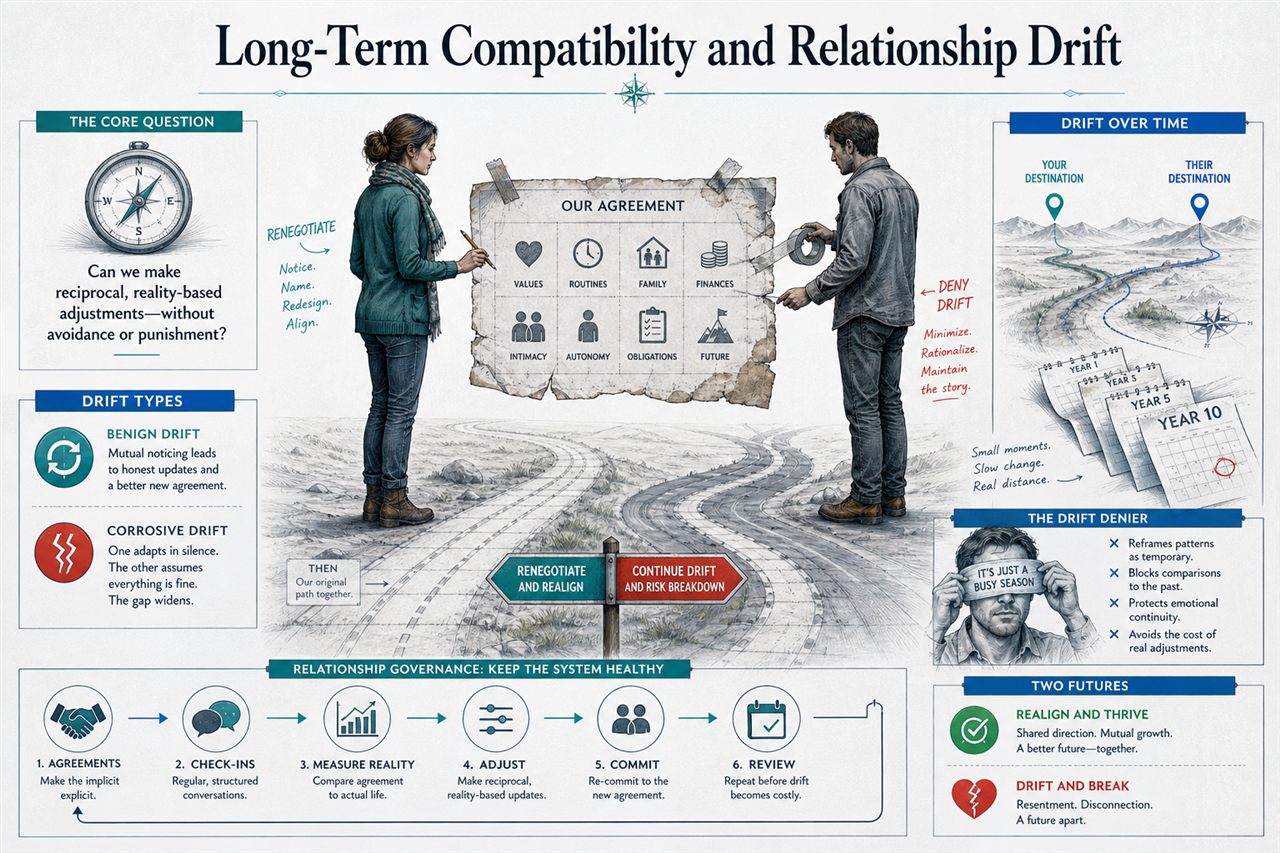
Long-term compatibility is the ongoing ability to coordinate values, daily life, intimacy rhythms, obligations, and future direction without one person repeatedly paying hidden costs. Drift happens when the relationship’s label and history stay intact while the working agreement quietly changes; love can remain even as the operating system fails. Track archetypal failure modes like denial, silent adaptation, unilateral upgrades, legacy-keeping, future-splitting, and conflict minimization, and favor explicit renegotiation. Diagnose across values/direction, daily rhythm, attachment/intimacy, and especially adaptation capacity. Watch patterns of temporal, verbal, contextual, and nonverbal signals, then convert ambiguity into concrete decisions, timelines, and reciprocal, observable agreements.