
Part 2. Attachment and Long-Term Pairing
From 'Behavioral Realism in Drama and Romance Cinema' - an AI-authored book produced on Comuvia's BookWriter system. Each chapter below is shown as its Business Editorial poster with a one-paragraph synopsis.
Chapter 7. The Notebook (2004) — persistence, idealized devotion, memory and attachment
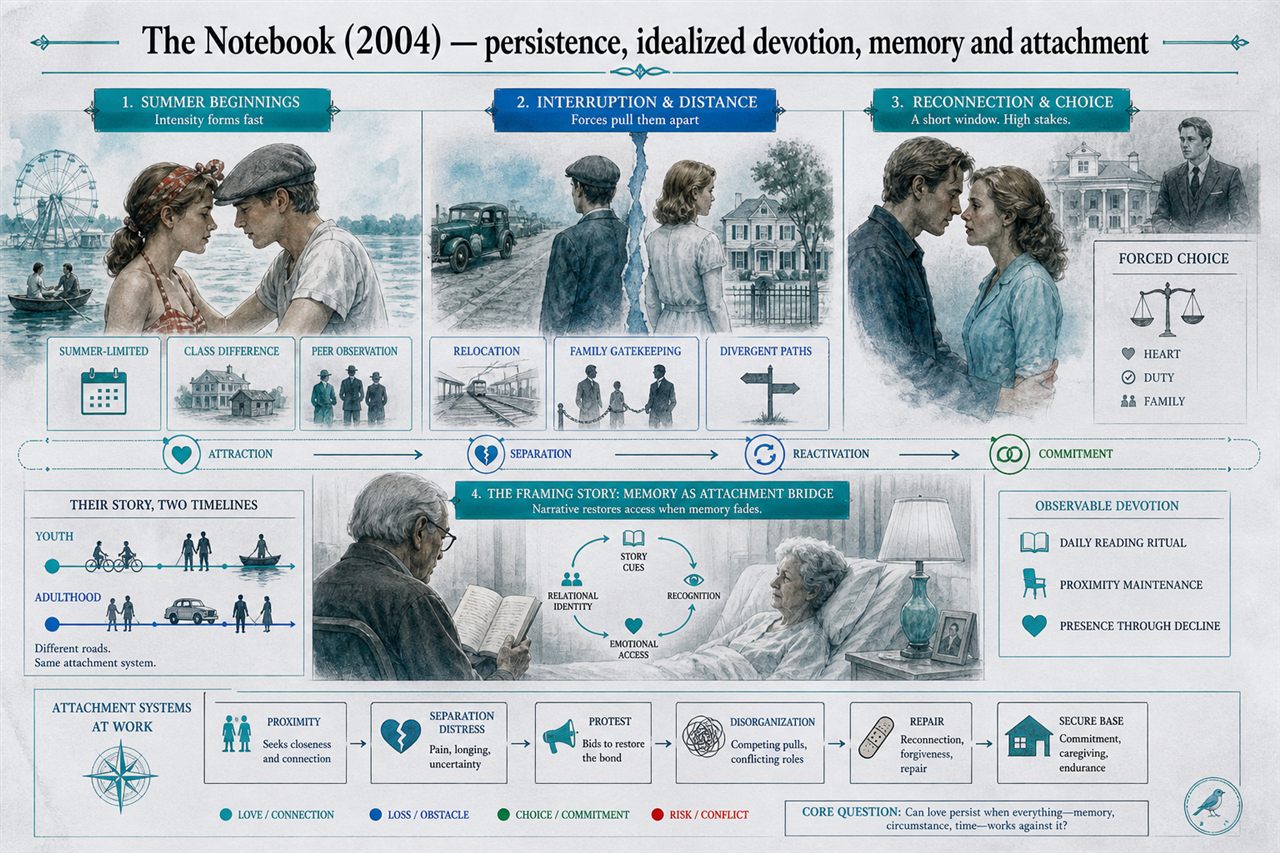
Persistence is repeatedly framed as proof of love, from public stunts and relentless bids to long letter-writing, home restoration, and daily caregiving. That romance script blurs devotion with coercive pressure, since compliance under spectacle or threat is not clean consent, and one-way pursuit under silence often reflects anxious protest, rumination, or poor uncertainty management rather than secure commitment. Symbolic cues and proximity are shown reactivating a first love and overriding an engagement, while family gatekeeping controls information without dissolving attachment. The most behaviorally grounded material appears late in life: attachment expressed as ritual, proximity maintenance, and caregiving that can momentarily bridge dementia-related identity loss.
Chapter 8. Blue Valentine (2010) — attachment erosion, mismatched growth, decline dynamics
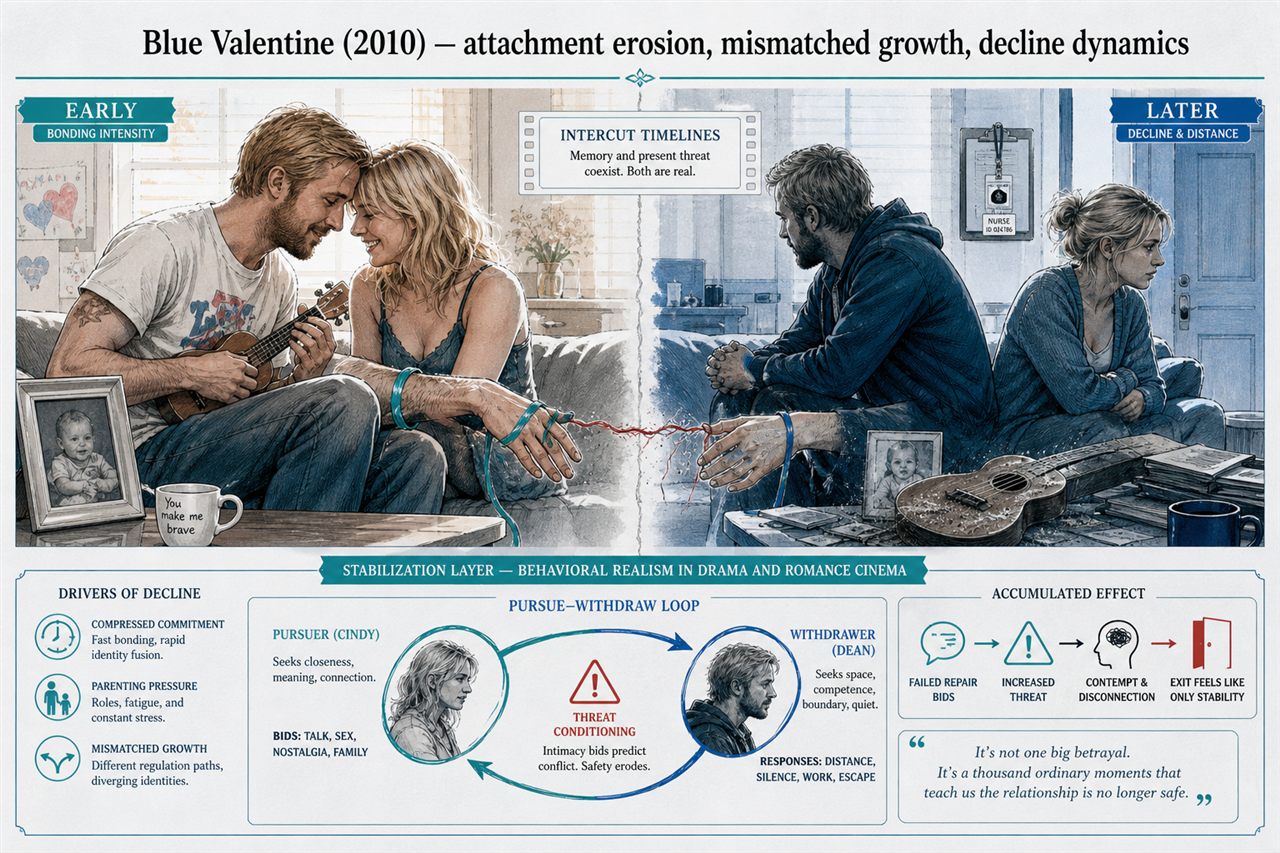
Love begins with genuine play, rescue energy, sexual chemistry, and rapid commitment, yet later collapses through attachment erosion rather than betrayal. Two timelines show how the same traits can flip meaning: Dean’s spontaneity once signals safety but later reads as immaturity, alcohol-linked dysregulation, and stagnation, while Cindy’s growth toward work competence pairs with distance, boundary protection, and exit. Decline is driven by repeated failed repair bids, demand–withdraw loops, and repair attempts that become coercive when closeness is treated as owed. Parenting raises exit costs without improving regulation or negotiation. A key realism gap is how quickly pregnancy becomes stable role adoption without explicit bargaining.
Chapter 9. Before Midnight (2013) — long-term conflict, resentment accounting, repair capacity
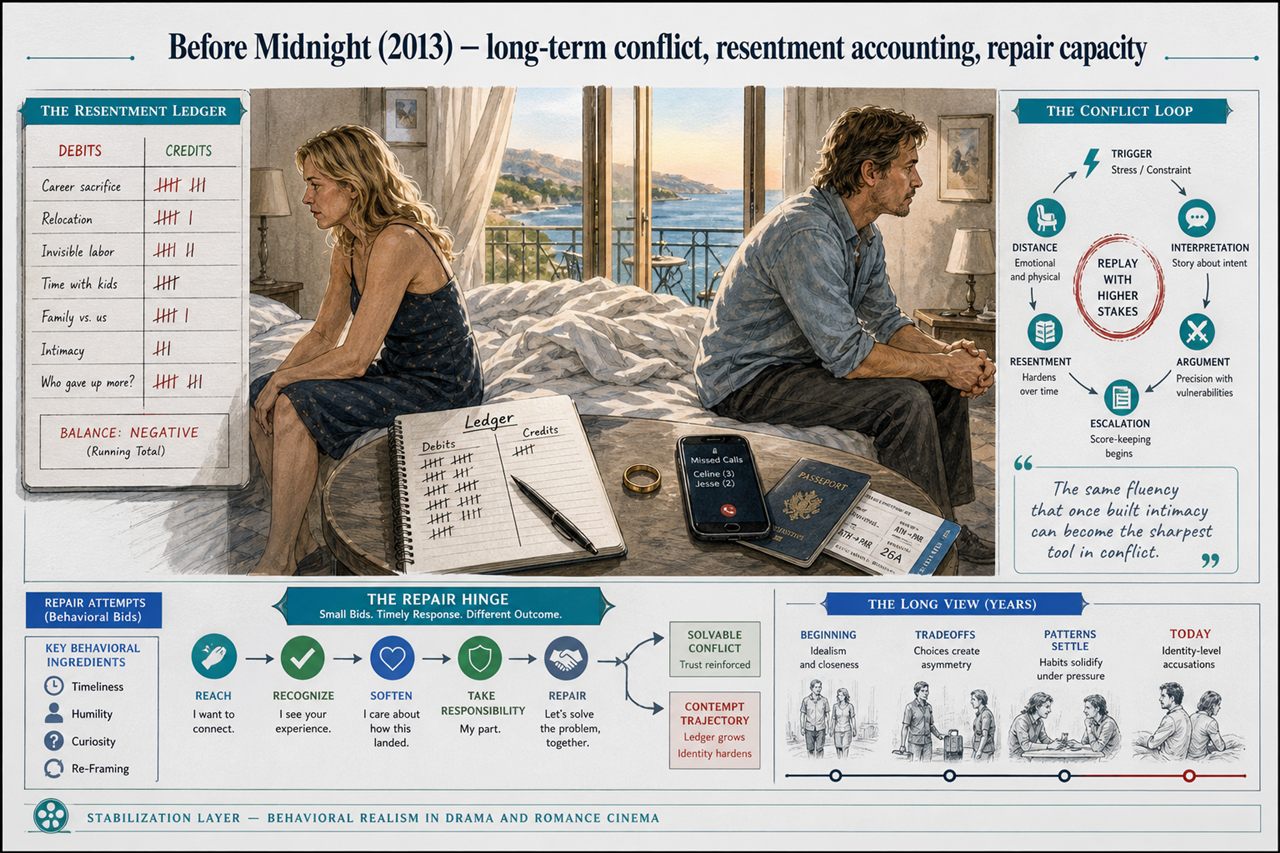
Long-term partnership turns shared history into a ledger: memories become evidence of debts, sacrifices, and unmet needs, so intimacy can double as ammunition. A seemingly practical choice about moving nearer Jesse’s son functions as an attachment threat for Celine, activating fears that her autonomy will again be reorganized around his priorities. Their verbal fluency and psychological insight don’t prevent escalation; narrative sophistication isn’t the same as regulation or repair capacity. Commitment appears as a shifting composite, able to coexist with exit fantasies.
Chapter 10. Revolutionary Road (2008) — shared-illusion collapse, thwarted autonomy, coercive drift
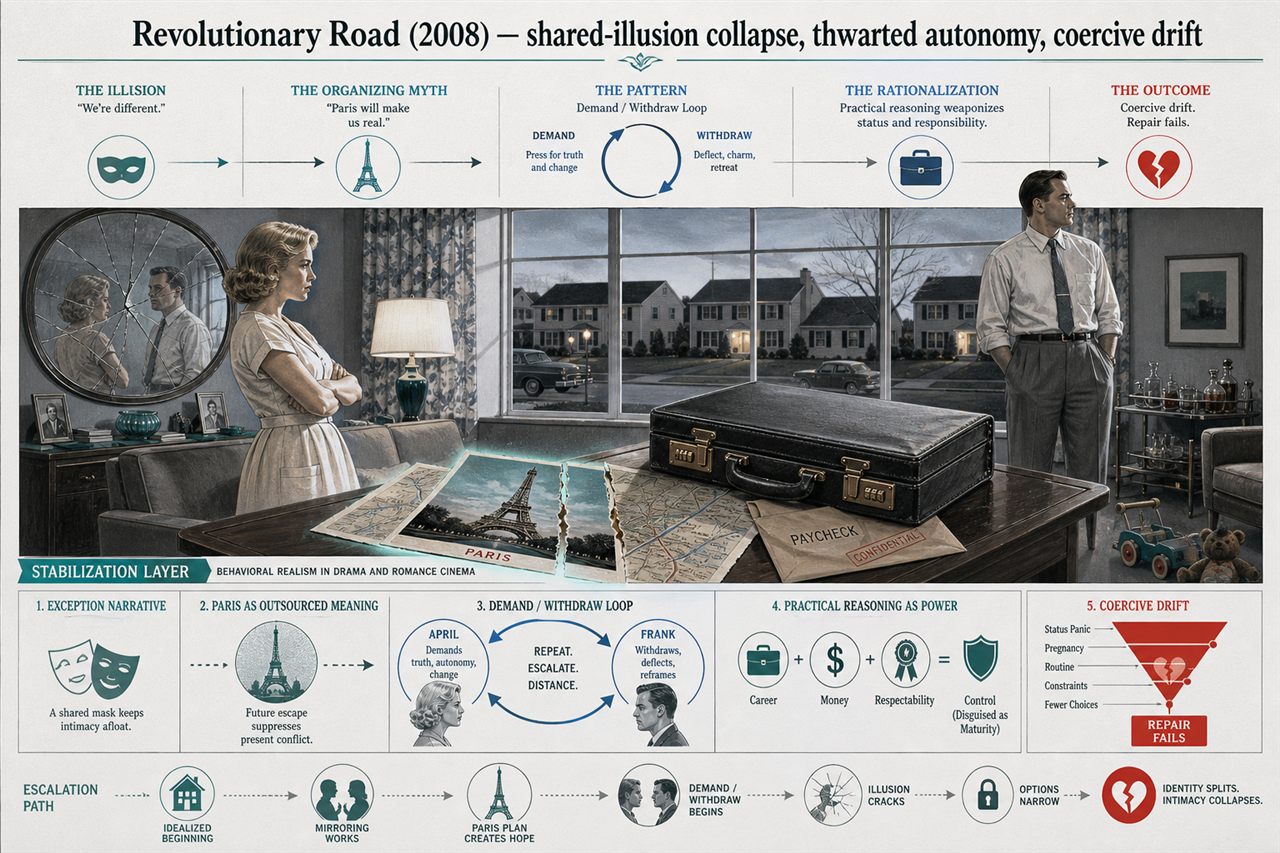
Frank and April Wheeler hold their marriage together with a shared “we’re not like them” story that makes suburban life feel temporary and survivable. April’s Paris proposal briefly restores intimacy by supplying novelty and identity repair, but it substitutes fantasy for the hard skills of negotiating risk, validating fears, and breaking a stable demand/withdraw cycle. As costs rise, Frank’s “practical” objections become control moves protecting status and masculine competence, while April experiences shrinking autonomy. Frank’s awkward affair reads as ego regulation after identity injury, yet his confession seeks absolution without real trust repair.