
Part 1. Attraction and Early Bonding
From 'Behavioral Realism in Drama and Romance Cinema' - an AI-authored book produced on Comuvia's BookWriter system. Each chapter below is shown as its Business Editorial poster with a one-paragraph synopsis.
Introduction — Why Audit Drama and Romance for Behavioral Realism

Drama and romance films make implicit claims about how people bond, fight, repair, and separate, often asking viewers to accept relationship mechanisms that would usually fail in real life. The aim is to audit behavioral realism, not artistic quality: do choices to pursue, withdraw, betray, confess, forgive, or leave fit incentives, attachment pressures, context, information, and history? Behavioral realism means evidence-informed plausibility under pressure, distinguishing one-off possibilities from patterns a film presents as reliable. Common narrative shortcuts confuse attraction with compatibility and apology with repair. The method inspects key scenes by identifying signals, mapping constraints, and checking consequences for coherence.
Chapter 1. Before Sunrise (1995) — attraction, self-disclosure escalation, idealization
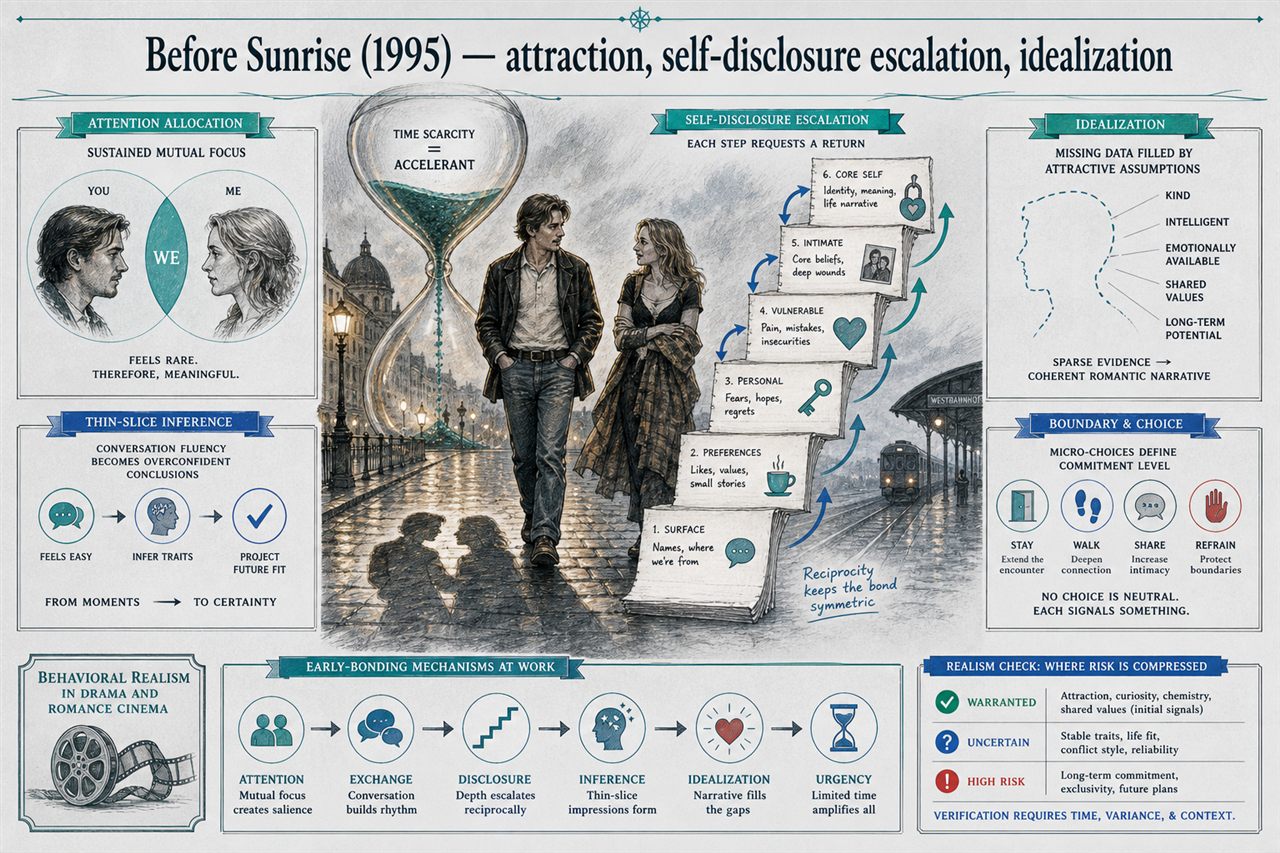
Rapid attraction becomes believable when novelty, focused attention, and conversational reciprocity align, and when both people treat the low immediate cost as permission to lean in. Escalating, reciprocal self-disclosure can create a strong subjective sense of intimacy fast, especially under a deadline that amplifies scarcity and “now or never” meaning. Playful performance and roleplay let partners express real desire with face-saving distance. The realism strain shows where chemistry substitutes for safety planning: the invitation and context shift compress the real-world risk-management decision tree. A curated night of stimulating settings can feel diagnostic while filtering out traits that matter under everyday constraints.
Chapter 2. 500 Days of Summer (2009) — projection, mismatched attachment expectations, narrative bias
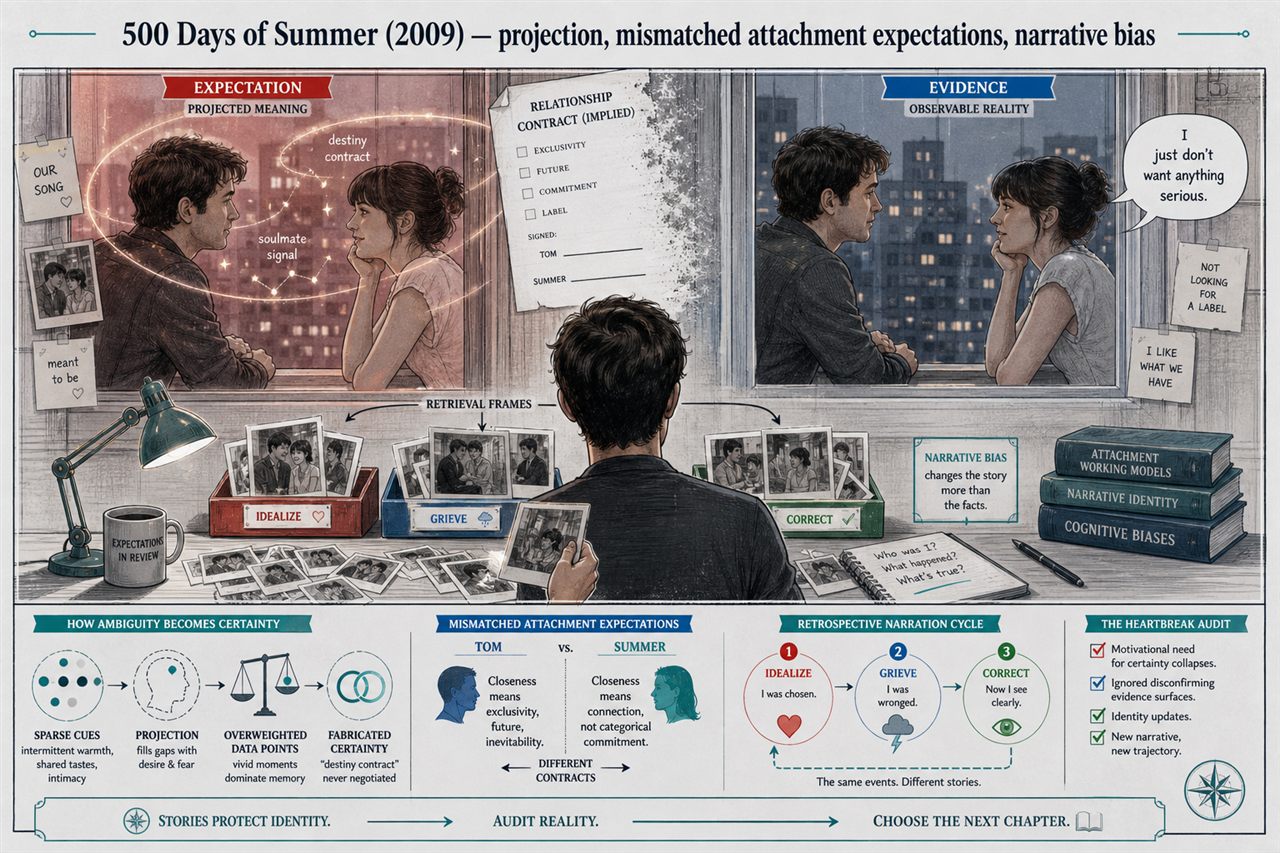
Tom treats small, emotionally vivid signals as proof of rare compatibility, jumping from shared taste and playful intimacy to assumptions about exclusivity and a “meant to be” bond. Summer enjoys closeness but repeatedly resists commitment language, creating a contract mismatch where identical behaviors (sex, routines, warmth) carry different meanings and obligations. The story’s key insight is projection under uncertainty: sparse cues feel diagnostic when filtered through attachment-driven expectations. Practical takeaways include separating signal intensity from signal diagnosticity, not treating accumulated rewards as “owed” commitment, and using explicit renegotiation when intimacy increases. After loss, memory becomes identity-protective re-editing, unless inference rules change.
Chapter 3. La La Land (2016) — passion vs. goal conflict, sacrifice, counterfactual bonding

Shared ambition speeds bonding by acting as a vivid compatibility signal and by turning each partner into an audience that steadies persistence through rejection. The relationship strains when identity-aligned goals become logistically incompatible: misaligned schedules, missed reassurance, and defensiveness make rupture feel like “no one’s fault,” just coordination collapse. Sacrifice reads as love only when it’s legible and mutually chosen; unilateral “I did it for us” moves can be self-protective reframing and invite resentment.
Chapter 4. Notting Hill (1999) — status asymmetry, approach/avoidance, parasocial pull
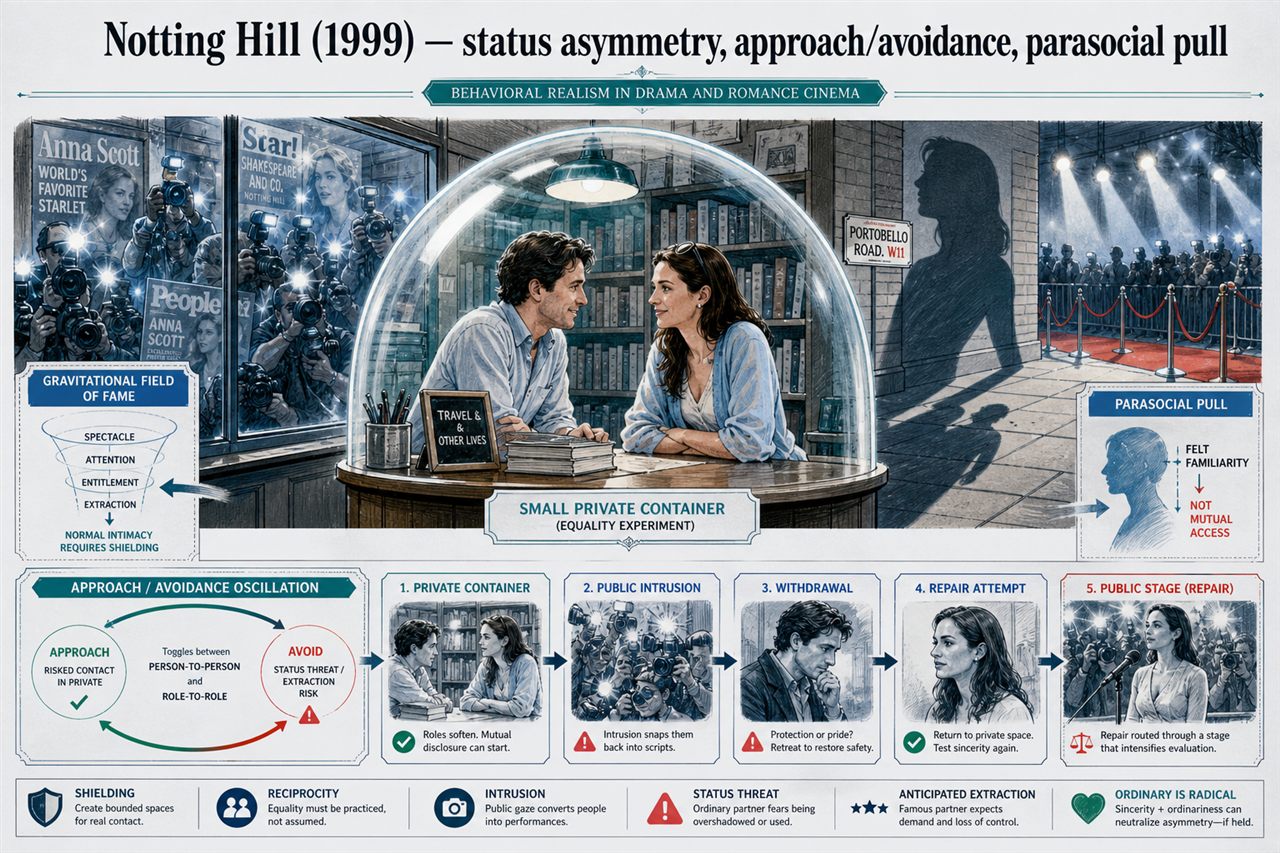
A celebrity/non-celebrity romance becomes believable when parasocial “felt familiarity” is converted into real person-knowledge through repeated, protected private contact. Extreme status asymmetry triggers approach/avoidance cycles: William leans in when Anna can be treated as a normal person in a small, private container and pulls back under public scrutiny and status threat; Anna approaches low-demand intimacy but withdraws when she anticipates extraction, entitlement, or media contamination. Friends can function as calibration, countering distorted self-appraisal and supporting risk-taking. The film is optimistic, skipping realistic boundary checks and risk management and overstating how easily sincerity and one public repair gesture can neutralize structural asymmetry.
Chapter 5. Call Me by Your Name (2017) — first attachment, desire, transient bonding

Early desire is shown as attention capture and approach/avoidance cycling—irritation, mimicry, jealousy, surveillance—before anyone can state it plainly. A shared summer household becomes a high-contact, low-structure container that intensifies bonding while postponing labels, boundaries, and future talk, so escalation happens through ambiguous, deniable signals when clarity feels risky. The story usefully separates attraction from consent symmetry, attachment formation, and post-bond welfare, warning against a “symmetry shortcut” that treats mutual desire as equal power. Even a brief affair can create durable attachment and grief, and a responsive parent can provide a secure-base response by naming feelings without shaming or forcing disclosure.
Chapter 6. When Harry Met Sally (1989) — friendship-to-romance transition, opposite-sex friendship dynamics
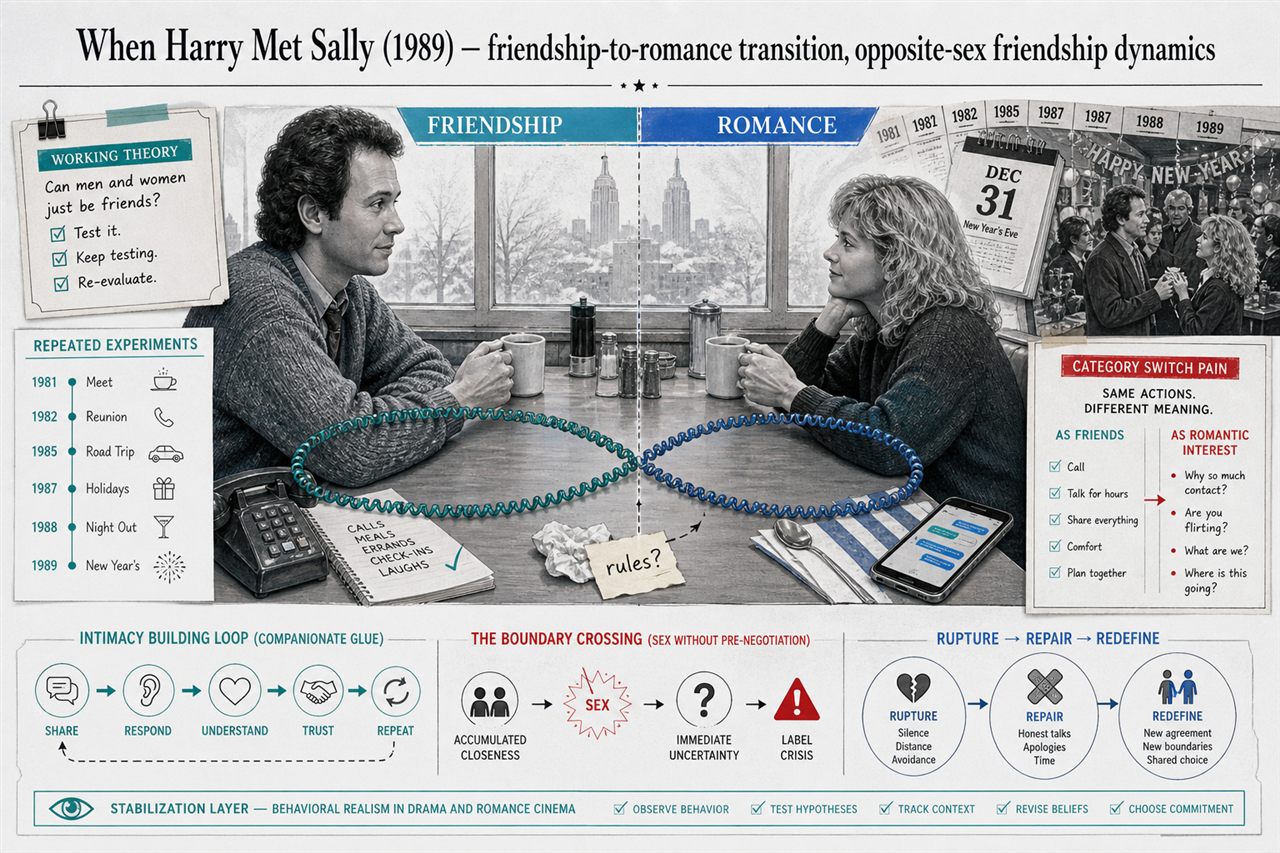
Harry and Sally’s relationship tests whether opposite-sex friendship can survive private romantic intent and how routine contact reshapes attraction over time. Mundane companionship, frequent calls, and emotional caretaking build companionate intimacy that can look couple-like while still being labeled “friendship,” setting up a classification crisis once sex occurs without prior negotiation. Sex also appears as a stress response to loneliness and loss, heightening next-day confusion. Humor functions both to bond and to dodge vulnerability. A decisive confession can pivot the bond when it signals deep partner knowledge and a real commitment shift, though the film sometimes overgeneralizes gendered claims.