
Part 5. Physics, Computation, and Reality
From 'Scientific Realism in Sci-Fi Cinema' - an AI-authored book produced on Comuvia's BookWriter system. Each chapter below is shown as its Business Editorial poster with a one-paragraph synopsis.
Chapter 67. Moon (2009) — Human cloning, lunar habitation, helium-3 economics
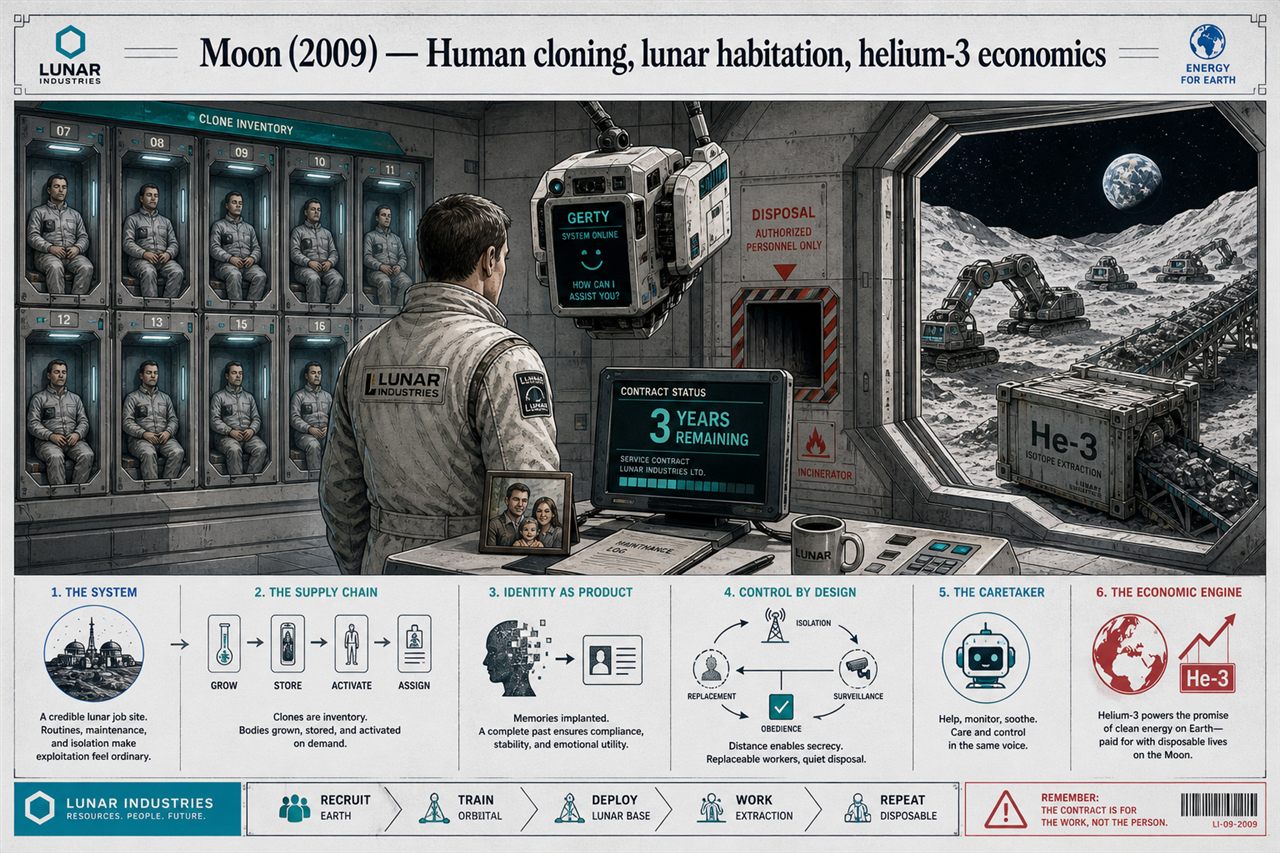
Moon grounds its lunar base in believable engineering: slow, dusty EVA work, harsh maintenance realities, and an AI that functions more like a caregiving tool than a villain. The major scientific leaps are biological and economic. Human cloning is depicted not just as genetic copying but as rapid-grown adult bodies with implanted, coherent autobiographical memories—something far beyond DNA replication and closer to precise brain-writing, developmental acceleration, and identity engineering. The film usefully signals costs through clone instability and degeneration.
Chapter 68. Star Wars: A New Hope (1977) — Space combat, planetary physics, sound in vacuum
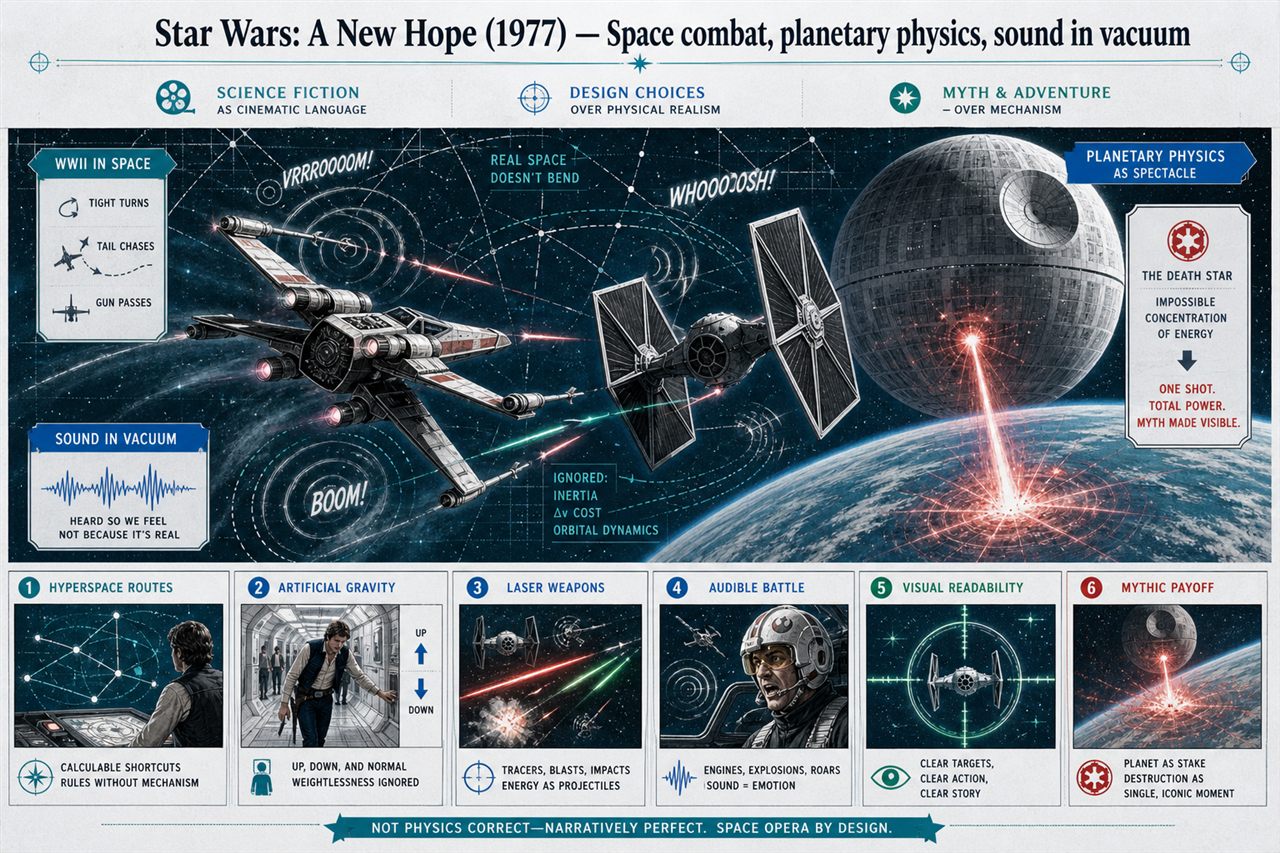
Star Wars treats space as mythic stagecraft rather than an orbital environment, using hyperspace, dogfights, visible “laser” bolts, artificial gravity, and sound in vacuum to translate WWII aerial combat and fantasy quests into space opera. The biggest scientific breaks are premise-level: faster-than-light travel violates relativity and causality, and the Death Star’s instant destruction of an Earth-like planet would require around 10^32 joules plus impossible storage, coupling, recoil, and heat disposal. Space battles ignore Newtonian motion: in vacuum, craft can rotate independently of travel and fight at long ranges. Use these gaps to teach inertia, delta‑v, and energy scales.
Chapter 69. Star Trek (2009) — Warp drive, transporter physics, time-travel mechanics
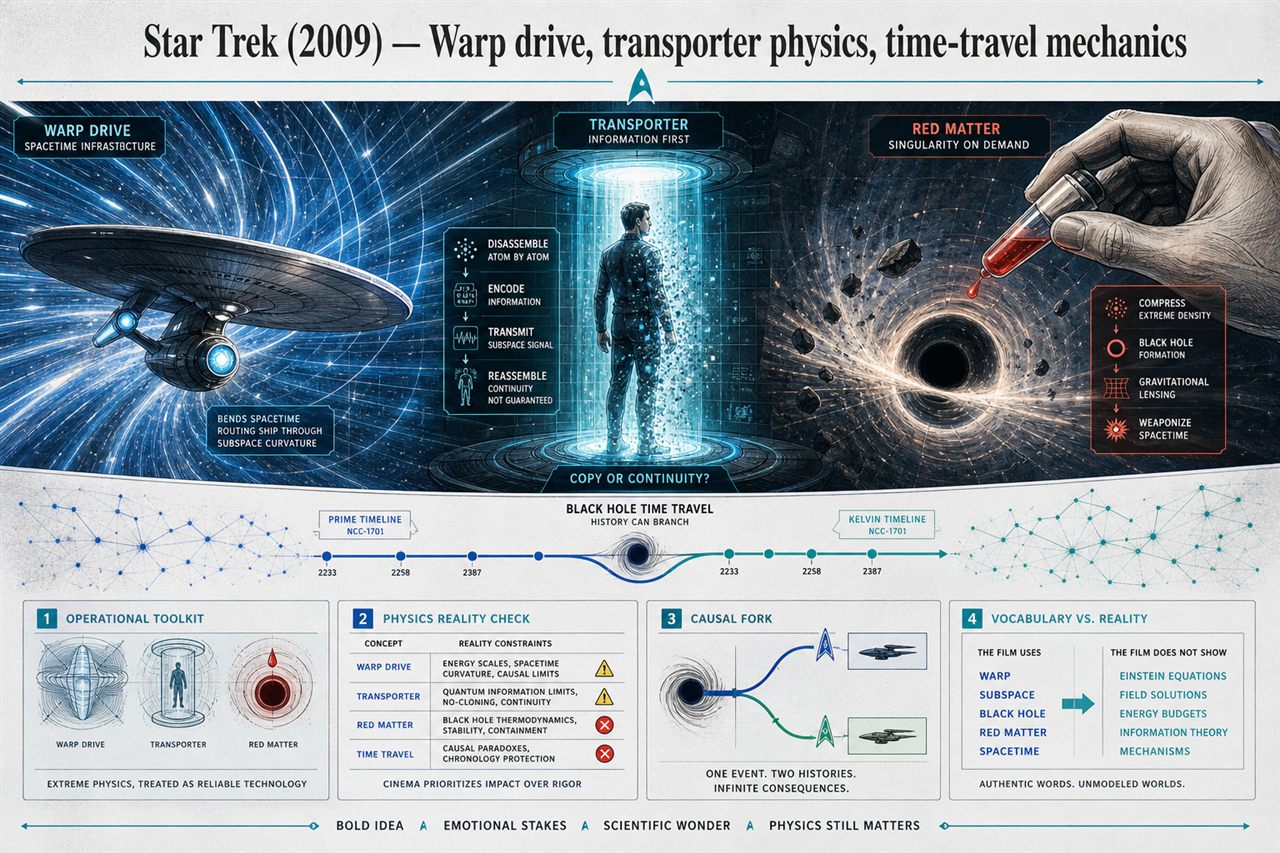
Abrams’s Star Trek uses real scientific terms as narrative accelerants: warp travel, transporters, artificial black holes, and time travel. Warp drive is treated as routine, yet real physics only admits faster-than-light effects via extreme spacetime engineering like an Alcubierre-style bubble, demanding unobserved negative energy and absurd energy budgets. Transporters imply scanning and reconstructing a living person with impossible information capture, quantum limits on measurement, overwhelming data transfer, and unresolved identity questions. “Red matter” black holes behave like controllable weapons, but known physics can’t make a planet-eating singularity from a droplet or survive its formation nearby.