
Part 4. Life, Biology, and Evolution
From 'Scientific Realism in Sci-Fi Cinema' - an AI-authored book produced on Comuvia's BookWriter system. Each chapter below is shown as its Business Editorial poster with a one-paragraph synopsis.
Chapter 50. Alien (1979) — Astrobiology, xenomorph life cycle, parasitic reproduction
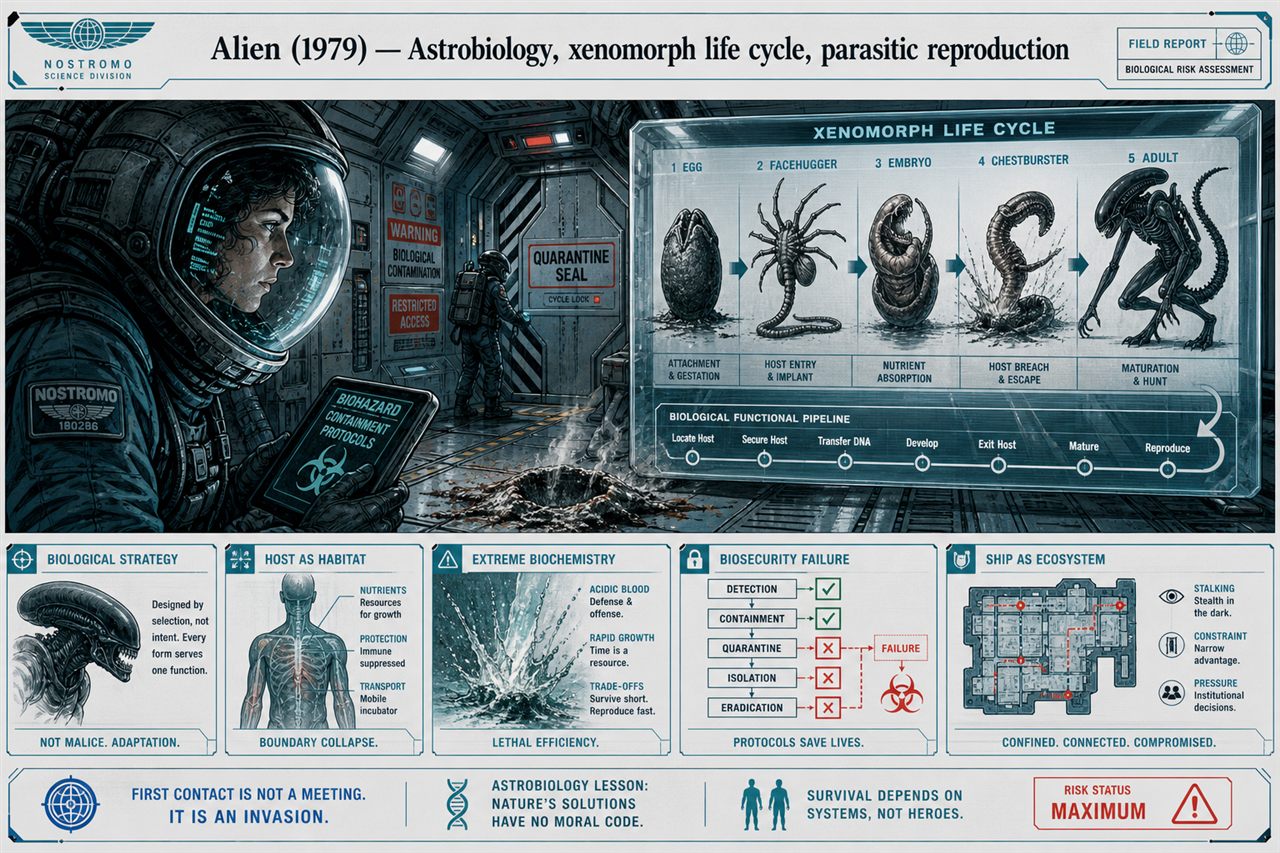
Alien treats first contact as a biosafety emergency, not a handshake, and makes its terror feel plausible by grounding the monster in a coherent life cycle: egg, facehugger, implanted embryo, chestburster, then adult. The key lesson is that “natural” evolution can produce organisms that are lethal without malice, and that disasters often begin with broken procedure—improvisation, unclear authority, and corporate incentives that override quarantine and treat crews as expendable assets. Scientifically, the film’s strongest weakness is the chestburster’s rapid growth, which ignores basic mass-and-energy constraints.
Chapter 51. Jurassic Park (1993) — Ancient DNA, paleogenetics, chaos theory in biology
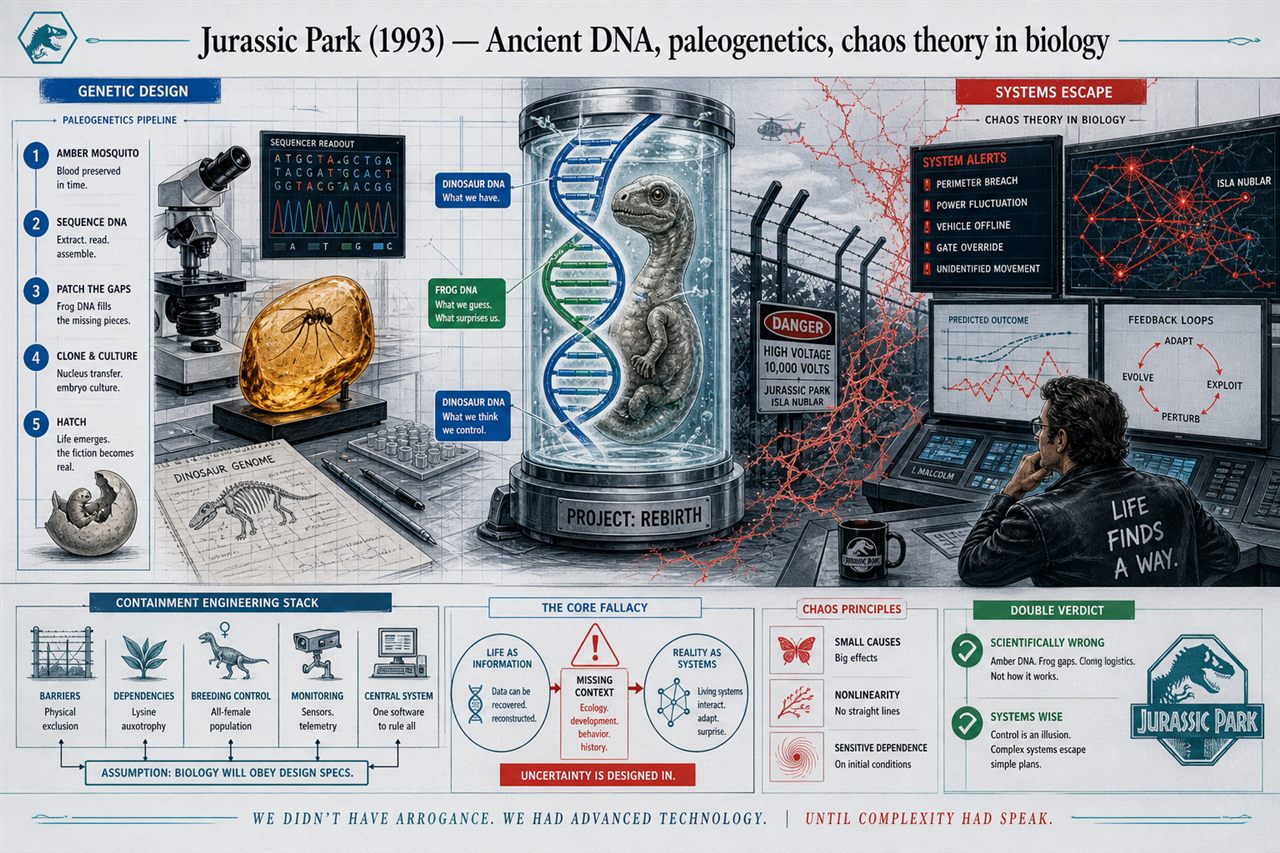
Extinction is treated as an information problem: recover dinosaur DNA from amber-trapped, blood-fed mosquitoes, patch missing genome regions with frog DNA, clone embryos, and stock a theme park. The biology hook is compelling but largely wrong scientifically: DNA from deep geological time would be chemically ruined, ancient-DNA work expects fragmented, contaminated scraps, and “filling gaps” with unrelated DNA ignores regulation, development, and genome architecture, making viable animals unlikely. The sharper insight is systems-level: safeguards like fences, software, lysine dependence, and all-female populations fail in nonlinear living systems where organisms adapt, compete, and reproduce, so “control” is a dangerous illusion.
Chapter 52. Annihilation (2018) — Evolution, gene transfer, refraction and entropy
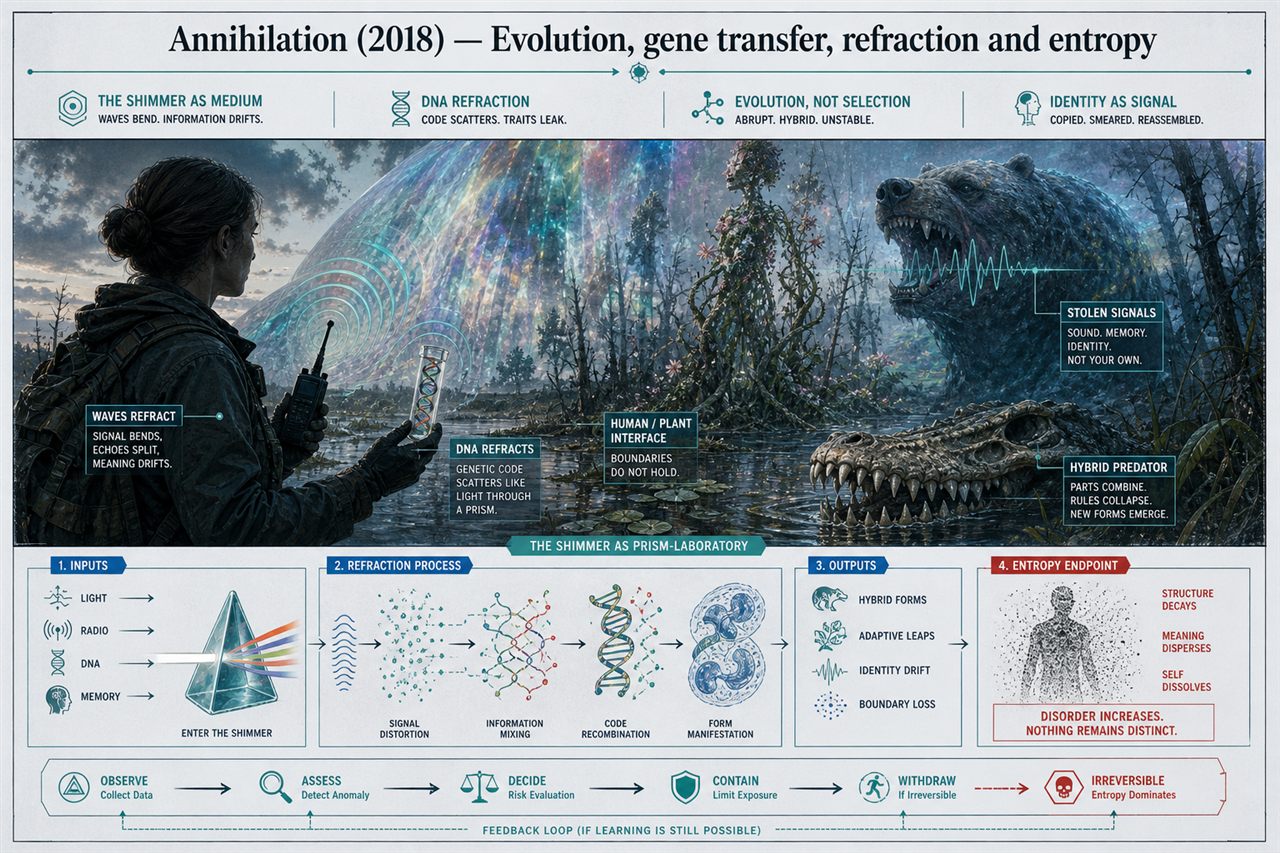
An alien impact at a lighthouse seeds an expanding zone where signals fail, time blurs, and organisms visibly transform, pushing the idea of first contact as indifferent ecological rewriting rather than communication. The story’s unifying metaphor is “refraction”: light and radio distortion become a stand-in for scrambled identity, memory, and biology. It earns credit for invoking real concepts—mutation, evolution, horizontal gene transfer, cancer-like proliferation, electromagnetic interference, and entropy—while challenging viewers to think about what counts as “self” if bodies can be copied or mosaicked. The main scientific objection is that “refracting DNA” is poetic but mechanistically wrong; DNA changes via molecular processes, not wave optics.
Chapter 53. Avatar (2009) — Xenoecology, neural interfaces, interstellar travel constraints
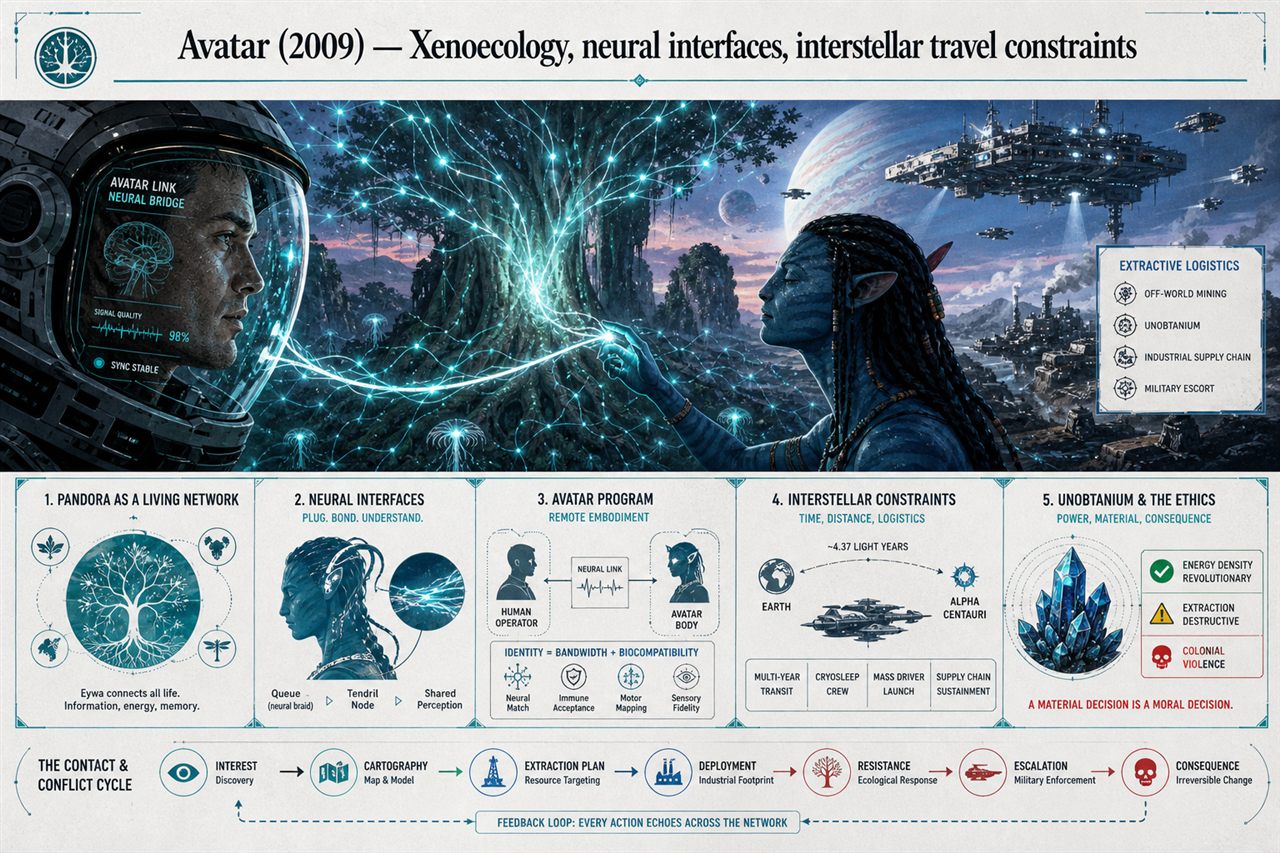
Avatar treats Pandora as a tightly coupled living system and uses that premise to link ecology, politics, and embodiment. Sublight interstellar travel and cryogenic transport are framed as hard engineering rather than magic, while Pandora’s lower gravity and dense air help justify outsized megafauna and dramatic flight. The most serious physics break is mountain-scale magnetic levitation: superconductivity can’t plausibly stabilize and support trillions of kilograms of fractured rock. Biologically, the near-universal neural “queue” is too plug-and-play across species, and the human-to-avatar link far exceeds real brain–machine interfaces, which rely on limited channels and gradual adaptation.