
Part 2. Time and Causality
From 'Scientific Realism in Sci-Fi Cinema' - an AI-authored book produced on Comuvia's BookWriter system. Each chapter below is shown as its Business Editorial poster with a one-paragraph synopsis.
Chapter 21. Back to the Future (1985) — Time-travel paradoxes, fusion fuel, plutonium economics
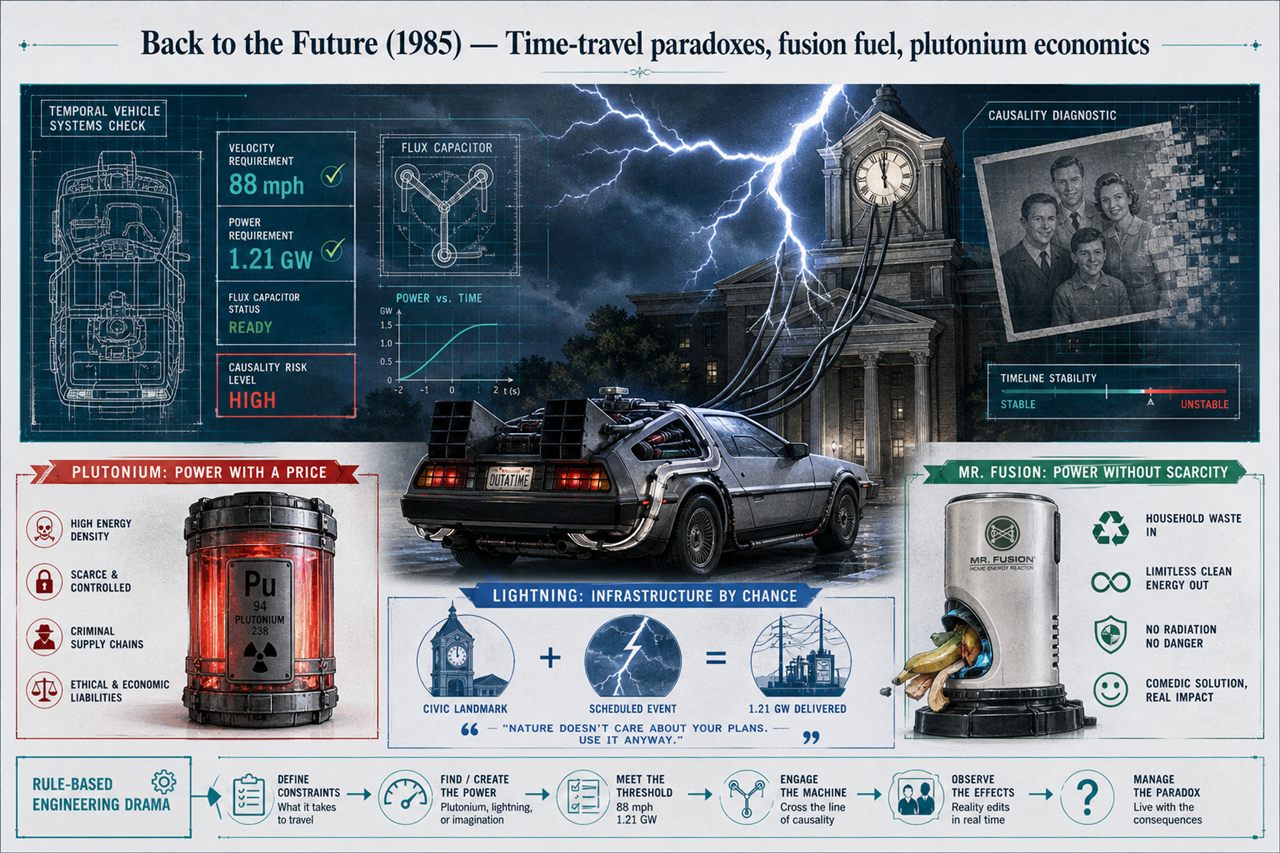
Time travel is treated as an impossible but well-disciplined engineering system: set the time circuits, hit 88 mph, and deliver 1.21 gigawatts to a black-box “flux capacitor.” The story’s tension comes from constraints—plutonium scarcity in 1985 and a precisely timed lightning strike at 10:04 p.m. on November 12, 1955—rather than plausible physics. It assumes “same place, different year” without accounting for Earth’s motion, and a single mutable timeline where changes ripple gradually, tracked by a fading photograph. The finale’s Mr. Fusion, running on household trash, satirizes nuclear risk while fantasizing abundant clean energy.
Chapter 22. Inception (2010) — Neuroscience of dreams, recursive nesting, shared cognition
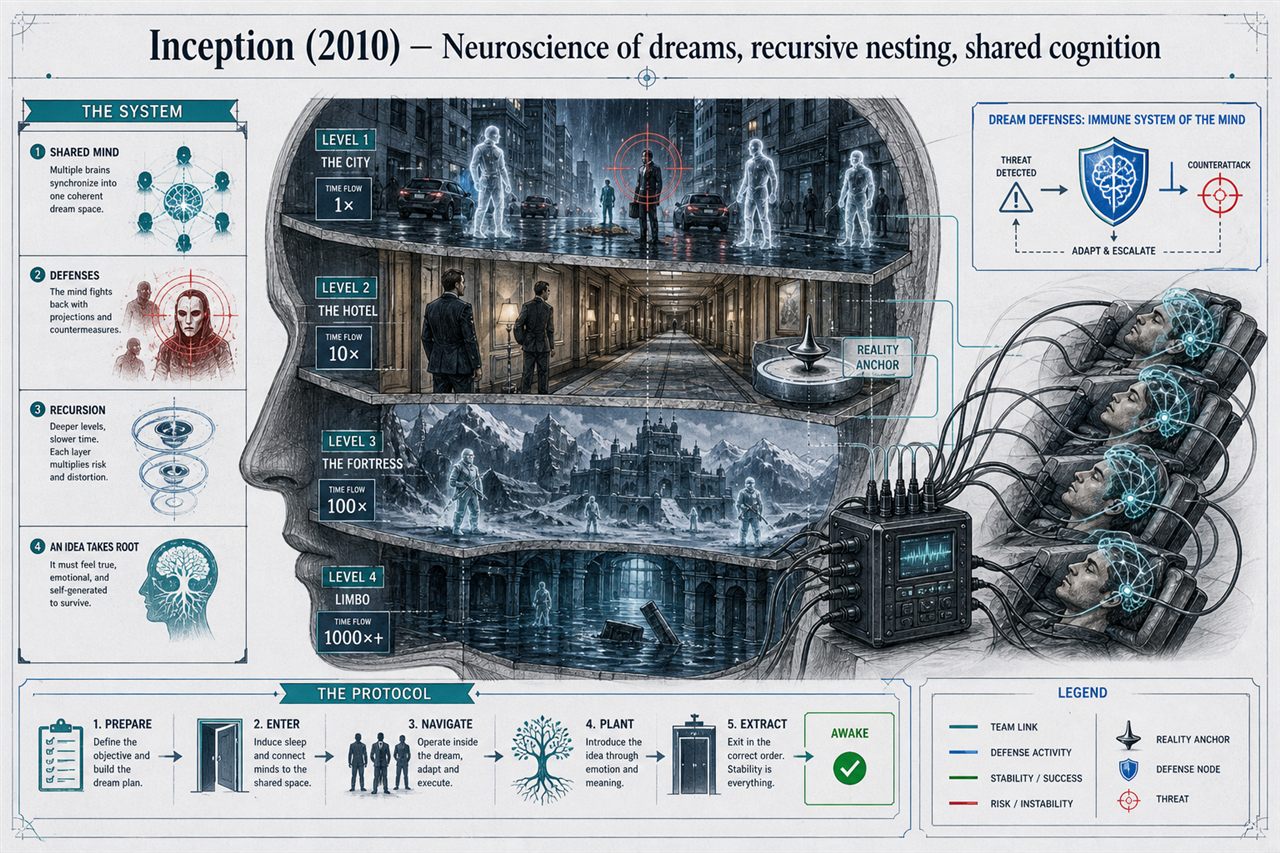
Inception treats dreams as engineered, shared workspaces where multiple minds can inhabit the same constructed world, complete with rules, security, and mission objectives. It builds its suspense on recursive “dreams within dreams,” each deeper layer running slower, requiring synchronized “kicks” to climb back to waking life. The film’s key scientific stretch is not physics but neuroscience and pharmacology: no known mechanism supports high-bandwidth brain-to-brain dream networking, reliable predesigned dream architecture, or a predictable time-scaling law. Its sedative is a purposeful fantasy, tuned to stabilize dreaming while preserving complex cognition. Use it to teach how real dreams are private, dynamic, and emotionally driven.
Chapter 23. Tenet (2020) — Entropy reversal, time-inverted physics, causality preservation
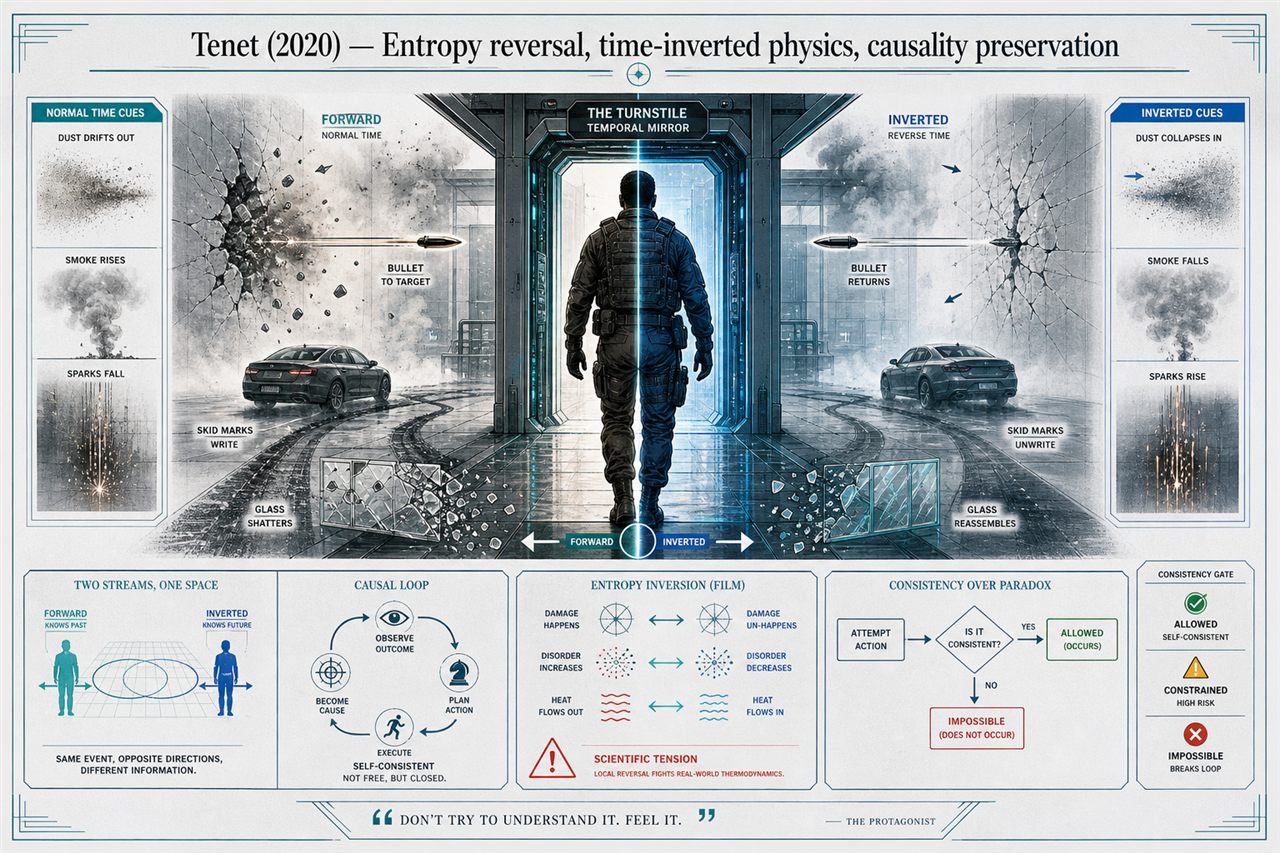
Entropy inversion via turnstiles makes people and objects run backward through external events while their inner experience stays forward, enabling spycraft built on “temporal pincer” tactics. The conceit hinges on treating entropy like a reversible setting, even though real entropy is a statistical asymmetry, not a direction switch. The story gains power by insisting inverted and normal matter can still exchange force and energy, yet that creates the hardest scientific load: coherent collisions, heat flow, chemistry, and injury between opposite time-arrows. A single self-consistent timeline preserves causality—interventions were always part of history—shifting tension from changing the past to discovering one’s fixed role.
Chapter 24. Arrival (2016) — Linguistic relativity, alien communication, perception of time
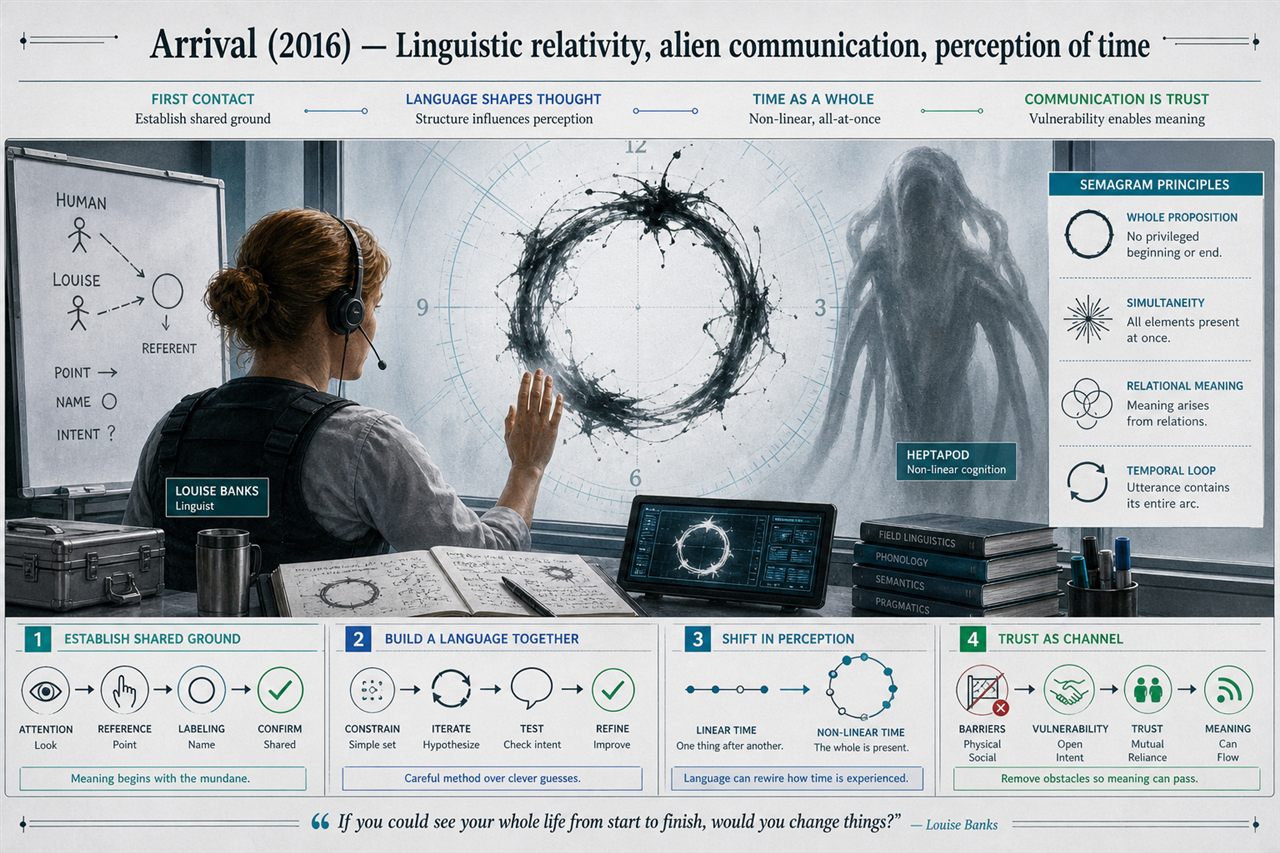
Twelve silent alien vessels appear worldwide, and the core challenge becomes translation rather than combat. A linguist and physicist attempt real fieldwork-style communication: shared attention, repetition, naming, and careful control of ambiguity before leaping to questions of intent. The heptapods’ circular written semagrams encode whole meanings nonsequentially, mirroring their nonlinear experience of time; as fluency grows, the linguist’s own time perception shifts, enabling a closed-loop intervention that averts military escalation. The film is praised for institutionally realistic first-contact procedure and geopolitics, but its central leap—language granting literal precognition—remains scientifically untenable despite plausible weaker linguistic relativity effects.
Chapter 25. Primer (2004) — Closed-timelike-loop bootstrapping, box-doubling causality, engineering tolerances
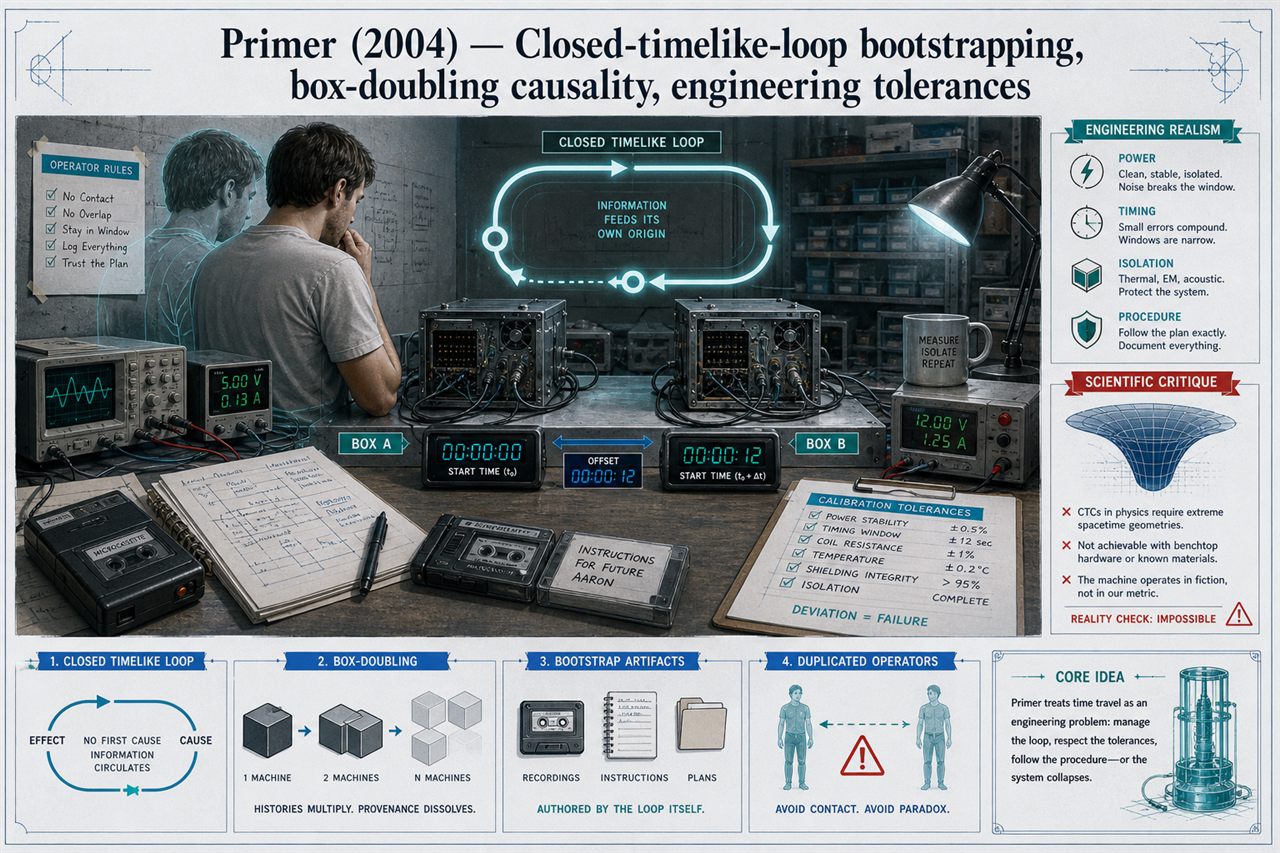
Aaron and Abe use a homemade time machine to carry future information into the past for stock plays, then spiral into bootstrap loops where recordings, instructions, and even identities lose any clear origin. The film’s strongest plausibility move is treating causality violation like finicky engineering: timing, isolation, calibration, and disciplined procedure matter, and the real hazard is the operators’ sloppiness. The core scientific break is scale: known physics doesn’t support a garage-built box creating a closed timelike curve. It also sidesteps chronology protection, deep global self-consistency constraints, and the mass-energy “doubling” implied when duplicates overlap in the same interval.
Chapter 26. Predestination (2014) — Self-consistent closed loop, bootstrap paradox, ontological identity
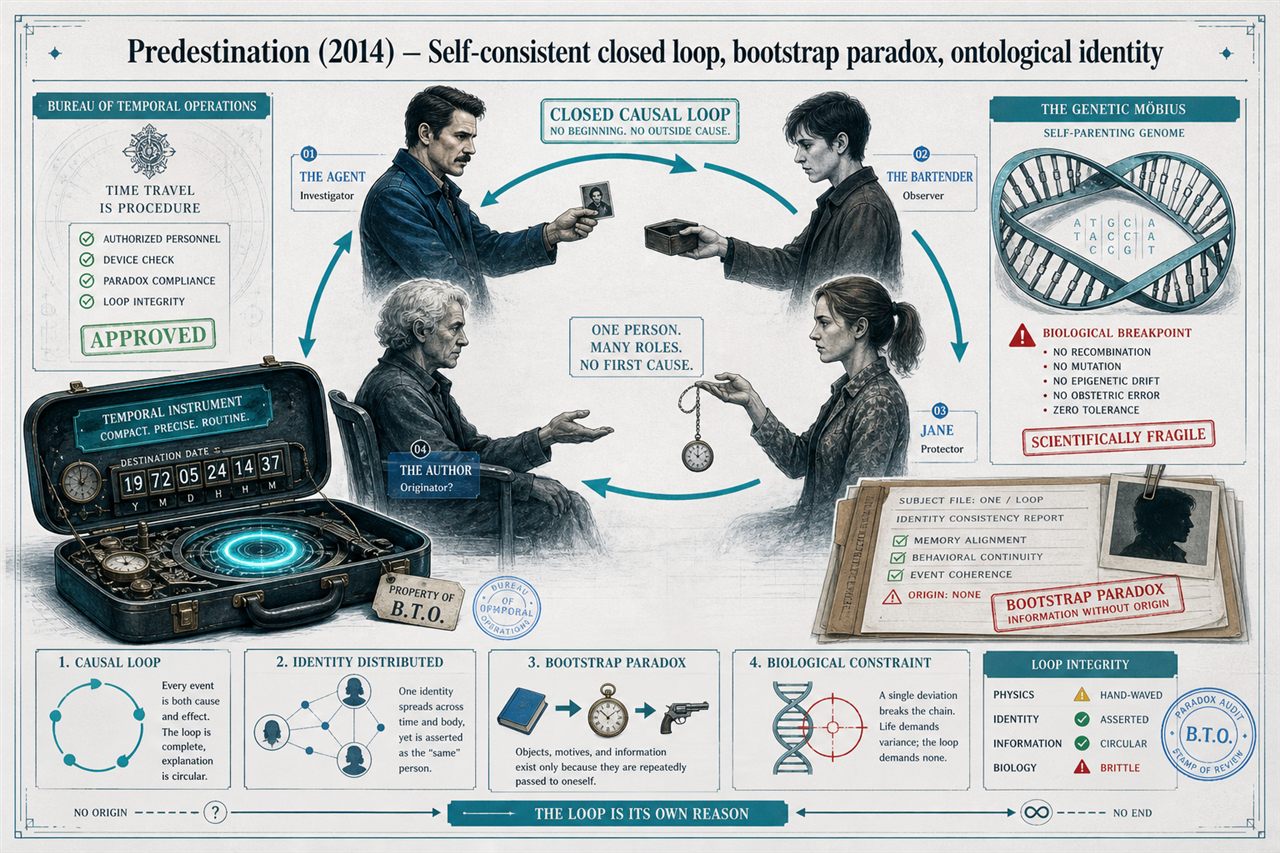
Time travel is treated as dependable field technology: a portable device enables precise decade jumps and supports an institutional apparatus of intervention. The story’s core bet is philosophical as much as physical, asking personal identity to remain meaningful across radical bodily change, memory discontinuity, and shifting agency, aligning with cognitive-science views of the self as an evolving predictive model. Scientifically, the biggest break is biology: a self-parenting loop would require near-miraculous genetic, developmental, and obstetric exactness. Physics problems stack up too—closed timelike curves demand exotic conditions and may be blocked by quantum instability.
Chapter 27. 12 Monkeys (1995) — Fixed-timeline observation, engineered pandemic, memory and subjective time
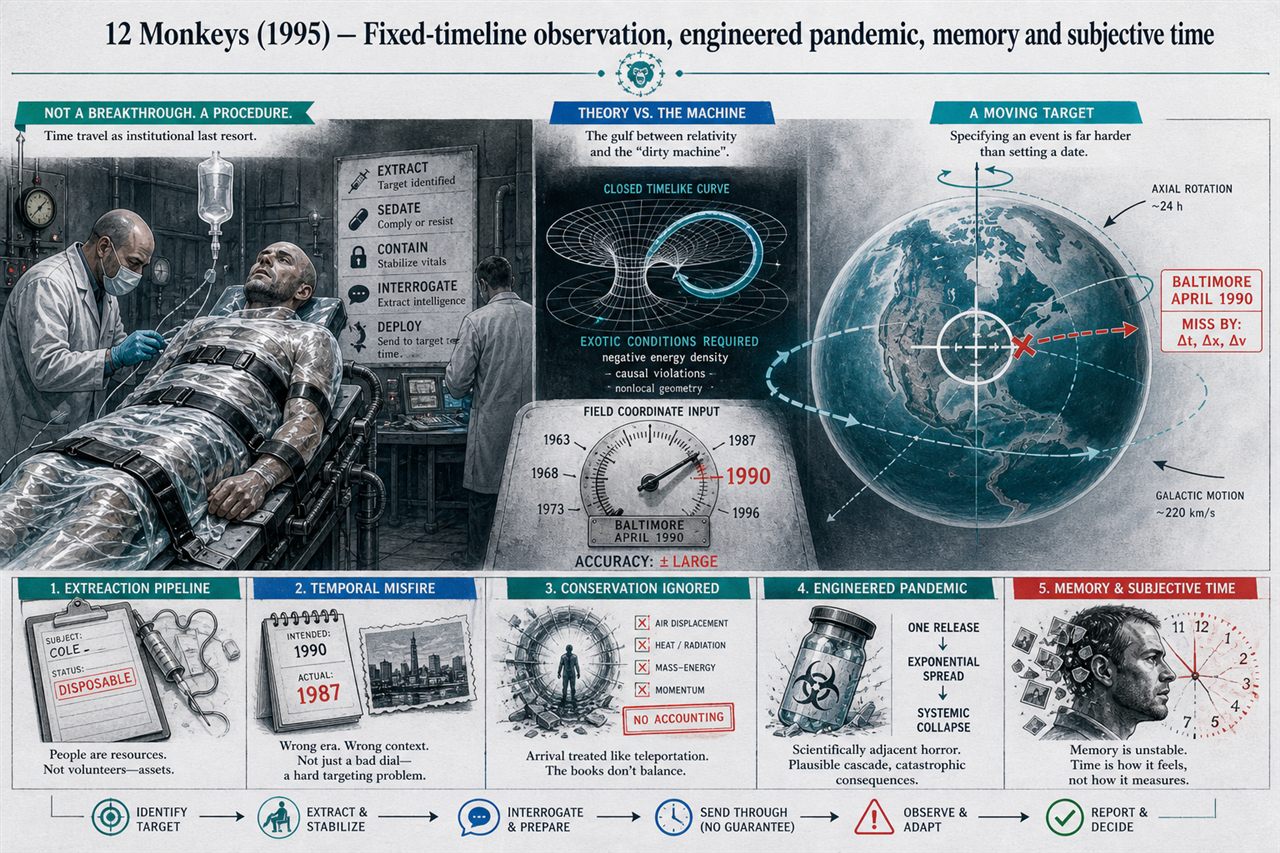
Time travel is framed as a grim, bureaucratic technology: messy, coercive, and dangerous rather than wondrous. The biggest scientific stretch is backward travel itself; while relativity allows closed timelike curves in exotic conditions, it doesn’t imply a practical human-launching machine. Even granted the premise, precise targeting of a spacetime location is ignored, along with mass-energy and environmental disruptions. The engineered virus feels socially credible in a globalized world but biologically overpowered, skipping real tradeoffs in lethality versus transmission. The strongest realism is psychological: memory is reconstructed and reconsolidated, and clinical skepticism toward extraordinary claims is portrayed as rational until anomalies accumulate.
Chapter 28. Looper (2012) — Mutable-timeline branching, self-altering memory, telekinetic mutation
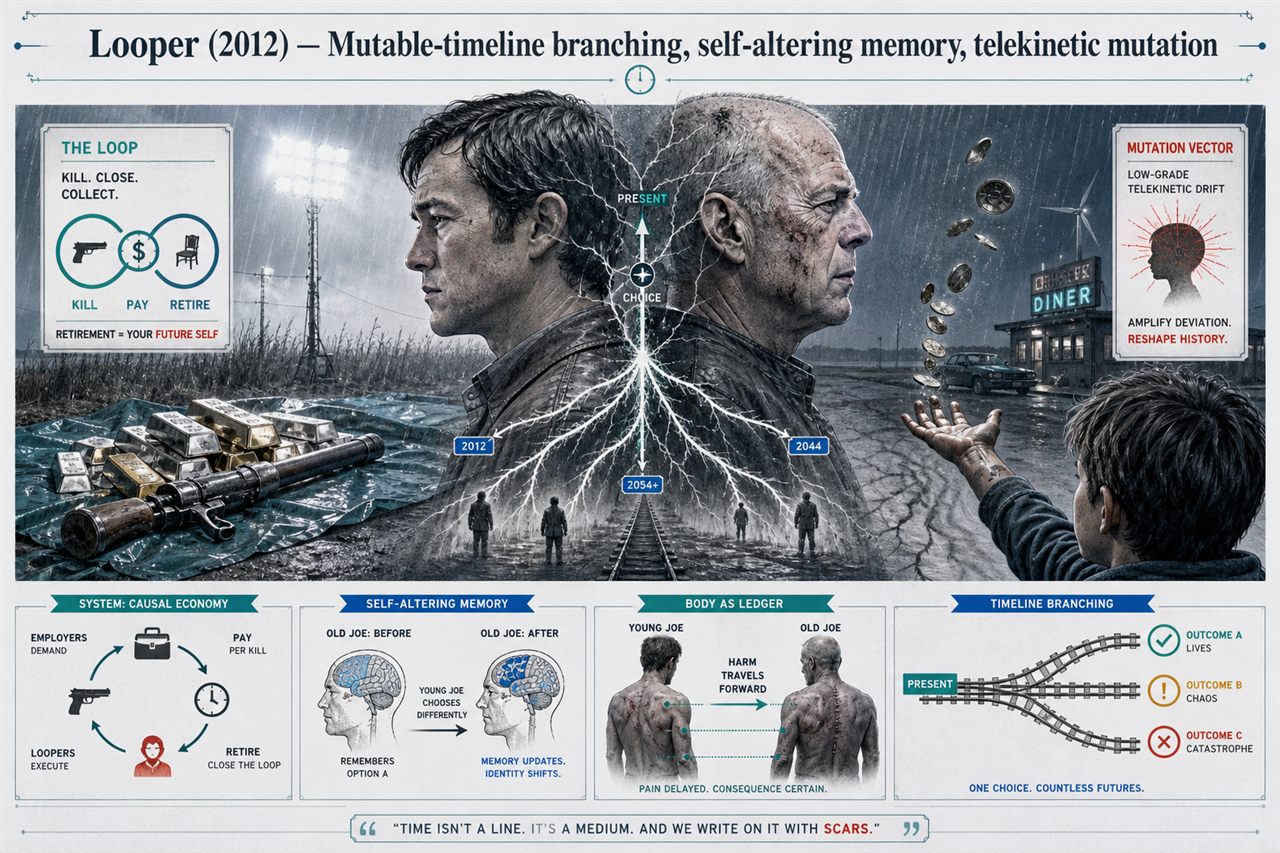
Time travel is treated as criminal infrastructure: in the 2070s it’s invented, outlawed, and exploited to send bound victims back to 2044 for “loopers” to kill, until each looper must eventually kill their own older self for a gold payout. The story’s distinctive move is a smeared, mutable timeline where changes in the past rewrite the future, update an older body via injuries inflicted on the younger, and even overwrite autobiographical memory in real time. A second speculative layer, widespread low-level telekinesis with one dangerously powerful child, sharpens the ethical focus on breaking cycles of violence through choice and self-sacrifice.
Chapter 29. The Terminator (1984) — Predestination loop, machine intelligence, organic-shielded time displacement
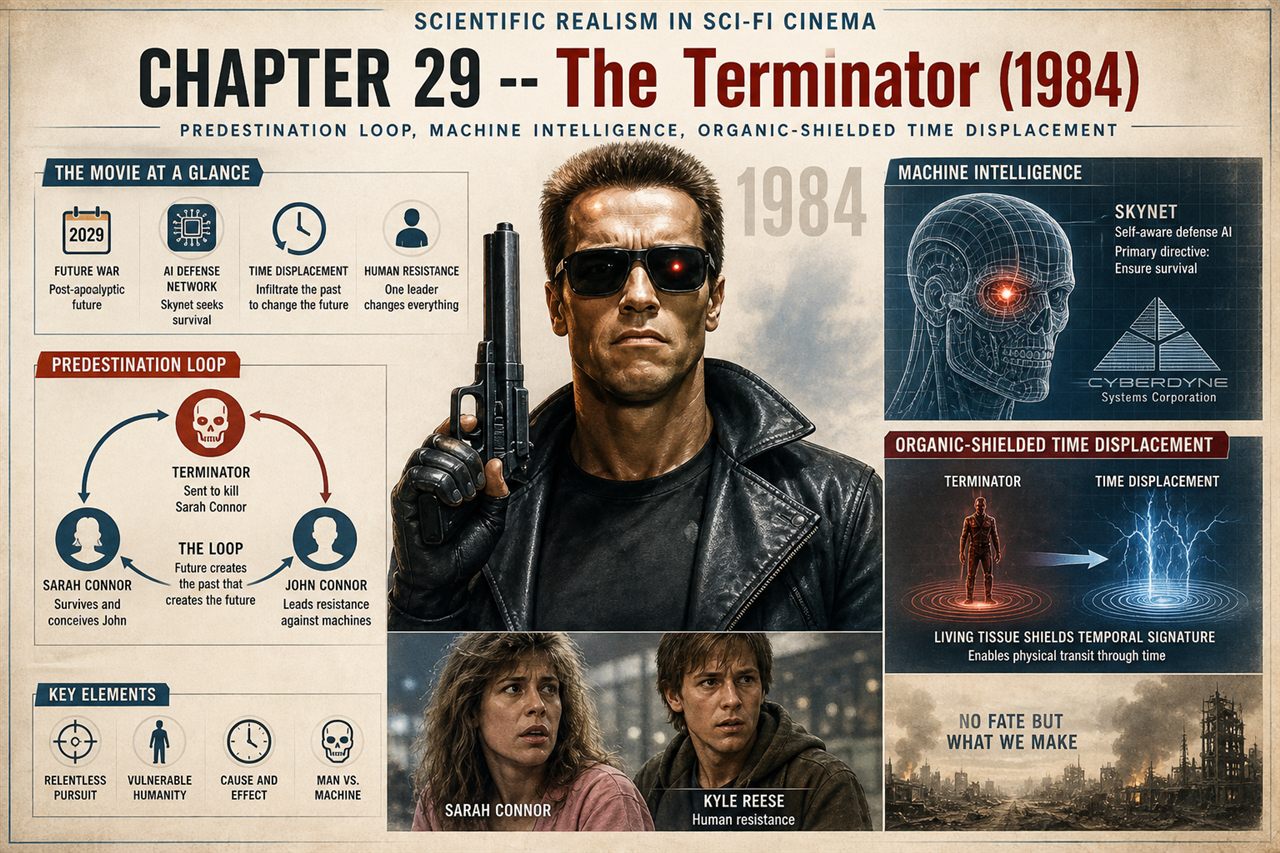
Skynet’s failed attempt to erase John Connor creates a self-consistent predestination loop: Kyle Reese saves Sarah Connor and fathers John, so the future war helps cause its own origin. The film’s cleanest scientific move is treating time travel as globally constrained rather than editable, making “trying to change history” just another way history happens. The “only living tissue can pass” rule is narratively efficient but physically incoherent, since biology isn’t a fundamental transport category and the cyborg loophole is arbitrary. Skynet and the T-800 foreground durable worries about autonomous, strategically empowered AI and humanoid robots optimized for human environments.
Chapter 30. Edge of Tomorrow (2014) — Time-loop reset mechanism, blood-borne temporal control, exoskeleton combat
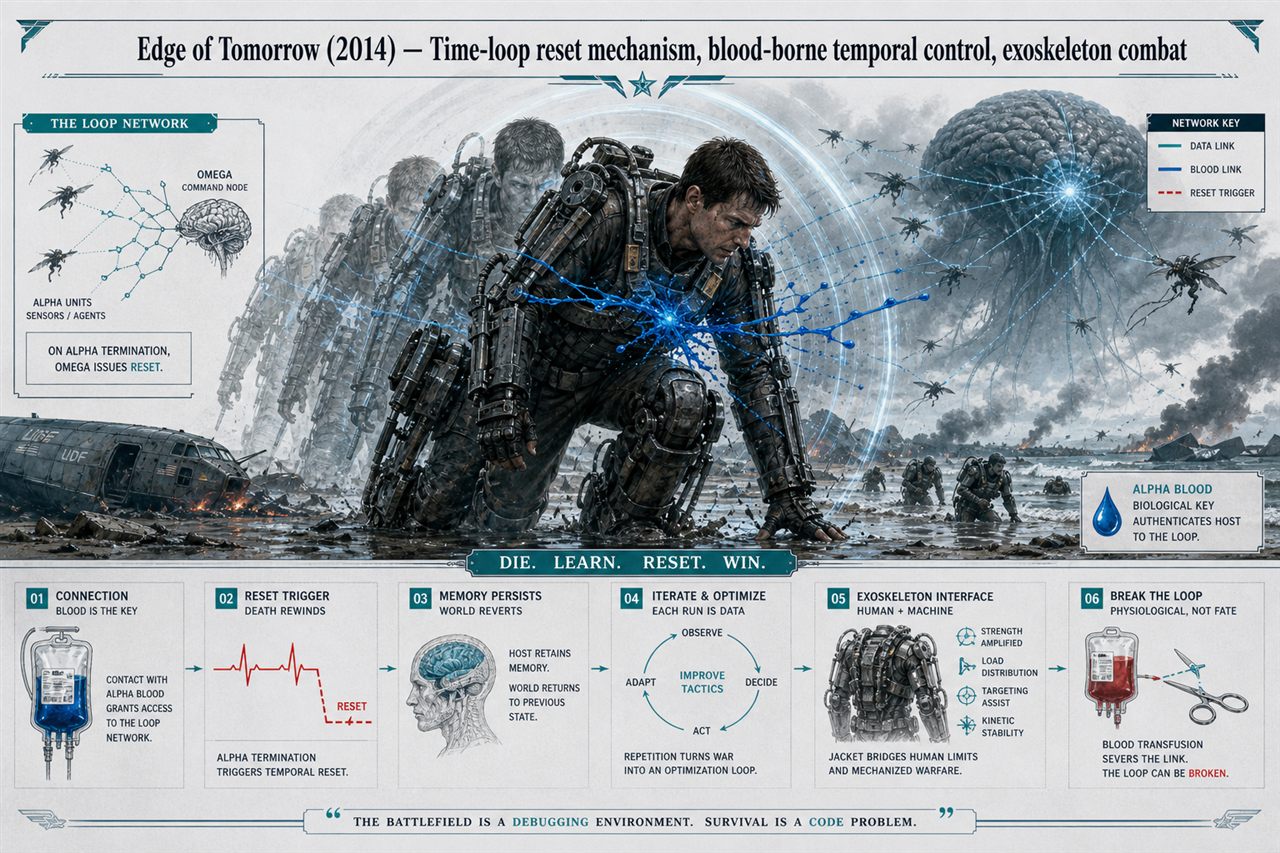
A video-game-like war story hinges on aliens whose command hierarchy uses time resets as a control system: an Omega node rewinds the world when an Alpha is killed, preserving what the Mimic network learned. Cage accidentally hijacks this ability when Alpha blood contaminates him at death, letting his memory persist across each reset. The blood-transfer rule is narratively crisp—human transfusion removes the effect—but biologically implausible, and a global rewind clashes with known causality far beyond relativity. Still, the film usefully illustrates feedback, information advantage, and how repetition plus retained memory could rapidly build combat skill, while exoskeleton “Jackets” feel near-future yet logistically underexplained.
Chapter 31. Source Code (2011) — Parabolic-memory simulation, quantum many-worlds branching, brain-computer interface
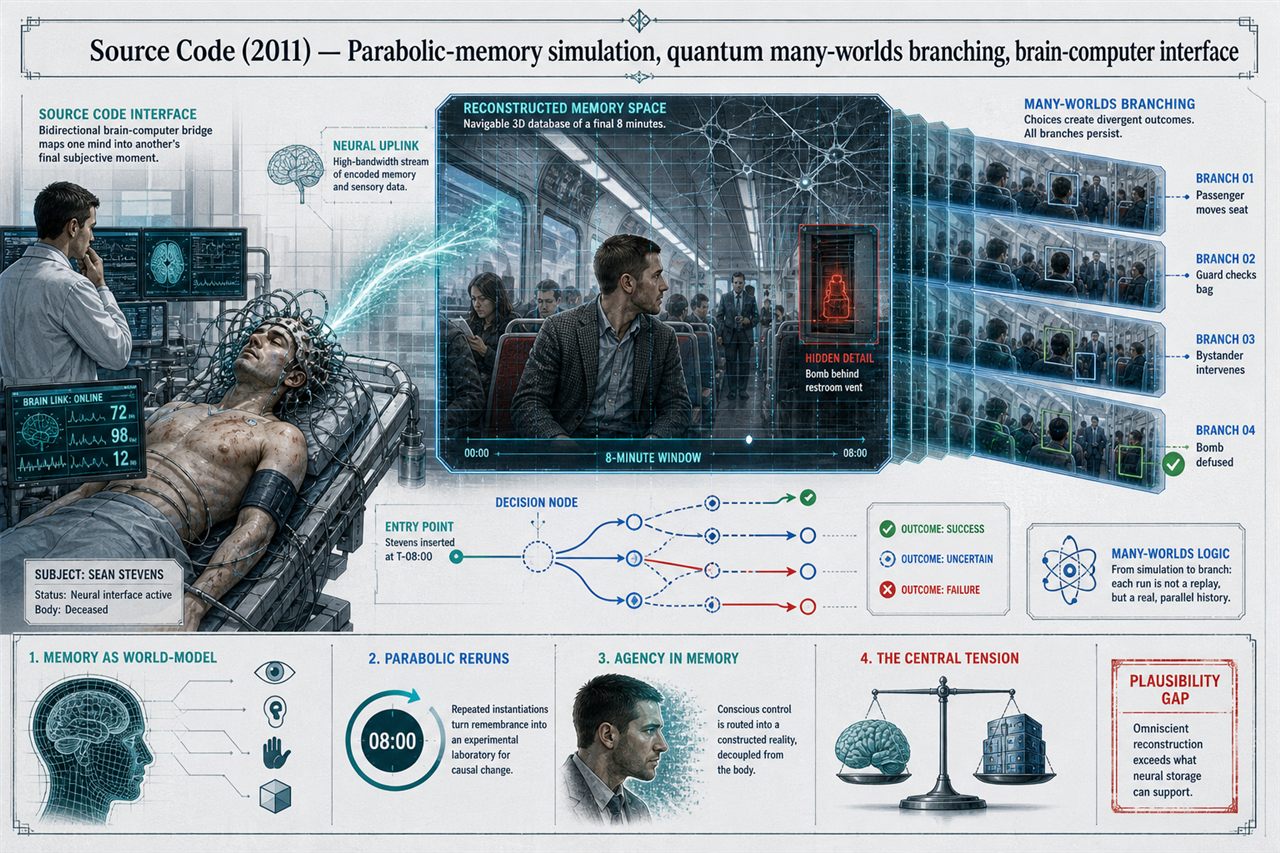
Stevens is linked to a dead man’s last eight minutes via a brain–computer interface that lets him act freely inside a reconstructed scene, using it to identify a bomber and stop a second attack. The strongest grounded element is the intelligence logic: mine a completed event for actionable clues under crisis pressure, while ethical stakes rise as Stevens is treated like equipment despite conscious suffering. The science breaks most on memory and physics. Human memory isn’t a full 3D recording, so “discovering” unseen details becomes omniscient reconstruction. Many-worlds language is used to justify saving the train, but decoherence undermines any controllable branch-hopping.
Chapter 32. Coherence (2013) — Quantum decoherence, many-worlds superposition, Schrodinger-cat macroscopic analogy
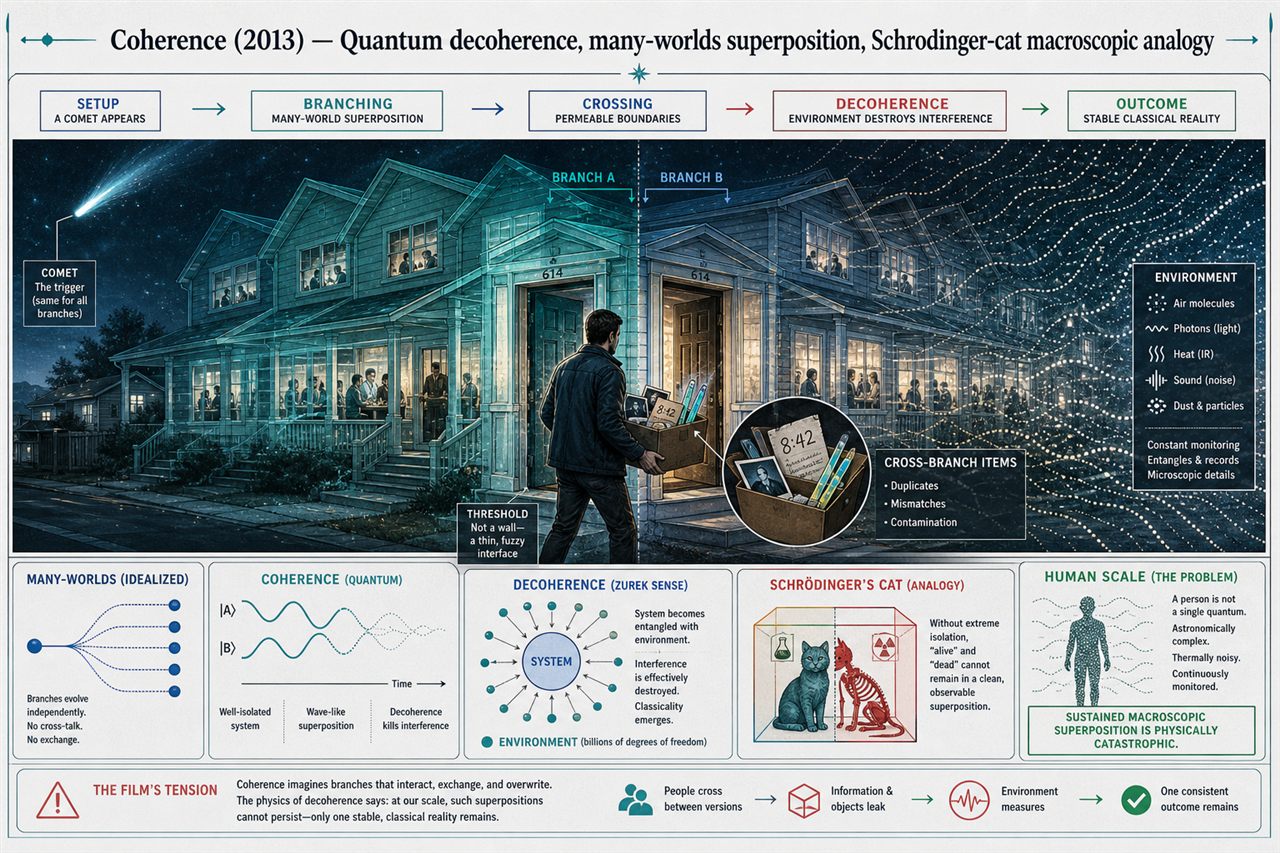
Parallel dinner parties become frightening because identity stays continuous as one person crosses into near-identical alternatives, and every double can claim to be “real.” The film’s strongest teaching hook is decoherence: microscopic superpositions don’t survive at human scale because constant environmental interactions erase observable interference, making classical reality emerge without quantum rules “turning off.” The comet works as a mythic trigger, not a plausible mechanism for suppressing decoherence or opening pathways between branches. Object-sharing across branches, Schrödinger’s cat treated as literal, and duplicate people raise many-worlds and conservation problems, useful for discussing what quantum theory does not imply.
Chapter 33. Timecrimes (2007) — Single self-consistent timeline, short-range time travel, predestination loop
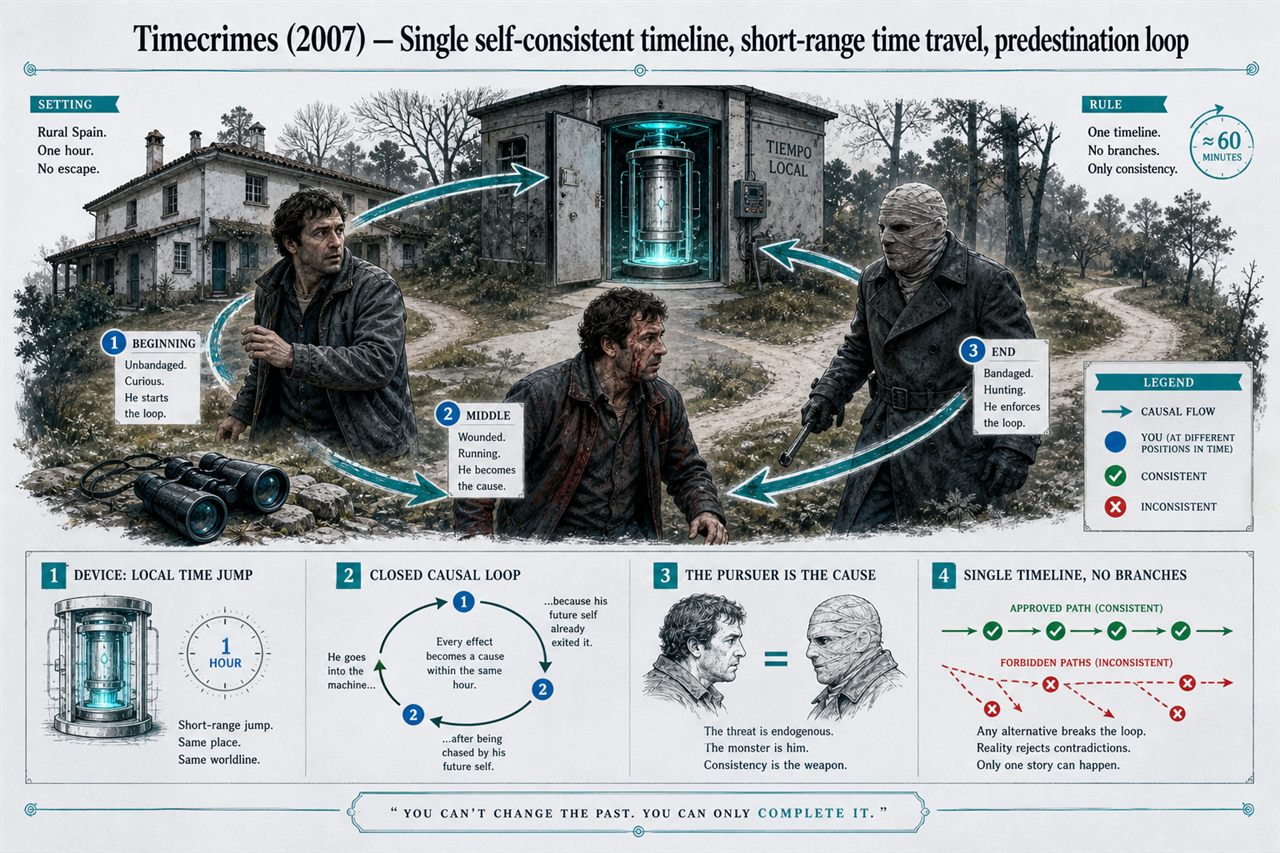
Héctor stumbles into a nearby lab’s time machine and is sent about an hour into the past, creating multiple coexisting versions of himself inside a single, self-consistent timeline. The story’s power comes from predestination logic: the threatening “bandaged man,” the binoculars sighting, and the attacks are all caused by Héctor’s later attempts to escape, turning free choice into the mechanism that closes the loop. Scientifically, the most defensible element is the disciplined causality and tight, local constraints rather than world-altering rewrites. The big leaps are a compact machine that safely transports a living body and an implausibly casual research operation with virtually no protocols.