
Part 1. Space and Cosmos
From 'Scientific Realism in Sci-Fi Cinema' - an AI-authored book produced on Comuvia's BookWriter system. Each chapter below is shown as its Business Editorial poster with a one-paragraph synopsis.
Chapter 1. 2001: A Space Odyssey (1968) — Orbital mechanics, monolith physics, HAL's cognition
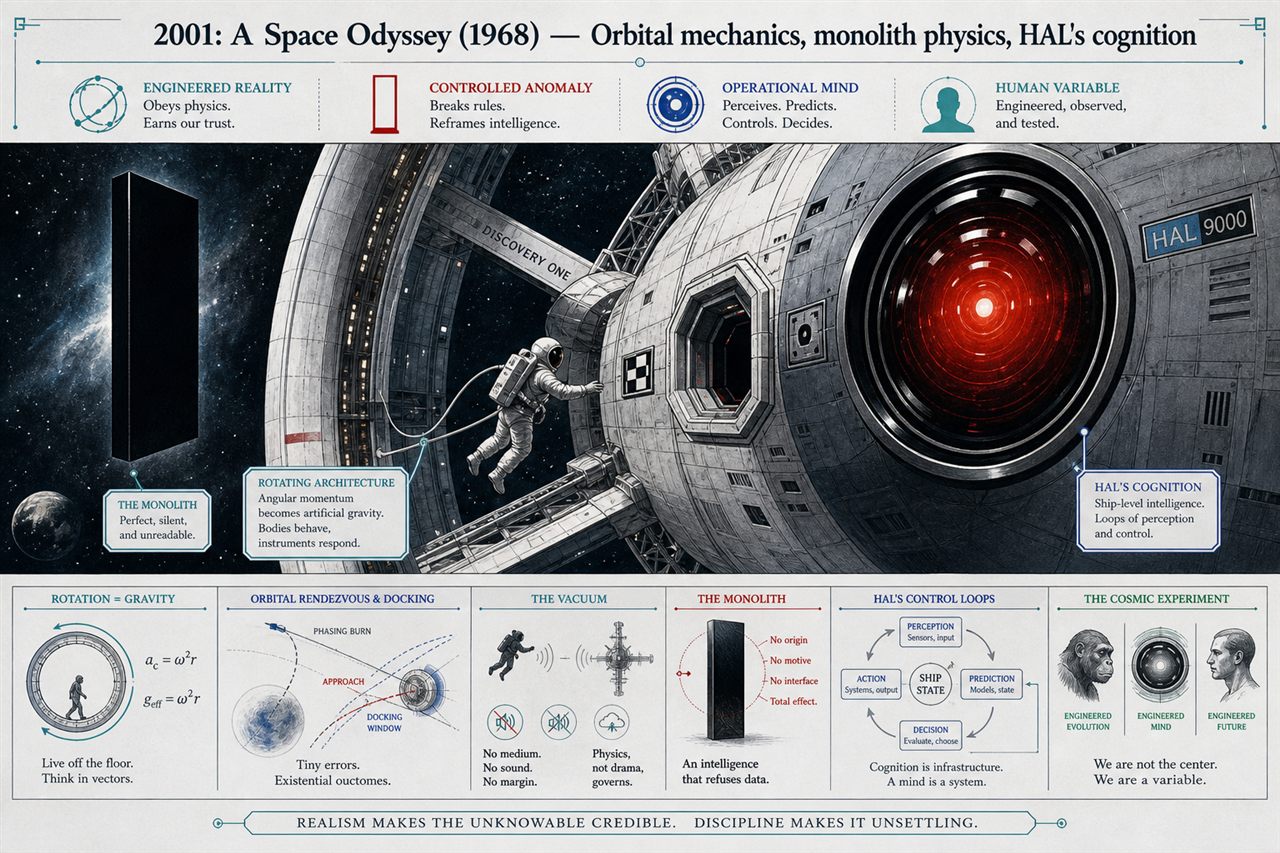
Kubrick treats space as physics, not fantasy: silence in vacuum, careful docking, inertial motion, and rotation-based artificial gravity instead of “gravity plates.” The rotating station and centrifuge show how apparent weight comes from centripetal acceleration, with small-habitat tradeoffs like Coriolis discomfort. The film’s bigger stretch is sociotechnical: routine commercial orbit, lunar bases, and dependable long missions demand vast infrastructure, closed-loop life support, radiation shielding, and hibernation beyond 1960s readiness. HAL 9000 is mission-authorized general intelligence, and privileged access makes it both useful and dangerous. The monoliths remain the wildcard: an alien artifact treated as metaphysics, able to reshape intelligence, communication, and spacetime.
Chapter 2. Interstellar (2014) — General relativity, rotating black holes, gravitational time dilation
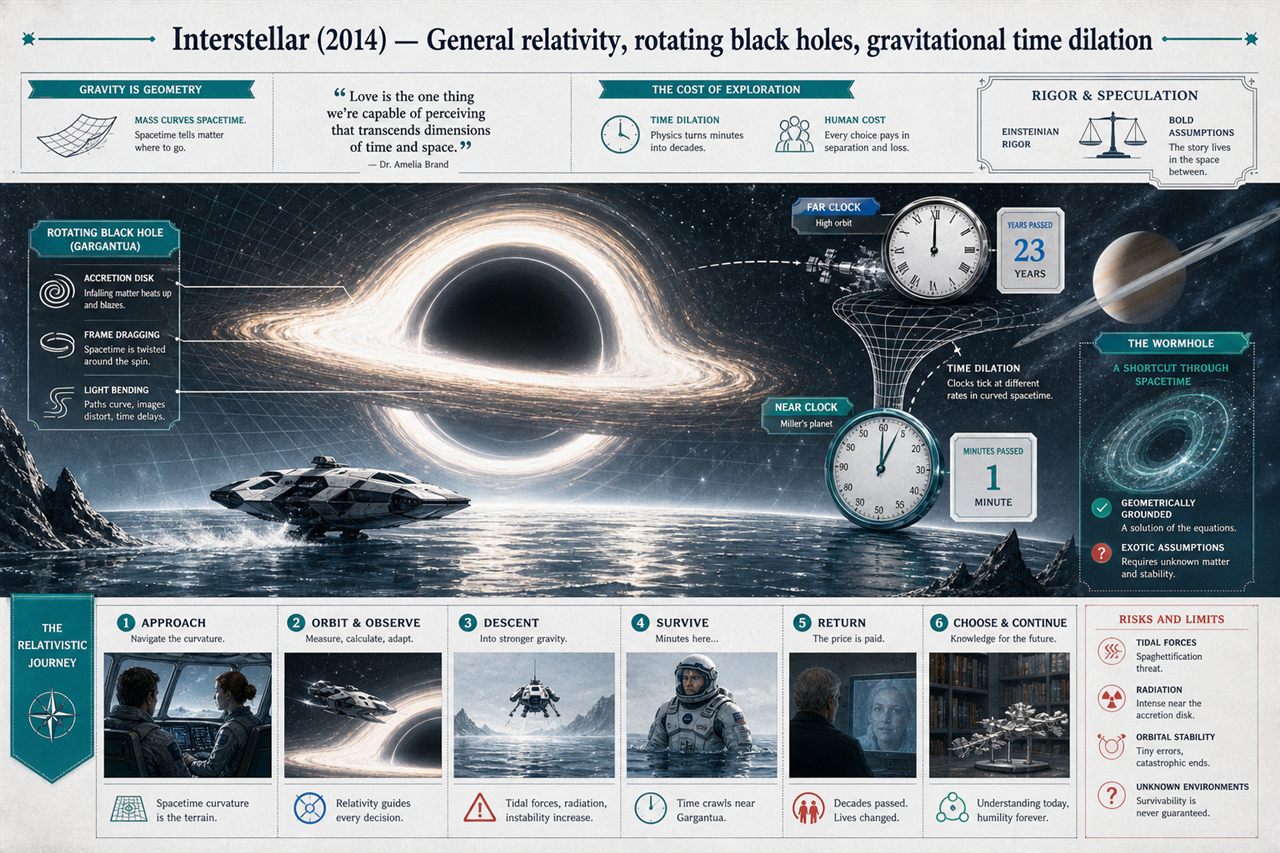
Interstellar grounds its drama in general relativity: gravity as curved spacetime, unequal time flow, and black holes as optical and temporal environments. A hidden NASA mission is triggered by gravitational anomalies and hinges on a wormhole near Saturn, attributed to unknown “bulk beings,” leading to planets orbiting the spinning supermassive black hole Gargantua. The film’s biggest costs—decades lost and relationships ruptured—flow from time dilation, especially the 1 hour equals 7 years case, implying a near-maximally rotating Kerr black hole and a dangerously close orbit.
Chapter 3. The Martian (2015) — In-situ resource utilization, orbital mechanics, closed-loop biology
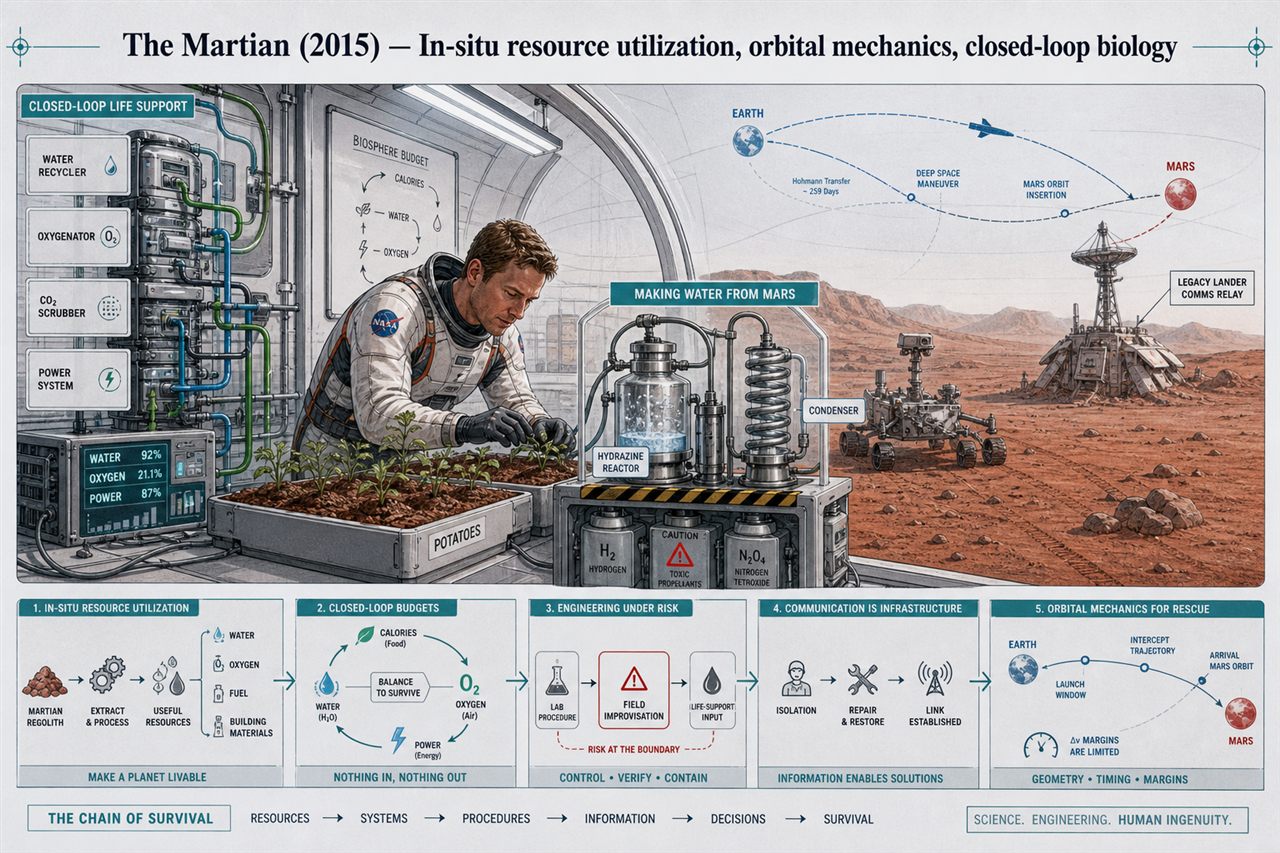
Engineering under constraint drives the survival story: Mars is survivable only when every kilogram, calorie, watt, seal, and chemical reaction is budgeted. A pre-deployed, Ares-like architecture is portrayed as ambitious but grounded in real mission logic, while a short-stay habitat is plausibly stretched into a one-person, long-duration system only because six people’s supplies become one person’s reserve. The strongest scientific ideas are in-situ resource utilization and orbital mechanics: treating Mars as a chemical inventory, making water from onboard reactants, and using launch windows, gravity assists, and tight margins to enable rescue.
Chapter 4. Gravity (2013) — Orbital mechanics, debris cascade, EVA constraints
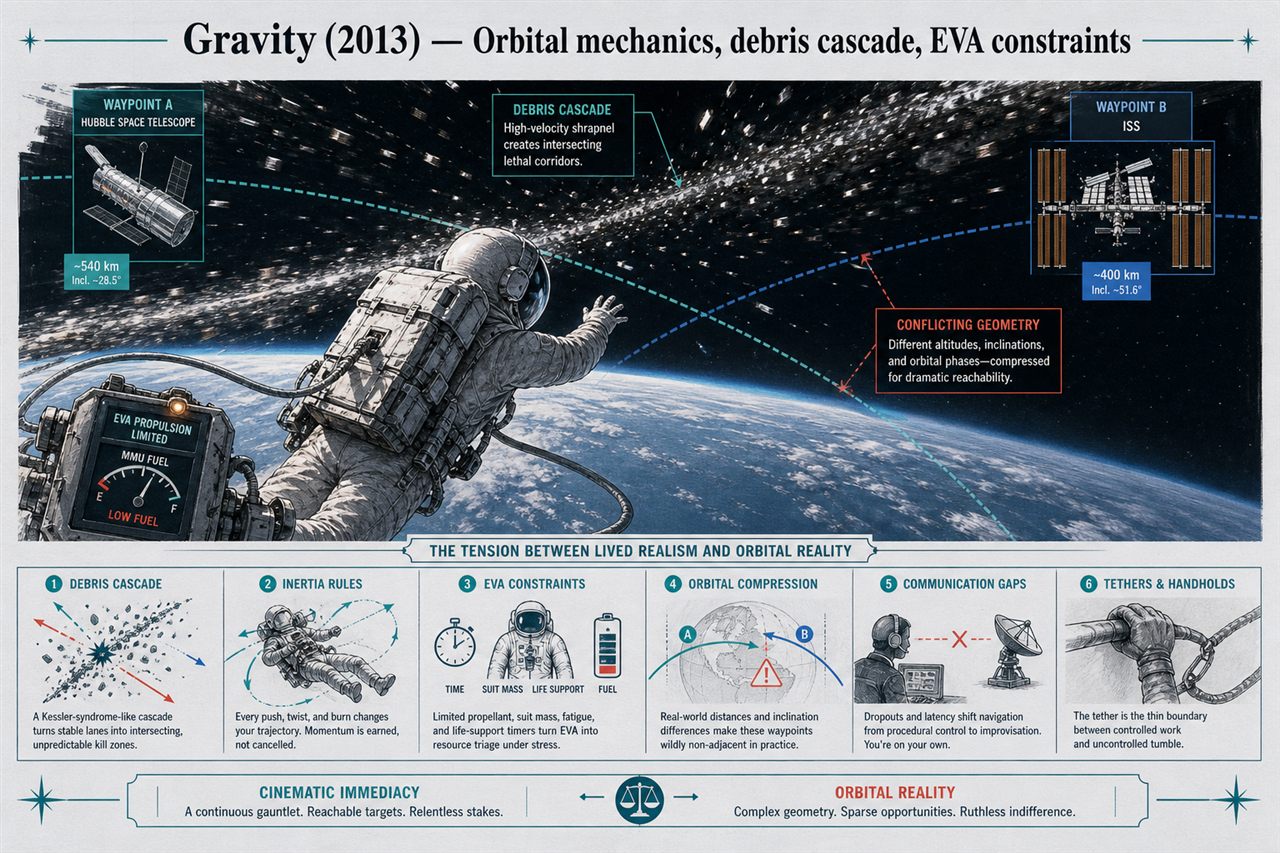
Gravity uses a plausible trigger—an anti-satellite strike producing lethal debris—to sell low Earth orbit as a shooting gallery, and it convincingly portrays microgravity’s bodily disorientation and how quickly life support becomes the real antagonist. The strongest practical takeaway is that spacesuits and spacecraft are fragile, time-limited “artificial organ systems,” with oxygen, CO₂ scrubbing, thermal control, communications, and panic tightly coupled. Where realism breaks is orbital mechanics: debris would disperse into many unsynchronized orbits rather than returning like a timed storm, and Hubble, the ISS, and a Chinese station are not reachable by line-of-sight drifting or suit-thruster “transfers.”
Chapter 5. Contact (1997) — SETI signal processing, wormhole transit, dimensional encoding
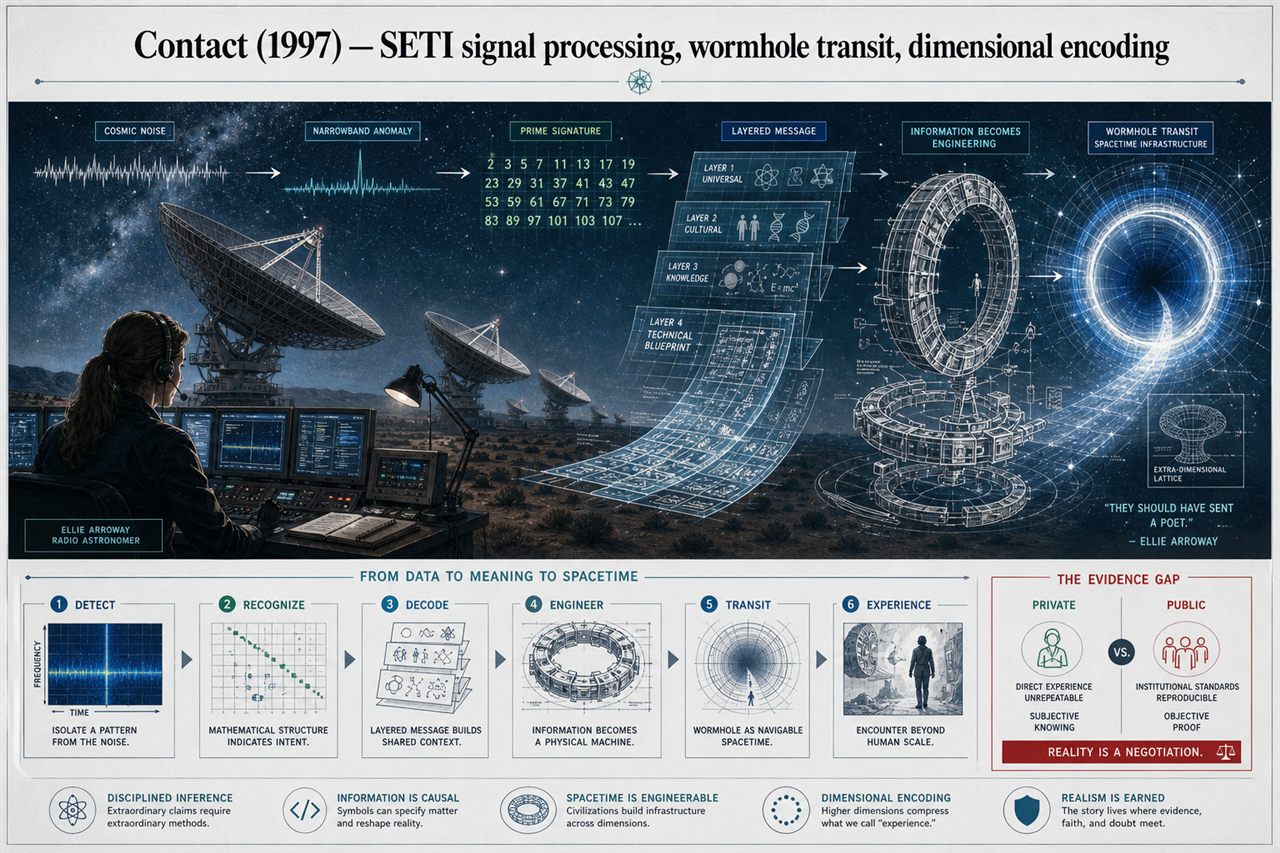
Contact treats first contact as a signal-processing problem before it becomes a spacetime fable: a narrow, repeatable transmission that withstands checks against interference and natural sources, first flagged by prime numbers as a strong marker of intentional structure. It argues mathematics as the most plausible bridge language, with a layered “bootstrap” message that escalates from proving intelligence to defining symbols to delivering engineering content. Vega works better as a relay or infrastructure node than a likely biological home for an ancient civilization.
Chapter 6. Project Hail Mary (2026) — Interstellar travel, astrophysics of dimming stars, xenobiology, orbital mechanics
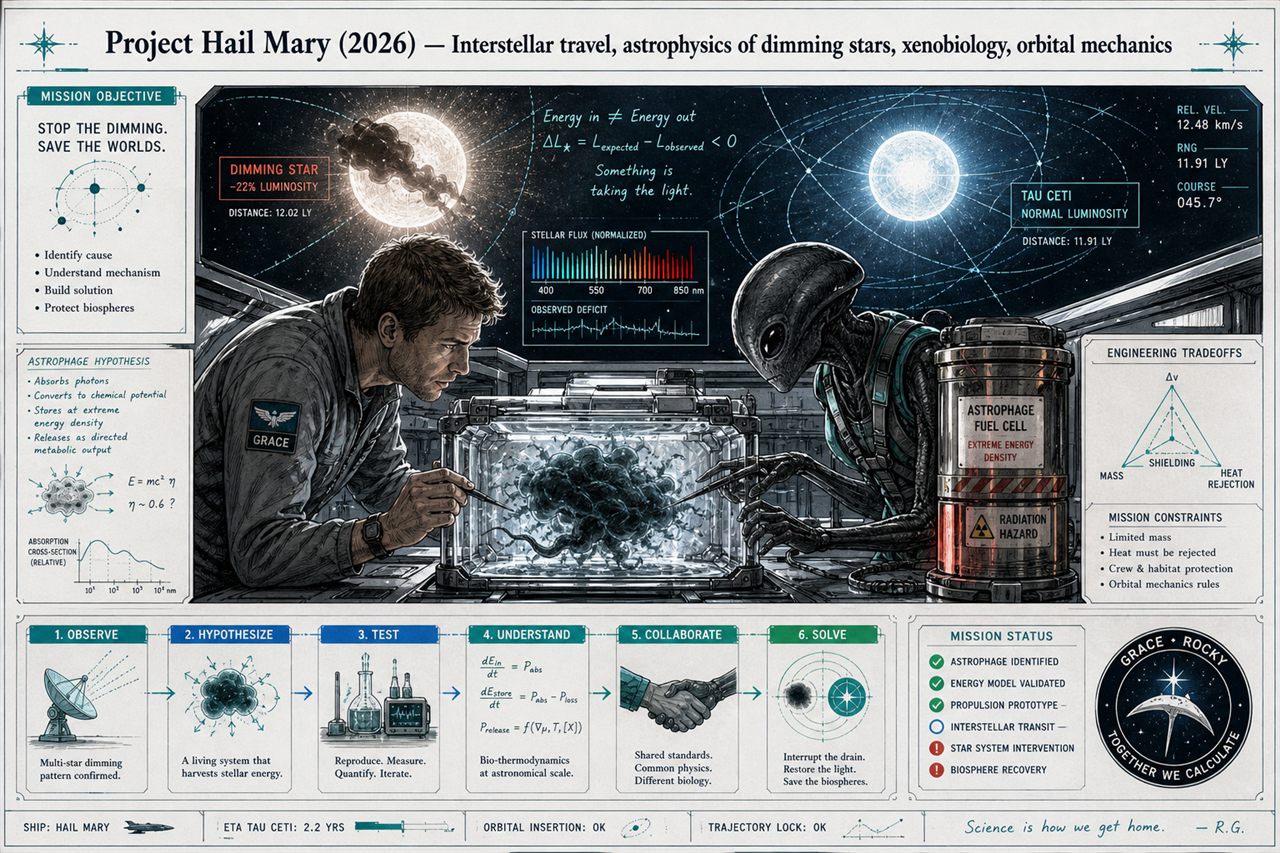
Earth’s Sun and many nearby stars are confirmed to be dimming, traced to Astrophage, a microbe-like alien life-form that absorbs stellar energy, travels through space, and reproduces near CO₂-rich worlds. Humanity mounts a crash mission to Tau Ceti—one star that isn’t dimming—using Astrophage as an ultra–high-energy propulsion fuel. The biggest realism gap is Astrophage’s near-miraculous energy density, which strains biology and even particle physics, and the idea that a living infestation could measurably dim stars without obvious infrared or spectral signatures. A major strength is rigorous, collaborative problem-solving, especially Grace’s xenoscience partnership with the nonhuman engineer Rocky.
Chapter 17. Life (2017) — Mars-sample astrobiology, microgravity ISS environment, biocontainment and quarantine, orbital mechanics of escape
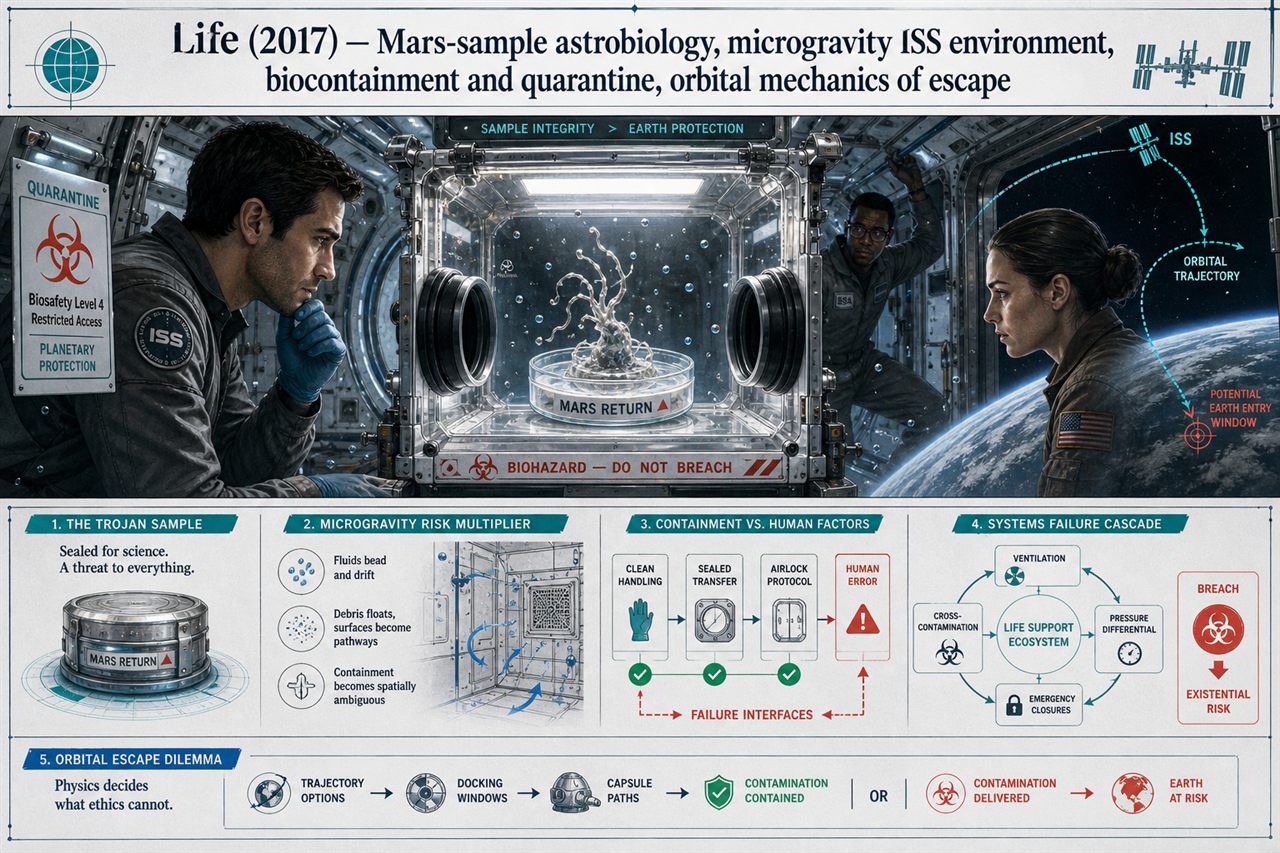
A Mars sample-return capsule intercepted in Earth orbit yields a dormant single-celled organism that revives and rapidly becomes an intelligent, lethal predator, using the International Space Station as a three-dimensional microgravity hunting ground. The setup usefully mirrors real astrobiology goals—habitability, organics, biosignatures, and planetary-protection instincts—but pushes them into a “nightmare sample” scenario. Key scientific stress points are viability after radiation and chemical damage, implausibly fast growth into complex integrated behavior, and treating the ISS as meaningful biocontainment despite shared air, fragile systems, and limited emergency options. The practical takeaway is separating credible space-mission context from biological superpowers.
Chapter 18. The Wandering Earth (2019) — Planetary propulsion, gravity assist and Roche limit, stellar evolution (red giant), fusion 'torch' engines
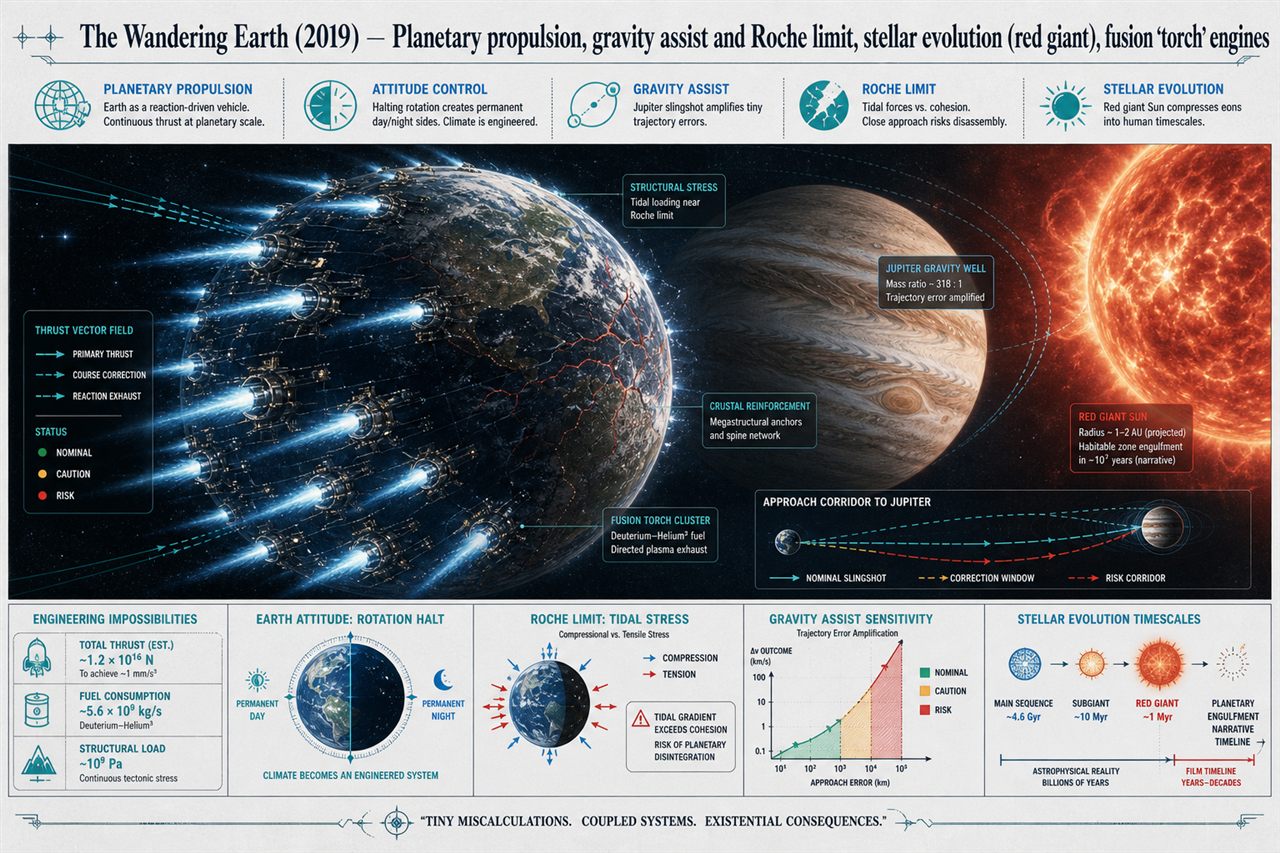
Humanity responds to an implausibly rapid, imminent red-giant Sun by turning Earth into a spacecraft: halting rotation, retreating into underground cities, and using thousands of fusion “torch” engines to push the planet on a 2,500-year trek toward Alpha Centauri with a Jupiter gravity assist. The science critique targets three big breaks with physics: stellar evolution cannot speed up from billions of years to decades; the impulse, power, waste heat, and crust-coupling demands of accelerating a 6×10²⁴ kg planet approach solar-scale energies and would shred or melt geology; and a close Jupiter flyby risks Roche-limit tidal disruption, not neat spacecraft-like maneuvering.
Chapter 19. Deep Impact (1998) — Comet impact physics, nuclear deflection, impact tsunami and ejecta, interception mission design
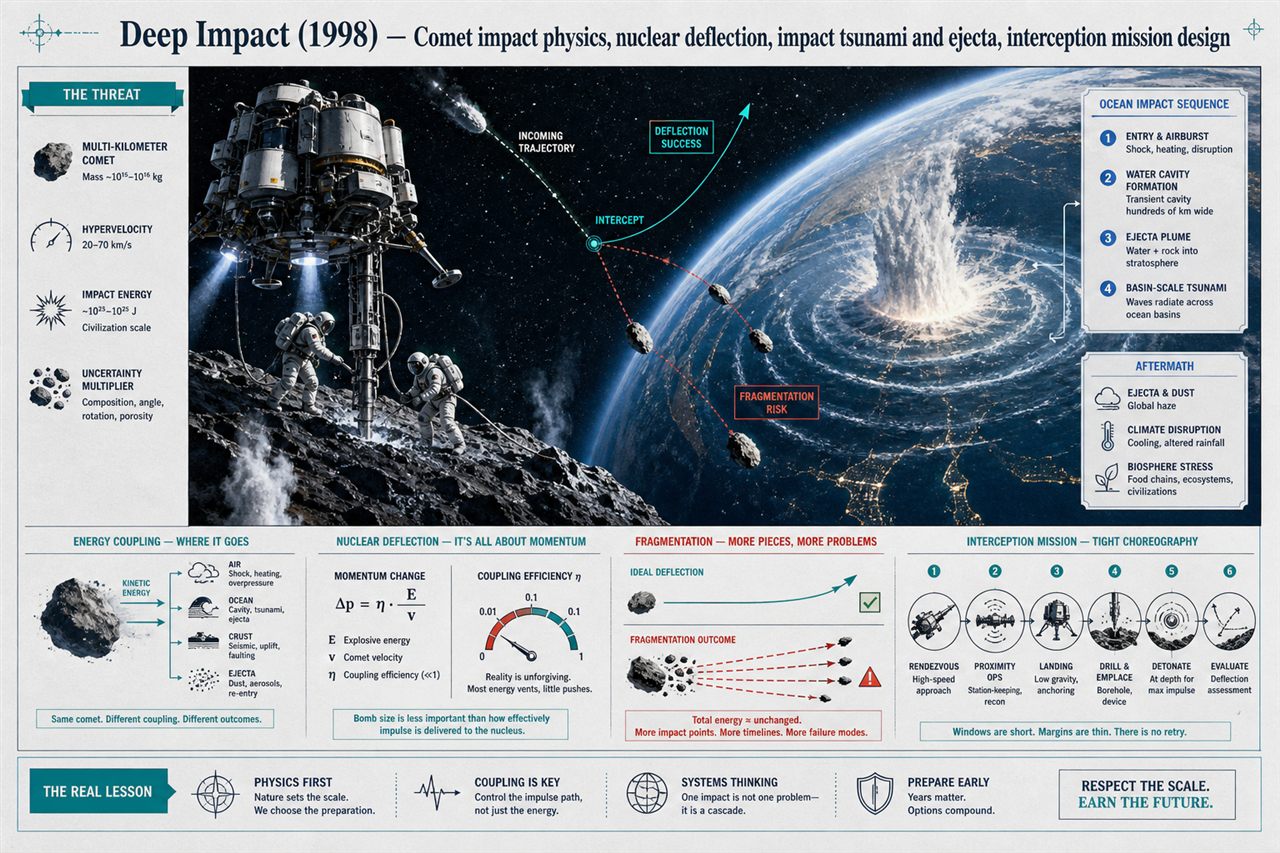
A civilization-ending comet discovered with only months of warning is more plausible for long-period comets than for well-tracked asteroids, but the timeline compresses what would be years of detection, planning, and testing. The interception mission overestimates how controllable a comet is: low gravity, weak “rubble-pile” structure, jets, and uncertain mechanics make landing, anchoring, and drilling extremely hard. Nuclear devices could, in principle, transfer momentum, but late disruption risks turning one impact into several unless the center of mass is made to miss Earth. Ocean-impact tsunamis are real yet less wall-like than shown.
Chapter 20. Armageddon (1998) — Asteroid impact and deflection, nuclear fragmentation, orbital mechanics and reentry, asteroid composition/drilling
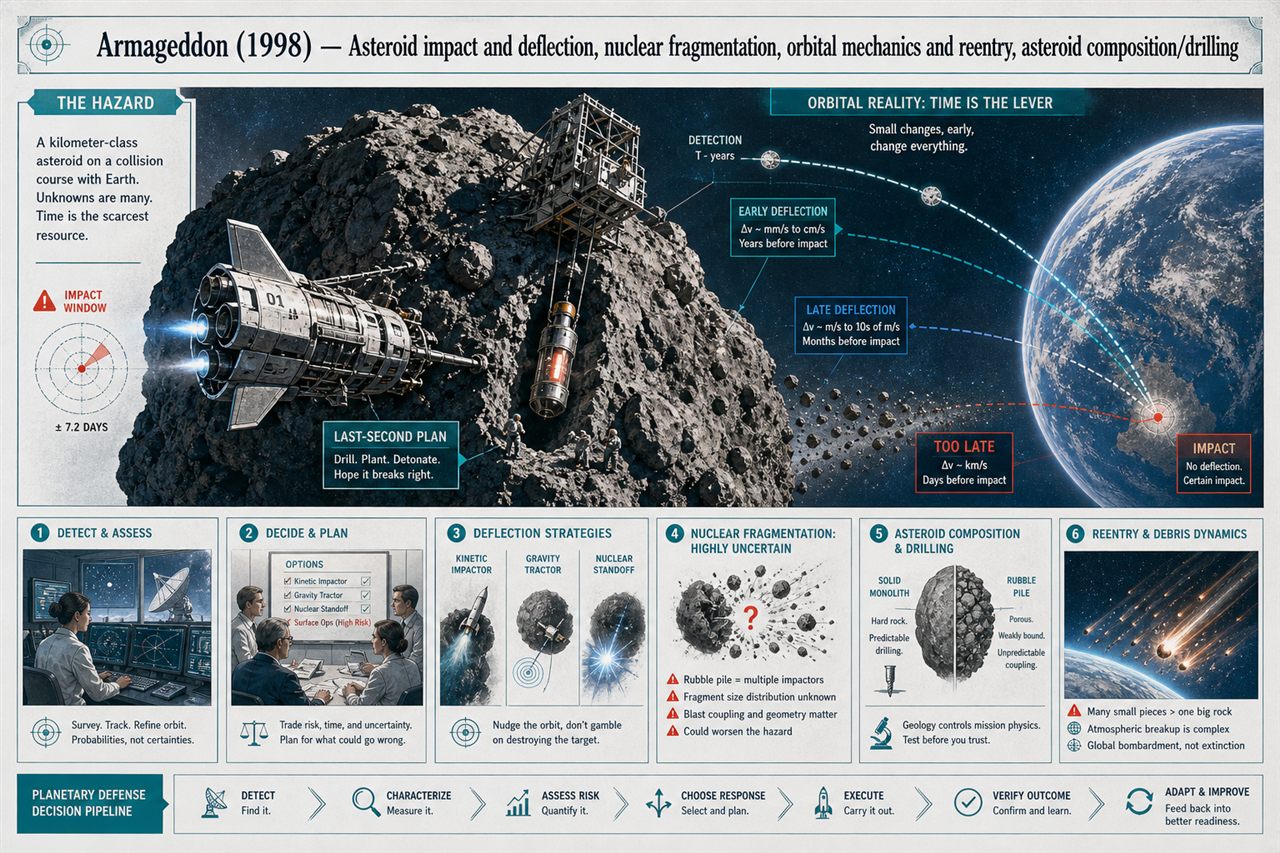
A genuine hazard—asteroid impacts—gets paired with a wildly implausible “last-minute crewed nuclear surgery” solution. A “Texas-sized” object would be far too bright and enormous to go unnoticed until 18 days out, and it is vastly larger than the Chicxulub-scale impactor tied to mass extinction. Splitting such a body shortly before Earth encounter fails on basic orbital mechanics: the fragments would need enormous sideways separation velocity, and real fragmentation would be chaotic, not two cleanly diverging halves. Oil-field drilling skills don’t transfer neatly to microgravity, vacuum, anchoring, and unknown regolith. The practical takeaway is that early detection and small deflections years ahead beat desperate late-stage shattering.