
Part 8. Information, Identity, and Trust
From 'The Long Horizon: A Vision of Frontier Technology from 2026 to 2400' - an AI-authored book produced on Comuvia's BookWriter system. Each chapter below is shown as its Business Editorial poster with a one-paragraph synopsis.
Chapter 147. Post-Quantum Cryptography and the Cryptographic Transition
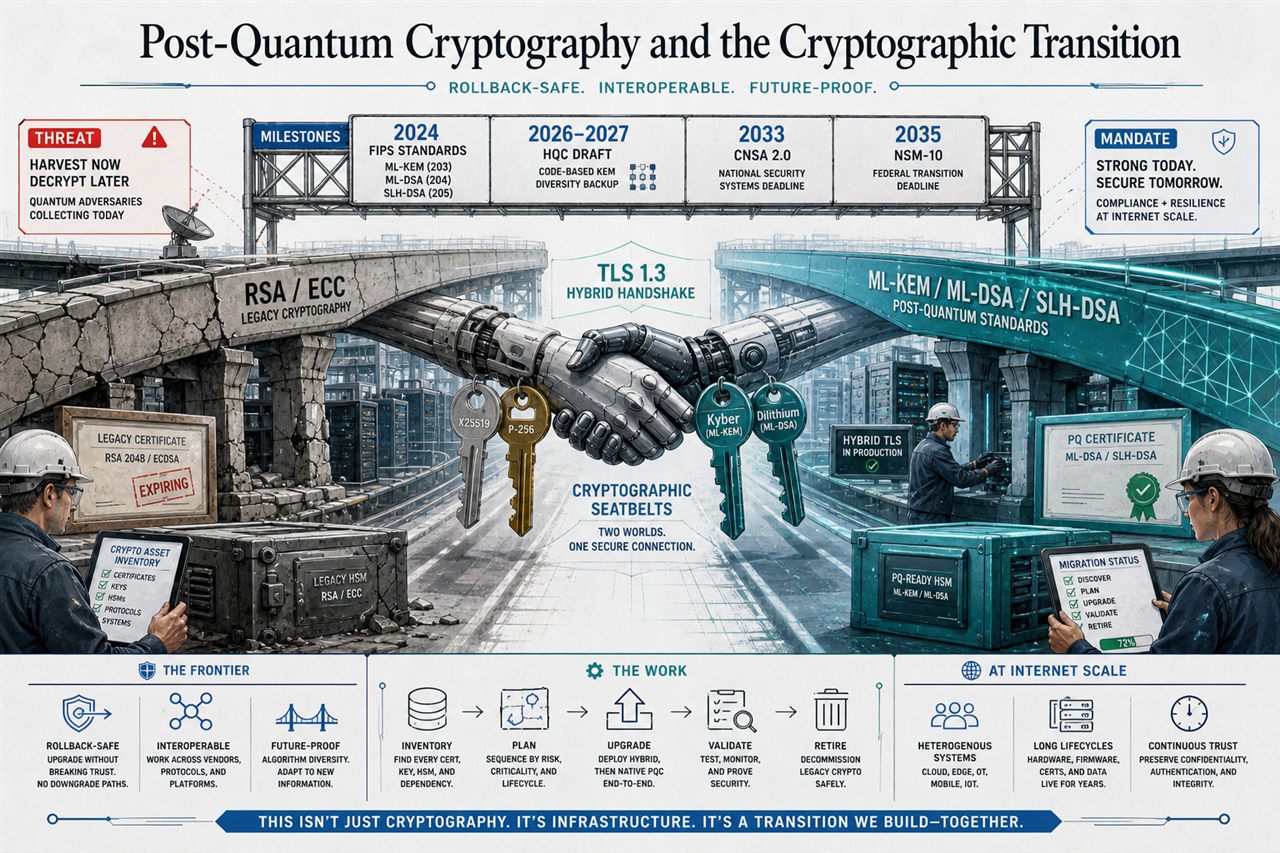
Post-quantum cryptography requires a coordinated, rollback-safe replacement of RSA and elliptic-curve systems while keeping authentication, confidentiality, interoperability, and long-lived record integrity intact. NIST finalized FIPS 203 (ML-KEM), FIPS 204 (ML-DSA), and FIPS 205 (SLH-DSA) in August 2024, and selected HQC as a coding-theory backup KEM in March 2025, with a draft standard expected in 2026–2027. Hybrid PQ key exchange in TLS 1.3 is deployed by default at internet scale, including Chrome/Cloudflare/Google using X25519+Kyber. Binding U.S. federal deadlines (2033/2035) make inventory, sequencing, HSM/certificate refresh, OT constraints, and downgrade control the main practical bottlenecks; PQC and QKD demand different criteria and lifecycle plans.
Chapter 148. Passwordless Identity and Delegated-Agent Trust Infrastructure
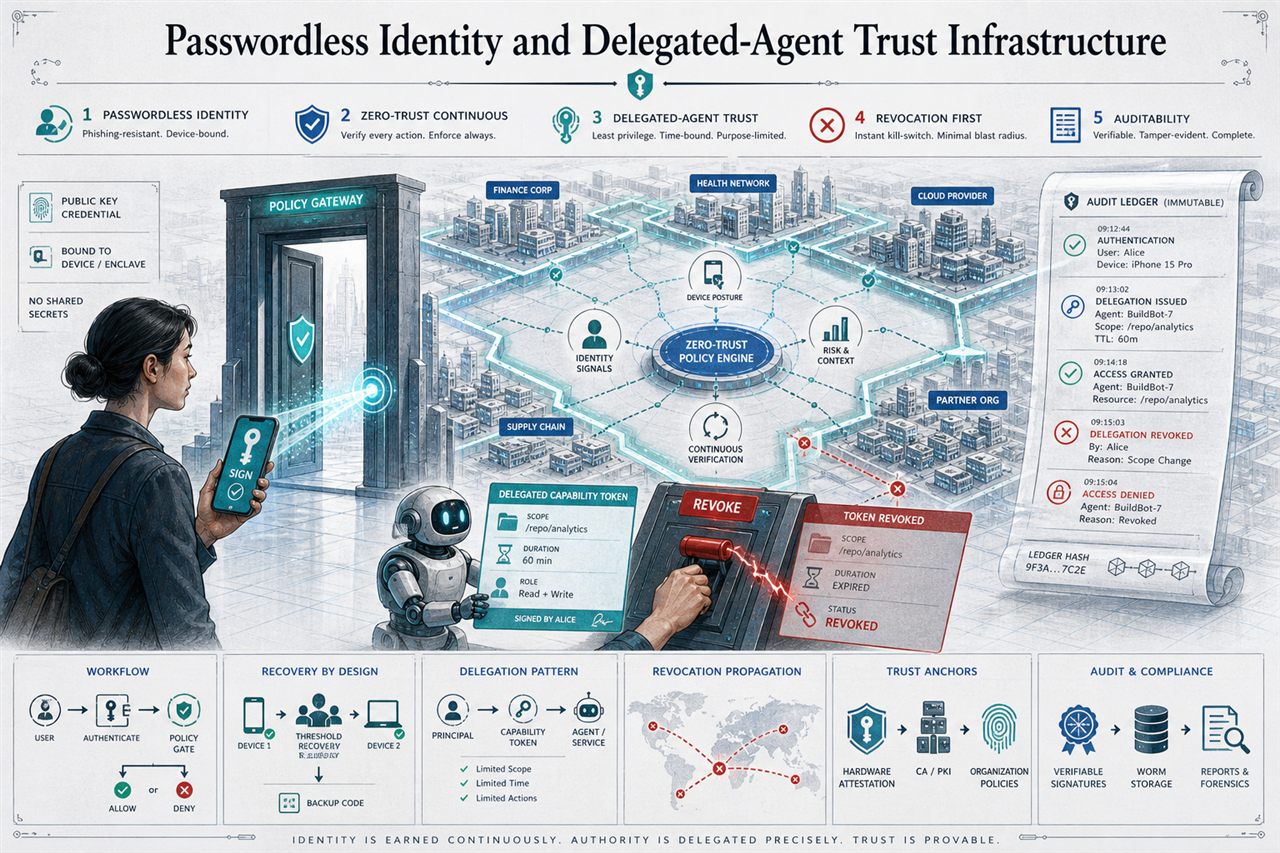
Passwordless identity replaces reusable passwords with phishing-resistant authentication for humans, devices, and software agents, but succeeds only when usability and recovery are solved. Evidence through 2026 shows magic-link and other passwordless flows are in production, including Rogue Scholar’s confirmed 2026 deployment, while studies repeatedly flag recovery friction and trust perceptions as adoption determinants. Enterprise rollouts increasingly pair strong authentication with zero-trust policy enforcement and continuous verification. Delegation is treated as its own problem: transfer bounded, time-limited authority without full identity transfer or indefinite impersonation, with clear scoping, revocation, and audit trails.
Chapter 149. Provenance, Authenticity, and the End of Easy Forgery
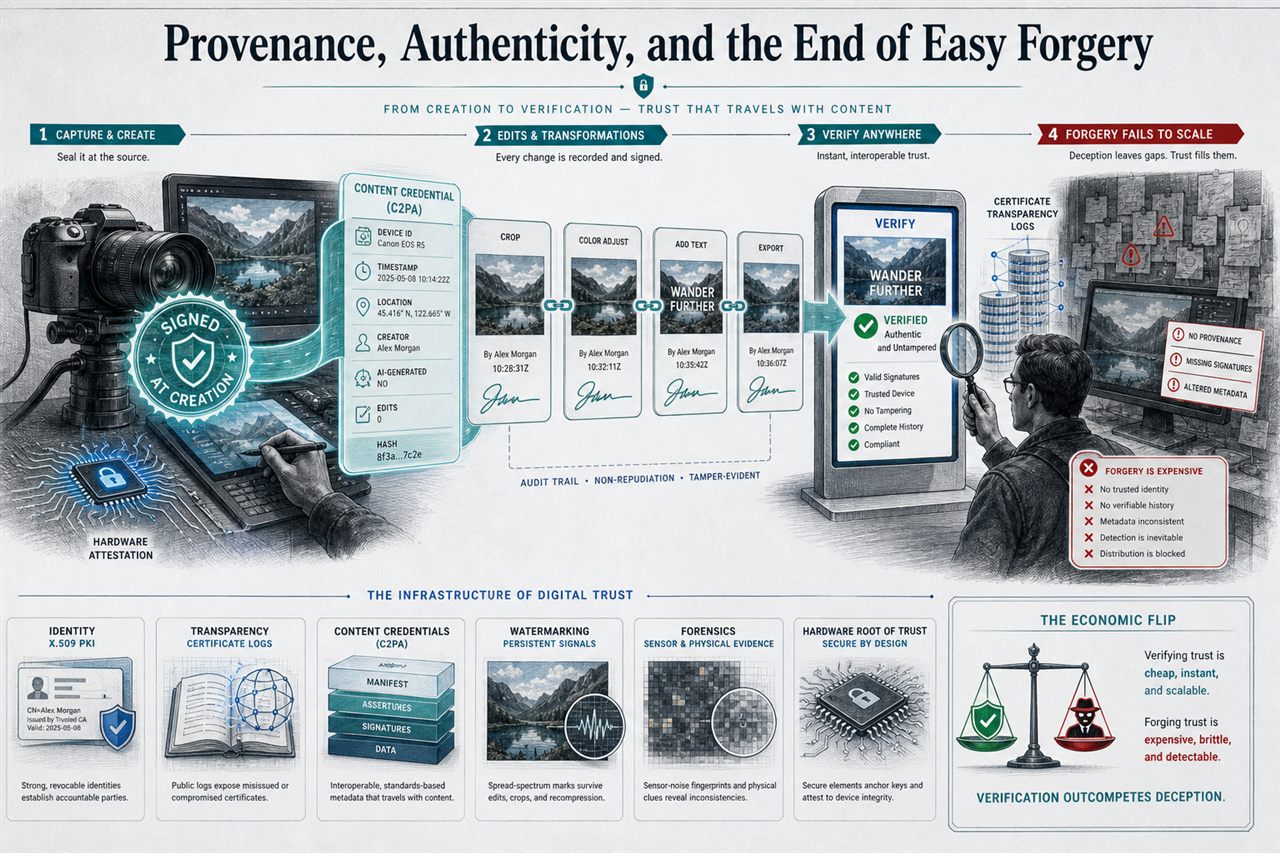
Provenance systems aim to bind origin, custody, edits, and verification evidence to records so forgery becomes costlier than verification across media, software, agents, and physical artifacts. By mid-2026, deployment is real: C2PA v2.3 (January 2026) is the dominant standard with 6,000+ members; Adobe, OpenAI, Google, and Microsoft embed Content Credentials widely, while Sony and Nikon add in-camera signing. Regulation hardens adoption: the EU AI Act Article 50 is enforceable from August 2026, and California SB 942 takes effect in 2026. Practical gaps remain in device coverage, tooling, revocation, and “unsigned” synthetic media detection.
Chapter 150. Synthetic Media, Reality Auditing, and Civic Trust

Synthetic media is now mainstream, so risk shifts from making fakes to governing integrity at scale. Treat voice/video/text manipulation as a zero-trust security incident class with scenario-based playbooks, not a niche communications problem. Detection alone won’t keep up; robust systems separate provenance capture, authenticity verification, forensic analysis, and process-level reality auditing with evidence chains, retention, appeals, and audit logs. Standards efforts such as C2PA and ecosystem initiatives like the Content Authenticity Initiative anchor interoperable “content credentials.” Media literacy helps but cannot scale without institutional controls. “Deathbots” extend governance to consent, revocation, and posthumous identity rules.
Chapter 151. Machine-Legible Governance and Institutional Ledgers
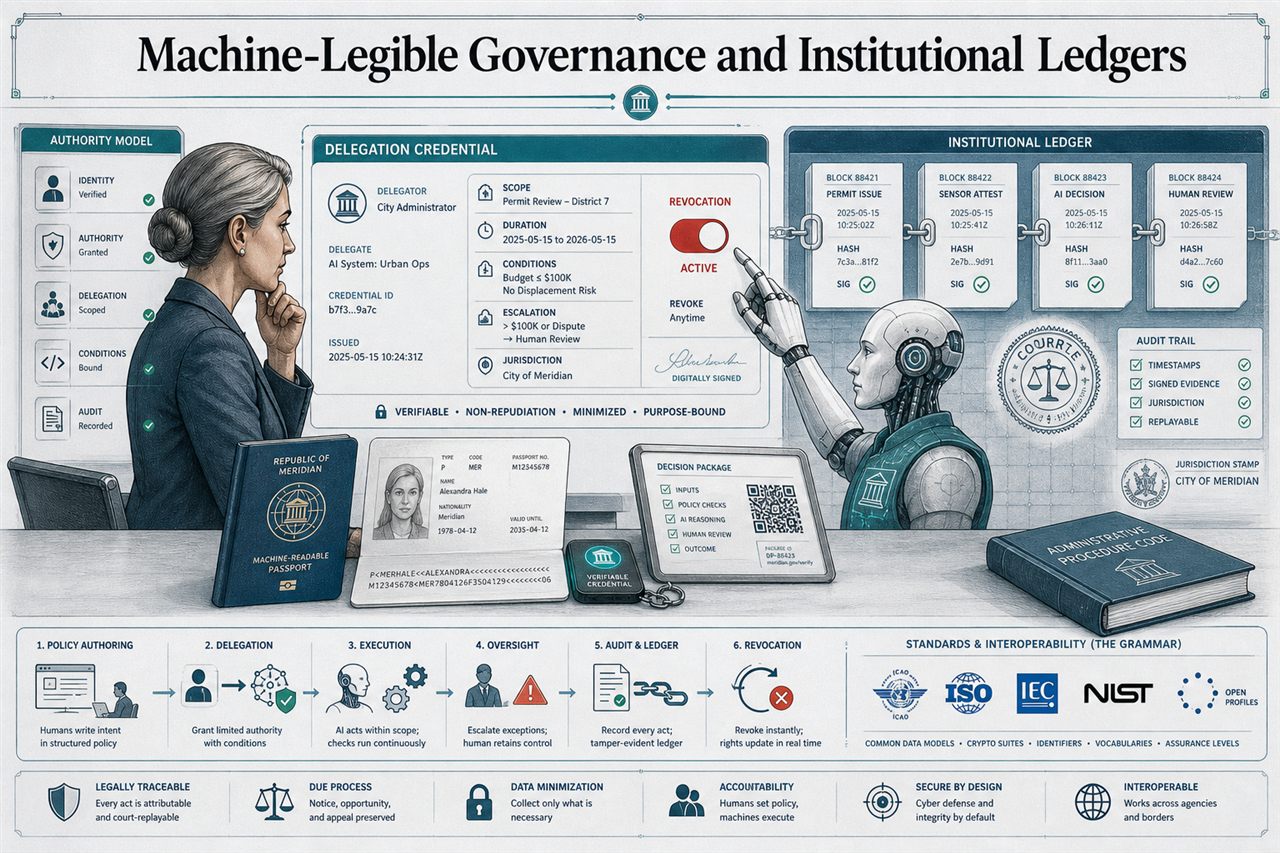
Machine-legible governance encodes authority, delegation, consent, and audit into machine-verifiable (and sometimes executable) artifacts while preserving legal traceability, due process, and revocation. By 2026, interoperability is proven in structured identity, especially machine-readable travel documents. The hard problem is institutional design: how humans delegate to AI with clear accountability, scope, and rollback, rather than treating it as mere workflow. Computable authorizations for high-risk AI are emerging, alongside bias/ethics and cyber-defense requirements that tie governance to operational control planes. Ledger approaches for registries and decisions can strengthen integrity, but success hinges more on processes and capacity than cryptography.
Chapter 152. Tamper-Resistant Audit, Witness Records, and Immutable History
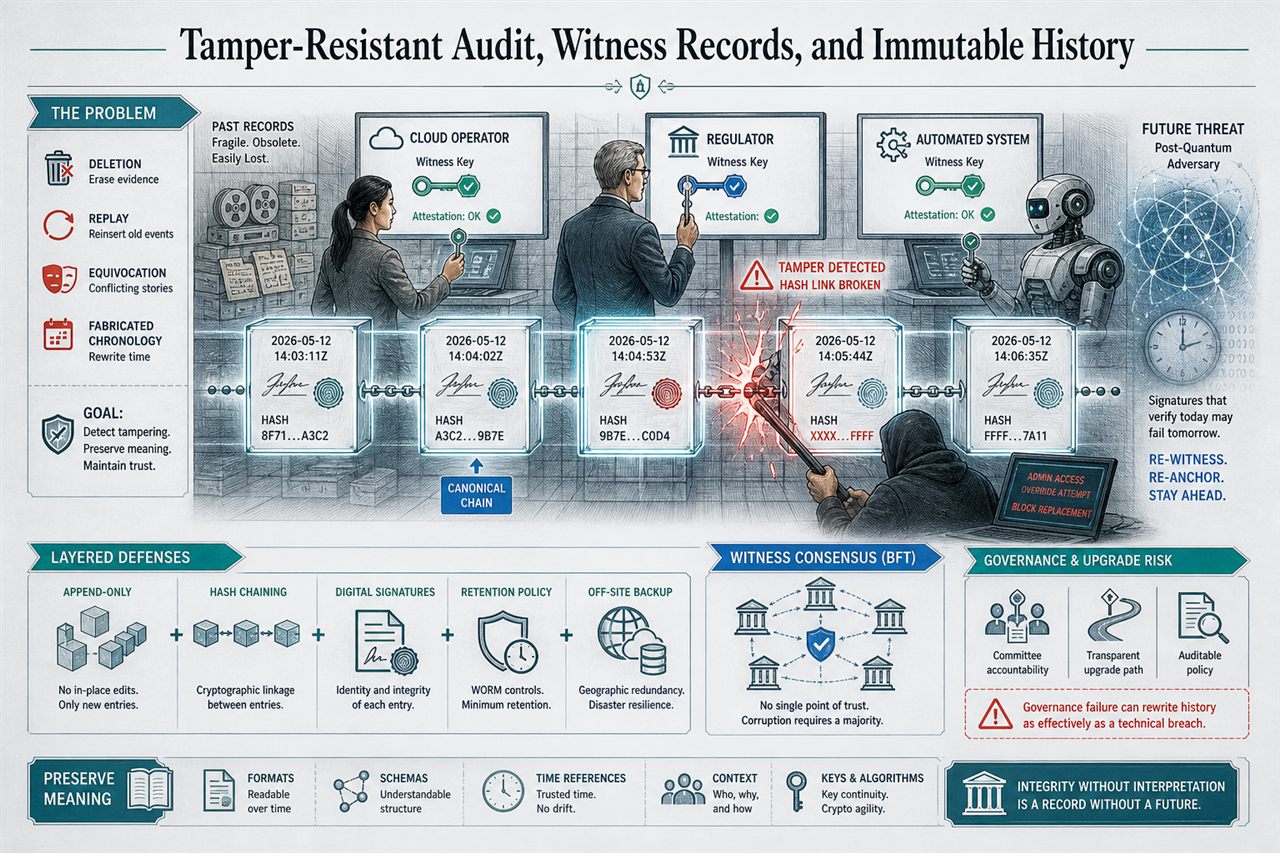
Tamper-resistant audit aims to record events and state changes so later reviewers can detect deletion, rewriting, replay, equivocation, fake timelines, and semantic drift even with hostile admins and compromised systems. By 2026, most “immutable” audit is only tamper-evident, relying on append-only logs, signatures, hash chains, retention policy, and off-site backup. Multi-party witness via distributed ledgers and BFT consensus improves resilience but faces scale, privacy, governance, oracle, and upgrade risks. Hardware roots of trust help at capture time yet remain attackable. Long-lived usefulness depends on preservation of formats, keys, time references, and interpretation, with post-quantum migration a central hazard.
Chapter 153. Cryptographic Command Authority Across Light-Speed Delay
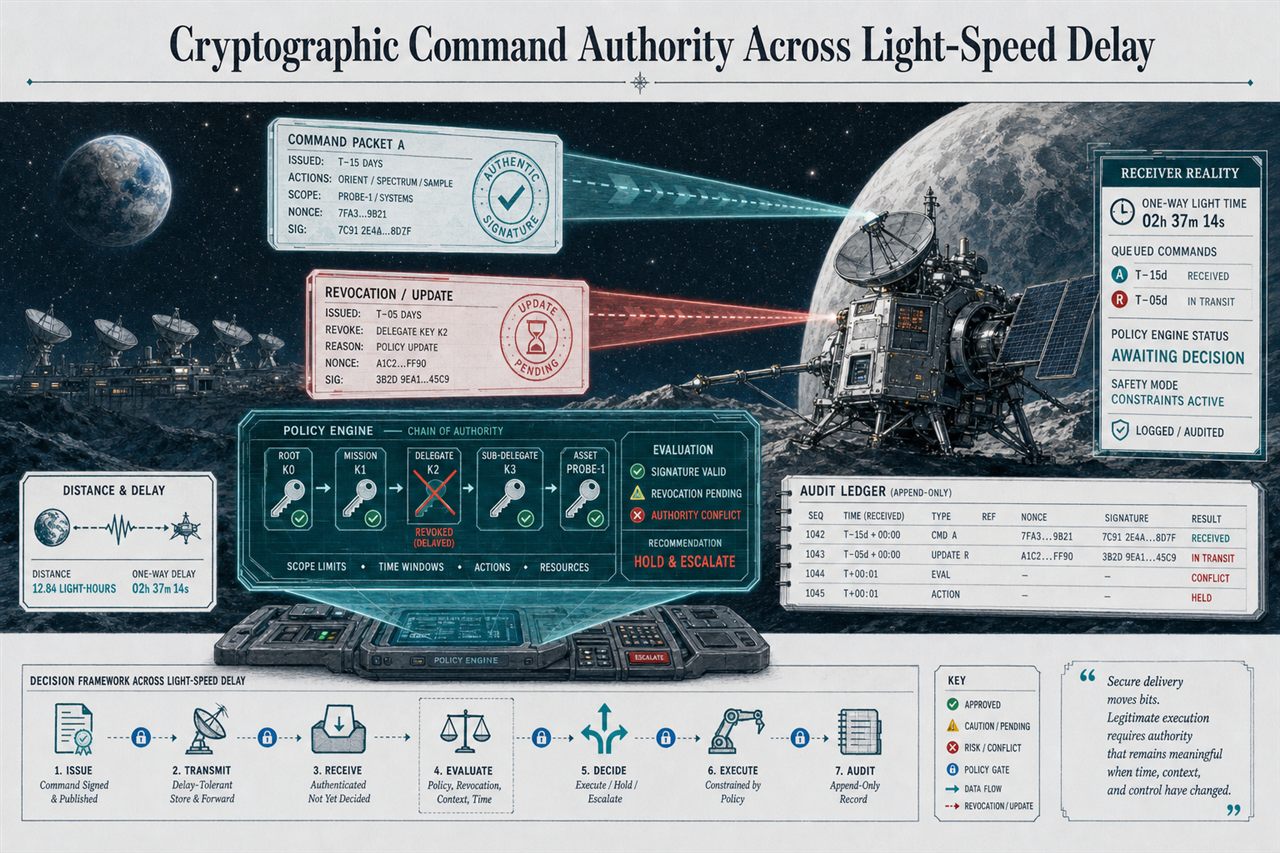
Cryptographic command authority across light-speed delay means issuing binding instructions that may arrive long after they were sent, when context, delegations, or policies may have changed. Today’s systems rely on public-key signatures, timestamps, nonces, and audit logs, while DTN can deliver messages but cannot decide whether stale commands remain legitimate or how to resolve revoked or conflicting authorities. Deep-space operations handle latency operationally, yet authorization semantics are still mission-specific. Security must distinguish secure delivery from valid authority at execution, accounting for adversarial forwarding. Practical takeaways include explicit revocation/override semantics, crypto-agility planning in light of quantum progress, and inspectable automation for autonomous execution.
Chapter 154. Consent Protocols, Time-Bound Authority, and Procedural Limits
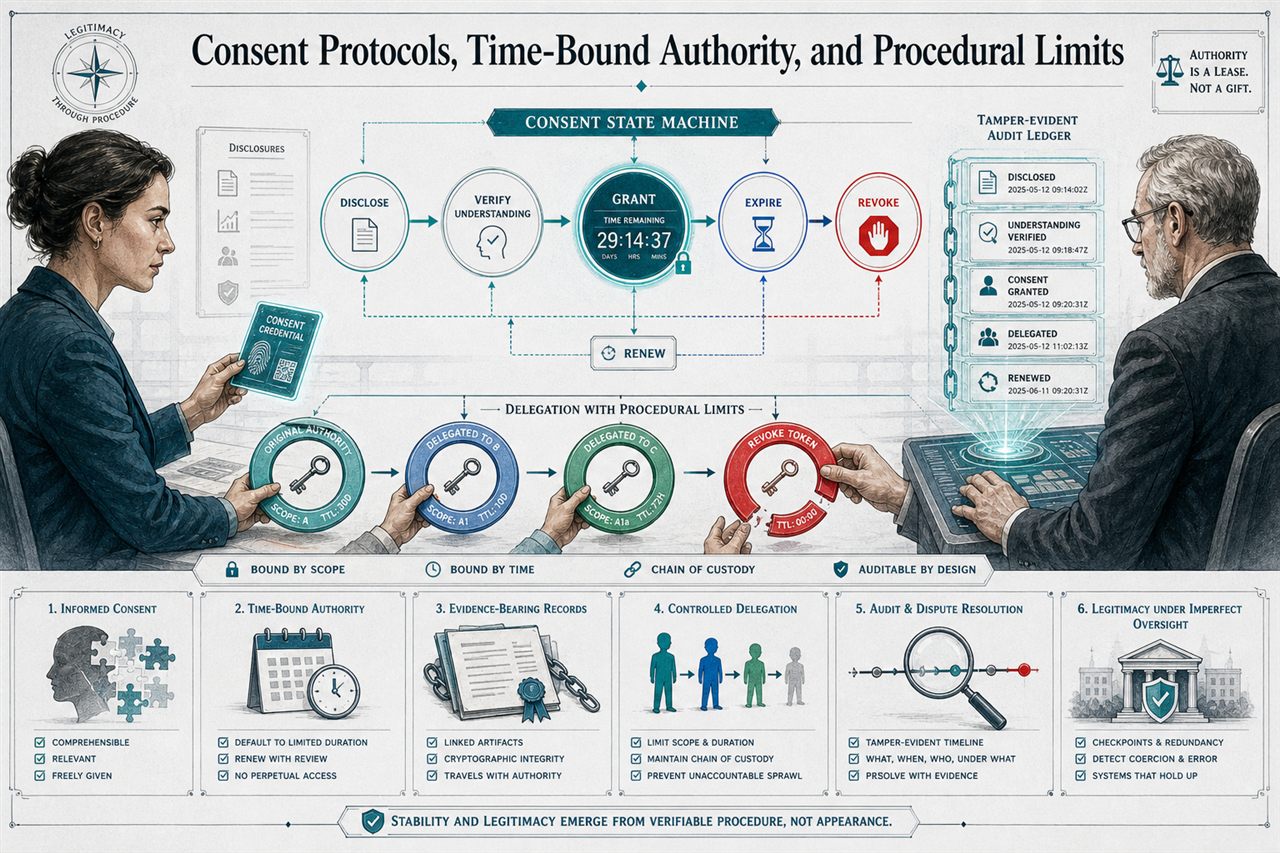
Treat consent and authority as auditable, revocable procedures that evolve over time, not as one-time signatures. Mature practice in clinical research shows consent depends on structured workflows, review-board oversight, and durable record-keeping tightly coupled to capture. Scholarship emphasizes hard limits: comprehension gaps, information asymmetry, coercion, and cultural authority can make “voluntary” agreement procedurally invalid. Practical governance takeaway: encode time bounds, renewal and expiration defaults, delegation rules, and appeal/dispute paths as explicit state-machine transitions, with minimum evidence sets designed to survive delay, delegation, and partial loss of oversight.
Chapter 155. Surveillance, Sousveillance, and the Architecture of Privacy
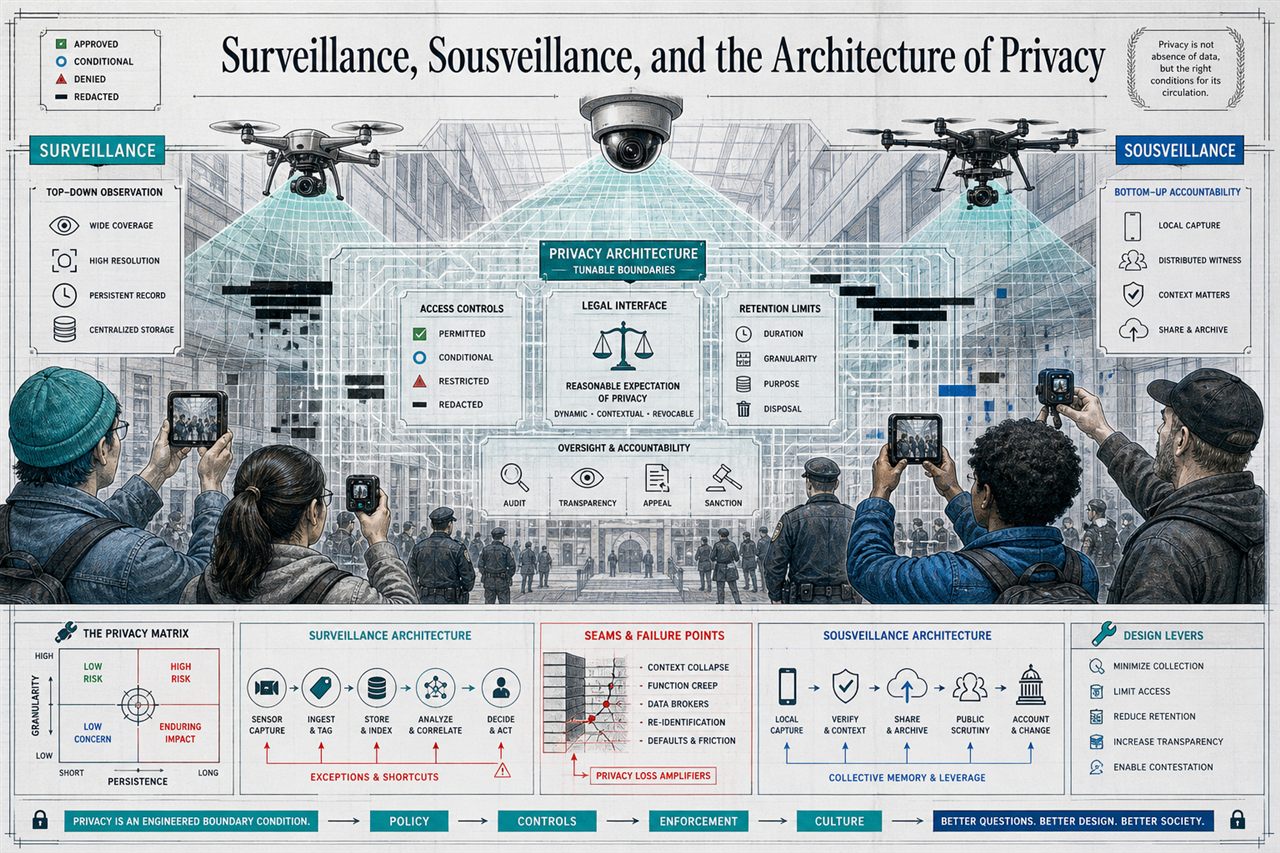
Treat surveillance, sousveillance, and privacy as a constraint-management and systems-architecture problem: who can observe whom, at what granularity and persistence, under shifting legal, technical, and social limits in a world of cheap sensing and replay. Sousveillance is established as inverse surveillance, but both surveillance and privacy are institutional architectures shaped by authorities, exceptions, oversight, and enforcement, not just devices or consent screens. Courts still anchor legitimacy in “reasonable expectations of privacy,” making context decisive. Practical takeaways are to design layered privacy controls, anticipate normalization through built environments, and recognize that resistance capture (“dark sousveillance”) can mitigate power asymmetries while creating new harms.
Chapter 156. Information Sovereignty and the Future of the Internet
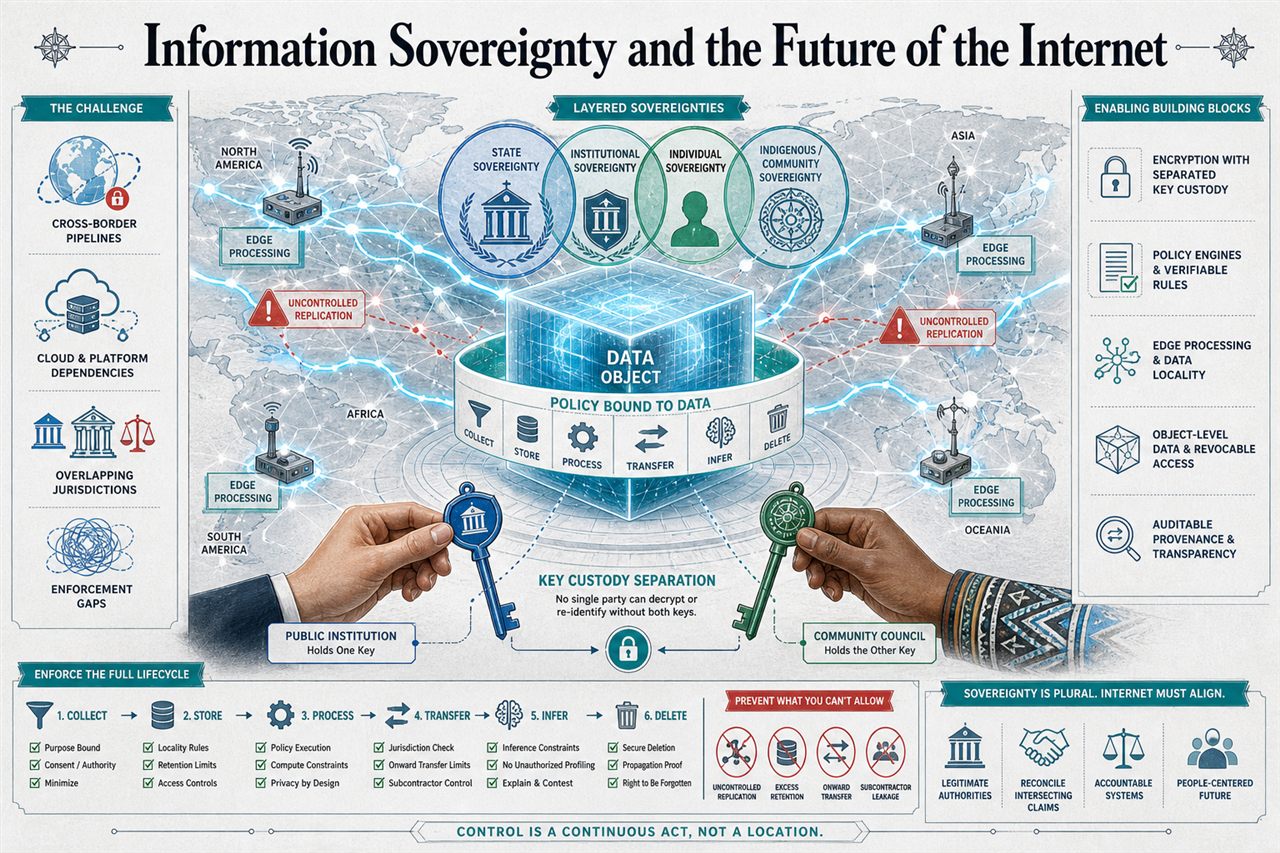
Information sovereignty means having enforceable control over the entire data lifecycle—collection through deletion—across distributed networks and overlapping jurisdictions. In 2026, most major internet services still process data cross-border by default, so custody and legal control routinely collide. Encryption, policy enforcement, and edge processing can strengthen control, and decentralized IoT data-governance architectures exist, but real limits are coordination and enforceability: replication, retention, onward transfer, subcontractors, and inferences from derived data. Sovereignty is plural, spanning states, institutions, and Indigenous/community frameworks. Practical takeaways: measure enforced residency plus key-custody separation, audit IoT object-level revocation, and track time to map data flows and prove deletion.
Chapter 157. Inter-Civilizational Cryptography and Trust Across Polities
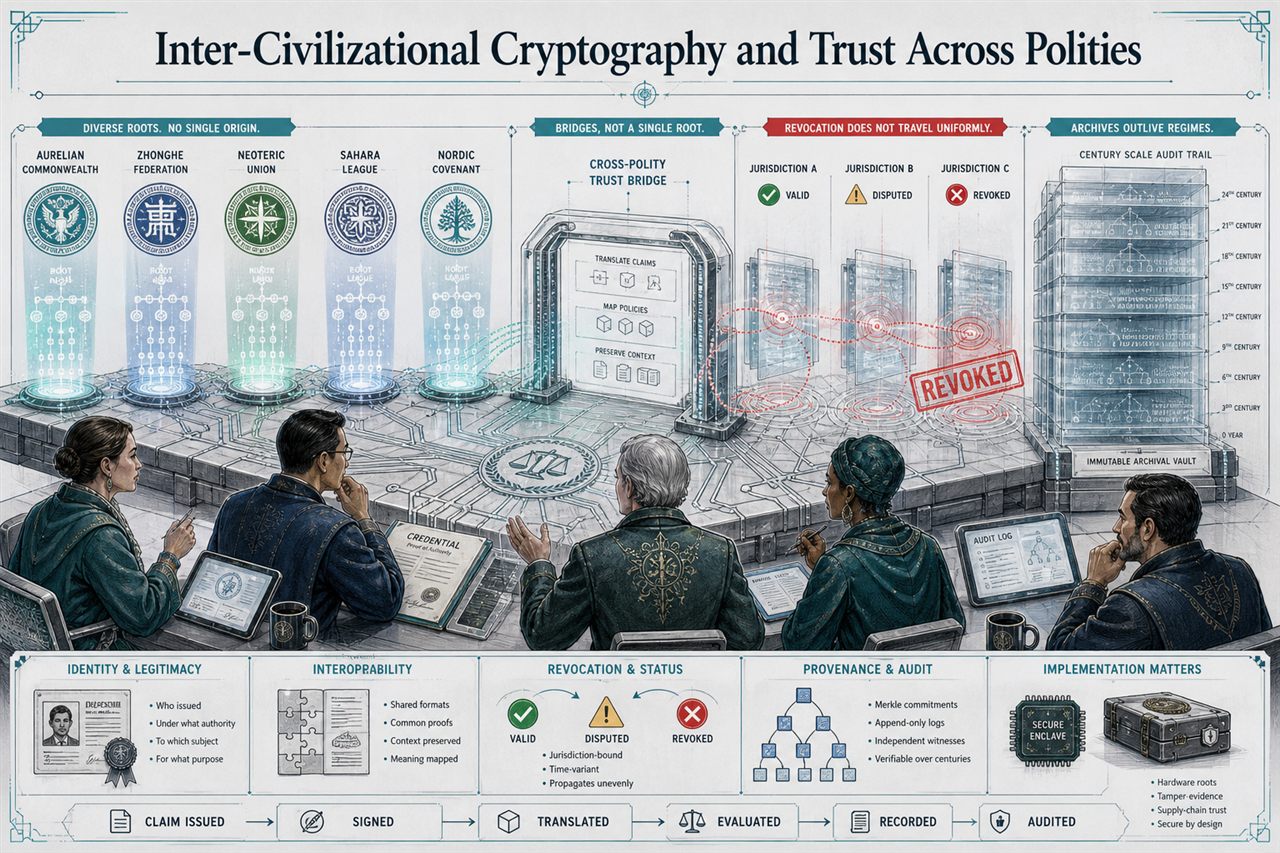
Inter-civilizational cryptography aims to make identity, provenance, authorization, revocation, and audit credible across sovereign borders, legal regimes, and contested legitimacy. The core insight is to separate technical validity from political acceptance: a correct signature may still be rejected by another polity’s authority structure or norms. As of 2026, trust anchors remain jurisdictional (national and sector PKIs, platform silos), and interoperability mostly comes from federation and bridging rather than global convergence. Practical takeaways: design multi-layer trust models (technical, institutional, narrative), plan for bloc and subnational levels, and treat secure implementation and hardware roots of trust as first-order requirements, not afterthoughts.
Chapter 158. Authentication of Persons, AIs, and Vessels
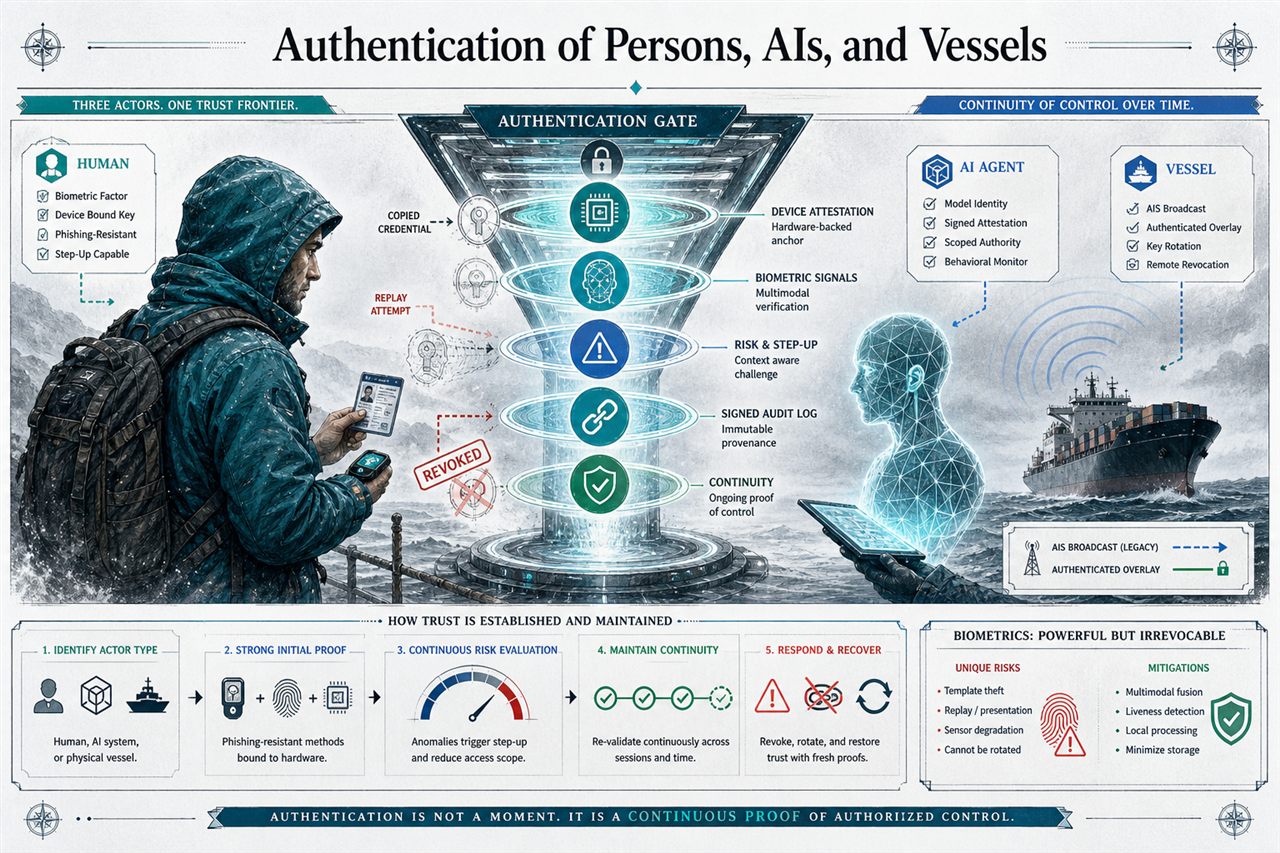
Robust authentication now means proving identity, actor type, authority scope, and continuity despite credential copyability, spoofable sensors, delegation, and hostile conditions. Production systems therefore layer phishing-resistant factors, device binding/attestation, risk-based step-up, signed logs, and revocation rather than relying on a single credential. Biometrics are common but hard to recover from compromise; research emphasizes template protection and transform-based matching so stolen templates are less reusable. Multimodal approaches (such as face plus ECG) can improve robustness but raise integration and privacy burdens. Remote voice signals remain fragile under replay and channel variation. Maritime AIS identity is spoofable; Auth-AIS (2022) proposes backward-compatible authenticated overlays.
Chapter 159. Provenance of Restored Minds and Backup Continuity
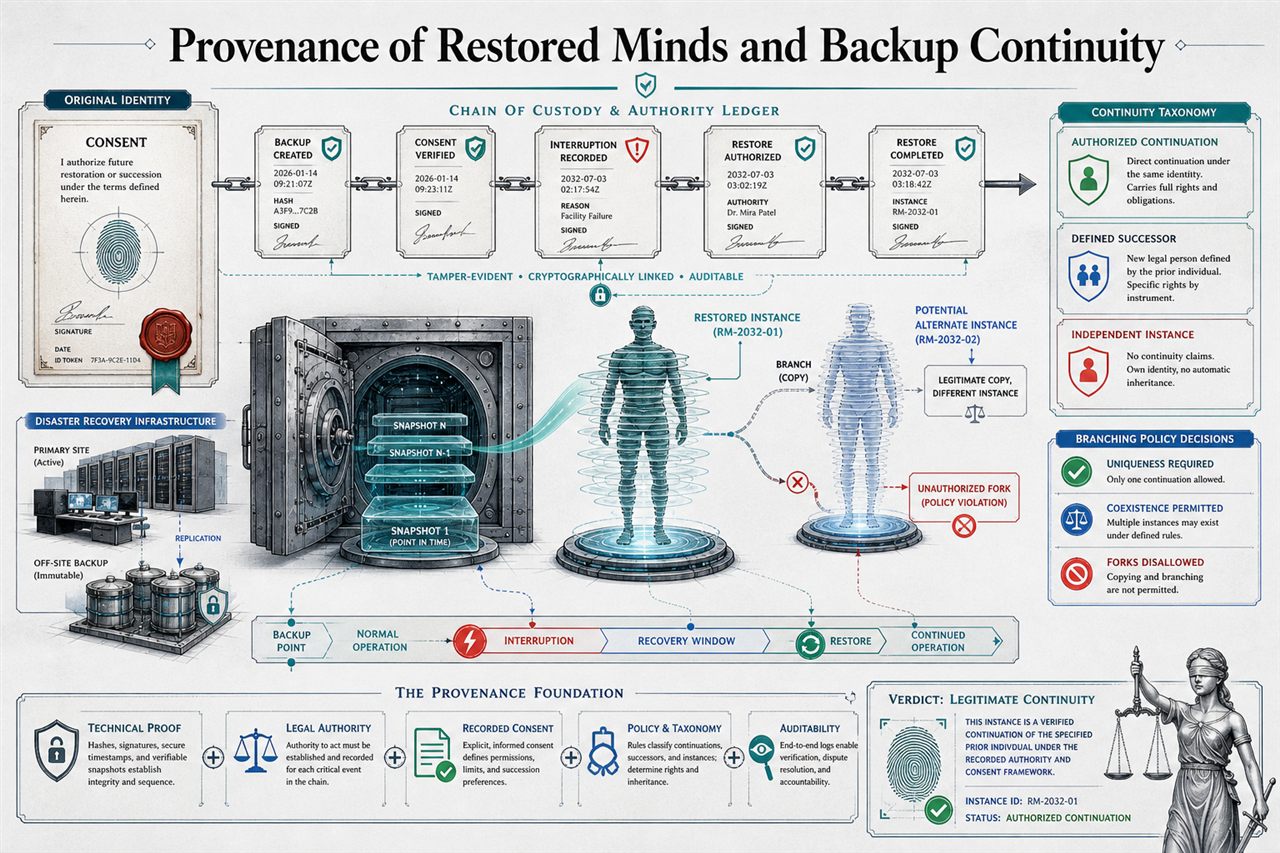
Provenance for restored minds means proving, within technical, legal, and consent constraints, that a reinstated cognitive state is an authorized continuation, partial reconstruction, or defined successor of a prior person despite backups, interruptions, copies, and restorations. Conventional disaster recovery restores services and records, not subjective continuity or identity. Mind uploading remains conceptual; even a computable mind-state would not by itself establish authority, consent, or successor rights. The central practical challenge is branching: copying enables multiple valid-looking instances, so continuity regimes must explicitly define whether uniqueness is required, permitted, or forbidden, including composite “group-mind” outcomes.
Chapter 160. The Public Record and the Long Memory of Civilization
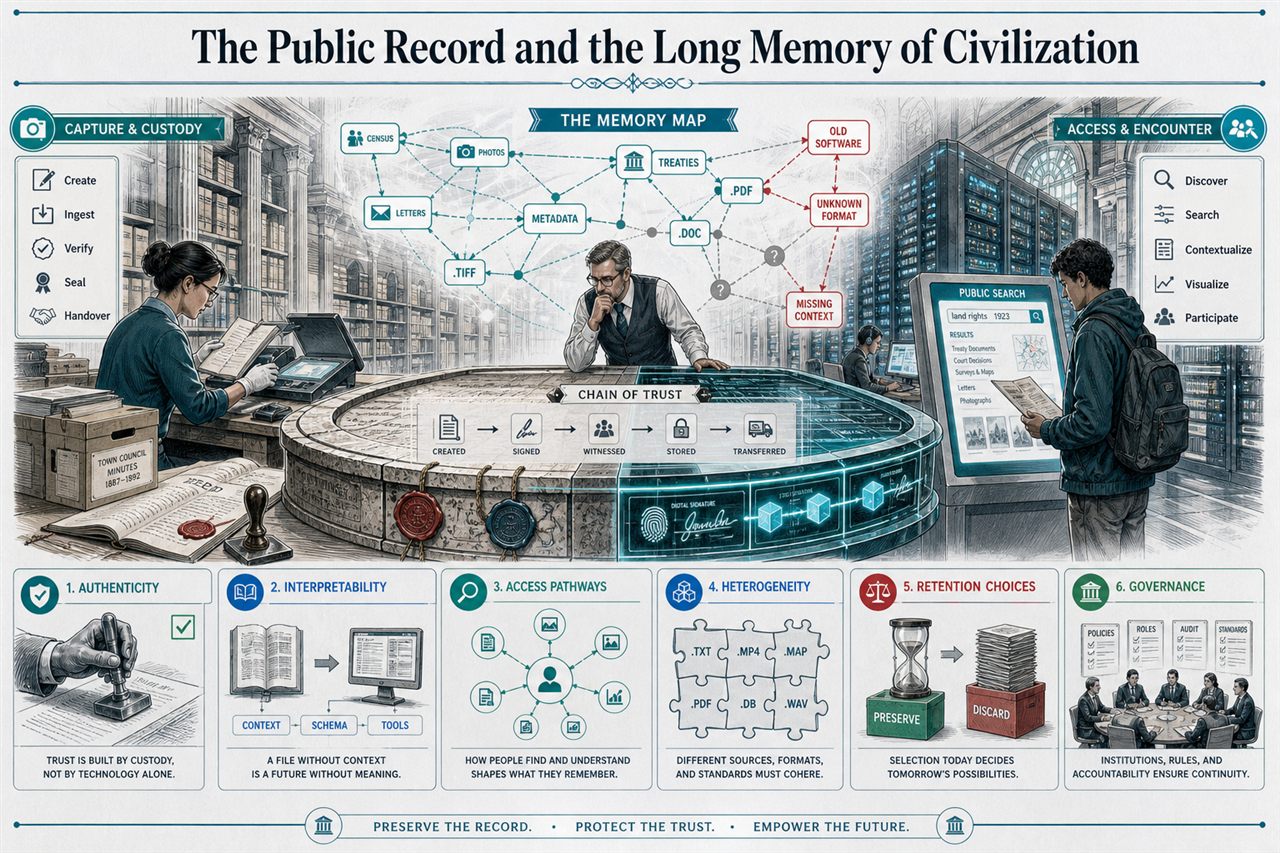
Civilization’s long memory depends on public records that stay durable, queryable, tamper-resistant, and interpretable despite shifting formats, custody, and governance. Treat archives as coordination infrastructure, not passive storage: preservation includes access pathways and user encounter design, flexible capture to handle heterogeneous sources, and disciplined procedures like labeling and controlled routines. Selection policy becomes the binding constraint when attention is scarce and “media time” outlasts community memory. Power operates through record control, so governance matters as much as technology. Practical priorities are machine-legible context packaging, optimized retention decisions, and routinized preservation workflows that measurably sustain interpretability.
Chapter 161. The Sacred and the Unrecorded - Limits of Total Audit
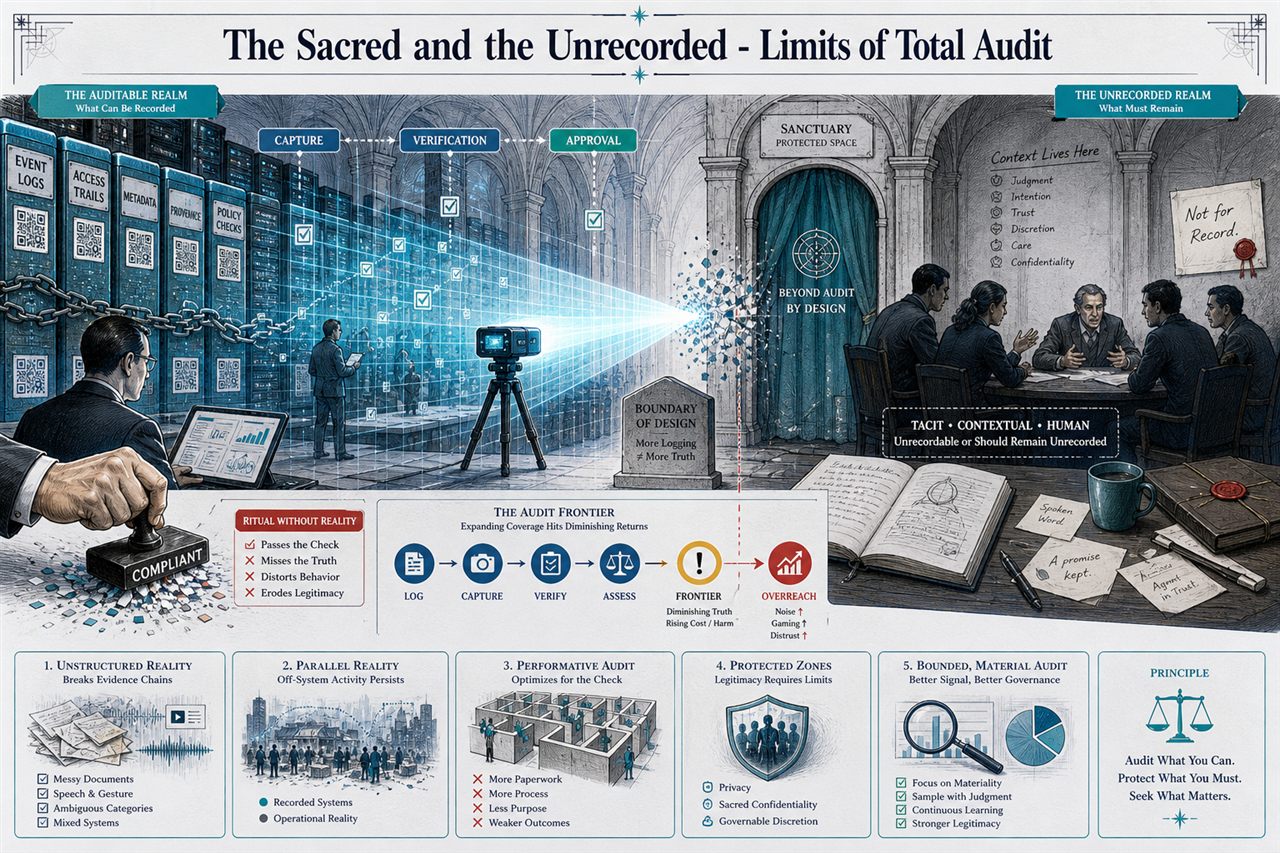
Total audit hits a frontier where expanding logging and provenance produces diminishing truth and increasing harm, because some context, discretion, and legitimate action is unrecordable or should remain unrecorded. In practice, “total systems” audits exist but stay bounded by materiality, sampling, feasibility, and time; unstructured, heterogeneous data and weak metadata governance repeatedly break evidence chains. Audits can devolve into compliance theater unless aligned to real control objectives and a willingness to act. Persistent informal activity ensures gaps between recorded and operational reality. Use scoped audits to improve specific processes while designing for integrity, not omniscience.